SMD 2026

New Patriot Battalion To Bolster Guam’s Defenses Within Months

The U.S. Army is on track to stand up a new battalion equipped with the Patriot surface-to-air missile system on Guam in October. The unit will also have Enduring Shield, a lower-tier air defense system that currently uses the AIM-9X Sidewinder as its interceptor. This is a major step forward in the U.S. military’s years-long effort to bolster air and missile defenses on the extremely strategic U.S. island territory in the Western Pacific. It is also a significant development for the Army’s Patriot force, which continues to be worryingly overstretched due to heavy operational demands, something TWZ calls attention to regularly.

The new Army air defense unit on Guam will be designated 3rd Battalion, 43rd Air Defense Artillery Regiment (3-43rd ADA). It will be under the purview, at least in part, of the 94th Army Air and Missile Defense Command (94th AAMDC) headquartered at Joint Base Pearl Harbor-Hickam in Hawaii.

“So, over the past couple of years, we’ve been working to increase the level of protection on Guam. In the past, we’ve had the THAAD [Terminal High Altitude Area Defense] battery there, and of course, Aegis BMD [ballistic missile defense capable] ship[s],” Army Col. Matt Dalton, Deputy Commander of the 94th AAMDC, said last week. “We’ve been working the past few years to increase that to provide a 360-degree defense, cruise missile defense, of the homeland [on Guam].”

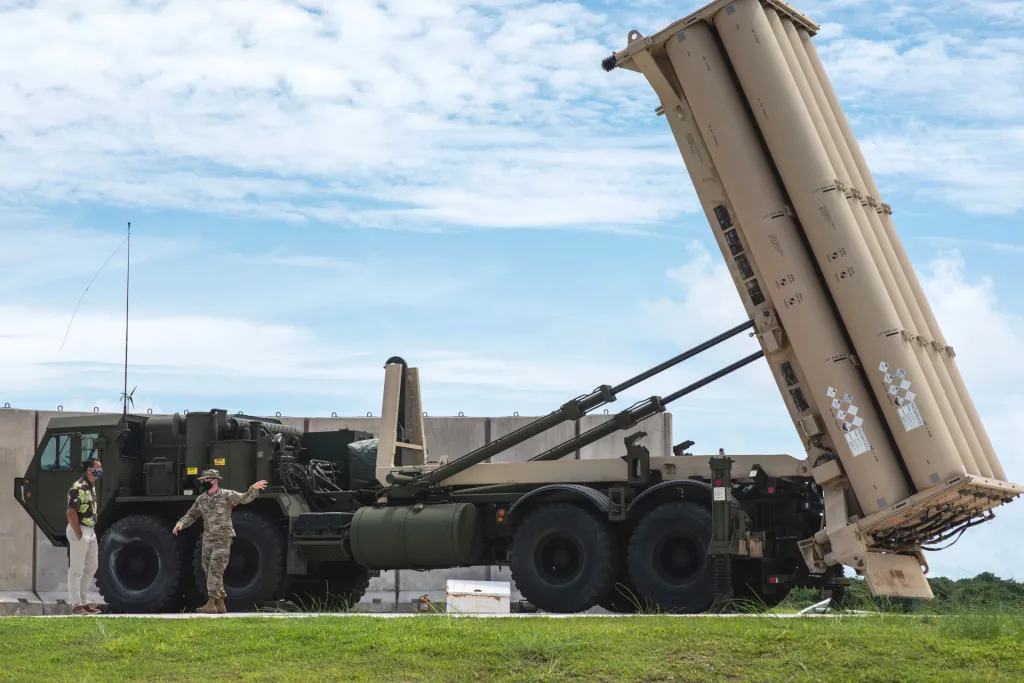
One of Task Force Talon’s THAAD launchers on Guam. USAF/Senior Airman Zachary Heal

Dalton was speaking during a panel discussion at the annual Space & Missile Defense (SMD) Symposium in Huntsville, Alabama, at which TWZ was in attendance. An Army unit, known as Task Force Talon, has operated the THAAD battery on Guam since 2013.

“What does that entail? Construction, planning, barracks, housing, defense design, coordinating with the local authorities in the joint community, the governor’s office, FAA [Federal Aviation Administration] – so many, many things over the last couple of years,” he continued. “I think right now what we’re seeing is we’re starting to see the fruits of all that labor. This summer, the battalion commander arrived. This fall, 3-43rd ADA will stand up in October. Currently, there are about 120 or so soldiers specifically for that battalion on [the] island, on top of the the soldiers already there for the THAAD battery. And then over the next few months, we’re going to see the delivery of the weapon system.”

“The battalion will have both the Patriot Missile System and IFPC, or mobile ground-based launchers, which they will integrate to provide 360-degree, layered air and missile defense for Guam as part of our expansion to the defensive architecture to better protect everyone living there,” an Army spokesperson told TWZ when asked for more information about the “weapon system” Col. Dalton had referred to.

IFPC stands for Indirect Fire Protection Capability. IFPC dates back to the early 2000s, but the Army transitioned to the second phase, or Increment 2, of the program in 2021. That, in turn, led to the acquisition of the Enduring Shield system, which is primarily intended to help defend against cruise missiles and drones. We will come back to this in a moment.

Whether the Patriot systems headed for 3-43rd ADA are new-production assets or available with the Army’s existing inventory as part of a reorganization of other units is unclear, and TWZ has reached back out for more details. At the time of writing, the service is known to have 15 operational Patriot battalions, as well as two more that are non-deployable dedicated training units. A typical one of these battalions consists of a headquarters element and between three and five firing batteries. A single Patriot firing battery can have up to eight trailer-mounted launchers, along with a fire control radar and other supporting equipment.

A graphic depicting the components of a typical US Army Patriot battery. via GlobalSecurity.org

“We know we have to grow that [Patriot force]. We have plans on the table to build a 16th, 17th, and 18th [battalions],” now-retired Army Gen. James Mingus, then the service’s Vice Chief of Staff, said last year. “And that’s not to include the Patriot battalion that we’re going to put in Guam as part of the Guam defense system.”

At that time, the Army general also talked about the possibility of future composite battalions with Patriot and IFPC/Enduring Shield systems. The Army also has plans to establish nine dedicated IFPC/Enduring Shield battalions.

“The IFPC battalions that are coming online will help offset that [demand for Patriot] as well, even though it’s not quite the same capability,” Mingus said. “In some environments, that [IFPC] actually is more appropriate to apply than a full-up Patriot battalion.”

Recent fighting with Iran has underscored the challenges posed by barrages that include a high-low threat mix. Furthermore, lower-tier IFPC/Enduring Shield systems can also provide critical defense for high-tier air defense assets like Patriot and THAAD, which are themselves high-priority targets for adversaries.

How many IFPC/Enduring Shield systems will be assigned to 3-43rd ADA is also unclear. The Army has said in the past that a typical IFPC/Enduring Shield platoon, multiple of which would be contained with a single battery, consists of four launchers linked to at least one AN/MPQ-64 Sentinel-series radar via the Army’s Integrated Battle Command System (IBCS) network. In their current form, each palletized launcher can be loaded with up to 18 AIM-9Xs. The Army is working to fielding at least one new interceptor for IFPC/Enduring Shield, primarily to help improve the system’s ability to defeat ever-more capable supersonic cruise missiles, though it would also boost its capabilities more broadly.

An Army Enduring Shield launcher deployed in South Korea. USAF Pfc. Sang Woo Choi

As an aside, the Army moved to acquire IFPC/Enduring Shield after deciding not to adopt a service-specific version of the Israeli Iron Dome system. An Iron Dome system was briefly deployed to Guam in 2021 as a test.

A US Army Iron Dome launcher on the back of a Heavy Expanded Mobility Tactical Truck (HEMTT) during testing. US Army

3-43rd ADA is still just one part of the larger plan to bolster air and missile defenses on the island as part of what is currently called the Guam Defense System (GDS). A prototype of a ground-based launch system based on the Mk 41 Vertical Launch System (VLS) used on various U.S. and foreign warships has already been emplaced on the island. There have been plans, at least in the past, for a Guam-specific version of the Aegis Ashore system that use Mk 41-based launchers to fire Standard Missile-3 (SM-3) and Standard Missile-6 (SM-6) interceptors.

The initial Mk 41-based launcher for the Guam Defense System (at left), as well as a view of it firing an SM-3 missile during a test in December 2024 (at right). MDA

Guam is also getting an entirely new sensor architecture as part of the GDS. Work to date has included the establishment of a radar site with a prototype AN/TPY-6, a design derived from Lockheed Martin’s AN/SPY-7 Long-Range Discrimination Radar (LRDR) in Alaska. Questions about the future of the AN/TPY-6 have been raised in the past, but it was still in place as of July.

Uniformed US military and civilian personnel pose in front of the AN/TPY-6 radar on Guam on July 16, 2026. USN

The Army has also previously deployed a Lower Tier Air and Missile Defense Sensor (LTAMDS) to Guam. LTAMDS can be used as a standalone sensor, but also intended as next-generation radar for Patriot, and it could easily be tied with 3-43rd’s other assets when the battalion stands up later this year.

A US Army Lower Tier Air and Missile Defense Sensor (LTAMDS) at Marine Corps Base Camp Blaz on Guam during Exercise Valiant Shield 2026. US Army

“So instead of what we have today, with our Q-series [AN/MPQ-65] radars that have about a 270-view look, which grows – or, kind of negates how much coverage that you can have, the new LTAMDS is 360 [degrees],” Gen. Mingus said last year. “It also goes from about 85 kilometers [close to 53 miles] up and 85 kilometers out to 300 by 300 [kilometers; around 186 miles]. So [it] greatly expands the range, the altitude, and it’s a 360.”

In works since 2021, the overall GDS plan reflects the extremely strategic position Guam occupies in the Western Pacific and the growing threats the island faces. As we previously wrote:

“Since 2021, expanding air and missile defenses on Guam has been a centerpiece of larger U.S. military efforts to reorient itself to preparing for future large-scale conflicts, especially a potential high-end fight with China in the Pacific. Guam is a vital hub for U.S. air and naval operations in the Western Pacific. It is also an important location for staging ground forces for onward movement across the region. In turn, being able to adequately protect key facilities on the island, including Andersen Air Force Base, Naval Base Guam, and Marine Corps Base Camp Blaz, especially from a growing array of Chinese ballistic, cruise, and hypersonic threats, is seen as critical. Various tiers of drones are also a real and still evolving threat. Guam could be a target for other adversaries, as well. Concerns about increasingly longer-range North Korean ballistic missiles prompted Task Force Talon’s initial deployment more than a decade ago.”

As mentioned, the Army establishing a new Patriot battalion, even one also equipped in part with IFPC/Enduring Shield is a significant development in of itself. The service’s existing Patriot force has been heavily in demand, and under significant strain as a result, for years, most recently due to the ongoing conflict with Iran. TWZ routinely highlights the worryingly inadequate capacity of the Army’s existing Patriot battalions to meet operational requirements now, let alone should a high-end fight, such as one against China in the Pacific, break out.

The PATRIOT Missile in Action thumbnail

The PATRIOT Missile in Action


At the same time, work to establish the 3-43rd ADA highlights continued challenges the Army faces in bolstering its Patriot force, as well as its air and missile defense capabilities and capacity more broadly. As noted, it will have taken more than a year just to stand up this composite battalion on Guam, which will also be dedicated to defense of the island. The Army’s timeline for establishing the three other planned Patriot battalions is unclear. Prime contractor Raytheon is itself under immense strain to meet existing global orders for new Patriot systems due to competing priorities, and not just ones emanating from the United States. Last year, Switzerland saw its orders for new Patriot batteries deferred to meet urgent requests from Ukraine, and authorities in Geneva subsequently raised the prospect of canceling the deal altogether as a result of the delays.

Patriot systems also need stocks of interceptors to go along with them, and this has also become its own area of serious concern, especially in light of heavy expenditures in fighting with Iran. Transfers to Ukraine have also had significant impacts on U.S. stockpiles, as well as those of other countries. Questions have been raised about the ability of Raytheon and Lockheed Martin to meet still-growing demand for PAC-2 and PAC-3-series Patriot interceptors, respectively. These are long-lead items that take years to deliver. Both companies have been working to bolster their production capacity, but it will take time for this to translate into increased deliveries. Lockheed Martin is now also developing a lower-cost PAC-3 variant, called the Adapted Capability Effector (ACE), which it sees as another way to help boost total production. Just this year, the Army put in its first order for a new-production batch of older PAC-2 interceptors in more than three decades, further underscoring the current level of demand.

The establishment of 3-43rd ADA on Guam in October will still be an important development. At the same time, there is still much work to be done before the Army meets its larger goals for a sorely needed expansion of its Patriot force.

Contact the author: joe@twz.com

Joseph is TWZ’s Deputy Editor, helping to oversee the site’s highly experienced and dedicated team, while also writing informative and impactful defense and national security content. He lives right in the thick of it in the Washington, D.C. area.


Howard is a Senior Staff Writer for TWZ. He writes frequently about conflict, focusing heavily on the Middle East and Ukraine, and interviews with military and intelligence officials and industry leaders from around the globe. He lives near Tampa, Florida, home of U.S. Central Command, U.S. Special Operations Command.


Source link

Hunt For New Mobile Missile Defense Radar Reinforced By Lessons From Iran War

The U.S. Missile Defense Agency (MDA) has plans for a new radar to succeed the AN/TPY-2. The AN/TPY-2 is most commonly associated with the Terminal High Altitude Area Defense (THAAD) ballistic missile defense system, but it can also be used as a stand-alone sensor in a larger integrated air defense network. MDA’s main desire now is to find a more mobile radar system to make them less susceptible to enemy missile and drone attacks. Iran’s successful targeting of largely static missile defense radars this year, including the reported destruction of at least one AN/TPY-2, has been a wake-up call to just how vulnerable these prized assets have become already. TWZ explored this reality and its implications in a detailed feature earlier this year.

MDA put out a call yesterday for “innovative prototype concepts” for what it is currently calling the Forward-Based Mode (FBM) Radar Next. This notably came just ahead of the annual Space & Missile Defense (SMD) Symposium in Huntsville, Alabama, that opened today and at which TWZ is in attendance.

The contracting notice stresses that the agency is currently in the pre-solication phase of this effort, but that it does have plans to eventually pursue these prototypes through an Other Transaction Authority (OTA) agreement. OTA is a mechanism typically used to support rapid prototyping and other research and development work outside of a typical and often drawn-out contracting process. In its budget request for the 2027 Fiscal Year, which was released earlier this year, MDA also explicitly asked for funding for a pair of “next generation radar prototypes to prove out and mature emerging technologies for the future FBM Radar fleet.”

The AN/TPY-2 radar, one of which is seen here, is what the U.S. military primarily uses today to meet its forward-based mode requirements. RTX

For some additional context, MDA uses the term FBM here to refer to a radar used to detect threats, traditionally ballistic missiles, after launch. Deployable radars like the AN/TPY-2 employed in this role are typically emplaced at semi-permanent sites. The U.S. military also has higher-end static strategic radar sites around the globe, along with space-based assets, to help provide additional layers of early warning detection.

FBM is one of two typical modes of operation for the X-band AN/TPY-2. The other is a terminal mode where the radar is used to cue interceptors to incoming threats. As mentioned, AN/TPY-2 is most commonly used in the terminal mode as part of the THAAD system, but it also has a demonstrated ability to feed data to Patriot surface-to-air missile systems.

At the time of writing, the U.S. military is publicly known to have two AN/TPY-2s deployed in the FBM mode in Japan, as well as three more at sites in Israel, Qatar, and Turkey. Additional AN/TPY-2 are also currently forward-deployed elsewhere globally as a component of the THAAD system.

AN/TYP-2s, as well as the generators needed to power them, are trailer-mounted and technically road mobile. However, they are not designed to be very rapidly relocated from one site to another. This brings us back to the FBM Radar Next.

An AN/TPY-2 together with its trailer-mounted generators in position at Kwajalein Atoll in the South Pacific for a test. MDA

“As adversarial missile capabilities become increasingly sophisticated, the need for agile, survivable, and highly precise forward-based sensors has never been greater. Current static or semi-mobile radars are vulnerable to counterattacks and lack the rapid relocation capabilities necessary for modern distributed operations,” the pre-solication notice explains. “FBM Radar Next will close this gap by providing a system that can be quickly transported, set up, and operated in austere forward locations while maintaining interoperability with existing Command and Control, Battle Management, and Communications (C2BMC) networks.”

In terms of transportability and deployability requirements, “the system must be capable of rapid deployment and transport via C-17 military airlift and tactical ground vehicles,” the notice says. “The radar must demonstrate rapid setup and teardown times (e.g., operational within specified hours of arrival, and tear down within minutes to maximize survivability).”

A trailer-mounted generator for the AN/TPY-2 radar seen being unloaded from a C-17 cargo plane, giving a sense of the size of the entire system. ENERCON

The next-generation radar must also be capable of “high-sensitivity detection, persistent tracking, and precise discrimination of advanced threats in high-clutter and contested electromagnetic environments,” the notice continues. MDA also wants “engineered physical, thermal, and electromagnetic signatures to
ensure platform survivability in contested environments.”

Furthermore, “the design must support remote operations, command and control integration, and automated system health monitoring,” the notice adds. Minimizing the onsite operator footprint is critical to improving personnel safety and increasing overall tactical flexibility.”

MDA wants the FBM Radar Next to be able to slot into more “versatile deployment architectures, with the capability to operate either as a highly integrated single aperture or as multiple distributed arrays to optimize geographical coverage, sensitivity, survivability, or electronic protection.” In line with this demand, there are additional requirements for a modular design with open architecture systems, as well as seamless integration with the existing Command and Control, Battle Management, and Communications (C2BMC) architecture.

The MDA video below highlights the general capabilities of the C2BMC architecture in the context of a notional engagement of a hypersonic threat utilizing the still-in-development Glide Phase Interceptor (GPI).

GPI Scenario Animation thumbnail

GPI Scenario Animation


A highly networked and distributed concept of operations could open the door to more novel radar configurations, including ones involving larger groups of smaller types, to succeed the AN/TPY-2. Smaller individual radars could also have reduced signatures, be easier to conceal, and be more readily relocatable, all helping to reduce vulnerability. This could also make the entire system more resilient in the event that nodes are lost or otherwise rendered inoperable for any reason.

There could be benefits in terms of unit cost and scalability of production from such an approach, too. Prime contractor Raytheon is understood to have only produced 16 AN/TPY-2s to date, in total, for all customers, not just the U.S. military. The unit cost of a single one of those radars is generally pegged at around $250 to $300 million, and these are long-lead-time items that take years to deliver.

“The system design must prioritize manufacturing ease, design-for-manufacturing-and-assembly (DFMA) principles, and cost-efficiency. It is critical that the prototype demonstrates a viable pathway to rapid, high-volume production at an affordable unit cost,” MDA’s FBM Radar Next notice makes clear. “This ensures the capability to quickly scale production and cost-effectively replace radar units in highly active forward-deployed environments.”

Regardless of the approach MDA ultimately decides to pursue, the threat ecosystem that is driving the FBM Radar Next plans is real now, and is not just limited to enemy missile attacks. Weaponized drones, especially long-range one-way attack types, present real dangers to high-value targets. This fact had already been driven firmly into the public consciousness by the ongoing war in Ukraine. It has now been further demonstrated by Iran’s aforementioned targeting of prized air and missile defense radars around the Middle East during fighting earlier this year. The ramifications of all of this go well beyond these particular conflict zones, too.

As we wrote back in March after Iran’s very deliberate targeting of U.S. and allied radars became clear:

“Strategic air and missile architectures, in general, exist in a world now where the threats they face are not limited to very-long-range standoff capabilities possessed only by peer or near-peer adversaries.

“It used to be, generally, that you had to fire a ballistic missile or high-end cruise missile in an attempt to strike one of these systems. Now, long-range one-way-attack drones, as well as increasingly capable cruise and ballistic missiles, continue to proliferate steadily, including to smaller nation-state armed forces and even non-state actors. An attack could even come from a small drone with a C4 charge launched from a fishing trawler 10 miles away from one of these critical radar installations. The threat of these kinds of near-field attacks has largely been overlooked for years, even as the low-end drone threat has exploded and ‘democratized’ precision-guided weaponry, as they did not fit the established aerial threat matrix and the countermeasures used to repel those threats.”

The scale and scope of Iran’s retaliatory attacks so far, while clearly threatening, pale in comparison to what one would expect to see in a major high-end fight between the United States and China in the Pacific. The overall ramifications would also be more severe.

“Beyond the more immediate impacts of losing this kind of strategic radar coverage, there are far larger implications. In some cases, these radars are designed to provide critical early warning and verification of incoming nuclear strikes, or other large-scale attacks by a major adversary, targeting a nation’s home soil. They are critical parts of the nuclear deterrent. As such, losing these sensors can have major downstream impacts on strategic decision-making cycles based on concerns about what suddenly is not being seen. Fewer radars also means fewer ways to double-check that a track is not a false positive in a scenario where the total available decision-making time could be seriously truncated, to begin with. These are concerns TWZ explicitly highlighted after Ukraine’s attack on the Armavir Radar Station in Russia in 2024.”

A satellite image of the Armavir Radar Station taken on May 23, 2024. Significant damage to the southwest-facing Voronezh-DM early warning radar at the site and associated debris are clearly visible. PHOTO © 2024 PLANET LABS INC. ALL RIGHTS RESERVED. REPRINTED BY PERMISSION

During a panel discussion at the SMD Symposium today, U.S. Army Lt. Gen. Richard Zellmann, Deputy Commander of U.S Space Command, further underscored the reality of the current threat ecosystem, including one-way attack drones layered in with traditional missile barrages. The general also highlighted the impact of more readily available space-enabled targeting and navigation capabilities.

“We see, I think, the low end on Epic Fury [the official nickname for U.S. operations against Iran earlier this year]. Sure, the missiles are more high-end, but we’ve seen our adversary employ a number of one-way attack systems that are coupled with these ballistic missile volleys,” Zellman explained. “We are really at this point in the history of warfare because of the democratization of space. Space isn’t a sanctuary. It’s no longer just the playground of nations with a lot of money.”

“The commercialization of space has created what many call essentially a transparent battlefield. And because I can see everything all the time with commercial ISR [intelligence, surveillance, and reconnaissance; in this case primarily satellite imagery], it’s given our adversaries capabilities that they haven’t had in the past,” he continued. “That ISR, if you couple it with a platform that has access to GPS or some other PNT [Position, Navigation, and Timing] system, and then you add in another layer of over-the-horizon comms, like say from an Iridium or a Starlink [satellite communications terminal], and you have a pretty lethal asymmetric weapon system that our adversaries can get a hold of.”

Munitions that use GPS, or a similar form of navigation, alone for guidance are only employable against static targets. This, in turn, only drives home even more the importance of the transportability and deployability requirements that are at the heart of the FBM Radar Next plan.

It’s also important to note that, like AN/TPY-2 now, FBM Radar Next will still be just one part of a larger air and missile defense architecture. In our analysis earlier this year, we noted that Iranian attacks on radars in the Middle East had reinforced arguments for new layered defenses to protect those and other prized assets and for migrating more early warning and missile tracking capabilities into space. There is still a question of how much of that functionality will be shared and eventually ported over into orbital sensing capabilities. As Lt. Gen. Zellmann pointed out today, threats to space-based capabilities continue to grow, and that domain can no longer be considered a sanctuary, either. Having a layered, redundant, and flexible mix of terrestrial and orbital sensing for ballistic missile tracking will remain highly important for the foreseeable future.

What exactly a successor to the AN/TPY-2 looks like in the end remains to be seen. What is clear now is that very real missile and drone threats have prompted a major rethinking on the part of MDA about how future missile defense radars will need to be employed to ensure they can survive going forward.

Contact the author: joe@twz.com

Joseph is TWZ’s Deputy Editor, helping to oversee the site’s highly experienced and dedicated team, while also writing informative and impactful defense and national security content. He lives right in the thick of it in the Washington, D.C. area.


Source link

Army Downed More Than 1,400 Iranian Missiles And Drones During Epic Fury And 12-Day War

During the two most recent major Middle East conflicts it has been involved in, the U.S. Army swatted down more than 1,400 Iranian missiles and drones, according to the officer in charge of the Army’s air and missile defense. The figures provided by Lt. Gen. John Rafferty, commander of the U.S. Army Space and Missile Defense Command, Joint Functional Component Command for Integrated Missile Defense, and Joint Task Force-Gold, offer new context about the number of Army interceptions during these fights. His comments also come amid concerns about the tremendous expenditure of U.S. interceptors that has exacerbated the stress on America’s magazine depth of these high-end defensive weapons, an issue that TWZ has raised frequently for years. 

“For the last 14 months,” the 32nd Army Air and Missile Defense Command (AAMDC), based at Fort Bliss, Texas, “has been in the largest air and missile defense fight in U.S. history,” Rafferty said during a panel at the Space and Missile Defense Symposium (SMD) in Huntsville, Alabama, attended by TWZ. “Over the 12-day war [between Iran and Israel], they successfully engaged 125 ballistic missiles, and during Operation Epic Fury, over 1,200 ballistic, cruise and UAS threats have been neutralized.”

The commander of U.S. Central Command dismissed reports Iran retains most of its missiles and launchers.
Iranian missiles stored in an underground location. (Iranian media) (Iranian media)

The 32nd AAMDC, which is responsible for all U.S. Army air and missile defense in the region, “adapted and innovated to overcome advanced threats,” Rafferty added. “The THAAD [Terminal High Altitude Area Defense], the Patriot, and our counter-UAS systems are the envy of the world, and that’s due in no small part to some of the efforts of the organizations that are represented by the leaders in the front row here, but also by the contributions of many of our industry partners and industry teammates here.”

Ukraine, short on Patriot interceptors, can't down Russian ballistic missiles.
Patriot interceptor launching. (U.S. Army) (Official Army photo)

Though he didn’t mention how many interceptions were performed by the U.S. Navy’s ship-launched SM-3 and SM-6 missiles, or Air Force air-to-air missiles and rockets, Rafferty’s comments added insight into the extent of the U.S. military’s defense of the region during numerous Iranian missile and drone barrages. It represented just a part of a much larger regional effort involving several nations that came under Iranian attack.

In May, Adm. Brad Cooper, commander of U.S. Central Command (CENTCOM), testified before Congress that Epic Fury “validated, at full scale and in actual combat, a combined Middle East Air Defense (MEAD) network – a concept the region had exercised for years but never fully operationalized.”

“During OEF, for the first time in history, U.S. air defenders stood shoulder to shoulder with partner air defenders across national systems… Over the course of the operation, this integrated architecture intercepted over 6,000 one-way attack drones and more than 1,500 ballistic missiles aimed at U.S. forces, Israel, and our Arab partners.”

Cooper did not break down how many interceptions were carried out by each country, but the figures provided by Rafferty suggest that the Army was responsible for about 16% of all of them. CENTCOM declined our request for the numbers of interceptions carried out by the Navy and Air Force.

As a result of this intense air and missile defense activity, partner nations, minus Israel which uses its own systems, have had their missile stocks backfilled by the U.S. due to the massive consumption of interceptors. It’s also worth noting that it is common to use multiple interceptors against each target to increase kill probability, so one target often doesn’t mean one missile was used to shoot it down.

LIVE: Head of Central Command testifies before Senate committee on Iran war thumbnail

LIVE: Head of Central Command testifies before Senate committee on Iran war


As for the 12-Day War, Iran fired about 550 ballistic missiles and around 1,000 drones at Israel, according to the IDF. About 90% were intercepted by the U.S. and Israel, the Jerusalem Post reported at the time. While the Army engaged 125 Iranian missiles, the U.S. Navy played a large role in swatting down these threats as well. It is unclear just how many interceptions the Navy performed during that conflict, but former acting Chief of Naval Operations Adm. James Kilby told the Senate Appropriations Committee in June 2025 that the service fired interceptors at incoming Iranian threats “at an alarming rate.”

An SM-3 interceptor being launched. (DOD)

As we noted earlier in this story, we have been sounding the alarm about magazine depth for years, especially in regard to America’s air and missile defenses. In fact, we laid out in detail these exact concerns and how they would be a major issue in war with Iran just prior to the conflict starting in a feature you can read in full here.

The U.S. has burned through hundreds of THAAD and Patriot interceptors since a shaky ceasefire went into effect on April 8, according to the Center for Strategic and International Studies’ (CSIS) latest assessment. CSIS was updating a previous analysis of munitions expenditures during Epic Fury that you can read more about here.

According to CSIS, the U.S. had about 2,300 Patriot interceptors in its inventories before Epic Fury, 1,030 by the time the ceasefire was agreed to, and between 759 and 827 as of July 27.

As for THAADs, there were 452 interceptors in the U.S. inventory before Epic Fury, between 232 and 262 on the date of the ceasefire, and between 234 and 278 as of July 27.

The test launch of a THAAD interceptor.
Terminal High Altitude Area Defense (THAAD) interceptor launch. (DoD) (U.S. Army)

During the SMD panel, Rafferty addressed magazine depth concerns but did not provide any granularity about the number of interceptors used. The bottom line, he said, is that THAAD and Patriot munitions are just one part of an overall defense.

“I cannot add anything to the emphasis on magazine depth… or for the need for cheaper and wide-ranging mix of interceptors,” he explained. “I mean that couldn’t be made more loud and clear from the highest levels of our government. But I do want to highlight the need that interceptors alone won’t do it, right? We need more of a comprehensive missile defeat strategy that focuses on interceptors, equally so on non-kinetic effects, both electronic warfare and directed energy.”

“And the type of targeting C2 enabled by a data strategy, and a cross-domain solution that works that helps us take data from TS [top secret], move it down to secret, and even down to CUI [controlled unclassified information], that’ll enable us to use that data to make decisions to engage targets faster,” he continued. “That’s the kind of comprehensive missile defeat strategy that isn’t just about more interceptors. It’s about integrating other capabilities, non-kinetics, and also decision-making into that.”

For the moment, things have calmed between the U.S. and Iran, with no major attacks against each other for several weeks. Media reports have suggested that President Trump has shifted to economic, rather than military pressure against Iran in large measure over concerns about the ability to sustain a conflict with greatly diminished magazine depth.

Still, Trump has been unable to compel Iran to give up its nuclear ambitions, reopen the Strait of Hormuz, pare its ballistic missile stocks or stop supporting proxies like the Houthis and Hezbollah. Given that, it remains possible the notoriously impatient president could resume hostilities at any time. So too could the Iranians, who have done it before.

Meanwhile, the heavy use of these expensive, hard-to-build, long-lead-time weapons raises additional questions about how the U.S. can defend itself from another major threat, and especially should a war break out with China. 

Rafferty didn’t bring up concerns about whether the supply of air defense munitions and general capacity was sufficient for a China fight, nor was he asked about it in the ensuing question and answer session. Still, he did imply that the U.S. Army’s air defenders were under significant stress battling Iran.

Contact the author: howard@twz.com

Howard is a Senior Staff Writer for TWZ. He writes frequently about conflict, focusing heavily on the Middle East and Ukraine, and interviews with military and intelligence officials and industry leaders from around the globe. He lives near Tampa, Florida, home of U.S. Central Command, U.S. Special Operations Command.


Source link

Iranian F-5s Bombing U.S. Forces In Kuwait Should Be A Wake-Up Call: Ex-USAF General

“I want to talk a little bit about forward [forces] and air base defense. Let’s be clear, we got our rear-end handed to us from drones and other vehicles, aerospace vehicles, if you will, including three F-5s that took off in Iran and flew low level and dropped bombs on an airbase,” retired U.S. Air Force Gen. Glen VanHerck just declared during a panel discussion today centered on counter-drone defenses at the annual Space & Missile Defense (SMD) Symposium in Huntsville, Alabama, at which TWZ is in attendance. Before his retirement in 2024, VanHerck served as head of U.S. Northern Command (NORTHCOM) and the U.S.-Canadian North American Aerospace Defense Command (NORAD).

“That’s embarrassing as an airman to me to say that happened,” VanHerck added, noting that this was the first time in decades U.S. forces had been subjected to an aerial attack of this kind.

A series of reports, as well as unconfirmed claims from Tehran, state that Iranian F-5s targeted Camp Buehring in Kuwait on an extremely dangerous low-level bombing mission. The attack reportedly came on or around March 1, just three days after U.S. and Israeli forces began launching combined strikes on Iran.

A stock picture of a pair of Iranian F-5s. Iranian quasi-state media

At the time of writing, the U.S. government still does not appear to have officially confirmed the Iranian F-5 strikes on Camp Buehring. TWZ has reached out to U.S. Central Command (CENTCOM) in light of VanHerck’s remarks today, and the command declined to comment.

NBC News was first to report on this attack in a story in April, citing anonymous U.S. officials. At that time, the outlet also said only that a single Iranian F-5 had struck Camp Buehring. American forces have been present at this base continuously since the lead-up to the invasion of Iraq in 2003.

In June, Iranian state media outlet PressTV aired a segment with additional claimed details about the operation, as well as interviews with what were said to be the pilots who took part. That report said that a trio of heavily refurbished Iranian F-5s, known locally as Kowsars, had been sent on the mission. Iran acquired a fleet of 166 F-5E/Fs from the United States in the 1970s under the regime of the Shah. How many of those jets were still operational to any degree when the latest conflict broke out on February 28 is unclear. The Iranian Air Force was heavily targeted by U.S. and Israeli forces from the start.

According to PressTV, the F-5s flew to Kuwait from Iran at extremely low altitudes, at times below 50 feet, and at high speed to evade detection, including by E-3 Sentry Airborne Warning and Control System (AWACS) jets flying above. The pilots maintained radio silence the entire time.

The PressTV report also claimed that pilots followed a route specifically designed to avoid Patriot surface-to-air missile batteries and other air defenses at Camp Buehring. Though this remains unconfirmed, it is worth noting that Patriot has known limitations when it comes to its engagement envelope. New capabilities are being developed for the system now to expand its flexibility to address targets approaching from different vectors, as well as ones that have already passed overhead. Without the aid of some type of look-down sensor capability, ground-based air defense systems more broadly cannot see through the horizon or topography, either.

Furthermore, the PressTV report claimed that F-5 strikes caused broader chaos and confusion that contributed to a Kuwaiti F/A-18 Hornet fighter shooting down three U.S. Air Force F-15E Strike Eagle combat jets. Americans and Kuwaiti authorities acknowledged this friendly-fire incident at the time, which thankfully did not result in any fatalities, but have yet to offer an official explanation for how it occurred.

Many questions remain about how Iranian F-5s would have been able to ingress and egress from Kuwait unscathed, and successfully drop unguided bombs on Camp Buehring in the process. It’s unclear where the jets launched from, and it is very possible they needed to carry significant extra fuel in external tanks just to have made the trip to and from Iran in the first place. This would also have impacted their top speed and capacity to carry ordnance.

As an aside, a pair of Iranian Su-24 Fencer swing-wing combat jets also attempted to strike targets in Qatar on March 2, but that would have been a much shorter trip across the Persian Gulf. Those jets were also shot down by Qatari F-15s before they could reach their destination.

In addition to the sensors associated with Patriot and other air defense systems on the ground, as well as E-3s in the air, the U.S. military has spent years developing a more integrated air and missile defense network with allies and partners across the Middle East. It is also worth noting here that Iran very actively targeted air and missile defense radars in the region early in the conflict, something we noted was its own separate wake-up call, as you can read more about here. This raises a question of what else Iran may have brought to bear in support of this operation. Iranian forces could have launched additional missile and/or drone strikes against sensors, command-and-control nodes, and other sites to help clear the way. Electronic warfare, cyber attacks, and/or deception of various kinds could have been employed, as well.

During the panel today, VanHerck said he did not believe any of this should have come as a surprise, and that it speaks to larger issues surrounding base defense facing the U.S. military today.

“People are like, ‘How come that happened? We got surprised.’ No, we didn’t get surprised,” he said. “What happened was we had two services pointing fingers at each other, and nobody made a decision on whose mission and role responsibility that was, candidly.”

Whether VanHerck’s comments here reflect his specific understanding of what happened during the attack on Camp Buehring in March, or if he was speaking more generally, is unclear. The two services he refers to here are the U.S. Air Force and the U.S. Army. As part of the delineation of official roles and responsibilities after the Air Force was split from the Army in 1947, the latter service was given the lead role in defending both services’ bases against aerial attacks. Today, the Army has a broader responsibility for ground-based air and missile defense across the joint force, abroad and at home, as well.

“The department needed to say it is this service or that service’s responsibility moving forward,” VanHerck continued today. “I’m not taking sides in that. The bottom line is, we didn’t make the decision, we accepted risk, and now we’re paying the price of that risk that we accepted, candidly.”

Now, “the Air Force chief has stood up and said, ‘Okay, I’m going to take that mission on,’” VanHerck also noted. “What we can’t have happen in the next year is a bifurcated solution where you have Patriots and THAADs [Terminal High Altitude Area Defense systems] operating up here, and you have counter-drone … down here, and they’re not fusing data and sharing C2 [command and control] and collaboration. That can’t happen, and we’ve got to make sure we get together and don’t allow that to happen.”

The Air Force is still very early in the process of taking on more responsibility for defending its facilities against aerial threats from the ground, and has been focusing first on acquiring and fielding new counter-drone and counter-cruise missile capabilities. Similar developments may now be afoot in the Marine Corps, particularly when it comes to ballistic missile defense. The Marines are already in the process of fielding a host of new and improved lower-tier anti-air and counter-drone systems.

For its part, in recent years, the Army has acknowledged significant gaps in its air and missile defense capabilities and capacity, especially when it comes to addressing drone threats. The service is also fully aware of the strains on its higher-end Patriot and THAAD units after decades of persistent operational demands in response to crises globally. TWZ has repeatedly called attention to concerns about the ability, or lack thereof, of the Army’s Patriot force to adequately meet operational demands now, let alone in the event of a future high-end fight against an opponent like China.

The PATRIOT Missile in Action thumbnail

The PATRIOT Missile in Action


All of this is now further wrapped in a succession of reports that U.S. stockpiles of anti-air interceptors for Patriot and THAAD, as well as other critical munitions, are now very worryingly low after months of fighting with Iran. This follows heavy expenditures of surface-to-air missiles and other weaponry by U.S. and allied forces in the course of other conflicts and crises in recent years. Efforts to replenish those stocks, as well as expand other air and missile defense capabilities and capacity, are underway now, but are still years away from yielding real fruit.

When it comes to Iran’s reported F-5 attacks on Kuwait earlier this year, much remains unknown and unconfirmed. However, it is certainly the opinion of retired Gen. VanHerck that it should be taken seriously and speaks to the urgency with which much bigger problems with the U.S. air and missile ecosystem need to be addressed.

Contact the author: joe@twz.com

Joseph is TWZ’s Deputy Editor, helping to oversee the site’s highly experienced and dedicated team, while also writing informative and impactful defense and national security content. He lives right in the thick of it in the Washington, D.C. area.


Source link

Drone Swarms Over Langley AFB Didn’t Surprise General In Charge Of NORAD

When the general in charge of protecting American skies found out that drones had been swarming over Langley Air Force Base, he was hardly shocked. It was the kind of threat now retired Air Force Gen. Glen VanHerck said that he and his predecessors had been warning about for years. TWZ was the first to report the December 2023 incursions over Langley, one of a select few bases hosting F-22 Raptor stealth fighters, and a particularly important installation for supporting the United States Northern Command (NORTHCOM) and North American Aerospace Defense Command (NORAD) missions to defend the U.S. homeland, including protecting the nation’s capital in Washington, D.C. For nearly a decade, we have been documenting drone incursions over sensitive U.S. military and civilian sites, warships and more.

VanHerck was in charge of both commands when drones of a still-mysterious origin began flying over the Virginian installation. He offered some lessons learned from that experience on Wednesday, during a panel at the Space and Missile Defense Symposium (SMD) in Huntsville, Alabama, attended by TWZ. VanHerck provided no new details about who was operating the drones. However, he did describe the frustration of knowing something like this could happen and the helplessness U.S. military installation commanders at the time were feeling about their inability to defend against such incursions.

A satellite image of Langley Air Force Base. (Google Earth)

“The first lesson I would tell you is there were no surprises, at least for myself and the team at NORAD/NORTHCOM and others,” VanHerck said of learning about the Langley incursions, which began on the evening of Dec. 6, 2023. “We’ve been articulating — my predecessors had been articulating — that this threat was here, it was real, it was now, and we weren’t ready for it.”

VanHerck said that two years before the Langley incursion, he expressed his frustrations to Lloyd Austin, defense secretary at the time.

“I actually had told the Secretary of Defense on the 16th of December 2021 that I lacked the domain awareness to really do my mission,” the retired general explained. “That we lack access to capabilities and capacity, timely access in the homeland to do the mission, not only for a drone threat but more broadly all threats.”

“Maybe the most important one,” he said he told Austin, “is that we’re not set up to fight in and from our own land. We make an assumption that we’re going to take the fight somewhere else, and it’s going to occur on somebody else’s land. And the fact is, it’s ready to happen here right now.”

The lack of domain awareness over the homeland is a topic TWZ has frequently raised over the years, but that U.S. officials would not admit to it or address until after the Chinese spy balloon floated over much of the country in 2023 before being shot down off the Carolinas.

Secretary of Defense Lloyd J. Austin III and U.S. Air Force Gen. Glen D. VanHerck, Commander, U.S. Northern Command/North American Aerospace Defense Command (NORAD) and Canadian Minister of Defence Anita Anand visit Peterson Space Force Base, Colo., June 7, 2022. Austin, Anand, VanHerck along with Canadian Prime Minister Justin Trudeau visited U.S. Northern Command/North American Aerospace Defense Command (NORAD) and the Cheyenne Mountain Complex. (DoD photo by Chad J. McNeeley)
Secretary of Defense Lloyd J. Austin III (r) and U.S. Air Force Gen. Glen D. VanHerck, Commander, U.S. Northern Command/North American Aerospace Defense Command (NORAD) (l) and Canadian Minister of Defence Anita Anand (c) visit Peterson Space Force Base, Colo., June 7, 2022. (DoD photo by Chad J. McNeeley) Chad McNeeley

As we described in our original story, a base official at the time told us that Langley “first observed UAS [uncrewed aerial systems] activities the evening of December 6 [2023] and experienced multiple incursions throughout the month of December. The number of UASs fluctuated and they ranged in size/configuration. None of the incursions appeared to exhibit hostile intent but anything flying in our restricted airspace can pose a threat to flight safety. The FAA was made aware of the UAS incursions.”

Beyond not having the means to detect and defeat incursions like the ones over Langley, VanHerck said he didn’t even have the authority to do so. It was not NORAD/NORTHCOM’s mission, VanHerck proffered. It was up to the individual services.

“But their responsibility and authority stopped at the fence line at the base, and immediately thereafter, it was really unclear to everybody whose responsibility and authority was it just outside the base,” the retired general noted.

Aircraft from the 1st Fighter Wing conducted an Elephant Walk at Langley Air Force Base, Jan. 31, 2025, showcasing the wing's readiness and operational agility. This demonstration highlighted the wing's capability to mobilize forces rapidly in high-stress scenarios. The wing’s fleet includes F-22 Raptors and T-38 Talons. As Air Combat Command’s lead wing, the 1 FW maintains unparalleled combat readiness to ensure national defense at a moment’s notice. (U.S. Air Force photo by SrA Ian Sullens)
Aircraft from the 1st Fighter Wing conducted an Elephant Walk at Langley Air Force Base, Jan. 31, 2025, showcasing the wing’s readiness and operational agility. (U.S. Air Force photo by SrA Ian Sullens) Senior Airman Ian Sullens

“Our installation commanders didn’t feel empowered,” VanHerck remembered. “They really felt a lack of trust. That ‘hey, if I take action, am I going to be covered for taking action and shooting something down that might be a civilian drone, but it might be a hostile drone?’ And so there was a lot of work to be done in that aspect, on the policy side and the authority side.”

VanHerck said that the pressure to act mounted after the so-called Jersey Drone incidents, which we were also the first to report. For a few months beginning in November 2024, thousands of people began reporting mystery drones in the skies.

“After New Jersey, there were calls for ‘just shoot them down,’” the general recalled. “Well, you know, in your homeland, that’s pretty hard to do, especially when you don’t have domain awareness. But shooting missiles that accelerate to four times the speed of sound or more, that have exploding warheads with fragmentation devices that explode titanium rods at thousands of feet per second over Langley or New Jersey is probably not where we needed to be, and for me that was really the only option I had as the NORAD/NORTHCOM commander.” 

Besides, as we frequently noted, the vast majority of these so-called drones were reported by civilians and turned out to be misidentified manned aircraft and even stars and planets. In fact, we saw no visual evidence of any mass drone incursions or strange objects over New Jersey during this prolonged series of events.

You can see video of one of the Jersey Drone situations below:

VanHerck was bringing up issues we pointed out in our own coverage about the murky authorities and prohibitions on the use of directed energy weapons, like lasers and high-power microwave systems, let alone kinetic capabilities, to bring down drones over military bases. 

Frustrations over that lack of authority and ability to act are issues that VanHerck’s successor, Gen. Gregory Guillot, has also raised and in many ways successfully pushed to change. You can read more about his efforts to give commanders greater authority to act against drones in our coverage here.

As we previously reported, in the wake of drone incursions like those over Langley, Wright-Patterson Air Force Base, Picatinny Arsenal, and others, NORTHCOM was given the role of synchronizing the U.S. military response during Guillot’s tenure. U.S. INDOPACOM was given a similar role for the Pacific. 

Wright Patterson Air Force Base in Ohio is the latest U.S. military installation to report drone overflights.
Wright-Patterson Air Force Base in Ohio was one of the U.S. military installations to report drone overflights. (Wright-Patterson Air Force Base) Wright Patterson Air Force Base

In addition, as VanHerck noted on Wednesday, there have been additional much-needed changes under current Defense Secretary Pete Hegseth, “who has cleared up a lot of the responsibility [and] authority [issues] with some of his actions.”

Among them, the military has been using directed energy lasers against cartel drones flying across the border and is working to expand that capability.

Moreover, the federal Safer Skies Act, which gives the Departments of Homeland Security (DHS) and Justice (DOJ) as well as certain state, local and tribal agencies, limited authority to mitigate drone threats domestically, “really helps clarify things,” VanHerck stated.

A chart of DHS counter-drone authorities. (DHS)

Still, there is a long way to go, however, before the U.S. can fully protect its skies, the retired general suggested.

“We still have gaps and seams, and we need an integrated, layered approach driven by specific policy on what you must defend,” VanHerck posited. “These are the key lessons that I took away and put in memos years ago that we still have to fix today, and we’re seeing some of this play out not only in our homeland. We’re seeing some of it play out forward as well. So that’s a long answer, but there are a lot of lessons here.”

Contact the author: howard@twz.com

Howard is a Senior Staff Writer for TWZ. He writes frequently about conflict, focusing heavily on the Middle East and Ukraine, and interviews with military and intelligence officials and industry leaders from around the globe. He lives near Tampa, Florida, home of U.S. Central Command, U.S. Special Operations Command.


Source link

New Anti-Satellite Weapons Now Officially A Top U.S. Priority

The head of U.S. Space Command (SPACECOM) says having a “credible, acknowledged” means of damaging or even destroying enemy assets in space is vital to deterring opponents and surviving if a major fight in orbit does break out. American officials have already been steadily more open about their desire for new offensive “orbital warfare” capabilities. China’s breakneck expansion of its intelligence-gathering and other capabilities in orbit, as well as its arsenal of anti-satellite weapons, has been a central factor behind this push.

U.S. Space Force Gen. Stephen Whiting made an explicit call for new “integrated space fires” capabilities, including both non-kinetic and kinetic options in orbit and/or within the atmosphere, during a talk yesterday at the annual Space & Missile Defense (SMD) Symposium in Huntsville, Alabama, at which TWZ is in attendance. SPACECOM is the main joint service command in charge of all U.S. military activities in space.

U.S. Space Force Gen. Stephen Whiting, head of US Space Command, seen speaking at the separate 2026 DoDIIS Worldwide Conference on August 10, 2026. DIA

“From the broadest perspective, maybe the most critical characteristic of the responsive and adaptive national security space architecture called for in the President’s Ensuring American Space Superiority executive order is that survivability matters at least as much as performance,” Whiting said. “In space, there is no safe harbor. You can’t dig a trench or build a shield. Our satellites are consistently or predictably in an opponent’s weapons engagement zone. And we can build the most high-performing, exquisite satellites in human history, but if they depend on fragile, targetable supporting infrastructure, their performance will drop to zero on the first day of the next war.”

“Space survivability isn’t just good to have or nice to have. It is need to have. Now let’s get specific. I’ve explained how durable we need our kit to be, but now I want to tell you about our FY29-to-33 [Fiscal Years 2029 to 2033] integrated priorities list,” the SPACECOM boss continued. “We’ve looked at risks and potential gaps and determined these are the top five capabilities we need to meet our Title 10 and Unified Command Plan responsibilities. This isn’t just a wish list. It’s a clear demand signal to several audiences, describing the warfighting capabilities we need to meet our mission.”

“Number one and two are integrated space fires and counter-pLEO that enable us to establish space superiority,” he said. pLEO, also sometimes written P-LEO, stands for proliferated low Earth orbit, and refers to distributed constellations of hundreds or potentially thousands of satellites in that orbital region. The U.S. military itself is investing heavily in this arena to develop and field new space-based capabilities that are more resilient to attack.

DARPA

The other three lines of effort Gen. Whiting outlined during his talk had to do with improved command and control, better situational awareness in space, and increased ability to maneuver assets in orbit.

“We’re a combatant command, and we fight to win wars,” Whiting declared. “To win, we need credible, acknowledged, kinetic, and non-kinetic fires. They are a key component of how we establish space superiority and restore credible deterrence.”

“Our space assets need to shoot, move, and communicate just like the rest of the joint force, so that our space assets can enable the joint force to shoot, move, and communicate,” the head of SPACECOM also said. “In short, space needs to fight like the joint force to empower the joint forces’ ability to fight and undermine our adversaries’ ability to do so.”

Whiting did not elaborate on what these future integrated fires and counter-pLEO capabilities might look like. An accompanying briefing slide did include a graphic depicting a kinetic attack on a satellite originating from within the Earth’s atmosphere utilizing what might be a laser-directed energy weapon.

A close-up look at the “integrated space fires” graphic, at left, and the full briefing slide from Gen. Whiting’s talk, at right. National Defense Industry Association

The threats that directed energy weapons, as well as cyber attacks, pose to friendly satellites, even ones in distributed constellations, had come up at a separate panel discussion at the SMD Symposium on Tuesday.

“If you have 10,000 satellites that are providing you with service, surely you’re not going to try and attack with a direct ascent ASAT [anti-satellite interceptors fired from within the Earth’s atmosphere] 10,000 satellites,” U.S. Army Lt. Gen. Rick Zellmann, Deputy Commander of SPACECOM, said during the panel. “I encourage our adversaries to try and shoot down 10,000 satellites that way. I don’t think they will. And, so, just like we do, our targeting folks will try to find the various nodes where you can get a one-to-many solution.”

“Those, I think, one-to-many solutions for proliferated constellations are twofold. One is cyber,” he continued. “I think the other is directed energy, because that doesn’t cost too much for a shot, right? So those two technologies are the ones I’d be concerned about.”

“Non-kinetic effects of directed energy, mounted on all types of platforms, from the surface all the way to space and everywhere in between,” could also be “opportunities,” Brig. Gen. Drew Morgan, the deputy head of the Army’s Space and Missile Defense Command (SMDC), another one of the panelists, also said later on. In a space context, non-kinetic directed energy ‘effect’ could include what is known as ‘dazzling’ using lasers to blind optics on satellites without causing permanent damage. In the past, U.S. officials have said that friendly assets in orbit are routinely subjected to various kinds of non-destructive attacks.

At present, a family of ground-based electronic warfare systems called the Counter Communications System (CCS) is the U.S. military’s only publicly acknowledged offensive counter-space capability. In June, the U.S. Space Force announced it had “operationally accepted” the latest version of the system, called Block 10.3, and also known by the codename Meadowlands.

Trailer-mounted antennas associated with the Counter Communications System (CCS). USSF

There have been hints for years that the U.S. military might have other operational anti-satellite capabilities in the classified realm, or at least have been actively experimenting with them. In 2019, then-Secretary of the Air Force Heather Wilson notably suggested a public live-fire demonstration of some kind could be necessary to deter potential opponents, such as Russia and China, from attacking American space-based assets.

It’s also worth noting that President Joe Biden’s administration announced a self-imposed moratorium on destructive direct ascent ASAT weapons testing in 2022, but it is unclear whether that is still in force. As TWZ pointed out at the time, this did not rule out the possibility that the U.S. military could use other testing means to help develop those capabilities. Space-based anti-missile interceptors are now a key component of President Donald Trump’s Golden Dome missile defense initiative.

“Protective measures on satellites is just like thinking about protective measures on aircraft, okay? And we’re working through that,” Lt. Gen. Gregory Gagnon, head of the Space Force’s Combat Forces Command (CFC), told TWZ and others more recently at a roundtable at the Air & Space Forces Association’s (AFA) Warfare Symposium in February. “I won’t provide specifics, because I want those protective measures to work, right? I don’t want to tell Beijing and Moscow what I’ve done.”

“But protecting and defending satellites can’t simply be done by protect and defend. You can’t run away from a bully forever. Sometimes you got to turn around and punch,” Gagnon continued. “So protect and defend, although necessary, is insufficient to deliver space control. We also need, as part of our joint force, the ability to attack.”

The first official painting commissioned by the Space Force, seen here, explicitly depicts a duel between a reusable spaceplane and a hostile ‘killer satellite.’ USSF

At that time, Gagnon also stressed that challenging China’s still-growing array of space-based capabilities was another key driver behind this desire for new offensive counter-space capabilities.

What “[China’s] President Xi [Jinping] has decided to do is build the second-best remote sensing architecture in the world from outer space, and that’s now what they have,” Gagnon also said at that time. “So when 2013 started, and he came to power, he had less than 100 satellites that were the total of what China had in outer space. They have about 1,900 today. Over 500 of those satellites are remote sensing satellites, which are purposely designed and networked to track mobile forces such as U.S. carriers, destroyers, and cruisers in the Pacific, as well as aircraft that deploy around the Pacific. Those have been built with a purpose. The purpose is to cue their long-range fire weapons.”

Gen. Whiting also said during his talk at the SMD Symposium yesterday that China, and its anti-satellite capabilities in particular, remained the greatest challenge facing the U.S. military in the space domain.

“Number one is the development of counter-space weapons that I highlighted in my remarks. These are not future possibilities,” the head of SPACECOM said. “Some of you have played the war games over the years where we have to give the ‘red force’ [the side playing the mock adversary] additional capability, maybe project five years forward and give them what we think they’ll have. And, no, the capabilities we talked about are real, they exist today, and we have to face them.”

“These include direct ascent ASAT missiles, ground-based lasers, jammers, and maneuverable co-orbital ASATs, and dual-use satellites like the SJ-21, which can target the satellites we rely upon for missile warning and defense missions,” the SPACECOM boss had said in his opening remarks. “They are, in no uncertain terms, expanding military options for sustained offensive operations against the satellites we rely on to defend the homeland and project power. These developments intend to degrade our current space superiority, and would potentially give China a maneuver and logistics advantage in space, something we would never accept on the land, at sea, or in the air.”

The SJ-21 satellite mentioned here has been a particularly hot topic of discussion since it was launched in 2021. It has a grappling arm with a demonstrated ability to tow other satellites in space. This is ostensibly intended to be used for non-military applications, such as on-orbit servicing and moving debris, but has obvious potential to be weaponized.

Long March-3B launches Shijian-21 thumbnail

Long March-3B launches Shijian-21


In general, so-called inspector-type satellites capable of rendezvousing and maneuvering closer to other objects in space have an inherent ability to be used to launch attacks, destructive and otherwise, using a variety of different means, as well as gather intelligence. This includes kinetic attacks where the inspector could be used as an interceptor and simply smashed into the target. U.S. military officials have been warning about the dual-use potential of inspector satellites for years now, especially in the context of examples that Russia has put into orbit.

A U.S. Defense Intelligence Agency graphic highlighting some of the ways on-orbit attack can be carried out, including via robotic arms. DIA

This all speaks further to counter-space capabilities U.S. forces could themselves bring to bear in the future. Last month, Northrop Grumman in the United States notably launched the first of what it hopes will be a constellation of new Mission Robotic Vehicle (MRV) satellites capable of performing on-orbit refueling and other servicing missions for commercial and military customers. The U.S. Defense Advanced Research Projects Agency (DARPA) and the U.S. Naval Research Laboratory (NRL) played key roles in the development of a payload equipped with a pair of robotic arms for the MRV. Questions about whether the MRVs with their arms could also have an offensive counter-space role have already been raised, as you can read more about here.

American officials also regularly point to Chinese and Russian anti-satellite developments, as well as those by other countries, in pushing back on concerns about the steady weaponization of space. As an aside here, two years ago, the U.S. government very publicly accused its counterparts in Russia of pursuing a new nuclear-armed space-based anti-satellite weapon.

“Depends on where you sit, right, you know? But to say that it’s the responsibility for the U.S. government to protect its citizens from emerging threats makes perfect sense to me,” outgoing Chief of Space Operations Gen. Chance Saltzman said last year. “And we clearly see a country like the PRC [People’s Republic of China] investing heavily in these kinds of threats, whether it’s hypersonic [weapons], whether it’s threats from space. And so now it’s time for the U.S. government to step up to the responsibilities to protect American citizens from those threats.”

Saltzman was speaking at the time in the context of a discussion about Golden Dome’s space-based interceptors during an interview broadcast online as part of Defense One‘s State of Defense 2025: Air Force and Space Force virtual conference.

How much will ultimately be acknowledged about the U.S. military’s future planned “integrated space fires” capabilities, as well as exactly what might be in its anti-satellite arsenal already, remains to be seen. Regardless, Gen. Whiting’s comments this week have now at least made the active pursuit of new counter-space weapons a matter of public record.

Contact the author: joe@twz.com

Joseph is TWZ’s Deputy Editor, helping to oversee the site’s highly experienced and dedicated team, while also writing informative and impactful defense and national security content. He lives right in the thick of it in the Washington, D.C. area.


Source link

U.S. Not Prepared To Handle Drone Attack From Inside Homeland: NORTHCOM Deputy Commander

The deputy commander of United States Northern Command (NORTHCOM) was asked on Thursday if he could defend against an attack by a swarm of drones in the homeland. His reply was blunt and chilling: “No.”

“We don’t have the sensors, and depending on where that swarm is going to attack, it depends on whether we have any sensors at all, and also on whether we’ve got any effectors to go after that problem,” stated Army Lt. Gen. Joseph Jarrard, who also serves as the Vice Commander, United States Element, North American Aerospace Defense Command (NORAD). He was addressing an audience at the Space and Missile Defense Symposium (SMD) in Huntsville, Alabama, attended by TWZ.

“So we are ill-equipped right now to handle something like that, and obviously we’ve seen it used,” the general added. “We’re seeing it used on a daily basis around the world, and we’ve got to figure out how to mitigate that threat, but we’re not there yet.”

2026 SMD Symposium Day 3 thumbnail

2026 SMD Symposium Day 3


Jarrard’s statements were a sharp admission by a U.S. military leader of a number of interconnected gaps, including the lack of domain awareness over the homeland. It is a topic TWZ has frequently raised over the years, but one that U.S. officials would not admit to or address until after the Chinese spy balloon floated over much of the country in 2023 before being shot down off the Carolinas. He was also raising other concerns we have often highlighted, like having the right systems in place to take drones down once they are detected and the proper authority to use them when needed.

Though Jarrard didn’t offer any specific examples of potential threat scenarios, the most glaring is Ukraine’s Operation Spiderweb attack on Russian air bases. Drones stored in pre-positioned trucks were launched nearby remotely and destroyed a large number of Russian bombers and other critical aviation assets.

You can see a video of one of those attacks below.

Another example of a similar near-field attack was the first-person view (FPV) drone strike on a U.S. Army helicopter in Iraq earlier this year, which you can read more about here.

The following video captures that incident.

These incidents underscore the very real risk faced by military infrastructure, other critical assets and VIPs in the United States, a point that TWZ has repeatedly raised for a decade. In particular, near-field attacks like Operation Spiderweb pose a huge threat and one that would be hard to stop once it began. Compared to a combat theater, there are fewer defenses and far less surveillance, let alone similar alert levels, at sensitive installations all over the U.S. With advances in drone technology and accessibility, attacks coming from within the U.S. could be executed by longer-range drones, as well, which presents additional challenges for preparing defenses.

Speaking at SMD, Jarrard acknowledged many of these concerns and offered some insights into the challenges the command faces and how it is working to address them.

While the authority to use counter-drone systems is still catching up with the technology, Jarrard noted that his commands are working to apply lessons from Operation Noble Eagle (ONE) on the counter-drone effort. ONE, which came into being following the September 11th attacks, changed America’s air defense posture. It included putting fighters on higher readiness and upping the surveillance over the United States with regular air patrols and flights by AWACS surveillance aircraft. In addition, new rules of engagement were put in place and trained for.

“We are integrating some of the TTPs [tactics, techniques and procedures] that we use in that mission to also incorporate with the counter-UAS mission, so some of that is just a natural flow from the ONE mission,” the general proffered at SMD without offering further details. “But the other problem is detection. That is obviously the biggest issue, and so how we are able to detect is one of our biggest concerns right now.”

“We’re using the assets that we have, radars, et cetera, but it’s going to be also involving local law enforcement because it’s not just installations, Army or military installations, but it’s also things like we did [by] interacting with the federal authorities and local law enforcement with respect to the FIFA World Cup,” Jarrard suggested. “We’ve got to be interoperable with the systems that they’re procuring, using, utilizing, and they’ve all got to talk together, and so that’s where we’ve got to get to with respect to the interoperability between not just military systems, but also those that are protecting our cities, critical infrastructure, et cetera, that are off our installations.”

Inside Look at US Drone Security During FIFA World Cup 2026 thumbnail

Inside Look at US Drone Security During FIFA World Cup 2026


As we have previously noted, NORTHCOM has taken measures to help base commanders protect against drones once they arrive. One example came earlier this year, after incursions over two installations, including Barksdale Air Force Base in Louisiana, home of B-52 Stratofortress bombers and nuclear weapons storage facilities, and a key part of the airborne leg of America’s nuclear triad. NORTHCOM deployed its new counter-drone fly-away kit, designed to give installation commanders the ability to detect, quantify, and defeat small drones that they cannot defend against on their own.

The NORTHCOM fly-away kit. (U.S. military)

However, given that these systems have to be requested and then delivered, there is a limit to just how much protection they can provide, especially against an attack like Spiderweb that popped up with no warning. The fly-away kits would not arrive until after such an attack occurred, unless there was intelligence that gave some kind of warning. Meanwhile, there is a huge lack of capacity when it comes to installing these systems on a more permanent basis at installations that really need them, let alone critical civilian infrastructure and other high-value targets.

Moreover, for years now, U.S. military officials have often pushed back on the utility and cost-effectiveness of investing more in the physical hardening of bases and other critical facilities, especially shelters to shield aircraft from drones and other threats. However, that is starting to change. In a notable shift in department policy, the Pentagon in February issued new guidance for defending critical infrastructure against drone attacks through the increased use of netting, cables, and other kinds of passive physical defenses.

Jarrard’s comments at SMD, while troubling, were also a refreshing acknowledgment by someone in charge of protecting the U.S. that we remain woefully vulnerable to the kind of attack Ukraine launched against Russia last year, and admitting the problem will hopefully help with putting real solutions in place in the not-so-distant future.

Contact the author: howard@twz.com

Howard is a Senior Staff Writer for TWZ. He writes frequently about conflict, focusing heavily on the Middle East and Ukraine, and interviews with military and intelligence officials and industry leaders from around the globe. He lives near Tampa, Florida, home of U.S. Central Command, U.S. Special Operations Command.


Source link

Hunt For New Lower-Cost Strike Missile With 1,000-Kilometer Range Underway By U.S. Army

The U.S. Army is on the hunt for a new lower-cost strike missile capable of hitting targets more than 621 miles (1,000 kilometers) away. The Affordable High Speed Strike (AHSS) missile could be more of a traditional ballistic missile-like weapon or feature an air-breathing propulsion system. AHSSs could be fired from new uncrewed launcher vehicles that the Army is pursuing separately, as well as certain existing crewed types like the M142 High Mobility Artillery Rocket System (HIMARS). The service sees these future weapons as offering a particularly important new way to strike enemy air bases, air defense nodes, missile launchers, and other high-value targets within a particular theater of operations.

AHSS was among the many programs the Army’s Combat Capabilities Development Command’s Aviation & Missile Center (DEVCOM AvMC) highlighted at its booth at the annual Space & Missile Defense (SMD) Symposium in Huntsville, Alabama. TWZ was in attendance at this conference, which wrapped up yesterday. Aviation Week was first to report on AHSS from this event.

A US Army M142 HIMARS launcher vehicle fires a 227mm guided artillery rocket. The service says this is one launcher that could be used to fire AHSS missiles in the future. US Army

“AHSS is an entirely new missile,” a DEVCOM spokesperson said, according to Aviation Week. At the same time, the Army is also clearly in the very early stages of defining what it wants from this new weapon beyond general affordability and reach.

A graphic on display at DEVCOM’s booth at the SMD symposium showed renderings of two distinctly different notional missiles under the AHSS heading, as seen at the top of this story and below. One has a traditional ballistic missile-type design with a cruciform fin arrangement at the tail end. The other notional missile has a more novel design with an air-breathing propulsion system feeding from an intake in the nose. In broad terms, the intake has a style commonly associated with high-speed jet engines such as ramjets and scramjets. It also has a completely different tail configuration, as well as what appears to be a long, slender stabilizing strake visible along the right side of the body.

Jamie Hunter

Aviation Week‘s story also highlights the Army’s current separate development of an entire new family of Common Autonomous Multi-Domain Launcher (CAML) vehicles. However, the current AHSS concept also includes “an option to be launched from a crewed HIMARS,” the DEVCOM spokesperson said, according to that outlet.

The prototype uncrewed version of HIMARS seen here, called the Autonomous Multi-Domain Launcher (AML), was an important stepping stone to the CAML program. US Army The Autonomous Multi-domain Launcher (AML) prototype. US Army

HIMARS, which uses a 6×6 tactical truck as its base, fires munitions via standardized ammunition ‘pods.’ As such, it seems likely that any other launcher that makes use of these same pods, such as the tracked M270 Multiple Launch Rocket System (MLRS), would also be able to fire the future AHSS missile.

US Marines load an ammunition pod into an M142 HIMARS launcher during an exercise. USMC

“This project directly supports Precision Fires capabilities by developing, maturing, and demonstrating affordable high speed strike missile technologies for responsive, mobile, deployable, survivable, and sustainable Army conventional theater strike weapons,” the Army said about AHSS in its 2027 Fiscal year budget proposal, which was released earlier this year. The program will “provide hardware and software technologies demonstrated, including affordable advanced propulsion, complementary warhead, guidance, navigation and control technologies, and integration onto Army mobile launch platforms.”

“The Army needs affordable, responsive high speed strike capability to attack theater level targets, provide offensive counter-air capability, and be launched from Army mobile, deployable, and survivable platforms,” the Army budget documents add.

The specific mention of the offensive counter-air (OCA) mission set is interesting as it is far more commonly associated with air assets. However, it is simply defined as “offensive operations to destroy or neutralize enemy aircraft, missiles, launch platforms, and their supporting structures and systems both before and after launch, and as close to their source as possible,” according to the January 2020 edition of the U.S. military’s official Dictionary of Military and Associated Terms. Long-range surface-to-surface missiles are very applicable for pursuing these objectives, something we will come back to later on.

It is also worth noting that DEVCOM’s graphic at the SMD Symposium used the exact same air-breathing missile render to represent the planned Increment 4 version of the Precision Strike Missile (PrSM). The baseline version of PrSM, or Increment 1, is a traditional short-range ballistic missile with ability to hit targets at least around 310 miles (500 kilometers) away, if not further. The Army’s current stated plan for Increment 4 is to acquire a new variant or derivative of PrSM with a range of at least 621 miles/1,000 kilometers. For further context, the Increment 2 PrSM, which is in active development now, is an anti-ship-focused variant with a new seeker system, allowing it to engage moving targets. The Increment 3 plan is centered on new unspecified “enhanced” payloads, which could include swarms of loitering munitions.

A look at the full DEVCOM graphic on display at the annual SMD Symposium this week. Jamie Hunter
A Lockheed Martin rendering of an air-breathing missile design tied to its work on an Increment 4 PrSM concept. Lockheed Martin

The Army has also talked in the past about an Increment 5 variation of PrSM with even greater range. This would put it in the same general category, at least in terms of reach, as AHSS. As noted, DEVCOM has stressed that AHSS is distinct from other existing efforts.

Furthermore, AHSS and PrSM are just two parts of a larger array of new longer-range strike capabilities the Army is working to acquire. The service has already fielded a small number of Typhon systems, which are currently capable of firing Tomahawk land attack cruise missiles and Standard Missile-6 (SM-6) multi-purpose missiles. Tomahawks can hit targets roughly 1,000 miles away. The Army is now pushing to field the Long Range Hypersonic Weapon (LRHW), also known as Dark Eagle, as well. Last year, new details emerged that put the maximum range of this weapon at around 2,175 miles.

On top of this, defense startup Castelion is developing a ground-launched version of its Blackbeard missile for the Army. Blackbeard is a lower-cost design said to be capable of traveling at hypersonic speeds. The exact maximum range of this missile is unclear, but the Army has said in the past that it is targeting “80% of the Precision Strike Missile (PrSM) Increment 4 capability.”

A key underlying factor in all of this was the collapse of the Intermediate-Range Nuclear Forces (INF) Treaty in 2019. Under the INF, the United States and Russia were both prohibited from developing and fielding nuclear or conventionally-armed ground-based ballistic and cruise missiles with maximum ranges between 310 and 3,420 miles (500 and 5,500 kilometers). The AHSS section in the Army’s 2027 Fiscal Year budget request specifically mentions that such developments are now “unconstrained by previous treaties.”

Depending on what kind of capability is ultimately pursued under AHSS, as well as PrSM Increment 5, the Army could be on track to field its first new medium-range ballistic missile (MRBM) since the INF went into force in 1988. MRBMs are categorized as ballistic missiles with maximum ranges between 620 and 1,860 miles (1,000 and 3,000 kilometers). Members of Congress have notably been openly supportive of the Army acquiring exactly this kind of long-range capability in the past.

Pairing this capability with new and improved crewed and uncrewed launchers could offer more flexibility for employing these weapons, while also helping to reduce vulnerability to enemy attacks. TWZ has highlighted now on several occasions how uncrewed mobile launch systems would offer even greater advantages for future expeditionary and distributed operations. Uncrewed platforms could be pushed further forward without necessarily exposing human operators to greater risks. This would also allow a smaller force of human personnel to operate a larger number of total launchers, in general.

The broader value of Army ground-based long-range strike capabilities has been demonstrated this year in the course of operations against Iran. PrSM, as well as older Army Tactical Missile System (ATACMS) short-range ballistic missiles, have been so heavily employed against Iranian targets that there are now serious concerns about the adequacy of the remaining stockpiles of those weapons. There are reports that stocks of PrSMs, which the Army only received in quantity in 2023 and that made their combat debut in strikes on Iran, have run especially low.

As such, AHSS also underscores the importance of acquiring new, lower-cost munitions that are also more readily procurable, something that has become a focal point for the entire U.S. military in recent years. As a point of comparison, the unit cost of an Increment 1 PrSM is around $1.5 million. It is also a long-lead item where the time between when orders are placed and deliveries occur is measured in years.

What the timeline might be for AHSS developments to evolve into an actual operational capability is unclear. The Army has asked for just over $94.2 million to support AHSS work in the 2027 Fiscal Year. In its report, Aviation Week also noted that the service has previously disclosed that Australia is an international partner in the AHSS effort. This is a capability that could be of interest to other branches of the U.S. military and other foreign allies and partners. The U.S. Marine Corps, in particular, has an interest in longer-range strike capabilities to support its new expeditionary and distributed concepts of operations, and axed its plans to field Tomahawks fired from uncrewed 4×4 launcher vehicles last year,

With the Army exploring initial concepts for AHSS now, more about its vision for these missiles may begin to emerge.

Contact the author: joe@twz.com

Joseph is TWZ’s Deputy Editor, helping to oversee the site’s highly experienced and dedicated team, while also writing informative and impactful defense and national security content. He lives right in the thick of it in the Washington, D.C. area.


Source link

U.S. Not Prepared To Handle Drone Attack From Inside Homeland: NORTHCOM Deputy Commander

The deputy commander of United States Northern Command (NORTHCOM) was asked on Thursday if he could defend against an attack by a swarm of drones in the homeland. His reply was blunt and chilling: “No.”

“We don’t have the sensors, and depending on where that swarm is going to attack, it depends on whether we have any sensors at all, and also on whether we’ve got any effectors to go after that problem,” stated Army Lt. Gen. Joseph Jarrard, who also serves as the Vice Commander, United States Element, North American Aerospace Defense Command (NORAD). He was addressing an audience at the Space and Missile Defense Symposium (SMD) in Huntsville, Alabama, attended by TWZ.

“So we are ill-equipped right now to handle something like that, and obviously we’ve seen it used,” the general added. “We’re seeing it used on a daily basis around the world, and we’ve got to figure out how to mitigate that threat, but we’re not there yet.”

2026 SMD Symposium Day 3 thumbnail

2026 SMD Symposium Day 3


Jarrard’s statements were a sharp admission by a U.S. military leader of a number of interconnected gaps, including the lack of domain awareness over the homeland. It is a topic TWZ has frequently raised over the years, but one that U.S. officials would not admit to or address until after the Chinese spy balloon floated over much of the country in 2023 before being shot down off the Carolinas. He was also raising other concerns we have often highlighted, like having the right systems in place to take drones down once they are detected and the proper authority to use them when needed.

Though Jarrard didn’t offer any specific examples of potential threat scenarios, the most glaring is Ukraine’s Operation Spiderweb attack on Russian air bases. Drones stored in pre-positioned trucks were launched nearby remotely and destroyed a large number of Russian bombers and other critical aviation assets.

You can see a video of one of those attacks below.

Another example of a similar near-field attack was the first-person view (FPV) drone strike on a U.S. Army helicopter in Iraq earlier this year, which you can read more about here.

The following video captures that incident.

These incidents underscore the very real risk faced by military infrastructure, other critical assets and VIPs in the United States, a point that TWZ has repeatedly raised for a decade. In particular, near-field attacks like Operation Spiderweb pose a huge threat and one that would be hard to stop once it began. Compared to a combat theater, there are fewer defenses and far less surveillance, let alone similar alert levels, at sensitive installations all over the U.S. With advances in drone technology and accessibility, attacks coming from within the U.S. could be executed by longer-range drones, as well, which presents additional challenges for preparing defenses.

Speaking at SMD, Jarrard acknowledged many of these concerns and offered some insights into the challenges the command faces and how it is working to address them.

While the authority to use counter-drone systems is still catching up with the technology, Jarrard noted that his commands are working to apply lessons from Operation Noble Eagle (ONE) on the counter-drone effort. ONE, which came into being following the September 11th attacks, changed America’s air defense posture. It included putting fighters on higher readiness and upping the surveillance over the United States with regular air patrols and flights by AWACS surveillance aircraft. In addition, new rules of engagement were put in place and trained for.

“We are integrating some of the TTPs [tactics, techniques and procedures] that we use in that mission to also incorporate with the counter-UAS mission, so some of that is just a natural flow from the ONE mission,” the general proffered at SMD without offering further details. “But the other problem is detection. That is obviously the biggest issue, and so how we are able to detect is one of our biggest concerns right now.”

“We’re using the assets that we have, radars, et cetera, but it’s going to be also involving local law enforcement because it’s not just installations, Army or military installations, but it’s also things like we did [by] interacting with the federal authorities and local law enforcement with respect to the FIFA World Cup,” Jarrard suggested. “We’ve got to be interoperable with the systems that they’re procuring, using, utilizing, and they’ve all got to talk together, and so that’s where we’ve got to get to with respect to the interoperability between not just military systems, but also those that are protecting our cities, critical infrastructure, et cetera, that are off our installations.”

Inside Look at US Drone Security During FIFA World Cup 2026 thumbnail

Inside Look at US Drone Security During FIFA World Cup 2026


As we have previously noted, NORTHCOM has taken measures to help base commanders protect against drones once they arrive. One example came earlier this year, after incursions over two installations, including Barksdale Air Force Base in Louisiana, home of B-52 Stratofortress bombers and nuclear weapons storage facilities, and a key part of the airborne leg of America’s nuclear triad. NORTHCOM deployed its new counter-drone fly-away kit, designed to give installation commanders the ability to detect, quantify, and defeat small drones that they cannot defend against on their own.

The NORTHCOM fly-away kit. (U.S. military)

However, given that these systems have to be requested and then delivered, there is a limit to just how much protection they can provide, especially against an attack like Spiderweb that popped up with no warning. The fly-away kits would not arrive until after such an attack occurred, unless there was intelligence that gave some kind of warning. Meanwhile, there is a huge lack of capacity when it comes to installing these systems on a more permanent basis at installations that really need them, let alone critical civilian infrastructure and other high-value targets.

Moreover, for years now, U.S. military officials have often pushed back on the utility and cost-effectiveness of investing more in the physical hardening of bases and other critical facilities, especially shelters to shield aircraft from drones and other threats. However, that is starting to change. In a notable shift in department policy, the Pentagon in February issued new guidance for defending critical infrastructure against drone attacks through the increased use of netting, cables, and other kinds of passive physical defenses.

Jarrard’s comments at SMD, while troubling, were also a refreshing acknowledgment by someone in charge of protecting the U.S. that we remain woefully vulnerable to the kind of attack Ukraine launched against Russia last year, and admitting the problem will hopefully help with putting real solutions in place in the not-so-distant future.

Contact the author: howard@twz.com

Howard is a Senior Staff Writer for TWZ. He writes frequently about conflict, focusing heavily on the Middle East and Ukraine, and interviews with military and intelligence officials and industry leaders from around the globe. He lives near Tampa, Florida, home of U.S. Central Command, U.S. Special Operations Command.


Source link

U.S. Must Fuse Missile Warning And Defense To Defeat Future Threats: SPACECOM Deputy Commander

The U.S. needs to change the way it tracks and defends against future missile threats, the deputy commander of U.S. Space Command (SPACECOM) said on Tuesday. The need to do so comes as changes in missile technology are moving faster than the current defeat system can keep up with.

“Historically, if you start from the high end here, missile defense and missile warning were operating on separate and distinct stovepipe networks,” Lt. Gen. Rick Zellman said during a panel at the Space and Missile Defense Symposium (SMD) in Huntsville, Alabama, attended by TWZ. “Missile warning, of course, was going to detect a launch and let people know something’s coming inbound and see a duck and cover and whatnot, and missile defenders were looking to get a little bit more fidelity in their track and be able to shoot down an incoming missile,” he continued. “But today we don’t really have any ballistic missiles. Everything is maneuvering. Everything is complex, and so we can’t provide warning without providing a lot more observations on these missiles.”

BEIJING, Sept. 3, 2015 : DF-26 missiles attend the military parade in Beijing, capital of China, Sept. 3, 2015. China on Thursday held commemoration activities, including a grand military parade, to mark the 70th anniversary of the victory of the Chinese People's War of Resistance against Japanese Aggression and the World Anti-Fascist War. (Xinhua/Cha Chunming via Getty Images)
DF-26 missiles on display at the military parade in Beijing, China, Sept. 3, 2015. (Xinhua/Cha Chunming) Xinhua News Agency

As a result of the evolution in missile technology, “the lexicon that we’re starting to see is missile tracking, right?” the general proffered. “And so missile warning and missile defense are really coming together in that realm. Missile warning was a space legacy mission area, and of course missile defense is missile defense. And you can see how these things are coming together. So really, the distinction between missile warning is almost obsolete at this point.”

The U.S. military has space-based early warning sensors that are integrated into its existing sensing, and has been for decades. But these warn of launches, they generally don’t track a weapon throughout its flight cycle. For some years now, work has been underway to substantially expand on space-based missile defense capabilities, to include the start of the fielding of new satellite constellations to help track ballistic missiles, as well as hypersonic boost-glide vehicles and other threats, during the mid-course portion of their flights. This is on top of a major push to move other kinds of terrestrial sensing to orbital layers, some of which could potentially have a secondary missile defense role.

To achieve the objective of fusing missile warning and tracking functions together, “we have to leverage a couple of really good partners,” Zellman stated, pointing to two in particular. One is the Space Development Agency (SDA), tasked with quickly delivering needed space-based capabilities to the U.S. military. The other is the Missile Defense Agency (MDA), charged with developing, deploying, and sustaining layered and integrated missile defense capabilities.

The SDA, noted the general, “is developing a number of missile-tracking satellites as part of their tranches that they’re launching.” The MDA, meanwhile, has “a long history of integrating battle management,” Zellman discussed.

“So those two together are really helping Space Command take separate disparate stovepipe information and bring it together,” he stated.

Tranche 1 Tracking Layer
The Space Development Agency is launching small satellites into space to help track advanced weapons like hypersonic glide vehicles. (SDA render) Space Defense Agency

“It also has to talk about decision speed, and this really is going to require us to look at more than man-in-the-loop [MITL], and maybe a man on the loop [MOTL] situation,” he noted. MITL is when a human is fully engaged in assessing and controlling the operation compared to MOTL, which usually relies on more heavily automated systems where the human approves critical decisions, usually based on distilled data presented by the system. AI is becoming a large part of making that possible in an increasingly successful way.

The reason to make this change, Zellman explained, is that “we have to make these decisions faster, and that data flow has to be able to enable our layered defenses – whether that’s coming from a THAAD [Terminal High Altitude Area Defense], or a Patriot, or directed energy, or SM-3, or space-based interceptors in the future – all that is going to be dependent on our decision speed.”

Ukraine, short on Patriot interceptors, can't down Russian ballistic missiles.
A Patriot interceptor launch. (Lockheed Martin) (Lockheed Martin)

“At the heart of all this for the United States Space Command is one of our unified command plan responsibilities, and that is as a global sensor manager,” the general said. 

“We don’t use sensors dedicated to a single mission,” he explained. “They may have originally been conceived to do space domain awareness or missile warning, or in some cases, missile defense, but we try to take the goodness of all those sensors and use them for all three of those mission areas.”

Under SPACECOM, “we take those sensors and we dynamically task them and prioritize accordingly, so we can support multiple commands around the globe. And that really, once again, gets to the theme about defending at home and abroad is being able to support these multiple commands simultaneously.”

The Space Based Space Surveillance (SBSS) operates around the clock collecting metric and Space Object Identification data for man-made orbiting objects without the disruption of weather, time of day and atmosphere that can limit ground-based systems. SBSS has a clear and unobstructed view of resident space objects orbiting earth from its 390-mile altitude orbit. (Image courtesy of Boeing)

The command’s “modern systems, whether it’s a long-range discrimination radar or some of our systems that have been around a little bit longer – like an upgraded early warning radar – they’re all inherently multi-mission,” Zellman put forth. “A single radar can see an object in space and give me space domain awareness information, and a little bit later it can see a missile launch and provide warning, and then hopefully down the road a bit more… provide essentially a track so that we can shoot an interceptor at it and kill it.”

“All these three things can be done in the same duty cycle with that same system, and so we have to be able to dynamically task these systems to ensure that whichever is the priority mission at that time is the one that is being serviced,” the general cautioned. “Historically, space domain awareness information went to space operators, and I would argue missile warning information probably went to both space operators and the missile defense community. But today, that information has to all be put in one data location, and we pull the information we need for the mission we have at hand.”

Long Range Discrimination Radar Capabilities thumbnail

Long Range Discrimination Radar Capabilities


“We recognize that what we do in space at Space Command is really fundamental to what the missile defense community has to do for missile defense,” Zellman vocalized. “So that really talks about the high end. Let’s talk about the low end.”

Lt. Gen. John Rafferty, commander of the U.S. Army Space and Missile Defense Command, Joint Functional Component Command for Integrated Missile Defense, and Joint Task Force-Gold “mentioned some of this today,” Zellman noted, referring to an earlier SMD panel. “We see, I think, the low end on Epic Fury. Sure, the missiles are more high end, but we’ve seen our adversary employ a number of one-way attack systems that are coupled with these ballistic missile volleys, and we are really at this point in the history of warfare because of the democratization of space.”

The commander of U.S. Central Command dismissed reports Iran retains most of its missiles and launchers.
Iranian missiles in an underground facility. (Iranian media) (Iranian media)

“Space isn’t a sanctuary,” the general shared. “It’s no longer just the playground of nations with a lot of money. The commercialization of space has created what many call essentially a transparent battlefield. And because I can see everything all the time with commercial ISR, it’s given our adversaries capabilities that they haven’t had in the past.” 

“That ISR [intelligence, surveillance, reconnaissance], if you couple it with a platform that has access to GPS or some other PNT [position, navigation and timing] system, and then you add in another layer of over-the-horizon comms, like say from an Iridium or a Starlink, and you have a pretty lethal asymmetric weapon system that our adversaries can get a hold of.”

Regardless of how much integration and automation occurs, it’s still a people business in Zellman’s eyes.

“So whether it’s a combination volley of attack drones or hypersonic glide vehicles, the mission at SPACECOM remains the same, and that’s to synchronize global missile defense and space domain awareness using a common set of information,” Zellman said. “But that synchronization doesn’t just happen in a vacuum; it happens with the joint warfighters that are standing on watch.”

Contact the author: howard@twz.com

Howard is a Senior Staff Writer for TWZ. He writes frequently about conflict, focusing heavily on the Middle East and Ukraine, and interviews with military and intelligence officials and industry leaders from around the globe. He lives near Tampa, Florida, home of U.S. Central Command, U.S. Special Operations Command.


Source link

Golden Dome Missile Defense Shield At Risk Of Grinding To A Halt Due To Budget Impasse

Gen. Michael Guetlein, the top U.S. military officer in charge of the Golden Dome missile defense shield, says he is confident that the initiative will be able to deliver the desired capabilities within its current stated budget of $185 billion. Operational elements of the huge new architecture are currently scheduled to start coming online in mid-2028. This is despite independent estimates that the required ‘system of systems’ could cost exponentially more to develop, field, and maintain. At the same time, Guetlein has now warned that work on Golden Dome could abruptly end, at least for a time, regardless of its total price tag, if a huge budgetary hurdle is not overcome.

Guetlein, whose current title is Director of Golden Dome and is presently assigned to the U.S. Space Force, shared new details about the initiative during a talk today at the annual Space & Missile Defense (SMD) Symposium in Huntsville, Alabama, at which TWZ is in attendance.

“What is the bill to the nation? How much national treasure are we asking the American public to commit to the defense of the homeland?” Guetlein said in his introductory remarks. “I’m on record, and I’m still up here saying the exact same number: $185 billion. We started at 175 billion dollars, and we added 10 more billion [dollars] worth of accelerating space capabilities that we thought the nation needed, that were not part of our original architecture.”

Gen. Michael Guetlein seen speaking today at the 2026 Space & Missile Defense (SMD) Symposium. National Defense Industry Association

“That is a lot of money. It’s one of the biggest systems that we’ve ever put together as a nation. We [have] got to keep it affordable,” Guetlein continued. “There’s two other cost estimates out there that are exceptionally larger, but I’m going to tell you those cost estimates are not estimating what we are building.”

The general did not specify what cost estimates he was referring to, but the Congressional Budget Office (CBO) has put out two top-level figures since the initiative was first unveiled in 2025. CBO’s first estimate in May 2025 said the complete architecture could cost up to $542 billion to develop, deploy, and then operate over a period spanning two decades. The office put out a second estimate in May of this year that said the full price tag might actually be nearly $1.2 trillion over the same 20-year timespan. At that time, CBO also explicitly said its analysis had been hampered by a lack of publicly available information about exactly what the so-called “objective architecture” for Golden Dome actually entails.

There are other independent estimates of Golden Dome’s full cost that are even higher than CBO’s May 2026 projection.

“We’re building something completely differently, and that architecture is coming together, and is being proven every single day,” Guetlein stressed today. “We have radars on contract. We have launchers on contract. We have space-based interceptors on contract. Hypersonic ballistic tracking system on contract. Space data network is on contract. Our construction contracts have been let [sic], and we are moving out with haste to get after what the President [Donald Trump] asked us to do in the summer of 2028.”

Space-based interceptors are notably vital to the Golden Dome plan as it has been described publicly to date. They are also central to CBO’s $1.2 trillion cost estimate, which projected that it would be necessary to have 7,800 of them in orbit at any one time for the architecture to work as intended.

The Northrop Grumman video below includes a computer-generated clip depicting a space-based interceptor engaging a target outside the Earth’s atmosphere, starting at 0:13 in the runtime.

Northrop Grumman Third Quarter 2025 Highlights thumbnail

Northrop Grumman Third Quarter 2025 Highlights


“We have our first operational site. We are digging dirt around the homeland, getting ready for the capabilities that the President asked us to deliver in the summer of 2028,” Guetlein also said, but did not elaborate on where that work was being done or its exact purpose.

“We’ve had two tests. We can’t talk about those tests, but those tests were phenomenally successful, and they demonstrated that the capabilities that we are putting together, both command and control, our sensor network, and our effectors, are going to be effective against the threats as they are currently designed,” the Golden Dome director added.

“We had committed to the President last year that we would do a major test every single year. So in January this year, I gave a challenge to the Missile Defense Agency of what test I needed to happen in the summer of 2026, and we executed that test,” Guetlein did note later on in the talk. “It was the most complex test with the most threats in the air in the history of WSMR [the U.S. Army’s White Sands Missile Range in New Mexico]. MDA pulled that off and executed that test in six months, and met every single test objective that I gave them.”

“So the MDA team, plus the WSMR team, plus SMDC [the U.S. Army’s Space and Missile Defense Command], plus PAE Fires [the Army’s Portfolio Acquisition Executive for Fires], plus Fort Bliss [in Texas], plus a whole host of other agencies, all came together in less than six months, starting from scratch, and delivered what I will argue is the most complex integrated missile defense test that we have pulled off as a nation,” he continued. “But that test is a fraction of what we got to do to deliver what they’ve asked us to do in [20]28. So the test in [20]27 will be even more complex.”

Despite all of this apparent progress and significant authority to keep pushing ahead, Guetlein warned today that Golden Dome is facing a potentially insurmountable budget impasse. This has to do with how the initiative has been paid for so far, with core funding coming from outside normal defense spending streams via a process called reconciliation.

L3Harris

“When the President submitted his President’s Budget over to the Hill for FY27 [Fiscal Year 2027], I was not in the top line. I’m in what they call mandatory funding, which is another reconciliation-type funding bill,” Guetlein explained. So, yes, we have a CR [continuing resolution], and we’re not going to shut down the federal government, but a CR doesn’t help me under Golden Dome because I don’t have a top line to fall back to to get that percentage of the continuing resolution.”

Continuing resolutions are short-term spending bills Congress passes to keep the government running in the absence of the approval of a full annual budget.

The defense budget for the 2027 Fiscal Year that the Trump administration submitted earlier this year was already historically large, in part because of expected reconciliation funding. The $1.5 trillion “topline” was broken down into a base budget of $1.1 trillion and then “$350 billion in additional mandatory resources through reconciliation.”

“So we’ve got to figure out, as a nation, a different way of funding Golden Dome, at least for [20]27. Right now, that’s under reconciliation,” Guetlein added. “I will tell you that if they don’t figure it out, there is no Golden Dome because there is no funding.”

Guetlein said today that $22.5 billion has been appropriated for Golden Dome so far, and that 95 percent of that money is already committed to specific work.

“I do believe, as a nation, we’re going to figure this out just because the sense of urgency is so great, but it is a challenging budget environment,” he continued.

As an aside, the Senate, which is currently controlled by President Trump’s Republican Party, just passed its version of the new continuing resolution last week. It notably omitted certain defense spending provisions the White House had sought, including $1 billion for work on the Trump class battleship program, another top priority for the administration. That bill still needs to be reconciled with a separate temporary spending bill making its way through the Republican-controlled House of Representatives before it can be sent to President Trump’s desk to be signed into law (or vetoed).

A rendering of the first planned Trump clsss battleship, to be named USS Defiant. USN

On top of all this, there has been some bipartisan pushback to further use of the reconciliation process and related mechanisms to boost defense spending outside of the U.S. military’s base budget.

“I think it’s safe to conclude there will not be another reconciliation bill,” Kentucky Senator Mitch McConnell, a Republican, said during a hearing on the U.S. Air Force’s proposed 2027 Fiscal Year budget back in June.

It is also worth noting here that a significant delay in additional funding could have a cascading impact on Golden Dome and its aggressive schedule. The Pentagon could also seek to redirect funds from other parts of its budget, but this could then have similar effects on other efforts. Guetlein did tell reporters after his talk at the SMD Symposium that the Pentagon is looking at contingency options to keep Golden Dome running in the absence of direct funding, according to Air & Space Forces Magazine.

“Several of the space capabilities that we are investing in are also being invested in by the Space Force,” he said, per Air & Space Forces Magazine‘s report. “So, if Golden Dome is not able to continue to invest in those type of capabilities, then the Space Force could decide at that time to continue the investments.”

“Because we have diversified execution of a lot of these capabilities, and a lot of these capabilities are already requested by combatant commands, there are some alternatives that we can pursue. We have not made any decisions on any pathway,” he also noted.

Still, this all comes a the U.S. military is currently in the midst of a host of other major modernization programs, many of which are also deemed critical to national security. This is especially true of costly and expansive programs now underway to update all three legs of America’s nuclear deterrent triad, as well as the command and control architectures that underpin them.

Based on Guetlein’s comments today, Golden Dome now looks to be approaching its first major watershed moment, with this budgetary dilemma set to have significant impacts on how the initiative continues to progress.

Contact the author: joe@twz.com

Joseph is TWZ’s Deputy Editor, helping to oversee the site’s highly experienced and dedicated team, while also writing informative and impactful defense and national security content. He lives right in the thick of it in the Washington, D.C. area.


Source link