Governing liberals edge ahead of opposition conservatives in a race too close to call, according to exit poll.
Published On 22 Mar 202622 Mar 2026
Slovenia’s governing Freedom Movement (GS) is on track to win a parliamentary election but will need to find more coalition partners to form a government, according to an exit poll.
GS was set to secure 29.9 percent of the votes, or 30 seats in the country’s 90-seat parliament, in a dip from its previous result of 41 seats, according to the poll, published by TV Slovenia and Pop TV on Sunday.
Recommended Stories
list of 3 itemsend of list
The opposition Slovenian Democratic Party, led by populist Janez Jansa, is expected to come second and secure 27 seats in parliament, according to the Mediana polling agency.
As he voted, incumbent Prime Minister Robert Golob, 59, called on citizens to cast their ballots.
“Democracy and Slovenia’s sovereignty cannot be taken for granted any more,” he told reporters.
Jansa welcomed the exit poll results and said he would wait for the final result.
“If someone wants a government like the one we’ve had so far, then they are probably satisfied with what these parallel results indicate,” Jansa said.
“Whoever wants change will likely have to wait for the final results, just as we will, and then we will analyse the situation. But we have done everything that was within our power,” he said.
The opposition party leader has served as prime minister three times, most recently from 2020 to 2022.
Ahead of the vote, the election had been marred by controversy after a report last week alleged that Jansa met with officials from the Israeli spy firm Black Cube in December.
Golob told journalists after the report: “The fact that … foreign services are interfering in the elections of a democratic member state of the European Union is something unheard of.”
Voters choosing between incumbent PM Robert Golob and pro-Trump Janez Jansa, with neither likely to win parliamentary majority.
Published On 22 Mar 202622 Mar 2026
Slovenians are voting in a tight parliamentary election, as incumbent liberal Prime Minister Robert Golob takes on right-wing populist Janez Jansa, who is eyeing a comeback.
Polls opened at 7am local time (06:00 GMT) on Sunday and will close at 7pm (18:00 GMT), with exit poll results to be released after voting.
Recommended Stories
list of 4 itemsend of list
A return of Jansa, an admirer of United States President Donald Trump, could see the former Yugoslav nation, a European Union member of two million people, take an illiberal turn again after four years of centre-left rule under 59-year-old Golob.
Neither is likely to win a parliamentary majority in the vote, which could be decided by smaller coalition partners.
Latest opinion polls confirm Jansa’s Slovenian Democratic Party (SDS) and Golob’s Freedom Movement (GS) are set for a close race after an eleventh-hour campaign drama involving allegations of foreign meddling and corruption.
Golob, left, and Jansa at the last televised debate ahead of the election, in Ljubljana, March 20, 2026 [AFP]
The last government of three-time premier Jansa, who is pro-Israel and an ally of nationalist Hungarian Prime Minister Viktor Orban, saw mass protests and EU criticism over rule-of-law concerns.
Under Golob, a political newcomer when he took over from Jansa in 2022, Slovenia legalised same-sex marriage and became one of the few EU countries to describe Israel’s war in Gaza as genocide.
Analysts say Jansa, 67, has a devoted voter base, and the lower the turnout, the higher the chances of him winning the election.
At stake is the domestic and foreign agenda of Slovenia, where the outgoing government focused on social and health reforms but delivered mixed results, resulting in a fall in popularity for Golob’s governing coalition.
Jansa has promised to introduce tax breaks for businesses and cut funding for civil society, welfare and media.
Slovenia, an Alpine country with a developed industrial base, emerged stronger from the collapse of Yugoslavia than other states such as Serbia or Bosnia and Herzegovina, which have been held back by war, economic sanctions and political infighting.
Jansa would also likely change Golob’s foreign policy under which Slovenia was one of the few European countries that recognised an independent Palestinian state and last year imposed an arms embargo on Israel.
Slovenia heads to the polls on Sunday in a closely contested race between incumbent Prime Minister Robert Golob and right-wing former Prime Minister Janez Jansa.
Opinion polls currently suggest no clear winner between Golob’s Freedom Movement (GS) and Jansa’s Slovenian Democratic Party (SDS), with the outcome likely to hinge on smaller parties and coalition-building.
Recommended Stories
list of 4 itemsend of list
Jansa has served three times as prime minister, between 2004-2008, 2012-2013 and 2020-2022.
Golob’s domestic agenda has been broadly reform-driven and welfare-focused, with a mix of social policy, green transition, and institutional reforms, something Jansa has promised to reverse by introducing tax breaks for businesses and cutting funding for welfare programs.
The election will also decide which direction the Alpine nation, which gained independence in 1991, will take on foreign policy, especially given the wildly divergent views on Israel and Palestine.
Slovenia’s government has been an outspoken critic of Israel’s war; in contrast, Jansa is a staunch supporter of Israel.
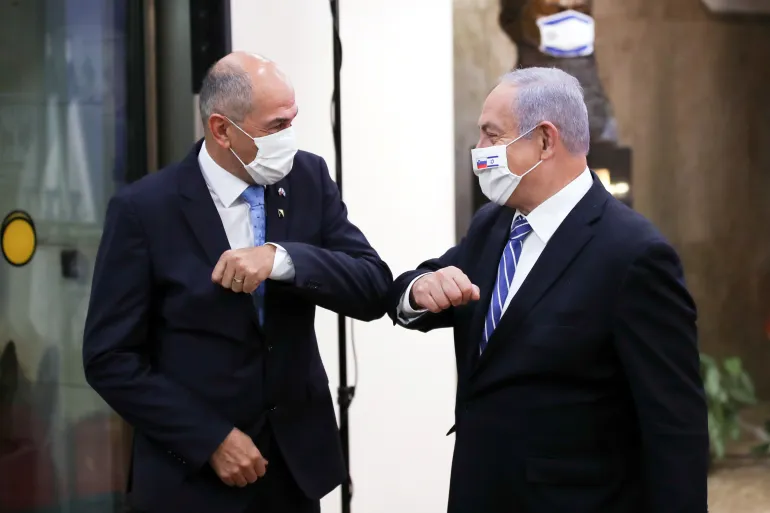
Slovenian then Prime Minister Janez Jansa and Israeli Prime Minister Benjamin Netanyahu met in Jerusalem on December 8, 2020 [Ohad Zwigenberg/Pool via Reuters]
Diverging views on Israel-Palestine
For a small nation – roughly the size of New Jersey in the United States – home to two million people, the Israel-Palestine conflict has played a significant role in its politics.
Slovenia’s current government has openly criticised Israel’s actions in Gaza and the occupied West Bank, even introducing a ban on imports of goods produced in the occupied Palestinian territory.
In May 2024, the country recognised Palestinian statehood, raising a Palestinian flag alongside the flags of Slovenia and the European Union in front of a government building in downtown Ljubljana.
A Palestinian flag flies next to a Slovenian and an EU flag, at the government building in Ljubljana, Slovenia, May 30, 2024 [Borut Zivulovic/Reuters]
In May 2025, Slovenia’s President Natasa Pirc Musar told the European Parliament that the EU needed to take stronger action against Israel, condemning “the genocide” in Gaza.
Later in the year, it banned far-right Israeli cabinet ministers Itamar Ben-Gvir and Bezalel Smotrich from entering the country and became the first country in the EU to ban all weapons trade with Israel over its genocidal war on Gaza.
It has also backed Slovenian International Criminal Court (ICC) Judge Beti Hohler, after she was sanctioned by the US for her role in issuing arrest warrants for Israeli Prime Minister Benjamin Netanyahu and former Defense Minister Yoav Gallant.
In a letter sent to the EU heads of state on March 13, Golob and Musar warned that Europe’s refusal to condemn the sanctions indicated that “concern for economic consequences has taken precedence over a principled defence of judicial independence and international justice … at a moment when armed conflicts rage, when international law is being violated, when the victims of the gravest crimes look to the ICC as their last hope for justice.”
Palestinian Foreign Minister Varsen Aghabekian Shahin meets with Slovenia’s Prime Minister Robert Golob, at the Office of the Prime Minister of the Republic of Slovenia, in Ljubljana, Slovenia, August 25, 2025 [Borut Zivulovic/Reuters]
Nika Kovac, a Slovenian sociologist and cofounder of the 8th of March Institute, a nongovernmental organisation focused on human rights, told Al Jazeera that support for Palestine is in part rooted in the fact that Slovenia is “a very young country”, which means “there is … solidarity with countries that want to be independent, and they cannot be.”
However, the country’s approach to Palestinian rights could shift if pro-Israel Jansa were to be elected.
Jansa has been a close ally to Israeli Prime Minister Benjamin Netanyahu and lambasted Slovenia’s decision to recognise the state of Palestine, with a statement from his party claiming it was tantamount to “supporting the terrorist organisation Hamas”.
A woman votes during the early voting before national elections, in Ljubljana, Slovenia, March 17, 2026 [Borut Zivulovic/Reuters]
Accusations of ‘foreign information manipulation’
In the lead-up to the election, a series of covertly recorded conversations was published online, featuring a Slovenian lobbyist, a lawyer, a former minister and a manager.
The videos purportedly show the individuals discussing ways to influence decision-makers in Golob’s coalition to expedite procedures and secure contracts.
On Tuesday, Golob accused “foreign services” of interfering in Slovenia’s elections, after a report by the 8th of March Institute and investigative journalists claimed that representatives of the Israeli private spy firm Black Cube had visited the country in December and Jansa’s headquarters in the weeks leading up to the leaks.
On Wednesday, Slovenia’s Intelligence and Security Agency confirmed the arrival of Black Cube representatives in Slovenia and presented a report on foreign interference in elections, which the agency’s director said was alleged to have been carried out at the behest of people in Slovenia.
The State Secretary for National and International Security in the Office of the Prime Minister of the Republic of Slovenia, Vojko Volk, made a statement following the announcement, saying, “According to information available to date, representatives of Black Cube have stayed in Slovenia on four occasions over the past six months.”
On Thursday, Golob sent a letter to European Commission President Ursula von der Leyen notifying her of “alarming information regarding what appears to constitute a grave instance of foreign information manipulation and interference currently unfolding in the Republic of Slovenia”.
French President Emmanuel Macron told reporters on Thursday that Golob “was the victim of clear-cut interference” by “third countries”.
“Today, in every election in Europe, there is interference that disrupts electoral processes,” Macron said.
Jansa has admitted to meeting with a Black Cube representative but denied any wrongdoing.
Luka Doncic is attempting to bring his daughters to the United States from his native Slovenia after separating from his fiancée, according to reports.
His former fiancée, Anamaria Goltes, 28, has filed a petition in California seeking child support and attorney fees from Doncic. One of Doncic’s daughters was with him for three months in 2025, and his other daughter has never been to California. Doncic, 27, told ESPN that he had “no idea” Goltes filed the petition.
“I love my daughters more than anything, and I’ve been doing everything I can for them to be with me in the U.S. during the season, but that hasn’t been possible, so I recently made the tough decision to end my engagement,” Doncic said in a statement. “Everything I do is for my daughters’ happiness, and I will always fight to be with them and give them the best life I can.”
Doncic and Goltes were engaged for nearly three years. Their oldest daughter, Gabriela, was born in November 2023, and Olivia was born in December. Doncic traveled to Slovenia for Olivia’s birth, missing games against the Toronto Raptors on Dec. 4 and Boston Celtics on Dec. 5.
During his visit, Doncic told Goltes he wanted to bring Gabriela to the United States when he returned to rejoin the Lakers, according to reports. Goltes objected, and Doncic departed without his daughter.
“I don’t even know how to describe it,” he told reporters of being present for Olivia’s birth. “It was a lot. I was there for the birth of my daughter, so that means everything to me. But it was definitely a roller coaster.
“I got to see my daughter again, my newborn. Coming back, it was kind of hard to leave them behind. But it’s a job, so I got to do it. So hopefully I’ll see them soon.”
Doncic posted a photo on social media of Olivia wearing a pink sweater with a heart emoji covering her face. In his first game back, he inscribed a G and O with a heart on his shoes.
“Two girls, they’re going to make my life hell for sure, I know that,” Doncic said, half-joking. “I’m going to be their security after I retire. All jokes aside, it’s the best thing in the world. I’m just blessed.”
Goltes deleted photos of her and Doncic from her Instagram account last week, and Doncic acknowledged that they had separated. Two weeks ago, he filed an injunction with a Slovenian court seeking immediate contact with his daughters, ESPN reported.
Doncic, who was traded to the Lakers from the Dallas Mavericks for Anthony Davis in February 2025, leads the NBA with a 32.5 points-per-game average. The guard also averages 8.4 assists and 7.8 rebounds.