‘Our Empire’ exhibit at the Cheech highlights the Inland Empire
Dilapidated buildings and decaying signage may put off the casual observer. But for Redlands-based artists James McClung and Marcus Mercado, the gritty patina of the Inland Empire urban landscape conjures memories of life in the region.
Honoring these unassuming entities is the main focus of a new community exhibit, titled “Our Empire,” at the Cheech Marin Center for Chicano Art & Culture.
A total of 29 acrylic, mixed media paintings and drawings by McClung and Mercado will be on display at the Altura Credit Union Community Gallery until Oct. 23.
“James and Marcus’ artistic excellence, deep local roots and passion to tell the stories of their neighborhoods aligns with the vision of the Altura Credit Union Community Gallery — a space dedicated to providing opportunities for SoCal artists to showcase their work and uplift the people and places of our region,” said Valerie Found, interim executive director of Riverside Art Museum.
“A lot of people that grew up in these communities see some of these locations and they’re very relatable to their upbringing,” says McClung. “Things have transformed this area as well.”
Take for instance the San Bernardino Santa Fe smokestack, a towering 189-foot-tall structure from the 1920s that fueled the nearby railway power plant until 1994.

(Kayla Bartkowski / Los Angeles Times)
For McClung, who grew up drawing comic book strips with his brother, the historic tower conjures memories of being in transit — after all, it is not far from the San Bernardino Santa Fe Depot, which links the city to other Southern California locations by train.
“I would go out to L.A. in my early 20s, just go off on my own and have a little adventure day,” says McClung. “Santa Fe structure stands out like a monument in the city.”
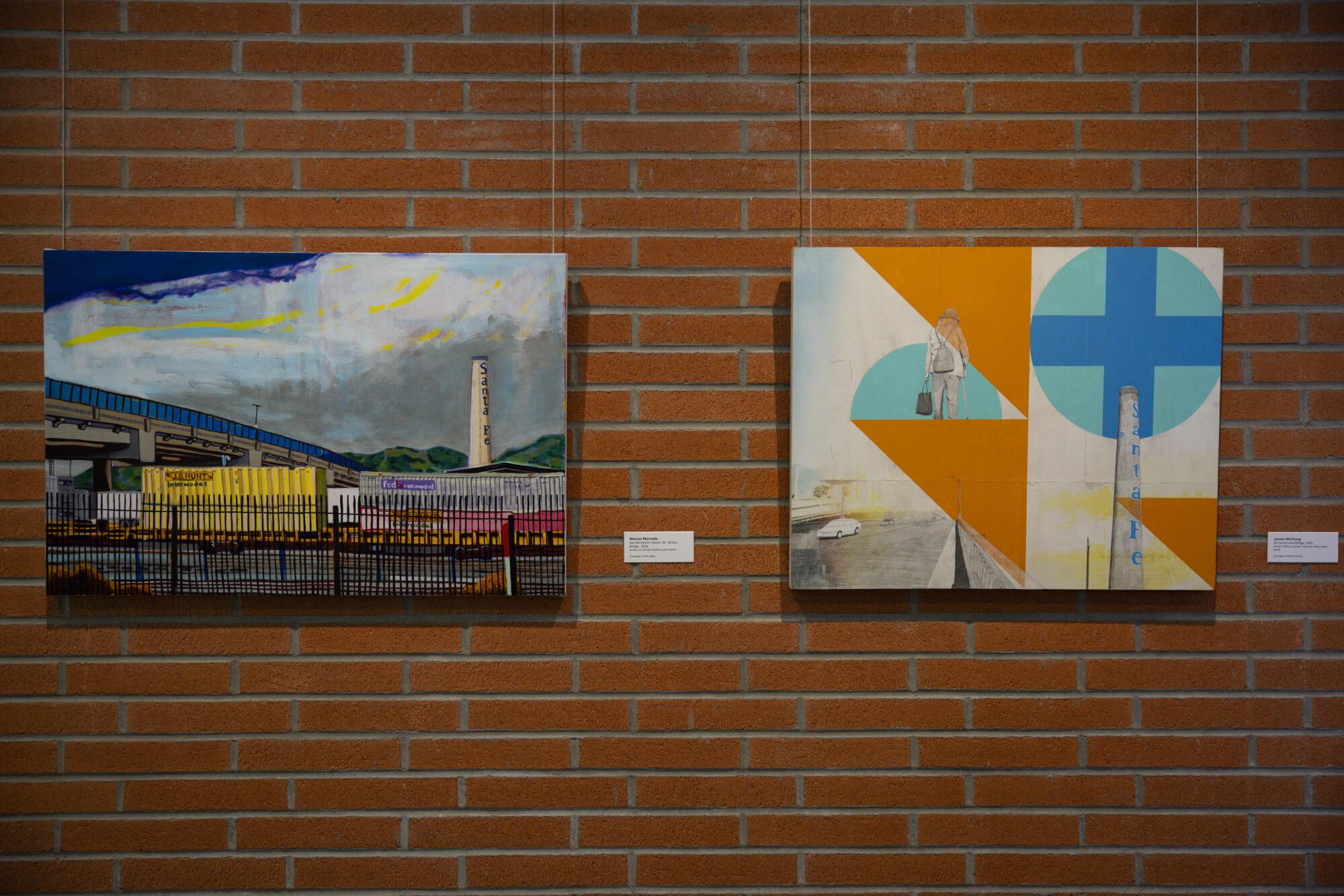
McClung depicts the tower with rigid orange triangles and hints of dewy sun-kissed hues, alongside a pencil-drawn image of the old Mt. Vernon Avenue Bridge, an 86-year-old structure that connected communities on the west side to the downtown commercial district. The bridge reopened last August under a $244.8–million project.
An elderly man holding a cane is also shown in the upper left area of the painting. ”Who knows, he probably walked that bridge most of his life,” says McClung, who says he began to appreciate where he grew up following the pandemic.
“When I was a kid, I just remember driving around, looking out the window and observing the area around me,” says McClung. “I think growing up here teaches you to accept the small things and appreciate them too, appreciating small businesses and local establishments.”
Mercado’s interpretation of the Santa Fe tower is subtle, with the smokestack laid out behind the long-stretching freight trains carrying J.B. Hunt and FedEx shipping containers that pass below the renovated Mt. Vernon Avenue Bridge — an industrial crossroad between old and new San Bernardino.
“It’s mostly a reflection of your starting point heading towards L.A.,” he said.
Mercado notes that he took an interest in painting familiar, neglected sites about four years ago. His subjects include the sun-faded hamburglar at the Historic Original McDonald’s Museum in San Bernardino, located at the site where brothers Richard and Maurice McDonald established what would become the largest fast-food chain in the world.

(Kayla Bartkowski / Los Angeles Times)
The defunct Redlands Mall, which is set to be demolished this year, is also a central subject in his artwork.
“I remember specifically being there, memories of the nail salon chemicals. There was a record shop and a hot dog on a stick,” says Mercado of the mall, which opened in 1977. “You’d go during Redlands Market Night, people would be hanging out, so all your friends would kind of meet up for that one night a week.”
When Mercado acquired photos from inside the vacant Redlands Mall from a friend, he saw his beloved hot dog on a stick shop, which he frequented in his middle and high school years, now in a desolate state with empty soda boxes and graffiti that depicted workers as stick figures. He painted it as such.
“To me, it is just a reflection of how we treat our memories or how we remember things,” says Mercado. “Is it the same as what we remember? Is it something that we wanna leave behind, or is it just, like, a ruin?”
Two extinct malls are referenced in the “Our Empire” exhibit, though the second might be hard to decipher unless someone remembers a mystery flute man who used to frequent the Carousel Mall in San Bernardino, which was demolished in 2023 after closing in 2017. McClung painted the flutist after hearing him in an empty parking structure beside the shopping center.

(Kayla Bartkowski / Los Angeles Times)
“I was driving around places in the [Inland] Empire that I wanted to capture. I would go out and take reference photos,” says McClung. “I park in a big parking structure at Carousel mall and I hear this flute. Come to find out he would go there weekly because of the acoustics in the area.”
A quick online search will prompt a flurry of Reddit and Facebook discussion about where the flute man — dubbed the mystical flute man by many — is located now. Besides some streamer vlogs in the area, no formal article or website has ever recognized the elderly man as an idol. His memory, as it exists in McClung’s painting, is reserved for those who share a unique collective experience.
Perhaps others in the area have stumbled upon the mysterious flute man themselves, or can recall the smell of monomer from a nail salon at the Redlands Mall. Or perhaps Inland Empire residents can recognize home from the towering Santa Fe smokestack.
“I want people to come and feel like they are part of this as well,” McClung says. “We have our own memory of what that space was for us, but other people have their own story, too.”