The Singa Market Fire in Kano That Left Dreams in Ashes
How do you comfort a man who has just watched years of his life turn to smoke?
Sulaiman Mustapha remained seated inside the mosque after the dawn prayer, long after others had left. He put both hands on his head as if trying to hold his brain in place. He could not speak. No wailing. No outburst. Just the stillness of a man whose world had collapsed overnight. Those around him tried to console him, but the words sounded distant, almost irrelevant.
Less than a month ago, Sulaiman bought a new motorcycle to make his trips to Singa Market in Kano, North West Nigeria, easier. For him, it was not just a bike. It was a milestone. For years, he had gone to the market with his brother as a worker, running errands for established traders. With time, he began handling purchases. Then he began trading in small quantities for himself. The profits were modest but steady.
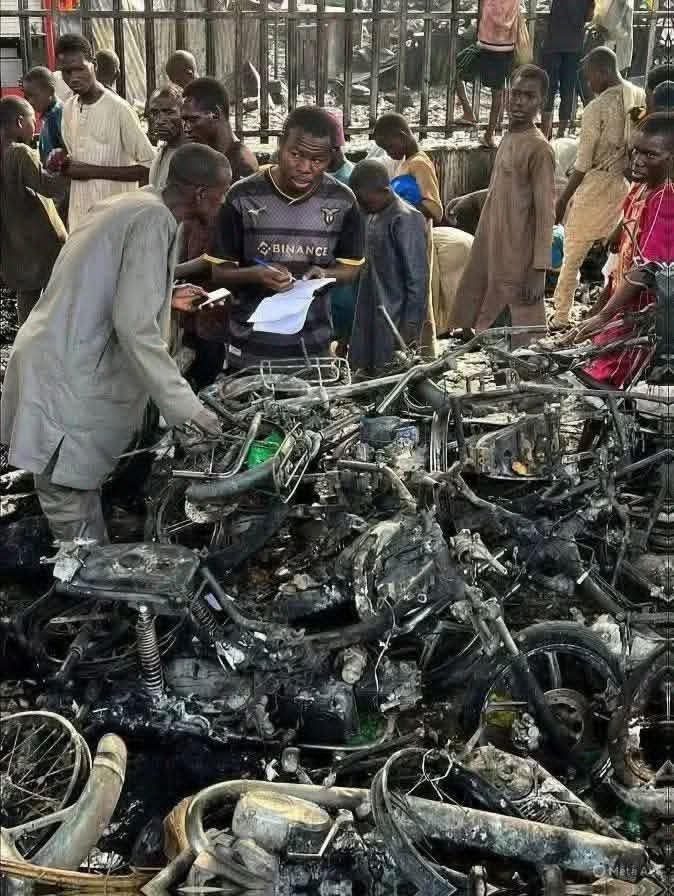
The motorcycle symbolised a shift. It meant he would no longer spend heavily on transport. It meant more capital for his small shop. It meant growth. Then, in a matter of hours, fire erased that growth. Now it was metal frames and ash.

On Saturday, Feb. 15, around 4 p.m., a fire broke out at Gidan Glass, a plaza at Singa Market. Witnesses say the fire spread quickly, leaping from shop to shop before traders could salvage much. It burned for two days. By the time it was contained, dozens of shops had been reduced to charred frames.
Sulaiman and his brother’s shop was among them.
When he sat in the mosque that morning, he was mourning years of hard work — the savings, the small profits he reinvested, and his mother’s inheritance. “After his grandfather died, the inheritance was shared,” his close friend, Abba Abubakar, told HumAngle. “His mother gave him her portion to grow the business.”
Now, everything is gone.
The fire that tore through Singa Market is the latest in a long line of infernos that have become almost routine in Kano markets. Within 48 hours, early estimates placed losses in billions of naira. But beyond the figures lies a deeper story: how recurring fires, weak emergency infrastructure, and structural neglect continue to threaten the livelihoods of thousands of small-scale traders who form the backbone of the city’s informal economy.
Sulaiman’s story is that of hundreds of traders whose stalls were destroyed. In markets like Singa, capital is built slowly from daily turnover and rarely backed by insurance. Many traders rely on family contributions, cooperative loans, or personal savings. A single disruption can undo a decade of effort.
For small-scale traders, the market is their safety net. It funds school fees, hospital bills, rent, and other family obligations. When the market burns, the consequences ripple far beyond the charred stalls.
By Monday afternoon, some traders had returned to sift through ashes, hoping to salvage metal frames or partially burned goods. Others simply stood in clusters, calculating debts they still owed suppliers.
There are still unanswered questions about what triggered the fire and whether preventive measures were in place. For now, what remains visible is the human toll.
The full extent of the damage and how traders will rebuild is still unfolding.
But how did it start?

Between sparks and sorrow
Around 3 p.m. that Saturday, Abba Abubakar noticed thick black smoke rising into the sky. The sight unsettled him immediately. Some weeks earlier, he had seen a similar column of smoke before a fire gutted Gidan Mazaf at the same Singa Market.
“But this one was very close,” he told HumAngle.
Abba is not a trader at Singa. He sells wrappers and garments at Abubakar Rimi Market, popularly known as Sabon Gari, just across the road. His fear was instinctive. Fires are not unfamiliar in that commercial district. When smoke appears, traders do not wait for confirmation. They imagine the worst.
“We rushed out of our shops and later realised it was solar panels burning on top of Gidan Glass,” he said. “By the time we got there, it had already consumed part of the upper floor, and the fire was raging.”
From another part of the neighbourhood, Muttaka Musa, who works in one of the affected stores, also saw the smoke. He had been at a nearby plaza known as Gidan Gwaggo Laraba when he looked up and saw the sky darken.
“Immediately I got there, the fire had already finished one of our stores and had started catching the other,” he said. Muttaka said people had been warned when the fire first broke out. But warnings in markets often compete with denial. No one expected the flames would escalate to that scale.

Auwal Ibrahim Gaya lost two shops in the blaze. He was performing the afternoon Asr prayer when he received the call. “When they told me the fire had started, I was at the mosque,” he said. “I rushed there, and when I saw it, I began reciting prayers. I said Allah is testing us, and we accept His decree.”
Faith, in moments like this, becomes both refuge and resignation.
As the fire intensified and traders failed to contain it, emergency services were called. But by then, the scene had drawn large crowds. Onlookers filled the narrow access roads, making it difficult for fire trucks to reach the core of the market.
One firefighter, who asked not to be named because he was not authorised to speak to the press, told HumAngle that “almost all the fire service trucks we have in Kano were mobilised. But the fire kept spreading from the top. It was moving across the upper structures, so it was difficult to control. If there had been a helicopter, it could have quenched it from above.”
An investigation by HumAngle found that the Nigerian Federal Fire Service does not currently operate firefighting helicopters. Announcements about acquiring one circulated between 2021 and 2024, but the purchase never materialised. The National Emergency Management Agency (NEMA), which previously had access to such support, is also reported to have non-functional aerial equipment.
As a result, even with the presence of the Federal Fire Service, NEMA officials, the Kano State Emergency Agency, and the state governor, Abba Kabir Yusuf, at the scene, the fire burned for two days before it was finally largely subdued.

What causes market fires in Kano?
Market fires are not new in Kano. Almost every year, a section of the city’s commercial heart goes up in flames. Sometimes it is a cluster of stalls. Sometimes an entire block. The pattern has become disturbingly familiar. Traders rebuild. Business resumes. Then another fire breaks out.
In the two months of 2026 alone, at least five fire incidents have been recorded within the Kano metropolis. Four occurred in markets: Kofar Ruwa yan Katako, Gidan Mazaf Singa, Gidan Glass Singa, and near Abbatuwa cemetery. One affected a filling station along Madobi Road. For a city whose economy leans heavily on trade, these events are structural tremors.
A 2021 study by Sulaiman Yunus, an urban risk and disaster management researcher at Bayero University, Kano, documented 366 fire incidents between 1974 and 2017. On average, that translates to at least eight outbreaks annually in markets alone. The data suggests a chronic vulnerability embedded within Kano’s commercial architecture.
But what explains this cycle? Why do the fires persist, despite decades of losses?
Sulaiman found that outbreaks are most frequent in highly concentrated, densely built, older commercial hubs. Large central markets such as Kantin Kwari Market, Kasuwar Kurmi, and Sabon Gari Market were identified as particularly vulnerable.
These markets evolved long before modern urban planning standards. Stalls are packed tightly together. Extensions are added informally. Electrical wiring snakes across wooden beams and zinc roofs. Access routes are narrow, often clogged with traders, buyers, and transporters. When fire breaks out, it meets fuel.
The study notes that most affected markets lack functional fire hydrants and emergency suppression facilities. In many cases, traders rely on buckets of water or improvised extinguishers in the crucial first minutes. By the time fire trucks arrive, flames have often climbed to rooftops and leapt across adjoining structures.
Temporal analysis in Sulaiman’s study shows a clear seasonal pattern. Fire outbreaks peak during the dry season, particularly between November and March. The Harmattan months record the highest incidence rate because the air is drier and the winds harsher. Materials that might otherwise resist ignition become combustible.
Yet climate alone does not ignite markets.
The research found that electrical faults and power surges account for the majority of recorded incidents. Illegal connections and overloaded circuits were identified as primary ignition sources. In markets where dozens of traders tap into a single supply line to power freezers, grinding machines, bulbs, and charging points, the system is often stretched beyond capacity. Electricity, meant to enable commerce, becomes the spark that destroys it.
The Singa Market fire fits within this broader history. Its scale may be exceptional, but its underlying conditions are not. The questions raised in its aftermath echo those of previous disasters: Were safety standards enforced? Were electrical systems inspected? Were access routes kept clear?
For now, attention has shifted to relief. The Federal Government has approved a ₦5 billion intervention fund for traders, while the Progressive Governors’ Forum also donated ₦3 billion, signalling recognition of the magnitude of the loss. But compensation, even when fully disbursed, rarely mirrors destruction. For small-scale traders, relief funds often dissipate before reaching the lowest tiers. Many operate without formal registration, insurance, or documented inventories. Their losses exist in memory, not in audited balance sheets. A bag of rice here. Ten kegs of oil there. A motorcycle bought less than a month ago.
Billions of naira in pledges may soften the blow at a macro level. Yet, for the petty trader who relied on daily turnover to survive, recovery is measured not in billions but in whether he can reopen with even a fraction of his former stock.
In Kano’s markets, fire is no longer an anomaly but a recurring chapter in the city’s commercial story. Each outbreak exposes the same structural weaknesses. Each investigation repeats familiar findings.
And each time, traders return to rebuild in the same crowded corridors, under the same fragile wiring, hoping that this season’s wind will be kinder than the last