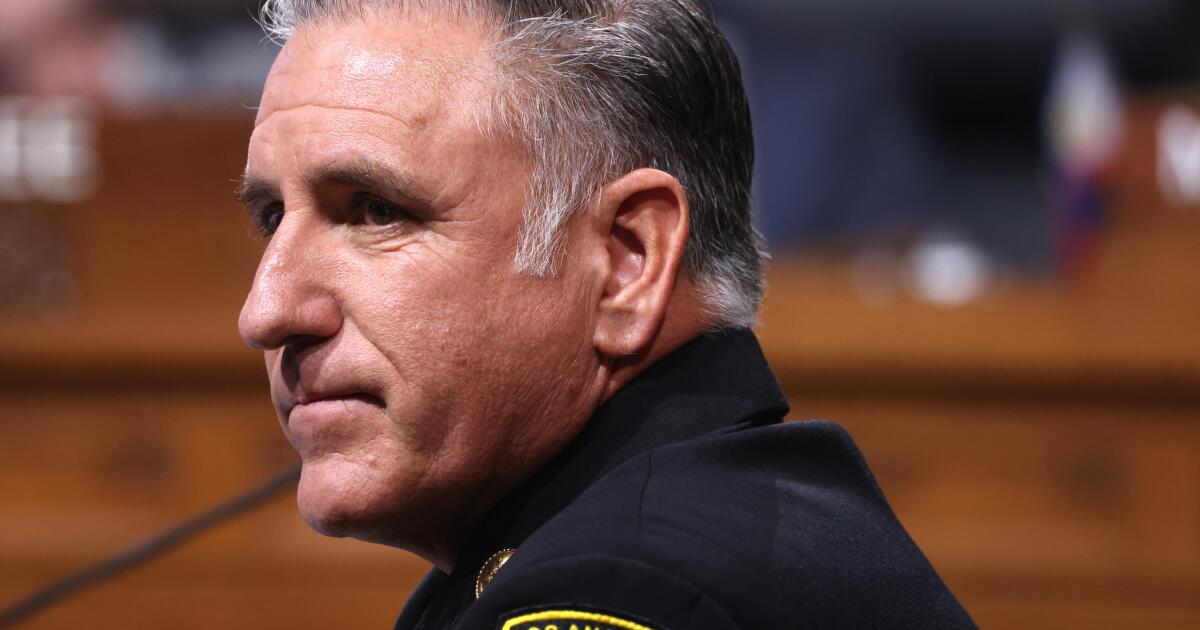
New LAFD chief won’t look into who watered down Palisades fire report
After admitting last week that the Los Angeles Fire Department’s after-action report on the Palisades fire was watered down so as not to reflect poorly on top command staff, Fire Chief Jaime Moore said Monday he does not plan to determine who was responsible.
Moore said he is taking a forward-looking approach and not seeking to assign blame for changes to the Oct. 8 report that downplayed the city’s failures in preparing for and responding to the disaster. But he said his predecessor, interim Fire Chief Ronnie Villanueva, ultimately was responsible for releasing the contents of the report.
As chief, Moore said, he will not allow similar edits to after-action reports, which he said are intended to help the department learn from and correct past errors.
“I don’t think there’s really any benefit to me” looking into who made the edits, Moore said in an interview with The Times. “I can see where the original report and the public report aim to fix the same thing. They aim to correct where we could have been better. And it identifies … the steps that are going to be necessary to make those corrective actions.”
Moore, an LAFD veteran who took the helm of the agency about two months ago, said last week that the edits to the after-action report, which were first documented by The Times, were intended to “soften language and reduce explicit criticism of department leadership.”
On Monday he said Villanueva “made the decision to publish it, had something to do with the decision that it was going to be published publicly, which caused these drafts to occur.”
Villanueva did not respond to a request for comment.
“My efforts need to be pointed toward fixing things, not looking back and trying to point blame at anybody,” said Moore, who previously headed the LAFD’s Operations Valley Bureau, overseeing nearly 1,000 firefighters. “I need to fix where we’re going so it never happens again.”
The Times found that the after-action report was edited to obscure mistakes by city and LAFD leaders in handling the fire last January that killed 12 people and destroyed thousands of homes. The Times reviewed seven drafts of the report obtained through a state Public Records Act request.
The most significant changes involved top LAFD officials’ decision not to fully staff up and pre-deploy all available engines and firefighters to the Palisades or other high-risk areas ahead of a dire wind forecast.
An initial draft said the decision “did not align” with policy, while the final version said the number of companies pre-deployed “went above and beyond the standard LAFD pre-deployment matrix.”
The author of the report, Battalion Chief Kenneth Cook, declined to endorse the final version because of changes that altered his findings and made the report “highly unprofessional and inconsistent with our established standards.”
Moore said he spoke with Cook, whose version included many more recommendations for improvements than ended up in the final report.
“He doesn’t know who did the edits. He provided me with the original that he submitted, and therefore, that’s all I can go by,” Moore said, adding that some recommendations were consolidated.
Earlier, the president of the Fire Commission said she was told that a draft of the after-action report was sent to the mayor’s office for “refinements,” though she did not know what they were.
Moore said he would refuse if the mayor, who is his boss, requested edits to an after-action report.
“I would just say, ‘Absolutely not. We don’t do that,’” he said.
A spokesperson previously said Mayor Karen Bass’ office did not demand changes and asked the LAFD only to confirm the accuracy of items such as how the weather and the department’s budget factored into the disaster.
“The report was written and edited by the Fire Department,” spokesperson Clara Karger said in an email last month. “We did not red-line, review every page or review every draft of the report.”
Moore also described his efforts to look into missteps made during the mop-up of the Lachman fire, which rekindled days later into the devastating Palisades fire. The after-action report contained only a brief mention of the earlier fire.
The Times found that a battalion chief ordered firefighters to roll up their hoses and leave the burn area despite complaints by crews that the ground still was smoldering. The Times reviewed text messages among firefighters and a third party, sent in the weeks and months after the fire, describing the crew’s concerns, and reported that at least one battalion chief assigned to the LAFD’s risk management section knew about them for months.
After the Times report, Bass directed Moore to commission an independent investigation into the LAFD’s handling of the Lachman fire.
Moore said he opened an internal investigation into the Lachman fire through the LAFD’s Professional Standards Division, which probes complaints against department members. He said he requested the Fire Safety Research Institute, which is reviewing last January’s wildfires at the request of Gov. Gavin Newsom, to include the Lachman fire as part of its analysis, and the institute agreed. Moore also pointed to the L.A. City Council’s move to hire an outside firm to examine the Lachman and Palisades fires.
Even with the internal investigation underway, Moore said he spoke with the battalion chief who was on duty during the Lachman fire mop-up.
“He swears to me that nobody ever told him verbally or through a text message that there was any hot spots,” Moore said.
Moore later added: “If that is true, then — you asked me about discipline — potential discipline would possibly occur.”
Former Times staff writer Paul Pringle contributed to this report.