Side

Van Hollen’s bid to replace Schumer as leader is putting pressure on Democrats to take sides

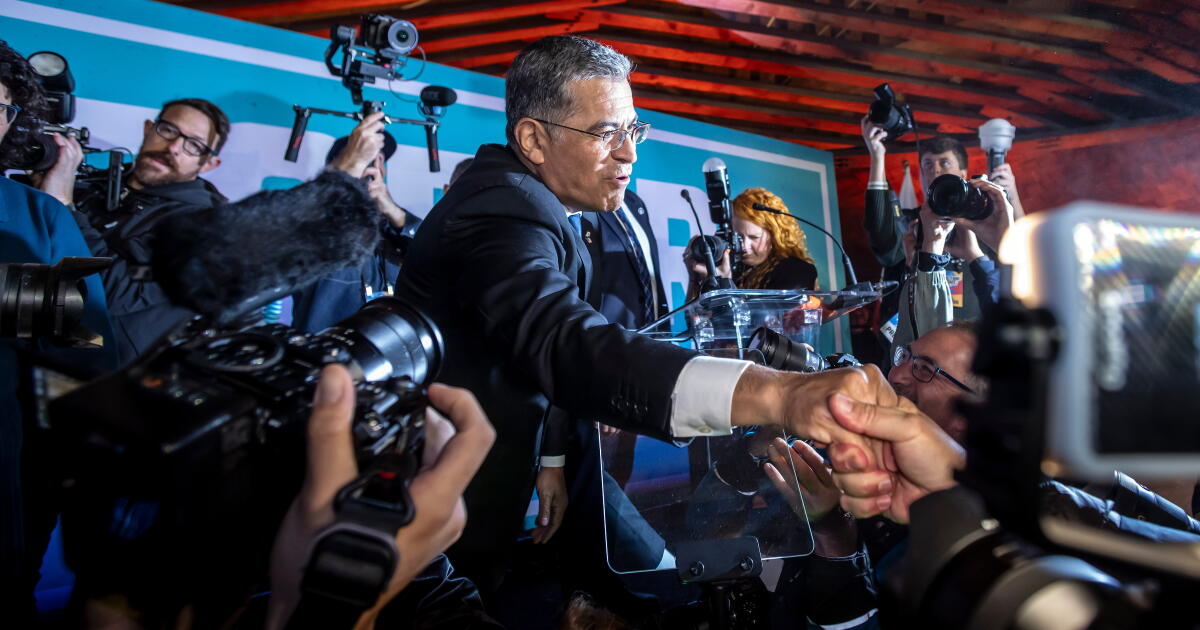
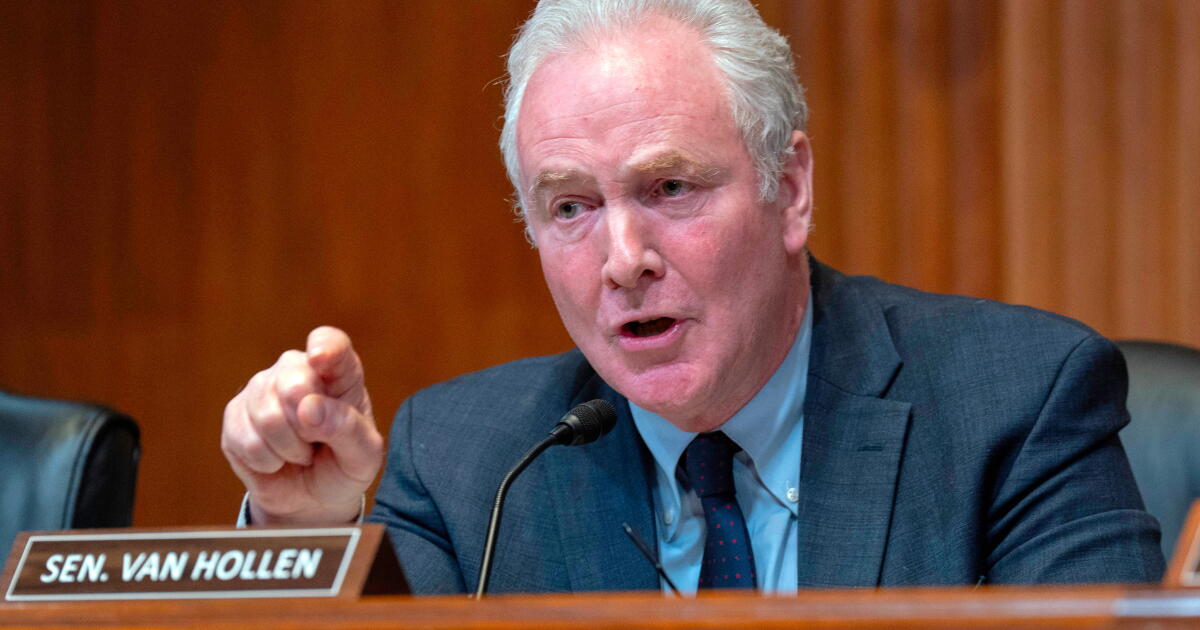
Senate Democrats elect their leader every two years behind closed doors and on a secret ballot. But this year’s race has burst into the public eye as Maryland Sen. Chris Van Hollen mounts an insurgent bid against New York incumbent Chuck Schumer.

The Dec. 1 contest has put Senate Democrats on edge and has forced what could become an ugly fight immediately after major victories in the midterm elections. It has also put the more moderate incoming Democrats in a tough spot, forced to take sides in a leadership race before they are even sworn into office.

Schumer, who recruited several of those moderate Democrats who helped win the majority, has said he has the votes to be reelected, and around 15 of the 55 elected Democrats in next year’s caucus have said publicly that they will support him. Four Democratic senators have said they will support Van Hollen. Everyone else is staying quiet for now.

“Leave it to the Democrats,” said Colorado Sen. John Hickenlooper, who flipped an imaginary coin when asked by reporters on Monday how he would vote. “We flipped nine seats, and the person who actually helps put it all together and do all that, and all of a sudden, there’s a revolt.”

Van Hollen, who is backed by progressive groups, says it’s time for new leadership after Schumer’s nearly decade-long tenure. While the two men align on most issues, Van Hollen says Democrats need to more aggressively push to end the Iran war and potentially even shut down the government next month, if necessary, to stop the flow of war funding.

“To deliver, we need new leadership,” Van Hollen says. “This isn’t about any one person – it’s about answering that call.”

Van Hollen is making his argument to the public as Schumer mostly keeps quiet and holds private his conversations with the senators who will decide his fate. Schumer shared his agenda for the next Congress in a caucus luncheon last week, laying out a plan to try to quickly pass legislation on healthcare and tariffs and to launch multiple investigations into President Donald Trump’s Republican administration.

Asked about Van Hollen’s challenge on Tuesday, Schumer said again that he’s confident he has the votes.

“We are united together on lowering costs and ending corruption,” Schumer said.

A public campaign for an insider’s job

The unusually public race — the first contested election for Senate Democratic leader in decades — comes when Schumer has drawn intense criticism from the party’s base. Some voters and progressive groups called for his removal in 2025 after he voted with Republicans to keep the government open and as they called for stronger opposition to Israel’s war in Gaza.

Still, many in the caucus see the role not as a national figurehead but as an inside operator who can navigate intraparty politics and the 100-member Senate’s arcane rules to pass legislation.

“I want to hear from any candidate what their vision is for the floor and managing the caucus,” said Georgia Sen. Jon Ossoff, who was just reelected. He said he hasn’t committed to either Schumer or Van Hollen.

Party leaders also spend much of their time fundraising and recruiting candidates — a particular interest for Schumer, who has been directly or indirectly in charge of the Senate Democrats’ campaign arm for two decades.

Most Democrats don’t want to reveal their vote

Returning to Washington on Monday for the first time since Van Hollen entered the race, most Democrats would not answer questions about who they would support. That included prominent progressives like Massachusetts Sen. Elizabeth Warren.

Michigan Sen. Elissa Slotkin appeared last week at a press conference with Vermont Sen. Bernie Sanders, an independent who caucuses with Democrats, as he declared that he would not support Schumer. Van Hollen entered the race two days later, and Sanders immediately endorsed him. But Slotkin has not.

“I’m not saying anything,” she told reporters on Monday.

Others like Virginia Sen. Tim Kaine defended Schumer while saying that they are still open to Van Hollen or someone else.

“Chuck delivered an amazing win,” said Kaine. “Chuck knows Trump, and that will be really, really important going forward.”

Still, Kaine said, “The voters are demanding change, so we have to figure that out as a caucus, and we’re going to be able to. We’re not afraid to have a discussion.”

Freshmen put on the spot

The eight incoming freshmen Democratic senators — nine if Mary Peltola wins the Alaska Senate race, which has still not been called — are set to alter the caucus next year. But only two have said how they will vote in the leadership election.

Abdul El-Sayed of Michigan and Peggy Flanagan of Minnesota, both of whom were backed by progressive groups in their campaigns, say they support Van Hollen. Schumer supported both of their opponents in their primaries, though he eventually put $67 million into El-Sayed’s competitive race.

El-Sayed said Tuesday that he likes Schumer and will work alongside him if he wins. But he said he thinks Van Hollen is the best person to take on affordability challenges and liberal priorities like Medicare for All.

“We have not seen an open Senate fight for leadership for a very long time,” El-Sayed said at The Atlantic Summit in Washington. “This is healthy. It’s good.”

For some of the other freshmen, many of them moderates from Republican-leaning states, the decision could be more difficult. Some said during their campaigns that they wouldn’t vote for Schumer. But it’s unclear if any of them would back the more liberal Van Hollen.

In South Carolina on Tuesday, Sen.-elect Annie Andrews, a doctor, said that she is in conversations with both candidates and has been “sharing my plans to fix our healthcare system.”

Incoming Iowa Sen. Josh Turek told reporters he’s met with both Schumer and Van Hollen. He said he wants more specifics on how they will help rural families, overhaul campaign finance and ban lawmakers from trading stocks. Turek said he also wants to assess “who is going to put forth the most robust anti-corruption agenda.”

Hawaii Sen. Mazie Hirono, who is backing Schumer, said that the caucus needs to hear more from the new senators who “have been through the fire to get here.”

“I think that we have to make sure that all these voices are heard,” she said. “They’ve got a lot of talent to bring to the table.”

Jalonick and Sloan write for the Associated Press. AP writers Joey Cappelletti and Kevin Freking in Washington, Meg Kinnard in Columbia, S.C., and Hannah Fingerhut in Des Moines, Iowa, contributed to this report.

Source link

Spain 2-3 England: How did Thomas Tuchel’s side win and what was learned from Argentina defeat?

Making defensive subs is fine when it works – but when it does not, boy will a manager hear about it.

In the World Cup last 16, England had been 2-1 up against Mexico in the Azteca when Jarell Quansah was sent off.

Tuchel brought on three defenders for a defender, a midfielder and a forward.

But England won 3-2 and Dan Burn’s cameo was the stuff of legend.

However, nine days later with England 1-0 up against Argentina, Tuchel did the same again – three defenders on for a defender, midfielder and forward.

The first of those subs, with Konsa replacing Anthony Gordon, was in the 72nd minute.

And England just sat back until Argentina broke their resistance.

However, against Spain this time, despite England being down to 10 men and facing incessant pressure, Tuchel was not so quick with defensive subs.

Myles Lewis-Skelly, replacing Harry Kane, was the first on after 78 minutes – 15 minutes after Anderson’s sending off. And then five minutes later he brought on two more players – but one of them was a striker in Dominic Calvert-Lewin.

Burn replaced fellow defender White in the 89th minute.

“Harry played 78 minutes, Jude [Bellingham] 83 minutes and then just defending and defending, it’s tiring,” explained Tuchel.

“So we needed fresh energy. I was asked yesterday what happens if there needs to be a critical or crucial substitution. And I said, I feel free enough to take any substitution if I think it is necessary to help the team and to influence the game.

“I feel free enough to do that and I think there was a lot of defending needed. So we just went for some fresh legs.”

Source link

‘Seduced by a dramatic landscape of canyons and lakes’: exploring Catalonia’s wild side | Travel

Alighting at the train station of Santa Linya in northern Spain, I paused to wonder what the railway engineers were thinking. A rough halt hewn out of the mountainside, with no ticket office, no waiting room, no sign of human habitation – just a single platform in the wilderness. On the far side of the track, a shimmering turquoise lake flanked by pine forests. Ahead – the only way out – a rocky trail snaking up the limestone cliff.

My husband and I had first strayed into this western corner of Catalonia – Pallars Jussà – on our honeymoon road trip 21 years earlier. Seduced by its dramatic landscape of canyons, lakes, crumbling ruins and the formidable Noguera Pallaresa river thundering south from the Pyrenees, we had vowed to return one day. He loves mountains, I love water, we both love abandoned buildings; it was a geographical match made in heaven. Now those vows had come good – we were back, on a mission to go deeper into the hinterland.

What was apparent on that first trip was that the real gems were found far from tarmacked roads, which is how we ended up standing on the empty platform of what must surely be one of Spain’s most remote train stations, staring up at a very steep climb. We had arrived at Santa Linya on the Tren dels Llacs – the Lakes Train, a service that runs on a single track from the city of Lleida north to the mountain town of La Pobla de Segur. Following the river valley, the line takes in 40 tunnels and 75 bridges along its 55-mile (89km) route, winding through the spectacular landscape of the pre‑Pyrenees. We had chosen to ride the Tren Historic service, a 1960s locomotive in original livery, complete with period dining car and mail carriage. There was the option of a slicker, modern Tren Panoramic, but the varnished wood and vintage furnishings seemed more fitting in this timeless valley.

Mont-Rebei Canyon. Photograph: Oksana Byelikova/Getty Images/iStockphoto

There was nowhere to go but up. The sun beat down as we began the ascent from the station towards the village of Santa Linya itself. It’s a three-and-a-half-mile rocky hike with a 190-metre (623ft) climb, so it seems unlikely any of the villagers are using this train as a commuter service. But this line isn’t about efficiency, and is all the better for it. Catching our breath in the village, we spotted a small signpost for our ultimate destination – a further four miles east, winding through Spanish oaks, almond and fig trees, the scent of rosemary drifting in the air. Our efforts were finally rewarded as we emerged from the trees at the Mirador del Balconet, a stomach-lurching cliff edge with a sweeping view over the Collegats Gorge and the Noguera Pallaresa River, a dizzying 300 metres below. That a world-class vista such as this is hidden away, miles from the nearest road, seems inconceivable – and reassuring – in our overshared world. Complete silence reigned. Griffon vultures soared and swooped on the thermals, so close we could almost make eye contact, before coming to land on their eyrie on the far side of the gorge.

Hopping on and off at the Tren dels Llacs’ request stops is a fine way to explore this region, but adding a bicycle helps to get deeper into the wilds. This is big country, with a vast network of ancient trails ideal for mountain biking, ranging from steep climbs and white-knuckle descents to gently rolling farm tracks, all linking numerous ruins, from castles to chapels and farmhouses, dotted across the hilltops. Our first trip had been during a roasting summer, but autumn temperatures in the foothills are reliably pleasant into November and ideal for cycling. Arriving in the town of Tremp on the train, we hired a couple of bikes and set off, eventually arriving at the lakeside Hotel Terradets near the village of Cellers (also on the train line), which is so bike-friendly it even has a workshop facility for its two-wheeled guests.

After all our exertion, the hotel appeared like a mirage to us weary travellers. With roots dating back a century, the Terradets was originally an inn providing food and shelter for merchants and muleteers traversing the Montsec mountains. Nowadays, it’s quite the stylish destination for outdoorsy types, offering bike and kayak hire, with a pool and terrace overlooking the Embalse de Terradets. This reservoir was created when the Noguera Pallaresa was dammed in 1935, and almost 100 years later it’s hard to believe the lake is not part of the natural landscape. Its shores are wild and unspoiled, with sandy beaches and pine groves, but beneath its calm, glassy waters lurk the ruins of the monastery of Sant Miquel de Cellers, submerged during the flooding of the valley.

The Hotel Terradets. Photograph: Cris Palomar

It was a challenge to drag ourselves away from the Terradets, not least because of its restaurant. Carnivores will be happy in Pallars Jussà, with the ubiquitous escudella pallaresa, a local meat stew, as well as Pyrenean river trout and cod cooked in local Montsec honey. Crema catalana, the regional version of crème brûlée, is the default (and delicious) dessert to be found everywhere. But a word of warning: if, like me, you find yourself seduced by the romantic-sounding postre de músic (musician’s dessert) – it’s a saucer of nuts and raisins. (This musician wished she’d ordered the crema catalana.)

skip past newsletter promotion


The menus are not the only reminder that you are very much in Catalonia. You won’t find any tapas round here; you certainly won’t find a menu in Spanish, and attempts to speak español are tolerated only from foreign visitors. In the towns, the population is small but the resistance is strong; the Estelada, the separatist flag, hangs from balconies and windows, while its red and yellow stripes are painted on roads, bridges and walls, along with pro‑independence graffiti ranging from the galvanising Fem República! (Let’s build the Republic!) to the more direct Puta España (Google it).

A walker braves the path halfway up the cliffs of the Mont-Rebei Canyon. Photograph: Martin Silva Cosentino/Alamy

After some rest and recuperation at the Terradets and daily swims in (and occasionally across) its magnificent lake, we were ready to take to the road again, for Pallars Jussà’s pièce de résistance. The Balconet had been a mere warm-up for the big one: the king of Catalan gorges lies in the next valley west, where the Noguera Ribagorçana River carves its path through 500m vertical cliffs, narrowing to a channel just 20 metres wide. This mighty river is the border between Catalonia and the Aragon region, creating a truly impassable frontier by way of the Mont-Rebei Canyon. We drove as close as we could get, but Mont-Rebei is famous for being the only gorge in the region surrounded entirely by pristine wilderness. Access is via a dirt track, and the gorge itself is not crossed by any roads, railways or power lines. We decided the best way to view its sheer magnitude was from the water, and hired kayaks to paddle the round trip of three or four hours from nearby Corçà, awed as we slithered between its towering rock walls. High above us, halfway up the cliffs, walkers appeared like tiny ants, negotiating a metre-wide path cut into the rock face.

This vertigo-inducing path was created a century ago, using dynamite, hand chisels and picks, as a route to connect remote communities. These days, getting around this wild corner of Catalonia is a little easier but it still takes time. There are no motorways in Pallars Jussà and life moves slowly (the four-hour siesta has caught out many an unsuspecting visitor), but there’s a connectedness to the land and its natural rhythms, and a spirit of resourcefulness that permeates everyday life. For the gentle traveller, or indeed, nostalgic honeymooners, the rewards are rich.

Source link

Major League Baseball content producers join WGA

Major League Baseball writers and other content producers have voted to join the Writers Guild of America East.

The WGA said Wednesday that 127 employees of MLB Advanced Media — the content creators for the league’s official website and popular app — are now represented by the New York-based guild for collective bargaining. The American Arbitration Assn. administered an election after a majority of the group signed union cards.

The move marks the first time workers of a professional sports league have formed a WGA bargaining unit.

“The Guild is excited to welcome more workers from the sports industry into the labor movement,” Writers Guild of America East President Tom Fontana said in a statement. “This bargaining unit now has earned a seat at the table with Major League Baseball to negotiate a fair first union contract.”

In a statement, the league said it did not stand in the way of the organizing efforts.

“MLB worked cooperatively and in good faith to identify the appropriate bargaining unit and to respect the rights of the affected employees to decide whether to unionize,” the league said. “We look forward to working with the WGAE as their new representative.”

Neither side disclosed what workplace matters prompted the group to organize.

The unit produces content for the league’s digital offerings in English, Spanish and Japanese.

The effort comes as baseball executives are embroiled in tumultuous contract negotiations with its big league players. The collective bargaining agreement with the Major League Baseball Players Assn. expires Dec. 1, and team owners could lock out players after that deadline if no deal is reached.

The two sides have been tussling over a proposed salary cap, which the union opposes.

A protracted salary-cap standoff could jeopardize the 2027 season.

Times staff writer Bill Shaikin contributed to this report.

Source link

Ireland 42-12 Argentina: Six tries and a big win – but were Andy Farrell’s side ruthless?

Beirne said that Argentina “came out firing” in Dublin as they chased a first away win over Ireland, something that came as no surprise to the Irish pack.

“We weathered the storm and got into how we wanted to play the game,” said Beirne.

“What was pleasing about that was some of those tries were proper team tries and everyone was involved with them. That was the biggest takeaway from the game that.”

But, like Farrell, the second row believes there is more to come at the attacking end of the pitch.

“We probably came away a little bit frustrated because we felt we didn’t capitalise on a lot of the territory at the end of the game and the chances we had.

“That shows how good a performance it was to come away feeling like that.”

After a bruising opener, Farrell will be forced to assess his squad ahead of Fiji’s visit to Dublin on 14 November.

After that, world champions South Africa will be a stern test before the finals weekend in London to round out the international window.

He had offered Craig Casey a chance to impress at scrum-half as first-choice Jamison Gibson-Park returns to full fitness, and he impressed after a slow start.

Ulster back row Nick Timoney also put in a big performance, while Prendergast’s showing at fly-half was also largely positive as he put his stamp on the 10 jersey.

When asked if the performances gave him food for thought for selections for the rest of the window, Farrell said: “Definitely, 100%.

“That’s exactly what you are after going into next week.

“Having some good competition, we’ve had it for 10 days in training so how they performed highlights how they have been training.

“Whatever side we pick next week, they’ll be competing to play the following week.”

Source link

Jannik Sinner: Coach Darren Cahill to leave Italian’s side at end of 2026

The coach who helped guide Jannik Sinner to five Grand Slam titles and the world number one spot is to leave the player’s camp at the end of the year.

Australian Darren Cahill, 61, joined the Italian’s team in June 2022 when Sinner was just outside the world’s top 10 and had never progressed beyond the quarter-finals of a Grand Slam tournament.

But, together with Italian coach Simone Vagnozzi, Cahill has helped Sinner to go on to win five Slams and occupy the world number one spot for 95 weeks.

Injury has meant the 25-year-old has not played since winning Wimbledon for the second year in a row in July, which led to Alexander Zverev recently overtaking him at the top of the rankings.

He is set to return to action at the Six Kings Slam tournament in Saudi Arabia next month.

Swede Magnus Norman, the long-time coach of recently retired Stan Wawrinka, will join Sinner’s team for next season.

“Darren has been an incredibly important part of my journey,” Sinner said.

“Together with Simone and the whole team, we have achieved things I dreamed of growing up.

“He has helped me grow both as a player and as a person, and his guidance will stay with me throughout my career.”

“Working with Jannik has been a special honour and privilege,” Cahill said.

Source link

Gov.-elect Becerra still mulling over how to cut prices, provide healthcare

In his first news conference since being elected governor, Xavier Becerra remained noncommittal on taxes, energy and healthcare policy — even refusing to commit to reversing cuts to Medi-Cal coverage for undocumented immigrants, a campaign pledge.

But he asserted that he was already working with legislative counterparts on how to provide critical services and lower the cost of living.

“I can’t make a commitment without knowing what exactly I’m facing,” Becerra said of reversing cuts to Medi-Cal. “I don’t think any voter, any taxpayer, any Californian wants to have a governor who’s still acting like a politician” on the campaign trail.

The governor-elect, speaking to reporters Thursday afternoon inside the state Capitol, had just concluded a meeting with Assembly Speaker Robert Rivas and Senate President Pro-Tempore Monique Limón. The three Democrats appeared side by side in a display of unity between two branches of government with a sometimes-prickly relationship.

“You guys should get used to this,” Becerra said, pointing thumbs at the lawmakers on either side of him. “We’ve got lots to do, and the public made it very clear we should be focused on jobs one, two and three, and that is: cost of living, cost of living, cost of living. Letting California families know we want them to stay, we want them to thrive. We want them to retire in California.”

Becerra has provided few specifics about his plans to ease inflationary pressures. Asked whether he would consider cutting income tax rates for low- and middle-income Californians, he responded that “everything should be on the table.”

“You’re probably going to be hearing me say that a lot, whether it’s on energy, whether it’s on revenue tax policy, whether it’s on healthcare,” he said. “Why should we take anything off the table? We will explore it. At the end of the day, what should stay on is what’s smart and makes sense.”

Although he did not support the billionaire wealth tax on Tuesday’s ballot, Becerra has said repeatedly that he thinks the state’s wealthiest should contribute their fair share.

As a trained lawyer who spent more than 25 years in Congress, Becerra has earned a reputation as a thoughtful politician who takes time to mull over decisions.

Rivas and Limón were equally noncommittal when asked about Becerra’s proposal to provide low-income people with two daily hours of free electricity, which he calls “power hour.”

“Could there be some alignment on this idea of power hour?” Rivas asked. “Possibly, but specific to this proposal, I don’t know enough about it.”

“There’s an opportunity here to look both short-term and long-term” at energy issues, Limón added.

California’s three most powerful elected leaders — for the first time, all Latino — in their private meeting discussed healthcare, energy costs, artificial intelligence and implementing funding from an $11.25-billion housing bond voters approved Tuesday. Becerra, the state’s first directly elected Latino governor, took several questions in Spanish.

The top Democrats will decide how to divvy up hundreds of billions of dollars in the state’s budget beginning early next year.

The state expanded Medi-Cal coverage to undocumented residents over several years, but the costs proved higher than anticipated. In an October 2025 report, the Legislative Analyst’s Office estimated program expansions cost the general fund $10 billion annually, “more than double the initial estimates.”

However, thousands of undocumented immigrants disenrolled from the program last year after President Trump took office.

Gov. Gavin Newsom and lawmakers imposed enrollment freezes and $30 monthly premiums for working-age undocumented adults, which take effect next year.

Becerra’s campaign website says he would “direct state agencies to protect access to essential, medically appropriate health services from federal restrictions, including reproductive care and healthcare for immigrant communities.”

Shortly before the news conference, Los Angeles Mayor Karen Bass conceded the race to challenger Nithya Raman. Becerra offered congratulations and said he would soon be in touch with the mayor-elect.

“I hope I can change the relationship with local government,” Becerra said, adding that he wants his administration to work closely with mayors and county supervisors around the state. “I know local government fears sometimes that Sacramento doesn’t pay attention to them and shortchanges them.”

On the Capitol grounds earlier in the day, Republican nominee Steve Hilton, whom Becerra defeated, said he hoped his opponent “can and will bring the change that people want to see in California.”

“There’s a desperation among regular working people in California,” Hilton said, his voice shaking with emotion. “Whatever they do in the next four years, I really hope they understand that Californians are at breaking point.”

Source link

Measure A could alter L.A. County labor talks. There’s little debate

Voters in the Northern California city of Vallejo passed a ballot measure adopting binding arbitration with its public employee unions more than 50 years ago, following a bitter police strike.

The goal was labor peace. Under binding arbitration, an independent referee is brought in when negotiators hit an impasse. The final decision on wages, benefits and working conditions is taken out of the hands of the local elected officials and placed squarely with the arbitrator.

With Measure A on the Nov. 3 ballot, Los Angeles County voters have a chance to do much the same thing here.

The measure is being pushed by unions representing county firefighters, sheriff’s deputies and other public safety employees who by law cannot go out on strike, and who say binding arbitration adds balance to the negotiation process by taking away the unilateral authority held by the county Board of Supervisors.

No formal opposition to Measure A has been submitted. But in his summary of the potential impact this year, county chief executive Joe Nicchita shared news stories showing how binding arbitration has played out in other jurisdictions, including Vallejo.

In 2007, a mediator determined that despite fiscal travails, Vallejo couldn’t reduce the size of its fire department. Eight months later, with little budgetary wiggle room, the city declared bankruptcy.

Vallejo had been the first California municipality to adopt binding arbitration. In 2010, the voters decided to ditch it.

Supervisor Holly Mitchell voiced concerns about Measure A when the board discussed placing it on the ballot this year.

“Arbitrators aren’t elected,” she said. “They’re not required to weigh countywide trade-offs like homeless services, like healthcare, capital improvements, all those things.”

The board voted 4-0 to place binding arbitration on the Nov. 3 ballot, with Mitchell abstaining. Supporters say there are sufficient protections to prevent the county from experiencing the financial tribulations that Vallejo and other cities suffered in part because of binding arbitration.

“This process opens up the books, allows the parties to come together and base decisions on facts rather than political preferences, and it also shows whether there are actually resources to meet the demands that are coming,” Supervisor Lindsey Horvath, an architect of the measure, said in an interview.

Horvath previously noted that just six of the 21 jurisdictions in California that have instituted binding arbitration, including two counties, have had to resort to it.

If a majority of county voters approves Charter Amendment A, it will cover 14 bargaining units representing some 16,500 county workers, among them lifeguards and deputy medical examiners. It would not apply to bargaining units whose workers can strike.

In the current system, if the sides are unable to reach an agreement, the supervisors can impose a final offer that the unions must accept. While contract negotiations are frequently contentious, historically the supervisors mandating final terms is rare; The Times previously reported that it has happened only twice since 2001.

Under the proposed measure, contract negotiations would begin as they do now, with the presumption that both sides bargain in good faith. However, if agreement proves impossible and an impasse is declared, a three-member arbitration panel would take over.

In that case, the county and the union each would select one member, with the sides together choosing the third person, who would serve as the panel’s chair. The arbitrators would hold hearings and weigh evidence related to employment elements such as wages and hours. In the end, the binding ruling would be made public.

Derek Hsieh, executive director of the Assn. for Los Angeles Deputy Sheriffs, said the current process began with a group of labor unions launching a signature-gathering drive to put binding arbitration before voters. That led to working with the supervisors and the county chief executive, who, Hsieh said, wanted to ensure there were certain safeguards.

Hsieh said binding arbitration would represent an important and balanced change.

“Currently, the employer has near unilateral control over what the contract provisions are,” he said.

He added that the threat of going before arbitrators would spur both county and union negotiators to reach an agreement before someone else takes over, and that it would prevent either side from pushing a “wild proposal” that arbitrators would quickly reject.

Dave Gillotte, president of the International Assn. of Firefighters Local 1014, which represents more than 3,000 L.A. County Fire Department employees, agrees that the very threat of winding up in binding arbitration would encourage negotiating teams to cut a deal.

“Binding arbitration really brings about leverage to move both parties to work hard to get a contract done, where we don’t have that now,” Gillotte said.

The practice of using binding arbitration to resolve union and government disputes has been around for decades.

“These are routine laws that are part of the labor relations framework,” said Justin McBride of the UCLA Institute for Research on Labor and Employment.

The strong union support for binding arbitration would seem to suggest that the process favors organized labor over elected local governments. McBride said academic studies don’t support that premise, and that neither side overwhelmingly comes out on top.

He pointed to a 2010 study from Cornell University that examined decades of negotiation outcomes in New York. One finding was that after a few years, the number of cases that wound up in arbitration declined, indicating that the sides learned to work together.

“Everyone gets a deal, and just like in a lot of contracts maybe both parties aren’t 100% with it, but that’s kind of the nature of collective bargaining,” McBride said.

Still, there have been instances in which decisions by independent arbitrators contributed to a municipality’s economic challenges, and elected officials were unable to unwind the rulings.

In her interview with The Times, Horvath said arbitrators would be expected to make decisions that consider the county’s fiscal situation.

“That’s what this is designed to do,” she said.

While no formal opponents to Measure A are listed on the ballot, some progressive groups aren’t on board. The voter guides for community organization L.A. Forward and prison abolition proponents La Defensa both urge a “no” vote. The inclusion of the Sheriff’s Department influenced that decision.

“We believe law enforcement special interest groups should not be treated as labor or given more leverage in negotiations,” La Defensa wrote in its guide. “More money and more power for the Sheriff’s Department is the crux of our opposition. By bundling deputies with firefighters and lifeguards, Measure A weaponizes a process we would otherwise support.”

Labor unions and other supporters are digging deep. The unions representing sheriff’s deputies, firefighters and other employee groups reported raising $7.7 million through mid-October to campaign in favor of Measure A, according to financial disclosure reports.

No campaign funds have been reported in opposition to Measure A.

Source link