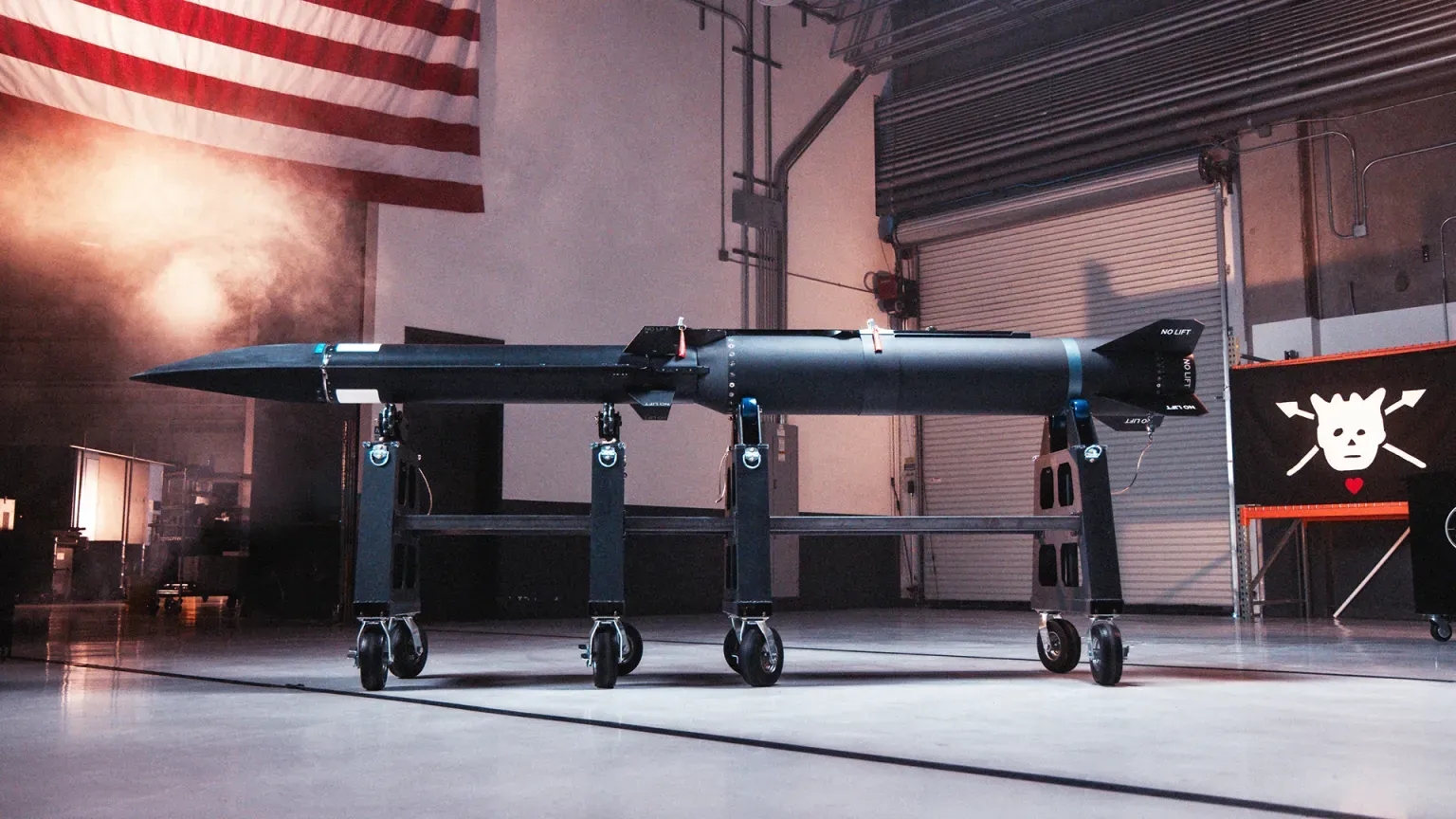
shown

New Cruise Missile-Armed MV-75 Tiltrotor Concept For The Marines Shown Off

Bell has put forward a new concept for a next-generation tiltrotor aircraft armed with anti-ship cruise missiles and other munitions for the U.S. Marine Corps. The design is based on what has been newly named the MV-75A Cheyenne II, which is in development for the U.S. Army. This comes as the Corps has said “everything is on the table” as it starts to formulate a new vision for what will succeed its AH-1Z Viper and UH-1Y Venom helicopters.

A model of the new armed MV-75 concept for the Marines is currently on display at the annual Modern Day Marine conference in Washington, D.C., at which TWZ is in attendance. It is painted in the markings of Marine Light Attack Helicopter Squadron 267 (HMLA-267), a unit currently equipped with AH-1Z and UH-1Y helicopters, which perform attack and armed utility mission sets, respectively.

Another view of Bell’s new MV-75 concept model at this year’s Modern Day Marine. Eric Tegler

The model’s most immediately eye-catching details are its armament. This includes two stub wings, each with a single pylon, mounted on either side of the top of the forward fuselage, situated between the main wing and the cockpit. A Naval Strike Missile (NSM), a stealthy anti-ship cruise missile with secondary land capability, is loaded on the left side. The Marine Corps is already fielding NSM in a ground-launched configuration. The missile is also in U.S. Navy service as a sea-launched weapon, as it was originally designed.

A close-up look at the NSM on the MV-75 model at the 2026 Modern Day Marine exposition, at left, and a full-size model of the NSM on display at a previous trade show. Eric Tegler / Joseph Trevithick

On the right side of the model, there is a pair of missiles, which are intended to reflect the Marine Corps’ forthcoming Precision Attack Strike Munition (PASM) capability. PASM is a version of L3Harris’ Red Wolf, a small, lower-cost cruise missile that you can read more about here.

A close-up look at the missiles on the stub wing on the right side of the model. Phil Hladky

It is interesting to note that the missiles on the model also look similar in broad strokes to Lockheed Martin’s Common Multi-Mission Trucks (CMMT, pronounced ‘comet’). Red Wolf and CMMT are just a few examples of a growing field of missile-shaped ‘air vehicles,’ many of which can be readily reconfigurable to perform a host of different tasks, including acting as a kinetic munition, an expendable electronic warfare system, or a decoy. Designs in this general category increasingly blur the line between uncrewed aerial systems, especially longer-range kamikaze drones, and traditional cruise missiles.

The stub wings could be used to carry other stores, such as AGM-114 Hellfire missiles or Advanced Precision Kill Weapon System II (APKWS II) laser-guided rockets, per Bell.

Two additional launchers are attached to the sides of each of the main landing gear sponsons. These are intended to depict launch tubes for the ALTIUS-700M loitering munition or something similar, according to Bell. This is a general category of uncrewed systems now commonly referred to as launched effects. There are also five apertures on either side of the fuselage through which additional munitions or drones could be fired via Common Launch Tube (CLT).

A look at the launchers attached to the right side main landing gear sponson. A row of apertures is also visible on the side of the fuselage. Eric Tegler

“There are some restrictions of [sic] where you can place them [launchers and/or pylons for munitions and other stores], because anything that’s forward firing would need to have the clearance to get past the [rotor] tip path plane and [have] it fit inside the fuselage,” Bill Hendricks, Senior Strategy Manager at Bell, told our Eric Tegler on the show floor at Modern Day Marine. “Our assumption is that, should the Marine Corps pursue something like this, they would want to be able to employ ordnance while in airplane mode with the nacelles forward. So the weapons that we have currently on that conceptual model would be something that you could fire in airplane mode.”

The design also has a three-barrel Gatling-type cannon or machine gun in a turret under the nose. What is depicted is in line with the M197 20mm Gatling-type cannon found on Marine AH-1Zs today. An improved, lightweight evolution of that cannon, the XM915, was also expected to arm the Army’s now-canceled Future Armed Reconnaissance Aircraft (FARA).

The video below shows a live-fire flight test of the XM915 mounted on a UH-60 Black Hawk helicopter.

XM915 20mm firing thumbnail

XM915 20mm firing


The model of MV-75 derivative for the Marines also has a sensor turret in the nose with a pair of large apertures in front, which typically reflect electro-optical and/or infrared video cameras inside. It has a retractable in-flight refueling probe, as well. The Army’s plans for in-flight refueling capability for the Cheyenne II are evolving. This is also a feature expected to be found on a special operations version of the MV-75.

A close-up look at the nose-end of the model showing the gun, in-flight refueling probe, and sensor turret. Phil Hladky

Compared to the AH-1Z and UH-1Y, with this tiltrotor design, “now you have additional range, you have additional speed, more operational flexibility, you can cover more area with one platform,” Bell’s Hendricks highlighted at the Modern Day Marine show.

“If that was something that we were asked to look at, then we can certainly explore that,” he added when asked about the possibility of extra fuel carried externally for even greater reach. “That’s not something that we’ve looked at with that conceptual design, because an MV-75 variant in that configuration with internal fuel would still have a range, after a short takeoff or a running takeoff, in excess of 1,000 nautical miles.”

As a single replacement for the AH-1Z and UH-1Y, an armed MV-75 derivative would come in a larger and more expensive package, which would present additional tradeoffs for the Marines to consider. As an aside, the service is also now in the process of charting a separate course to a replacement for the MV-22 Osprey.

A U.S. Marine Corps AH-1Z Viper attack helicopter, in front, flies together with a UH-1Y Venom armed utility helicopter, at rear. USMC

As noted, the Marine Corps has now begun to lay out a new vision for what will succeed its AH-1Z and UH-1Y helicopters. The service has previously told TWZ that this effort, currently known as Future Attack Strike (FASt), will also help fill certain capability gaps created by the retirement of the AV-8B Harrier jump jet and legacy F/A-18C/D Hornet fighters. The Marines have long said the main replacements for the AV-8Bs and F/A-18C/Ds will be variants of the F-35 Joint Strike Fighter.

“So, right now, for FASt, everything is on the table. Manned, unmanned, optionally-piloted, I think, are good avenues to take a look at. Conventional rotary-wing, tiltrotor. Maybe there’s something else out there,” Col. Scott Shadforth said in response to a question, also from Eric Tegler, while speaking today at Modern Day Marine. “There is no steadfast, solid response to that.”

Shadforth is currently Director of the Expeditionary Maritime Aviation-Advanced Development Team (XMA-ADT) within Naval Air Systems Command (NAVAIR). XMA-ADT focused on rapid prototyping and experimentation to help refine future Marine Corps aviation requirements in cooperation with the Navy.

“So, as we look at unmanned, manned-unmanned teaming, air-launched effects, all the capabilities to help extend the range of various assault support or attack type platforms, all of those are on the table for consideration by the Marine Corps at this time,” he added.

Another view of the MV-75 concept model at Modern Day Marine 2026. Eric Tegler

In the meantime, the Marines are notably working to integrate a standoff strike capability onto the AH-1Z through the aforementioned PASM, which will open up significant new operational possibilities. The service has also been looking at ways to expand the roles and missions of the UH-1Y, to include anti-submarine warfare capability and acting as an airborne drone controller.

It is important to note that this is not the first time Bell has shown models and renderings of armed variations of this design, originally branded as the V-280 Valor, that could perform sea control and other maritime mission sets. This has included versions with internal bays, as well as pylons under the wings and ones mounted on the sides of the rear end of the fuselage.

From ‘Hook: Bell showed this seriously armed variant of its MV-75/FLRAA it is offering for the USMC’s AURA, and reminding the Navy of its paid-for engineering for FVL-MS pic.twitter.com/fs9r2m7IxT

— Brian Everstine (@beverstine) August 25, 2025

Previous navalized concepts have also included folding main wings and rotors, similar in form and function to those features on the V-22 Osprey tiltrotor, to help reduce the aircraft’s physical footprint when operating from ships. Bell has said previously that the ‘stowed’ configuration of the V-280 could be small enough to fit inside the hangars on Arleigh Burke class destroyers, as well as those on larger naval vessels.

A rendering of V-280-based naval tiltrotors on the stern flight deck of an Arleigh Burke class destroyer. Bell

Bell has also pitched navalized V-280/MV-75 designs in the past, paired together with its uncrewed V-247 Vigilant tiltrotor drone. This has included previous proposals specifically aimed at meeting future Marine Corps aviation requirements, which have evolved significantly in recent years.

V-280 and V-247-based designs depicted operating from an amphibious assault ship. Bell
A rendering of a V-247 carrying a pair of Joint Strike Missiles (JSM), a design derived from the NSM. Bell

“I can see conceptually, where the Navy could, if this is what they wanted, adopt like this to [meet] their sea control, or ASW [anti-submarine warfare], or ASuW [anti-surface warfare] mission set [sic], because of the additional range that it gives you,” Bell’s Hendricks said when asked about whether this concept could also be relevant to that service’s needs. “It would outperform the speed and range of an H-60, and so that would give them more operational reach.”

In recent years, the Navy has been exploring options for replacements for its MH-60R and MH-60S Seahawk helicopters, as well as its MQ-8C Fire Scout drone helicopters. However, at least in the near term, the service seems to be leaning more toward a major evolution of the Seahawk platform rather than an entirely new platform.

The Marine Corps has made clear that all options are currently on the table, including a tiltrotor like Bell’s MV-75 or a derivative thereof, as the service works to firm up requirements for a replacement for its AH-1Z and UH-1Y helicopters.

Eric Tegler and Phil Hladky contributed to this story.

Contact the author: joe@twz.com

Joseph has been a member of The War Zone team since early 2017. Prior to that, he was an Associate Editor at War Is Boring, and his byline has appeared in other publications, including Small Arms Review, Small Arms Defense Journal, Reuters, We Are the Mighty, and Task & Purpose.


Source link

The Testaments is the most radical TV show of 2026 and should be shown in schools

The sequel to The Handmaid’s Tale focuses on the young teens of Gilead

The Testaments teased in trailer from Disney+

The Testaments couldn’t have come at a more depressingly relevant time given the state of the world.

From the reversal of the historic Roe vs Wade ruling in America, to the erosion of women’s bodily autonomy across the world, to Incel culture via Andrew Tate and the Manosphere, to the continuing unfolding horrors emerging from the Epstein Files, being a woman in 2026 has never been a more frightening prospect.

That’s why I believe Disney+ and Hulu drama The Testaments should be compulsory viewing in all schools and serves as a warning that if we don’t try to change things now, all hope could be lost forever.

The series is adapted from Canadian author Margaret Atwood’s Booker Prize-winning 2019 novel The Testaments, which itself was a sequel to her seminal 1985 classic The Handmaid’s Tale.

The follow-up novel came about thanks to the success of Hulu’s adaptation of The Handmaid’s Tale starring Mad Men’s Elisabeth Moss in the title role. The original series first hit screens in 2017 – not long after Brexit and newly elected President Trump’s first term in office – and instantly captured the zeitgeist thanks to its dystopian, Black Mirror take on the world.

Get Disney+ for £5.99

This article contains affiliate links, we will receive a commission on any sales we generate from it. Learn more
Content Image

£5.99

Disney+

Get Disney+ here

A Disney+ subscription now starts at £5.99 and includes hit series like The Testaments, The Handmaid’s Tale and The Bear, plus countless titles from Marvel, Star Wars, Pixar and more.

Atwood has previously said how The Handmaid’s Tale was originally based on things that had already happened across history and were still happening, however, since she published her novel over 40 years ago, it appears those times have become a disturbing and tangible new reality for us.

The Testaments TV show follows a group of teenage girls from the upper echelons of Gilead society preparing to become Wives to Commanders, many of whom are much older than them. Their destined husbands are determined by the Aunts in a series of arranged marriages to ensure there isn’t any accidental incest, given the use of Handmaids and babies getting handed over to Gilead’s finest families.

The girls known as ‘Plums’ – thanks to the Cadbury shade of purple they wear – are forbidden from reading or writing at the risk of losing a finger; their sex education is non-existent; they witness Gilead’s harsh brand of Old Testament justice; and they are constantly warned not to tempt men, who apparently can’t control their urges.

Amid the Plums is Pearl Girl Daisy (played by Lucy Halliday), a Canadian teen from Toronto posing as a Gilead convert after she’s sent into Gilead by the resistance movement Mayday. Street-wise and sex-savvy, Daisy serves as the audience’s perspective in the show as she challenges the Plums in the face of the regime’s fallacies.

While the drama isn’t as dark as its predecessor, The Testaments delves into issues of consent and sexual abuse in a more age-appropriate way. The Testaments shows why we all need to be educated about sex and making informed choices about our bodies.

The Testaments is also one of the few shows to feature periods and menstruation so prominently. Gilead celebrates menstruation as a sign of fertility to the point that the Plums ring a bell heralding the news and then embark on a catwalk of sorts while their fellow pupils cheer them on. Not since reading Judy Blume have I seen so much discussed about periods, if only there were more positive depictions of period in media.

Sadly, it’s a double-edged sword for the girls as it means it’s now time for them to find a husband as they essentially become child brides. Again, this complexity is intriguing and one that feeds into grooming teens – the way the Commanders eye up Agnes MacKenzie (Chase Infiniti) as a potential bride-to-be when she greets her father during a meeting is chilling.

But amid all the bleak dystopian misogyny, hope springs: Daisy is trying to stoke a fire from within Gilead and give the Plums agency. It’s this message that’s so important: you may be a teenage girl but you still have the power to shape the world and make your voice heard.

I’ve always believed that TV has the power to change things for the better in this world. If you can see it, then you can be it. Whether it’s onscreen representation from the likes of Netflix’s Heartstopper depicting blossoming queer love, to soaps brilliantly covering a myriad of topics from domestic violence and stillbirth, to Adolescence, which led to discussions in Parliament about male radicalisation. Meanwhile, a whole generation of women pursued STEM careers thanks to Gillian Anderson’s iconic performance as medical doctor and scientist, FBI agent Dana Scully in The X-Files.

If The Handmaid’s Tale was sounding the alarm for my generation, then The Testaments is the wake-up call for this generation. The future of the world is in your hands, and you have the chance to change it right now.

The Testaments airs weekly on Hulu and Disney+ on Wednesdays

Source link