Michael Conlan began his professional boxing career with great fanfare and an ambition to become a multi-weight champion, but despite going close, he was unable to replicate his success as an amateur.
The 34-year-old called time on his career following Friday’s defeat to Kevin Walsh in Belfast when his last roll of the dice to get back into title contention unravelled.
A polarising figure, Conlan could sell out arenas and outdoor venues to the tune of 12,000, while eliciting the ire of others in his home town.
What could not be disputed was he talent inside the ring, with his silky switch-hitting skills bringing his from the streets of west Belfast to the top of the amateur game and within a whisker as a pro.
“I didn’t think I lost tonight but it was too close for my liking and no matter how I would lose, no matter if it’s a robbery, I said that would be my time,” Conlan told reporters in his dressing room after his defeat to Walsh.
“It’s all very raw at the minute and how I’m answering questions is all emotion.
“How light I feel at the minute is probably relief. I’ve had so much pressure on my, so many expectations, even my own.
“I’ve not achieved what I wanted to but I said when I came back into it [in 2025] it would be if I achieve it, then great but if I don’t then so be it. This is the so be it situation and now I can spend time with my family.”
Having followed his brothers into the boxing gym as a seven year old, Conlan would blossom into one of, if not the best Irish male amateurs.
Collecting Antrim, Ulster and Irish titles as a junior, his first major international senior competition came at 2010 Commonwealth Games in Delhi, where, as a 17-year-old, he came unstuck against Australia’s Jason Moloney.
It was just the beginning as the following year, he won the first of five Irish Elite titles which earned him a place on the team for the World Championships in Baku, reaching the quarter-finals which earned a place at the 2012 Olympic Games in London.
There, he made the big breakthrough, reaching the semi-finals where he lost to Cuba’s Robeisy Ramirez but returned with a bronze medal to great acclaim.
Victor Wembanyama had 21 points and 13 rebounds and the San Antonio Spurs overcame an early 14-point deficit before blowing most of a 24-point lead and recovering to hold off the Clippers 119-115 on Monday night at Intuit Dome.
Stephon Castle had 23 points, eight assists and seven rebounds to lead the Spurs (50-18), who reached 50 wins for the first time since 2016-17 and trail the first-place Thunder by three games in the West. Devin Vassell added 20 points.
Fighting to secure a spot for the play-in tournament, the Clippers’ second straight loss dropped them back to .500 with Kawhi Leonard watching from the bench. The NBA’s sixth-leading scorer sat out with a sprained left knee.
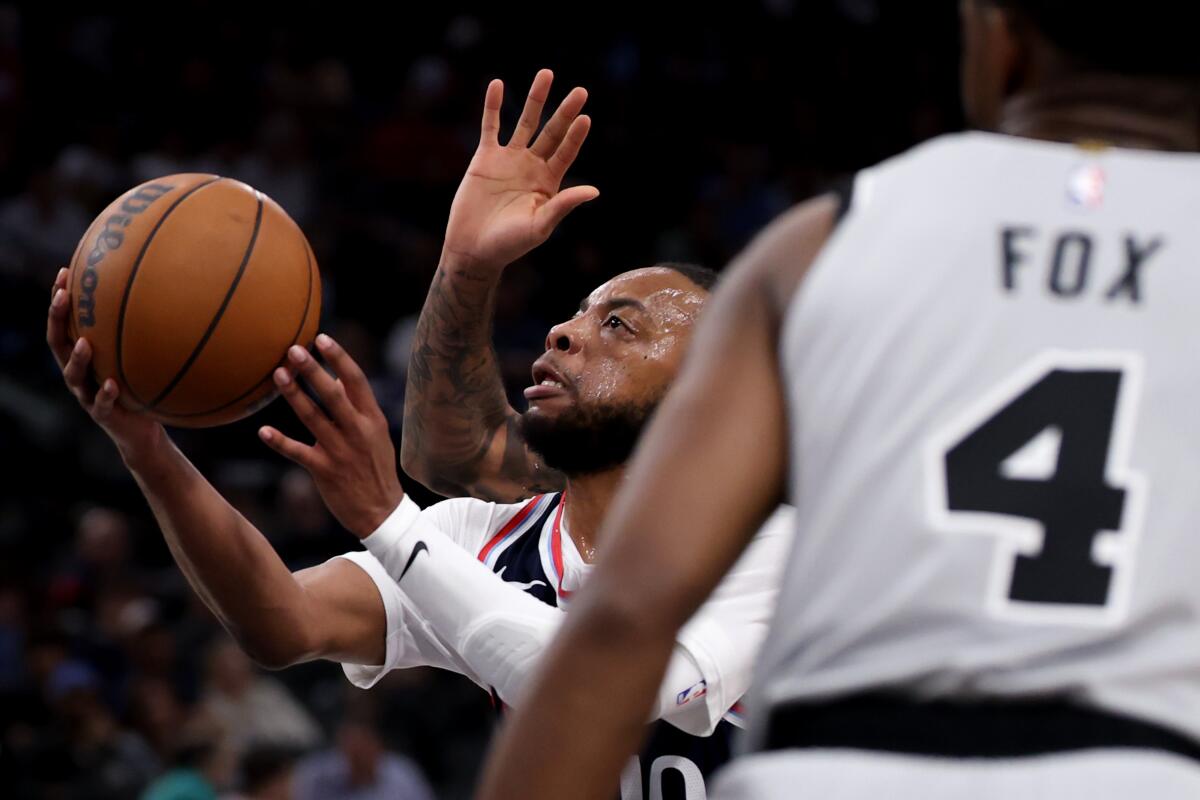
Darius Garland drives to the basket against De’Aaron Fox and Victor Wembanyama of the Spurs in the second half.
(Eric Thayer/Los Angeles Times)
Darius Garland led six Clippers in double figures with 25 points and 10 assists. Jordan Miller had 22 points off the bench, which outscored the Spurs’ reserves 57-30.
After the Spurs ran off seven in a row to lead 115-102, Garland scored seven of the Clippers’ nine points to get within four with 38 seconds remaining. But the Spurs made four straight free throws to preserve the win.
The Spurs led by 24 points in the third before the Clippers closed with a 16-3 run to trail by 10 going into the fourth.
The Spurs started slowly, missing eight of their first nine shots, while the Clippers surged to a 17-3 lead. They shot 65% from the floor in the opening quarter, hit five of seven three-pointers and made 10 of 12 free throws.
San Antonio turned things around in the second. The Spurs erased all of their 14-point deficit, helped by 15 straight points over the end of the first and start of the second. In the period, they outscored the Clippers 37-15 to lead 66-52 at halftime.
Weekly insights and analysis on the latest developments in military technology, strategy, and foreign policy.
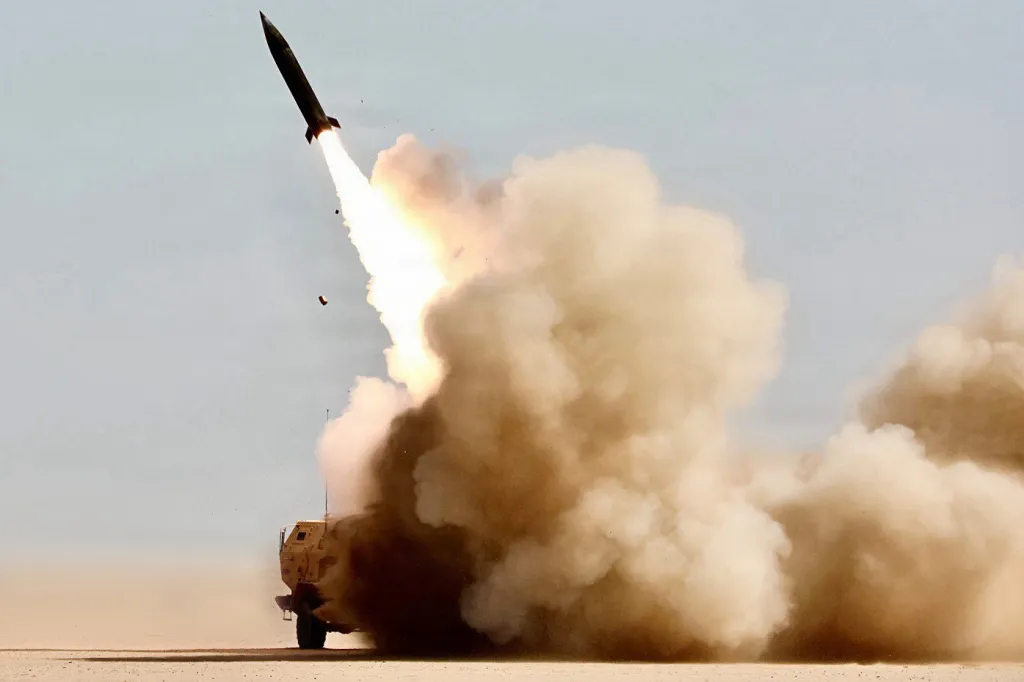
A submarine is among the Iranian naval vessels that U.S. forces have struck with Army Tactical Missile System (ATACMS) short-range ballistic missiles. ATACMS cannot hit moving targets, so the submarine would have had to have been stationary in port when struck. TWZ was first to report earlier this week that M142 High Mobility Artillery Rocket System (HIMARS) launchers firing ATACMS, as well as Precision Strike Missile (PrSM) short-range ballistic missiles, had been aiding in the destruction of Iran’s Navy as part of Operation Epic Fury. The conflict has also marked the first combat use of PrSM, which brings a major boost in range over ATACMS.
Chairman of the Joint Chiefs of Staff U.S. Air Force Gen. Dan “Razin” Caine put a particular spotlight on the contributions of field artillery units in current operations against Iran at a press conference at the Pentagon this morning.
A M142 HIMARS launcher fires a PrSM short-range ballistic missile in support of Operation Epic Fury. CENTCOM
“Today, I’m going to talk about our incredible artillery force, comprised of American soldiers and Marines who’ve been sinking ships, [and] destroying depots,” Caine said. “Our Army and Marine artillerymen are hitting sites that Iran relies on to project power beyond their borders and protect our deployed [forces].”
“In just the first 13 days of this operation, our artillery forces have made history. They fired the first Precision Strike Missiles ever used in combat, reaching deep into enemy territory,” the Chairman continued. He also said that soldiers from the Army’s 3rd Battalion, 27th Field Artillery, part of the 18th Field Artillery Brigade based at Fort Bragg, North Carolina, were the ones to fire the first PrSMs against targets in Iran.
In a historic first, long-range Precision Strike Missiles (PrSMs) were used in combat during Operation Epic Fury, providing an unrivaled deep strike capability.
“I just could not be prouder of our men and women in uniform leveraging innovation to create dilemmas for the enemy.”… pic.twitter.com/bydvIv5Tn5
“They used Army ATACMS to sink multiple ships, including a submarine,” Caine added. “And they’ve done all of this with the precision and determination that comes from relentless training and trust in each other and in their weapon systems.”
“We’ve rendered the Iranian Navy combat ineffective,” but “continue to attack naval vessels,” Caine also said, speaking generally.
Caine did not name the Iranian submarine that was destroyed using ATACMS, nor did he say what class it was. TWZ has reached out for more information. There is no known operational version of ATACMS capable of hitting moving targets, so, as already noted, the missile would also have had to have been employed against a submarine in port or one that was otherwise stationary.
A review of satellite imagery in Planet Labs’ archive does show one of Iran’s three Russian-made Kilo class diesel-electric submarines sunk at Bandar Abbas as of March 4. The submarine had looked to be untouched in an earlier Planet Labs image taken on March 2 in the aftermath of a wave of strikes, as TWZ previously reported. Bandar Abbas is the Iranian Navy’s main base and occupies a particularly strategic position along the Strait of Hormuz.
In a video address on March 5, U.S. Navy Adm. Brad Cooper, head of U.S. Central Command (CENTCOM), had also said that “the most operational Iranian submarine … now has a hole in its side.” What submarine Cooper was referring to here remains unclear, but it may have been the Kilo class submarine struck at Bandar Abbas. At that time, his comments were also taken by many to be a reference to the IRIS Fateh, a domestically-produced diesel-electric coastal attack submarine that entered Iranian service in 2019. The fate of that boat remains unconfirmed.
The IRIS Fateh seen ahead of its launch in 2019. IRNA
On March 10, CENTCOM released the video seen below, showing strikes on various Iranian vessels at sea and in port, including what looks to be a Ghadir class diesel-electric midget submarine. That boat was struck by an AGM-114 Hellfire missile, a U.S. official told TWZ. How many Ghadir class submarines were in Iran’s inventory before the current conflict is not clear, but prior estimates had generally put the size of that fleet at between 16 and 20 hulls.
U.S. forces are degrading the Iranian regime’s ability to project power at sea and harass international shipping. For years, Iranian forces have threatened freedom of navigation in waters essential to American, regional and global security and prosperity. pic.twitter.com/gIBN02mowh
Regardless, it makes good sense that the U.S. military would focus on neutralizing Iran’s submarine force, and doing so in port if possible, as part of the larger objective of neutering the country’s naval capabilities. Finding, fixing, and engaging submerged submarines, even older and louder designs, can take significant time and effort, as you can read about in more detail in this past TWZ feature. Iranian submarines could have been used to discreetly lay mines, as well as to attempt attacks on friendly warships or commercial vessels. As it stands now, maritime traffic in and out of the Persian Gulf through the Strait of Hormuz has still ground to a virtual halt over concerns about mines and other remaining Iranian threats, which is already having global ramifications.
Chairman Caine’s comments today also reinforce the role that ATACMS and PrSM have been playing in the current conflict, in general. TWZ previously noted that this is a preview of what one would expect to see from U.S. forces in other future conflicts, especially when it comes to using ballistic missiles in the anti-ship role as part of a high-end fight with China in the Pacific. PrSM, which only began entering service in the past two years or so, offers significantly greater reach than ATACMS, allowing it to hold a much broader swath of territory at risk from any launch position.
Just yesterday, Lockheed Martin also announced the first test launch of a full-up Increment 2 PrSM, an anti-ship optimized version in development now. In that test, a HIMARS launcher fired the Increment 2 missile, which flew out to a range of around 217 and a half miles (350 kilometers), according to a company press release. The Increment 2 PrSM features an additional multi-mode seeker specifically designed to allow it to engage moving targets at sea. Lockheed Martin also released the rendering below as part of its announcement yesterday, which looks to show apertures for the seeker system around the nose.
Lockheed Martin released this rendering along with its announcement about the successful PrSM Increment 2 test launch. Lockheed Martin
Questions do remain about the anti-ship and/or moving target capabilities that might be found on baseline Increment 1 PrSMs. A pair of “early operational capability” PrSMs – a term generally understood to refer to Increment 1 missiles – were fired at what was described as a moving maritime target during a test in the Pacific back in 2024.
In the meantime, the older ATACMS, which PrSM is set to eventually replace, has now scored a hit against an enemy submarine, albeit one not on the move.
Dozens of civilians, including children, wounded by an Iranian drone strike in Bahrain. France deploying warships to secure shipping commerce in the Strait of Hormuz. Australia taking heat from President Trump over its handling of the Iranian women’s soccer team. Markets across Asia plunging as the price of oil surged.
Lebanon reporting half a million people displaced by fighting between Israel and Hezbollah. The U.S. State Department telling nonessential staff to get out of Saudi Arabia after attacks there killed workers from India and Bangladesh. Ukrainian anti-drone experts turning their attention from their war with Russia to help intercept Iranian attacks. The defense minister of ever-neutral Switzerland saying his country believes the U.S.-Israeli war violates international law.
In less than two weeks, the Trump administration has instigated a truly global conflict — and with no quick and clear path to resolution, despite Trump insisting to congressional Republicans gathered at his Miami resort Monday that it would be a “short term excursion.”
“Short term! Short term!” Trump said in a bullish speech about the conflict, in which he said “the world respects us right now more than they have ever respected us before.”
“We’re counting down the minutes until they will be gone,” he said of Iran’s remaining leadership, while adding that the U.S. “will not relent” until Iran is “totally and decisively defeated.”
The war is not isolated to Iran, though it has certainly caused devastation there — with more than 1,300 deaths reported and toxic clouds from strikes on fuel depots hovering over Tehran, a city of some 10 million people.
The war’s effects also are not limited to the Middle East, though they are widespread there — as Israel has pushed into Lebanon and Iran has launched a wave of retaliatory strikes on U.S. allies across the Persian Gulf. The fighting has grounded regional air traffic, threatened desalination facilities that provide drinking water to millions and undermined the safe reputation of modern metropolises such as Dubai and Abu Dhabi.
Unlike the recent U.S. incursion into Venezuela to capture and oust President Nicolás Maduro, the U.S. war on Iran has been met with stiff resistance militarily, drawn in a slew of allies, reignited proxy battles, drastically destabilized the oil trade and shifted dynamics between the U.S. and other major powers such as China and Russia.
China, which gets upward of 50% of its crude oil imports through the Strait of Hormuz, has largely stayed out of the conflict, though China’s Foreign Minister Wang Yi said Sunday that the war “should never have happened” and “benefited no one.”
Trump said Monday that the U.S. is less harmed by strait disruptions, and was “really helping China” by securing the strait.
Russia, meanwhile, has emerged the lone winner of energy disruptions in the region, said Robert David English, a UCLA international policy analyst — as the Trump administration considers reducing oil sanctions on Russia to take pressure off of Mideast sources.
Trump said he had a “good talk” with Russian President Vladimir Putin about Iran on Monday. He also said the U.S. was going to suspend sanctions against other countries in order to alleviate strain on oil markets while the Iran conflict persists, but did not provide specifics.
The scope of the war has been dictated in part by Iran, which has historically limited its responses to U.S. strikes but warned after the U.S. bombed its nuclear sites last summer that it would treat any new attacks — large or small — as an act of war, and respond in kind.
Its strikes on U.S. facilities and allies throughout the region reflect that strategy, and are aimed in part at making the war more politically costly for the U.S. by straining global markets and its regional allies, experts said.
However, “you can’t attribute the increasingly global characteristics of the conflict solely to an Iranian strategy, because wars in this region tend to spill over the longer they last, with unintended consequences” including “bringing in all kinds of actors that don’t want to be involved,” said Kevan Harris, an associate professor of sociology who teaches courses on Iran and Middle East politics at the UCLA International Institute.
That can serve as a deterrent to starting wars in the region, he said, but “also makes them more difficult to wind down.”
The surge in oil prices to nearly $120 a barrel Monday — before a remarkable reversal to below $90 by the time U.S. stocks closed — is one of the furthest-reaching effects of the war, and one that clearly had Trump’s attention.
“Short term oil prices, which will drop rapidly when the destruction of the Iran nuclear threat is over, is a very small price to pay for U.S.A., and World, Safety and Peace. ONLY FOOLS WOULD THINK DIFFERENTLY!” Trump wrote on social media Sunday.
How long prices will remain elevated or volatile is a matter of debate, but Trump’s “short term” projections have been undercut by increasing strikes on oil and gas facilities in the region.
“If you can tolerate oil at more than $200 per barrel, continue this game,” Ebrahim Zolfaghari, a spokesperson for Iran’s Islamic Revolutionary Guard Corps, said Sunday.
Prices at the pump have surged for average Americans, some of whom were attracted to Trump’s candidacy because of his promises to avoid foreign wars and focus on driving down the cost of living for U.S. citizens.
Now, Trump and other administration officials are facing questions about their own role in putting the world at war, and offering various different justifications. They’ve asserted without proof that the U.S. faced an imminent threat of attack from Iran. Trump has repeatedly hinted that his goal was removing the government.
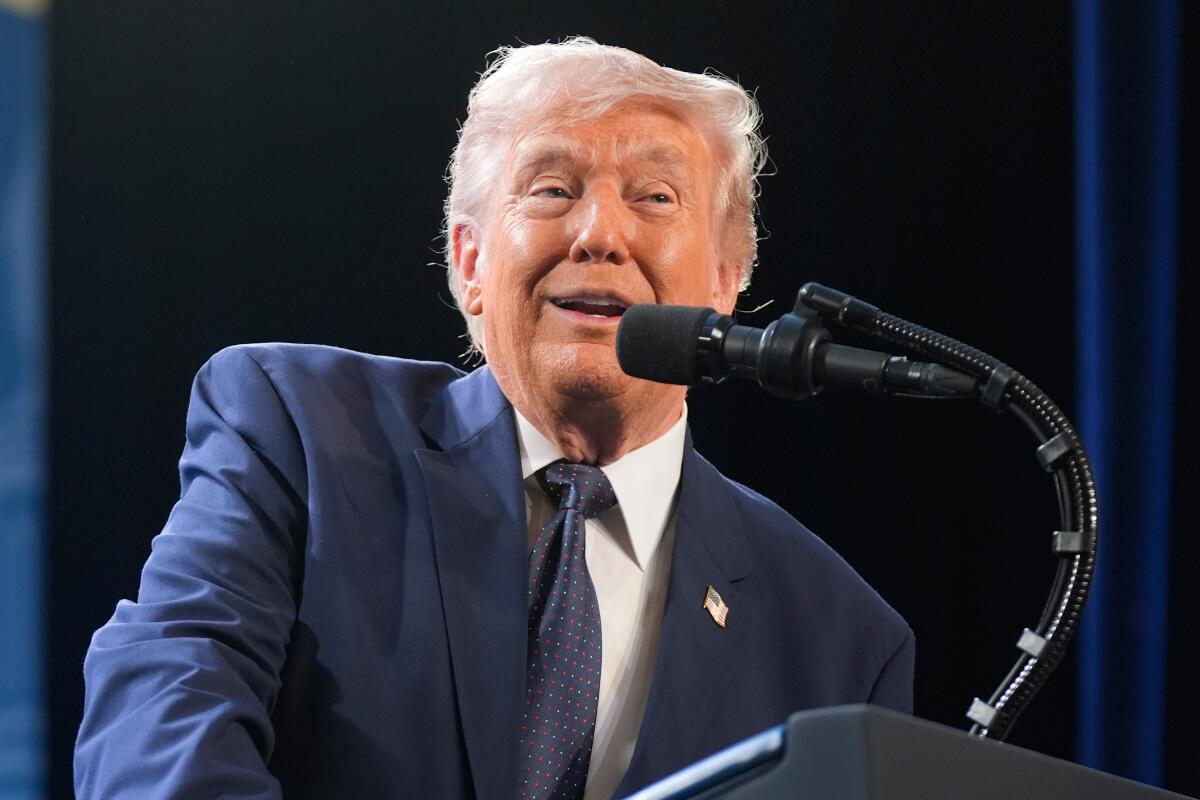
President Trump speaks at the Republican Members Issues Conference on Monday at Trump National Doral Miami in Doral, Fla.
(Mark Schiefelbein / Associated Press)
In the meantime, Iran has shown no signs of bowing to Trump, rejecting his calls for “surrender” and for him to have a say in naming their next leader. Iran installed Mojtaba Khamenei after Trump said the hard-liner son of the late Ayatollah Ali Khamenei would be “unacceptable.”
The choice was hailed by the president of Azerbaijan and the leader of Yemen’s Houthi rebels, among other allies.
To date, seven U.S. service members have been killed in the conflict, according to U.S. officials. Every day, U.S. taxpayers are on the hook for nearly $1 billion in war costs, according to one estimate. Democrats have slammed Trump for both.
“This war is coming from the same President that is building a $400 million ballroom in the White House. The same President that says $100 for a barrel for oil is worth it. The same President that doubled healthcare premiums for millions of Americans. But we have money for another endless war?” Sen. Alex Padilla (D-Calif.) wrote Monday on X.
Other world leaders focused on the global economic impact.
Traffic through the Strait of Hormuz, which transports about 20% of the world’s oil, has nearly halted, while producers in Saudi Arabia, Iraq, Kuwait and the United Arab Emirates ceased oil operations without open routes for export.
In response, French President Emmanuel Macron suggested French and other allied naval assets could escort oil tankers in the strait, shifting the security burden there from Washington onto Europe, leaving European vessels vulnerable to hostilities and potentially drawing the European Union deeper into the conflict.
Already, they’ve agreed to allow the U.S. to use bases in their territories, though the U.S. and Spain got into a spat after Spain rejected U.S. use of its bases and Trump threatened U.S. trade with the country.
Macron on Monday also threw additional military support behind Cyprus, following a meeting with Cypriot President Nikos Christodoulides and Greek Prime Minister Kyriakos Mitsotakis at a Cyprus air base.
France will dispatch an additional 11 warships to operate across the eastern Mediterranean, the Red Sea and the Strait of Hormuz, Macron said, after an Iranian drone struck a British military base on Cyprus on Monday.
“When Cyprus is attacked, it is Europe that is attacked,” Macron said.
Located just 150 miles from Israel in the eastern Mediterranean, the island of Cyprus has emerged as a strategic — and exposed — nerve center in the U.S. offensive against Iran. It hosts vital British military bases and acts as an intelligence, surveillance, and logistics hub in countering Iranian influence and proxy attacks.
Britain’s Defense Secretary John Healey said Monday that the United Kingdom was conducting air defense to support the UAE, and that Typhoon jets had taken out two drones — one over Jordan and the other headed to Bahrain.
Trump suggested Monday that the U.S. was on the path toward victory, but acknowledged it had not accomplished all of its goals.
“We’ve already won in many ways, but we haven’t won enough,” he said — adding the conflict will end “pretty quickly.”
He said Iran had been “very foolish, very stupid” when it attacked its neighbors, hurting its own chances of success in resisting the U.S.
“Their neighbors were largely neutral, or at least weren’t gonna be involved, and they got attacked,” Trump said. “And it had the reverse effect. The neighbors came onto our side, and started attacking them.”
Iran may still attempt to widen the conflict’s economic and geopolitical impact to keep up pressure and push for a ceasefire in its favor, but that could also backfire, said Benjamin Radd, a political scientist and senior fellow at the UCLA Burkle Center for International Relations.
“Iran’s becoming increasingly like North Korea in this sense,” he said, “isolating itself further.”
A CONCACAF source with knowledge of the issue not authorized to discuss it publicly said the organization was aware of the problem and working with the team to appeal the decision. The Champions Cup is the most prestigious club tournament in CONCACAF, the 41-nation FIFA confederation that governs soccer in North America, Central America and the Caribbean.
Mount Pleasant FA, champion of last year’s CONCACAF Caribbean Cup and runner-up in the last two Jamaican Premier League tournaments, is playing in the Champions Cup for the first time. The team has six Haitian players on its roster, and Haiti is one of 19 countries whose citizens have been banned from entering the U.S by the Trump administration. Citizens from an additional 20 countries faced partial restrictions.
“This decision raises serious concern about the administration’s willingness to abide by its own agreement and statements regarding the issuance of visas for the World Cup,” said David J. Bier, director of immigration studies at the Cato Institute. “The President’s proclamation clearly exempts athletes and necessary support personnel for ‘major sporting events.’ But apparently, this exception is not being applied in all cases.”
The State Department has the ability, under the Presidential Proclamation exception, to grant entry to “athletes, coaches and essential support staff” from any country traveling to the U.S. for “the World Cup, Olympics or other major sporting event as determined by the secretary of state.”
Despite that, eight members of Cuba’s delegation to the World Baseball Classic — among them federation president Juan Reinaldo Pérez Pardo and pitching coach Pedro Luis Lazo — had their visa requests denied. Under the Trump administration’s rules, Cuban citizens are subject to the same travel restrictions as Haitians.
However, Haiti and Jamaica were able to play in last summer’s Gold Cup soccer tournament in the U.S. without issue. The State Department did not respond to requests for comment.
The CONCACAF source said the confederation hopes to reach an agreement with the State Department but added that Mount Pleasant’s game with the Galaxy will go forward either way. The club, which is scheduled to depart Sunday, told a Jamaican newspaper that up to 10 players have been denied visas and coming to Los Angeles without them would require it to rely on seven or eight players from the team’s youth academy to fill out the roster.
“We don’t want to just show up for the game, we want to be able to compete, but we are not being given the opportunity to be at our best,” Paul Christie, the team’s sporting director, told the Jamaica Observer.
The teams will meet in the second and deciding leg of the two-game playoff March 19 at National Stadium in Kingston, Jamaica. Mount Pleasant is expected to be at full strength for that game.
The State Department’s approach to the visa requests for the Cuban baseball delegation and Jamaican soccer team raise questions about how the Trump administration will handle visa requests ahead of this summer’s World Cup. Four tournament qualifiers are impacted by the administration’s travel restrictions, with citizens of Iran — a country with which the U.S. is at war — and Haiti facing a total ban, and those from Senegal and Ivory Coast subject to severe restrictions.
Members of Iran’s delegation were refused entry to the U.S. for December’s World Cup draw in Washington, during which FIFA president Gianni Infantino presented President Trump with the FIFA Peace Prize. And last summer, Senegal’s women’s basketball team was forced to cancel a 10-day training camp in the U.S. when visa requests for five players, six staff members and a ministerial delegation were rejected.
Devon Toews scored the tiebreaking goal late in the third period, Martin Necas added an empty-netter to go with two assists, and the Colorado Avalanche defeated the Kings 4-2 on Monday night.
Toews got free in the slot and converted Nathan MacKinnon’s pass with 4:55 remaining to help the Avalanche (40-10-9) become the first NHL team with 40 wins this season.
MacKinnon and Gabriel Landeskog each had a goal and an assist. Mackenzie Blackwood made 19 saves for Colorado, which has won five of seven.
Brandt Clarke had a power-play goal, Angus Booth scored in his NHL debut, and Anton Forsberg made 35 saves for the Kings, who were playing their first game since firing coach Jim Hiller on Sunday and replacing him on an interim basis with D.J. Smith.
The Kings were also missing seven key players because of injury or illness, including medalists from the Olympic hockey tournament at the Milan-Cortina Games in defenseman Drew Doughty, forwards Joel Armia and Quinton Byfield and goalie Darcy Kuemper. Those absences led to the Kings giving three players their NHL debuts in Booth, center Kenny Connors and winger Jared Wright.
With Kuemper ill, the Kings also recalled Erik Portillo to back up Forsberg. Armia was placed on injured reserve before the game.
The Avalanche capitalized early, scoring twice in the opening 10:13 on one-timers from MacKinnon and Landeskog, before the Kings responded with a power-play goal from Clarke late in the first period.
An early whistle wiped out Necas putting in a rebound early in the second, and Booth got to the top of the crease to tip in Brian Dumoulin’s centering pass to tie it 2-all at 8:32.