shohei ohtani

Dodgers should have taken Shohei Ohtani off the postseason roster

The Dodgers never waver in their game plan for the regular season: win enough games to secure a bye in the opening round of the playoffs and, in so doing, afford players all the down time they need during the summer to be in top form come fall. They do not need to hurry anyone off the injured list so they can squeak out another National League West title.

Unfortunately for the Dodgers and their increasingly perilous hope of a three-peat, they did not follow that game plan with Shohei Ohtani. The Dodgers failed Ohtani this summer, and now all that remains is for them to cross their collective fingers and hope for the best.

Hope, as they say, is not a strategy.

The Dodgers should drop Ohtani from the postseason roster.

They won’t. They won’t even take him out of Wednesday’s lineup.

Amid headlines about how the Dodgers might have benched Ohtani for Game 3 of the NL Championship Series, manager Dave Roberts said the thinking was more about coupling Tuesday’s day off with a second consecutive day of rest.

“It was never a benching,” Roberts said.

Roberts drew a parallel between what might have happened with Ohtani and what did happen with Freddie Freeman during the NLCS two years ago, when the Dodgers provided what the manager called a “reset” — a day off for the team, followed by a rest day for Freeman.

“And he ends up winning the MVP in the World Series,” Roberts said.

Freeman had been playing with a bad ankle for three weeks, and even then he had been more productive that October than Ohtani has been in this one. Ohtani has been playing with a bad knee and biceps for three months, and the Dodgers already have tried intermittent rest.

They tried that in September, twice. They touted their bye week before the start of the playoffs. They talked up their three days off before the start of the NLCS.

They went 0 for 4. Enough already.

Roberts said the Dodgers — not just Ohtani, but the coaching staff and the training staff — see progress. True, no doubt. But we’ve heard similarly encouraging words after each of Ohtani’s rest breaks.

“We’re listening to Shohei, and we’re going to support the crap out of him and believe in him,” Roberts said, “and that’s it.”

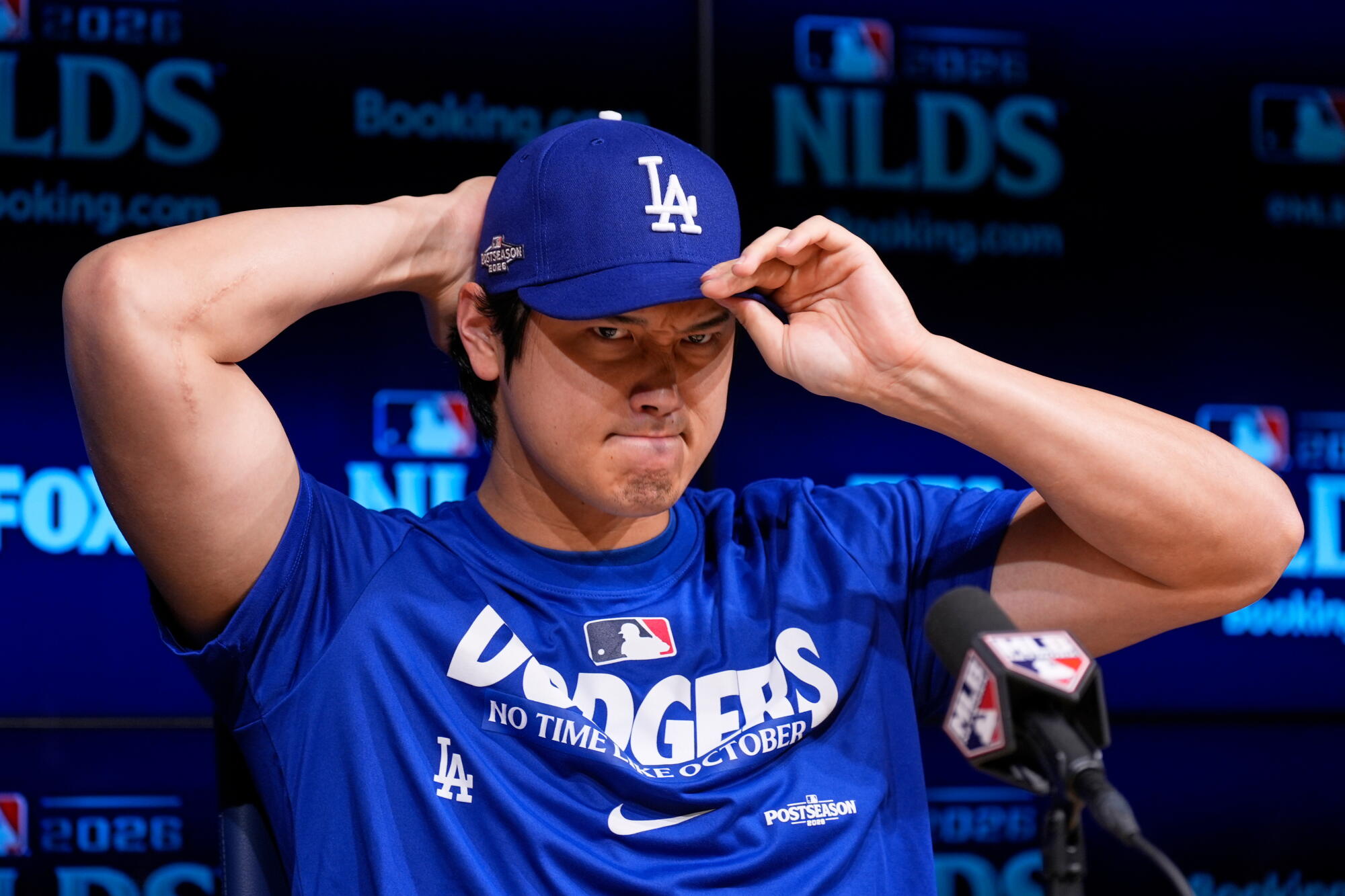
Ohtani said Tuesday that his symptoms have subsided since the Dodgers put him on the injured list, for the minimum stay. That was a month ago.

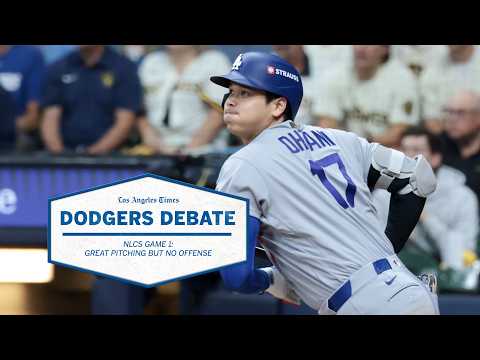
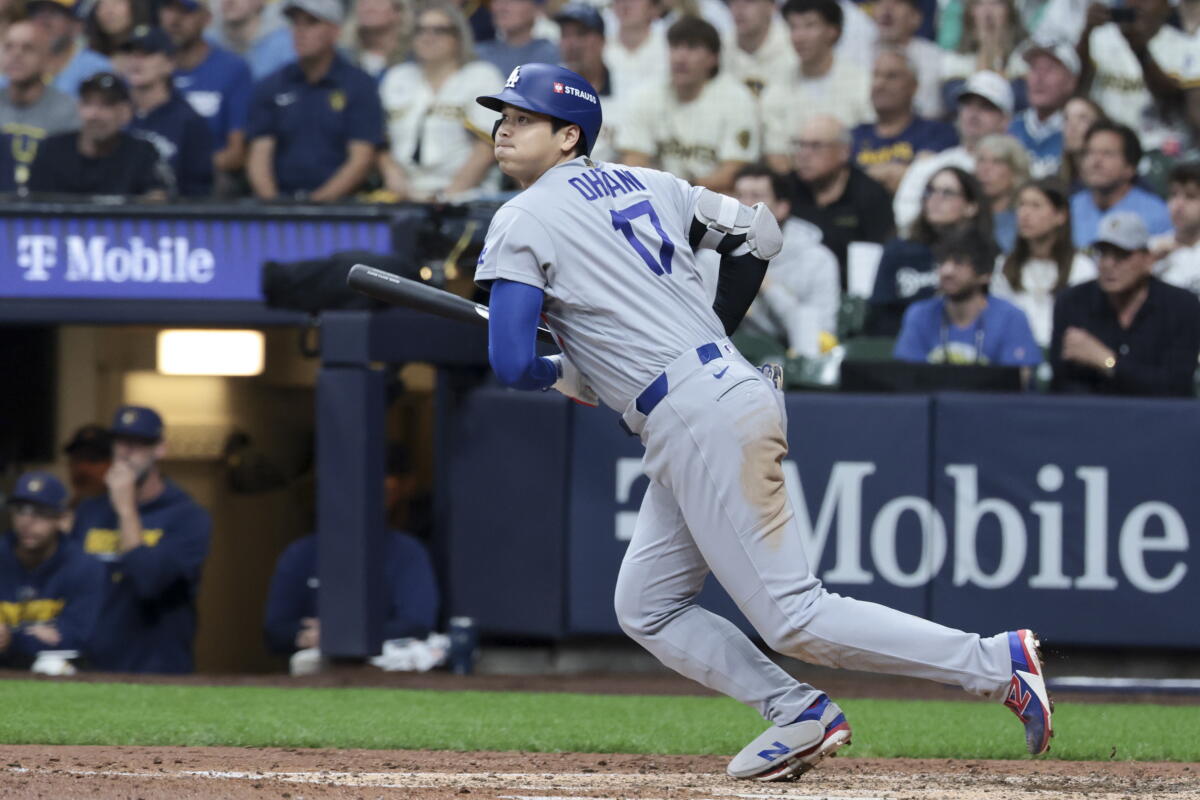
Shohei Ohtani is just three for 20 this postseason.

Shohei Ohtani is just three for 20 this postseason.

(Robert Gauthier / Los Angeles Times)

On Tuesday, he said his approaches can alternate between “focusing on reducing the symptoms and getting rid of the pain and/or just making sure that I’m moving well in the swing.”

There is no evidence so far that this might work, and an uncomfortable and increasing body of evidence that it might not.

Ohtani is batting .150 in the playoffs, with three hits in 20 at-bats. Of the 39 players with at least 20 at-bats this postseason entering play Tuesday, only three have a lower OPS than Ohtani’s .411.

One of them, Dodgers catcher Will Smith, has one hit in 23 at-bats. But he is hitting the ball hard: in the NLCS, one ball hit at 102 mph, another at 101, and every ball hit harder than the one Ohtani hit the hardest.

That exit velocity: 86 mph.

He has not pulled a ball in the series for a hit, or for an out.

Over his major league career, he has homered once every 14 at-bats.

He has not hit a home run since Aug. 18, a span of 107 at-bats. He has driven in one run since then; the Dodgers batted him cleanup in Game 2.

And, since hitting that last home run, Ohtani is batting .036 against fastballs thrown 95 mph or harder. The average fastball in this postseason: 96.2 mph, according to analyst Mike Petriello’s close-up of all the different ways Ohtani’s swing is fouled up.

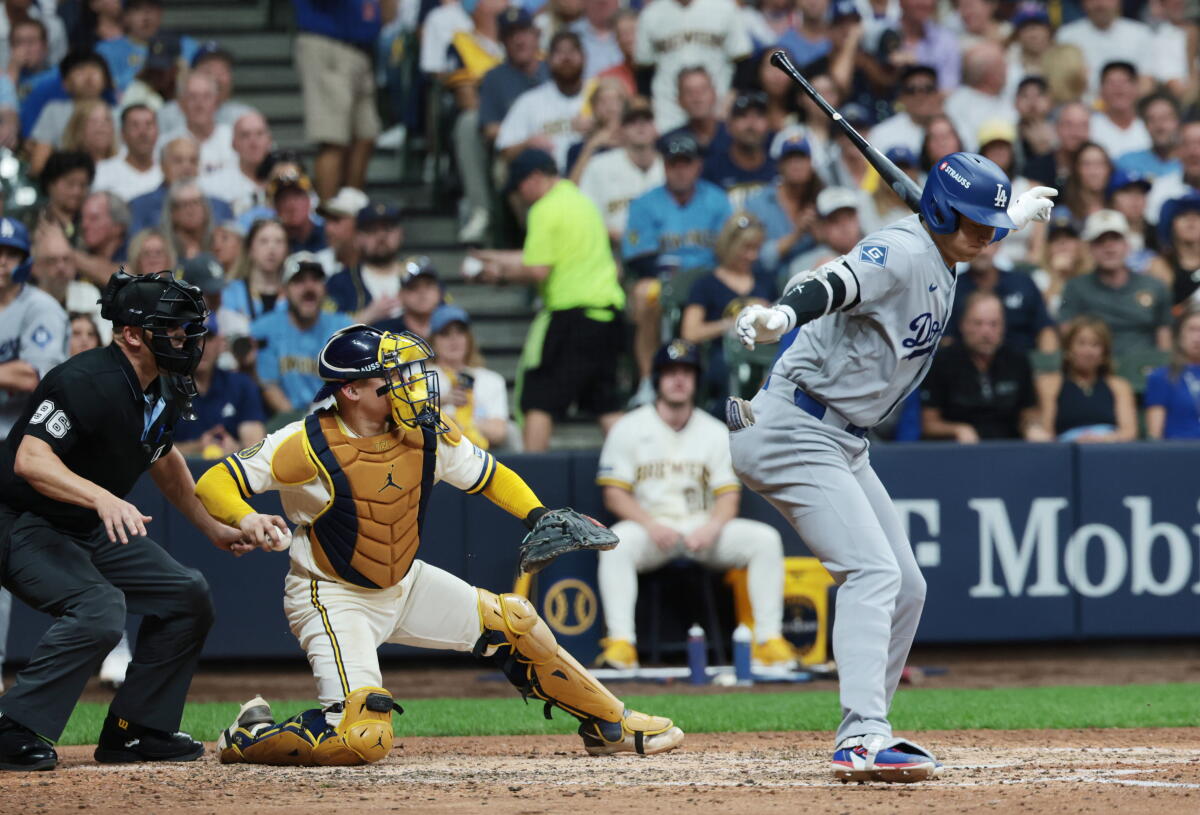
Breaking balls? Brewers reliever JoJo Romero threw him one low and away in Game 2, and Ohtani lost his bat as he lunged to make contact.

When Ohtani spoke with reporters before the playoffs started, he said he might not know the full extent of his injuries or what he might need to do to rehabilitate them until after the postseason.

“I haven’t been able to get a good grasp of the root cause of all this,” he said then. “I think that process is going to happen during the offseason, when I’m going to have a little bit more time to be able to address it. But as of now, it’s something I’m just going to have to manage.”

The Dodgers did not need Ohtani to win the NL West. They needed to shut him down for an extended period to maximize their chances of winning in October.

They failed to do that. They believed a few days of rest would allow them to nurse Ohtani through the rest of the season.

One big swing in October, and who cares? Ask Kirk Gibson, who hobbled to bat and then hit one of the most dramatic home runs in World Series history.

Here is what the Dodgers ought to keep in mind: That was the only at-bat Gibson took in that 1988 World Series.
Source link

Dave Roberts: Shohei Ohtani is adamant he can help Dodgers

Shohei Ohtani emerged from the visiting dugout at American Family Field with a bat in his hand, and the mass of media members scattered in foul territory up the third-base line shifted his way, pulled by the magnetic force that is Ohtani’s stardom.

Monday marked the third straight day Ohtani had hit on the field, after a multi-round session off the pitching machine on the workout day and batting practice before each of the first two games of the National League Championship series against the Milwaukee Brewers. But the novelty of the move — Ohtani only took batting practice on the field a few times during the regular season, always in the midst of a slump — had yet to fully wear off.

“The results, take full responsibility,” Ohtani said through interpreter Will Ireton on Tuesday. “That’s all I can really say, why the results haven’t been where I wanted it to be. But I think there’s different approaches to this, whether that be focusing on reducing the symptoms and getting rid of the pain and/or just making sure that I’m moving well in the swing.”

That break of routine for the start of the NLCS did not pay off in terms of results. But after a conversation with Ohtani, manager Dave Roberts said Tuesday that he felt “great” about playing Ohtani in Game 3 of the NLCS, even though Ohtani is still physically compromised by nagging right biceps and left knee problems.

“He’s adamant he feels good enough to be in there,” Roberts said. “He’s close to finding something with his swing. … Yeah, he wants to be in there and help us win a ballgame and win a championship. Great conversation, and I’m excited about having him in there.”

Roberts made clear that he wasn’t ever considering “benching” Ohtani, but rather weighing whether it would make sense to give him a couple days to “reset,” similar to how they approached Freddie Freeman’s ankle injury in 2024, giving him two days off during that postseason run.

“The symptoms have subdued a lot, especially when I was on the IL, spending that time just being able to reduce the symptoms,” Ohtani said. “As of now with the swing, it’s a daily process of trying different things, different feel on a daily basis.”

Though Ohtani’s arrival kicked off the Dodgers’ back-to-back championships, this isn’t his first time slumping in the postseason. His bat went quiet in the 2024 World Series (two for 19). And between his two-homer game to open last year’s wild-card round, and Game 4 of the NLCS when the two-way star authored the best individual game ever played, he went four for 33.

The difference this time is Ohtani, who has hit three singles in 20 postseason at-bats, isn’t fully healthy. But he was adamant that he would still be able to find a way to produce regardless.

“Over the course of this long season, there’s only really a short period of time when my mechanics is completely in sync,” he said. “So it’s just really kind of just going back and forth, finding the right parts of the swing and managing just the different parts of the swing. So it’s a constant, ongoing process that’s headed in the right direction.”

When healthy, Ohtani has the ability to break out of even the most dire of slumps with an otherworldly performance, like that three-homer (as a hitter), 10-strikeout (as a pitcher) all-timer. Opposing pitchers still have taken a cautious approach to facing him.

This version of Ohtani, however, hasn’t hit a home run since Aug. 18, a little over three weeks before he landed on the injured list. He’d played through nagging knee and biceps injuries for most of the season. But by the first week of September, the Dodgers could no longer argue that his poor performance wasn’t necessarily connected to his ailments.

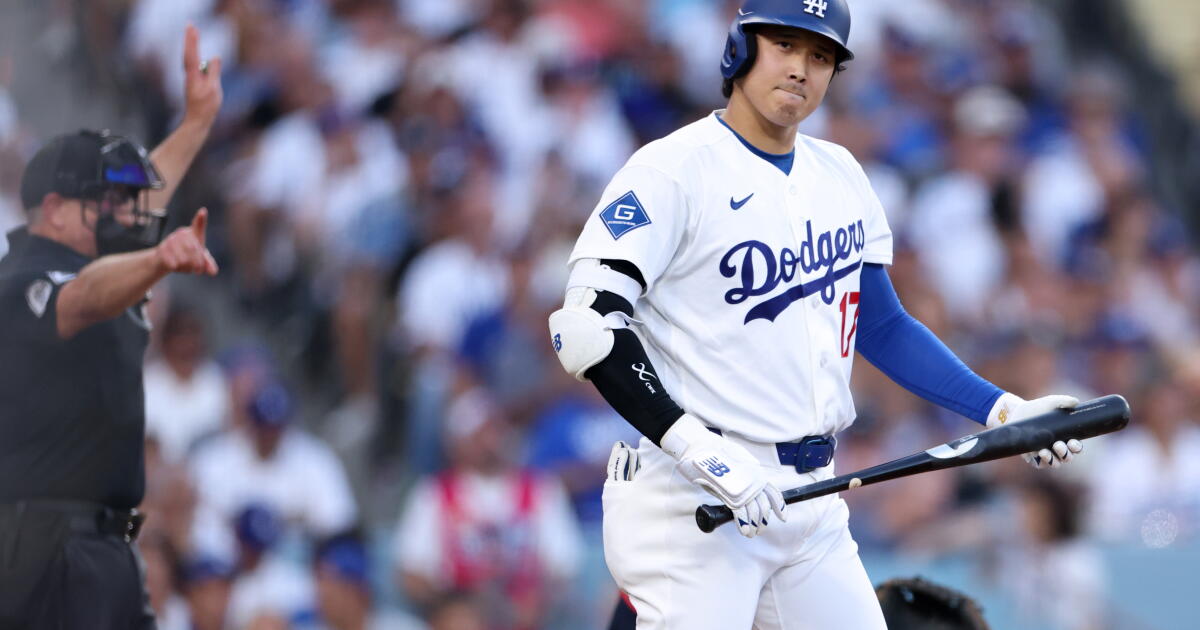
Shohei Ohtani strikes out during the sixth inning of Game 2.

Shohei Ohtani strikes out during the sixth inning of Game 2.

(Robert Gauthier / Los Angeles Times)

Now, the stakes are as high as ever. Trailing the Brewers 2-0 in the best-of-seven series, the Dodgers desperately need to put themselves in the best possible position to win Game 3 and avoid four straight win-or-go-home contests. And to do so, they need to know what kind of production Ohtani is physically capable of.

“I’ve never wavered in my belief in him,” Roberts said. “The work that he’s putting in — shoot, he squared the bunt in Game 2 to potentially get on base. That just speaks to whatever it takes to help the team win. He’s always been about the team, whether it’s hitting first, second, fourth, or wherever, right? So for me, just hearing his conviction, that’s what I wanted to hear.”

The communication between Ohtani and the team on injuries has been a work in progress in his third year with the Dodgers.

“We certainly had a lot of communication with him throughout the year, and worked together really well in terms of how to go about this,” president of baseball operations Andrew Friedman said in late September.

“And I think in his mind, he just thought that what he was dealing with was more minor, because it wasn’t like he would see a doctor and go, ‘Oh my God, you have this ailment.’ There were just a number of different things that were bothering him. And I think in his mind, he thought the best way to help the team was to go out and play, which I respect. But us staying really connected and sharing that information, I think, will be really important going forward.

“And again, the communication back and forth has been awesome. The fully sharing exactly how he’s feeling, maybe not as awesome. But again, I would rather [have] that with a guy than the other side of that.”

So, Ohtani kept trying to work his way back to the mound for weeks after receiving a lubricating Orthovisc injection in his knee at the beginning of the All-Star break. And when his biceps injury flared again, and the discomfort extended up through his neck, the Dodgers put off an IL move as long as possible.

Roberts said Ohtani’s conviction lined up with what the manager was hearing from the Dodgers hitting coaches and medical staff.

“No one knows what’s going to happen tomorrow and the ensuing days,” Roberts said. “At the end of the day in this big moment, we’re listening to Shohei, and we’re going to support the crap out of him and believe in him, and that’s it.”

Source link

Will Smith is in a slump, but benching him isn’t an option for Dodgers

The Dodgers have a big hole in the middle of their batting order, and it’s not Shohei Ohtani.

If anything, Ohtani has reemerged as an offensive force in the cleanup spot, singling, walking and scoring the Dodgers’ only run Sunday in a 2-1 loss to the Milwaukee Brewers in Game 1 of the National League Championship Series.

The problem is with the guy hitting in front of Ohtani.

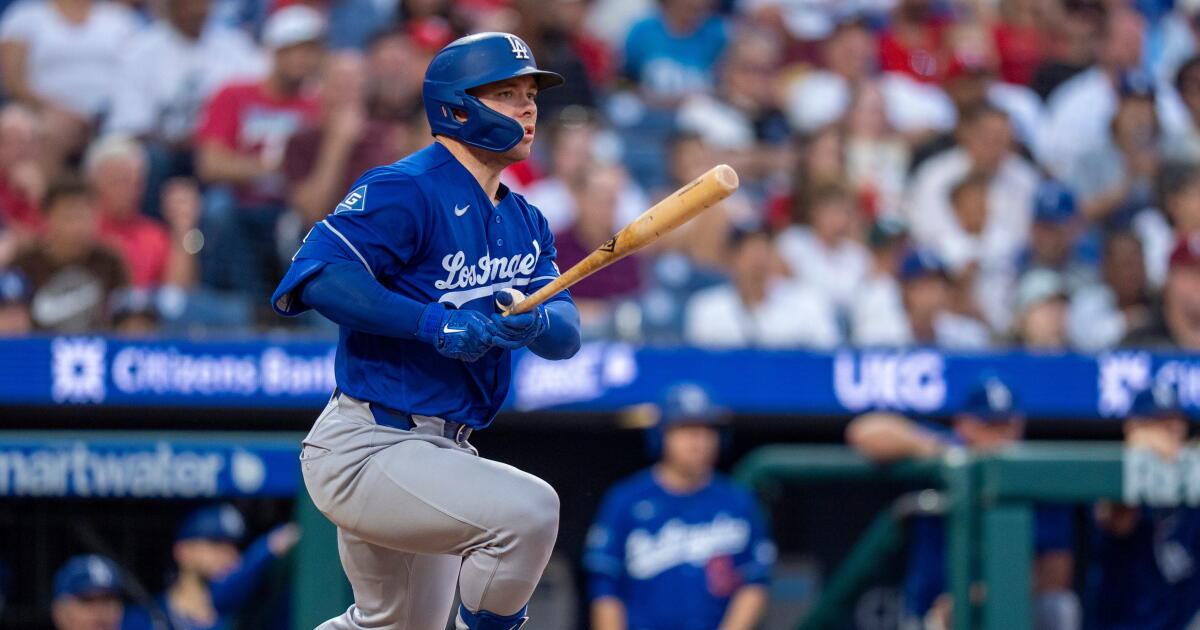
Will Smith walked in four plate appearances, marking just the second time he’s reached base in the postseason. In the four division series games against the Atlanta Braves, he had a single in 16 at-bats, striking out seven times. He’s hitting .053 in the playoffs — only Cleveland’s Ángel Martínez has a lower average among players with at least nine at-bats.

But there’s not much the Dodgers can do about it. They are built to win with pitching and Smith, the catcher, is the guy they rely on to guide those pitchers through games.

Dalton Rushing, who started just five fewer games behind the plate than Smith this season, is injured and not on the roster. Hunter Feduccia, who did make the team, caught just 15 complete games this season and isn’t an option to start in the playoffs.

“I’m not going to put Feduccia in place of Will Smith,” Dodgers manager Dave Roberts said. “That’s just not going to happen.”

So Roberts and the Dodgers are left to muddle on with Smith regardless of how much he struggles offensively. That’s because he’s far more valuable crouching behind the plate than standing next to it.

“I don’t even know how he’s performing offensively,” said Tarik Skubal, who took the loss Sunday. “Catchers, I think it’s the most important position on the field. They’re the ones calling pitches, dictating game flow, rhythm, all that type of stuff. I’m going to trust those guys always.”

Smith appears to be executing his catching duties very well, since opponents have scored just 10 runs and are hitting .160 against the Dodgers this postseason. Only Tampa Bay, which has played two fewer games, has done better.

As for what Smith thinks, that’s unknown because the Dodgers did not make him available to the media Sunday. But since he’s not coming out of the lineup, the next-best solution might be moving him to another spot in the order.

That worked with Ohtani, who had as many strikeouts as hits in the first two games of the division series, when he batted second. Since being dropped in the order, he has reached base four times in three games, stolen a base and scored twice.

“There’s always lineup construction. I can think it through. He’s not swinging the bat well,” Roberts said of Smith. “It’s hard because of the body of work, he just has that knack to get a hit, to get a big hit.”

That’s exactly what happened last fall when Smith’s two-out, 11th-inning home run in Game 7 of the World Series helped the Dodgers win a second straight title.

Smith was on the injured list for 86 days this summer because of neck disk inflammation, returning for the final month when he slashed .290/.400/.548. He has cooled off considerably in October, just as he did last year, when he returned from a right hand contusion three games into the playoffs and got just two hits in his first 14 at-bats.

He recovered to bat .400 in last year’s NLCS win over Milwaukee, then broke a 4-4 tie with his winning homer against the Toronto Blue Jays. Just as important, though, Smith caught all but 11 innings in the Dodgers’ final 15 postseason games — including two 11-inning games and another that lasted 18 innings.

Smith rarely has hit well in the postseason, batting just .206 in 18 series, which may explain Roberts’ lack of panic. Plus, Roberts knows his All-Star catcher has helped him win three World Series rings, and if the Dodgers are to get another, it will be on the strength of their pitching, not their hitting.

And that side of Smith’s game is as strong as ever.

“To be honest, that’s not where my focus is with Will,” Skubal said of his catcher’s hitting. “My focus is what he’s doing behind the dish and he’s very important. He’s very important to the entire pitching staff.”

Source link

Shohei Ohtani dropped in the batting order for NLDS Game 3 vs. Braves

Dodgers superstar Shohei Ohtani took the news that he was hitting fifth in Game 3 of the National League Division Series so well that he responded with a joke.

As manager Dave Roberts tells it, when he laid out his thoughts on the lineup against Braves ace Chris Sale, Ohtani said, “In all honesty, I was going to come to you in September and say, why don’t you hit me seventh?”

Regardless of how poorly Ohtani has hit lately, the news came as a shock on Tuesday. And it reflected the aggressive read-and-react approach Roberts is going to take with the best-of-five series tied through two games.

Fifth is the lowest Ohtani has ever hit in the Dodgers’ starting lineup. He hasn’t hit fifth or lower in a starting lineup since 2020 with the Angels.

For most of the season, through ups, downs and injuries, Ohtani has led off. When he returned from the injured list with five games left in the season, Roberts started batting him second against left-handed pitchers, with right-handed hitting Mookie Betts batting ahead of him.

But in eight postseason at-bats so far, Ohtani has recorded just two hits, both singles.

“This is just a Sale thing, and also who I feel is going to come out of the bullpen tonight,” Roberts said, making clear that he doesn’t plan to bat Ohtani fifth against all left-handed pitchers in the postseason. “So [Wednesday] versus [right-hander Tyler] Mahle, it will look different.”

Against Mahle, however, Roberts said Ohtani won’t necessarily lead off, citing Mahle’s neutral-to-reverse platoon splits. But Ohtani won’t hit fifth, Roberts said. Sale is a special case.

The last time the Dodgers faced Sale, he shut them out for nine innings. All time, Ohtani has a .517 OPS against Sale in the regular season, and he went one for seven against him this year.

“It might give him a different look, let the game come to him a little bit later,” Roberts said. “I don’t think it’s a pressure thing. I do think it’s something where he wants to do more. But in that same breath, I do think that there’s going to be a couple big spots today where he’s going to be at bat.”

In the Dodgers’ first two postseason games, Ohtani’s plate discipline has wavered, making it difficult to pinpoint the root of his struggles. Does it all come down to approach? Could his nagging left knee and right biceps problems be contributing to his poor performance?

The Dodgers aren’t looking for him to be the hero every game, and trying to do so could even exacerbate his problems at the plate. For the lineup to click, however, he does need to be more productive.

“He’s a very good self-evaluator, a very extremely high competitor and expects a lot from himself,” Roberts said. “I still think he’s very confident. But Sale’s a different monster. He’s tough, certainly against lefties.

“But I still think [Ohtani’s] confident. So now with that, just getting him back in the zone — and that’s easier said than done, I understand that.”

On Tuesday, Roberts also inserted right-handed hitting Kiké Hernández into the lineup, batting ninth and playing third base. And he kept right-handed hitter Miguel Rojas in the lineup, moving him from third to second and starting utility player Tommy Edman on the bench. Left-handed hitting third baseman Max Muncy will also be available off the bench.

“Tommy, he’s been going through it in the last couple of months, and it’s been a grind for him on both sides of the plate,” Roberts said. “Hasn’t had a whole lot of success against Sale — the heater up, the ball down below, with a flat swing. … Getting Kiké involved right now, I think it’s added intensity, urgency. I just think he’s going to put forth some good at-bats, and you’re not giving up anything on the defensive side.”

Source link

Move Shohei Ohtani down in Dodgers’ lineup? Dave Roberts ‘open’ to it

As the Dodgers mull potential lineup changes for Game 3 of the National League Division Series, manager Dave Roberts said he is “open” to moving Shohei Ohtani lower in the batting order.

In his three seasons with the Dodgers, Ohtani has batted first or second in every game he has started. However, as he has admitted he is trying to “manage” in the aftermath of knee and arm injuries, and as Roberts has acknowledged Ohtani is “not 100%,” the lack of success could compel the manager to replace him at the top of the lineup with a more productive hitter at some point.

“I would,” Roberts said Monday. “I would. I think it’s something that, you know, I think moving him from 1 to 2 — but going further than that? I’m open to it.

“And it’s something that if I do, I would obviously have the conversation with Shohei to explain why. And at the end of the day every conversation I’ve had with him is whatever’s best for the team, he’s all-in on. So I know that undoubtedly.”

The Dodgers are batting .215 through the first two games of the NLDS, with the Atlanta Braves scheduled to pitch left-handed ace Chris Sale in Game 3 on Tuesday. If the Dodgers lose, they would need to win back-to-back elimination games to advance beyond this series.

Roberts said the lineup changes he would consider include starting Kiké Hernández and Miguel Rojas, both of whom hit well against left-handers. That could mean infielders Max Muncy (0 for 7 against Sale, with five strikeouts) and Tommy Edman (0 for 11 against Sale) might not start.

Center fielder Andy Pages, who batted so poorly last October he was benched for the final three games of the World Series, is hitless in seven at-bats in this series, with four strikeouts.

“I’m gonna continue to give Andy leash,” Roberts said. “I believe in him. I feel that for us to win the World Series this year, we’re gonna need him to be an active part of our team.

Roberts said he did not envision benching catcher Will Smith, who is 0 for 8 in the series. The Dodgers’ backup catcher, Hunter Feduccia, is a career .205 hitter with no postseason experience.

But, even with the Dodgers’ star-studded lineup, the spotlight shines brightest on Ohtani.

Ohtani has not homered since Aug. 18. He hit .157 between then and the end of the regular season, striking out in 41% of his at-bats. In this series, he has two hits and two strikeouts in eight at-bats, and his inability to refrain from swinging at pitches outside the strike zone has become a glaring weakness.

“He’s not 100%,” Roberts said. “But, at the end of the day, he can still do a better job of staying in the strike zone.”

Ohtani hasn’t given the Braves a reason to challenge him within the strike zone.

“Everything orbits around Shohei, in the sense of his talent,” Roberts said. “And the Braves are going to enter with caution. And, so, knowing that, they’re going to continue to expand as long as we keep giving that to them. So until we show some discipline, they’re going to continue to kind of use that playbook.”

Source link

Dodgers hope Shohei Ohtani’s injuries won’t derail three-peat

There are all the stars in this series — Mookie Betts, Matt Olson, Freddie Freeman, Ronald Acuna Jr., Yoshinobu Yamamoto, Chris Sale, Tarik Skubal, Michael Harris II and more — and then there is the face of baseball around the world.

Major League Baseball wrapped a postseason advertisement around the front page of The Times this week. “OCTOBER STARTS TODAY,” the headline screamed.

Beneath those enormous letters, Shohei Ohtani smiled. Who else?

And so dozens of reporters crammed into a cramped room within Dodger Stadium on Friday afternoon, on the eve of the National League Division Series between the Dodgers and the Atlanta Braves, waiting for Ohtani to answer a few versions of “How are you?”

It’s not just about attracting casual fans to watch the icon whose face adorns everything from airplanes to skin care products. For the Dodgers and their fans, it’s about whether their most famous player can be a game-changer in October.

The Dodgers could have shut him down as a pitcher rather than let him continue to try to pitch through knee and biceps injuries. They didn’t, and that backfired.

The Dodgers could have shut him down as a hitter, not for the season but for a stint on the injured list. They didn’t. They gave him just a few days off, and that backfired.

Then the Dodgers did put him on the injured list, but activated him for the final five games of the regular season rather than give him extended rest for the playoffs, limiting his activity to controlled workouts.

That might backfire, or it might not, and the repercussions of the former could represent a significant hurdle in their quest for a third consecutive World Series championship. Giving Ohtani time off during the regular season would have carried no penalty; the Dodgers would have won the NL West with or without him.

If the Dodgers decide Ohtani needs a few days off now, they would face this unpleasant dilemma: play one man short, or put him on the injured list. Under MLB rules, a player put on the injured list during a postseason series must sit out the next series. So, if Ohtani starts wincing at the end of his swings during the NLDS, a stint on the injured list would mean he could not play again until the World Series — if the Dodgers get there.

Shohei Ohtani speaks during a news conference at Dodger Stadium on Friday.

Shohei Ohtani speaks during a news conference at Dodger Stadium on Friday.

(Mark J. Terrill / Associated Press)

Ohtani has not hit a home run since Aug. 18. Since then, he is batting .157, and he has struck out in 41% of his at-bats. In those final five games, he hit the ball hard in the first two, then hit ground balls in the final three. In the on-deck circle, he did not always take a swing.

In batting practice Friday, he hit lots of home runs.

The general sense of how Ohtani is feeling now: good enough.

Ohtani said he feels “really good” as compared to before he went on the injured list, but acknowledged he isn’t sure what he might need to do to address the injuries over the winter.

“As of now, it’s something I’m just going to have to manage,” he said through interpreter Will Ireton.

Dodgers manager Dave Roberts offered this medical update: “Shohei’s not 100%, but he’s going to be in the lineup.”

Same for Freddie Freeman, who has not homered in a month. The difference, Roberts said, is how encouraged the manager was by Freeman’s workouts this week.

“With Shohei, I’m not so sure,” Roberts said. “I know that once the lights turn on, the postseason starts, the focus will be heightened. I expect good things. I really do. We just haven’t seen it enough to really — for me to forecast it.”

Ohtani plays when he says he can. After he tore up his left shoulder in Game 2 of the 2024 World Series, he had trainers tape the shoulder in place and took 11 at-bats over the final three games of the series. He had one hit, a single.

“I do pride myself on playing every day,” Ohtani said. “I do see it as an obligation as a professional to be on the field every single day.”

Andrew Friedman, the Dodgers’ president of baseball operations, acknowledged recently that communication with Ohtani has been “awesome” but “fully sharing exactly how he’s feeling, maybe not as awesome.”

Said Friedman: “He’s not always the best reporter of how he feels. Freddie’s the same way. Clayton Kershaw. I’ve been around a lot of these guys that feel like their job is to be out there to help the team however they can, and sometimes will downplay some things that are bothering them. But again, it’s because he wants to help the team win.”

The Dodgers are talented enough that Ohtani not hitting well would not damage their chances as much as, say, Sale not pitching well for the Braves. In the NLDS and the first three games of the NLCS last October, Ohtani hit .103 with no home runs and struck out in 48% of his at-bats.

In the NLCS clincher, he hit three home runs (and struck out 10 batters). The Dodgers could trade a few bad days from Ohtani for that one really good day.

In that MLB advertisement, the one that featured Ohtani, the league acknowledged that its screaming headline was not exactly accurate. The explanation also fits the Dodgers’ hopes of Ohtani starring in October.

The ad, after all, appeared on Sept. 29.

October starts today?

“Logic and reason would tell you otherwise,” the ad read. “But October isn’t about being reasonable.

“It’s about belief.”

Source link

Kyle Tucker unlikely NLDS hero as Dodgers head toward sweep

Teoscar Hernández? Sure. Max Muncy? Certainly. Tarik Skubal? Absolutely.

But Kyle Tucker? Are you kidding me?

Of all the heroes in the Dodgers’ 5-3 victory over the Atlanta Braves in their National League Division Series opener Saturday at Dodger Stadium, none was more stunning than the shrugging, somnolent, underachieving right fielder whom Dodger fans have treated like an overpaid outcast.

Just listen to them now.

Booo…Yayyyyy!

Locked in a one-run game on a scorching 100-degree afternoon, Tucker drove an AJ Smith-Shawver fastball 408 feet over the right-field fence in the sixth inning for a two-run homer that essentially ended the Braves’ afternoon and set up the Dodgers for what appears to be a certain series sweep.

Yes, the Dodgers only lead one game to none in this best-of-five deal, but the Braves are clearly out of breath and out of pitching after enduring last week’s wild-card series against the Philadelphia Phillies.

The Braves dug deep in their bullpen for all eight innings Saturday. They may have to dig even deeper in Game 2 on Sunday or desperately start ace Chris Sale on short rest.

Their offense looks wasted, their bullpen is taxed, and they spent most of Saturday in one sweaty mess.

Of course, the Dodger bullpen almost handed the game back to them when Ozzie Albies hit a two-run homer off Tanner Scott in the ninth to close what seemed to be an insurmountable gap. But Scott was mercifully lifted for Evan Phillips, who recorded the final out of the game to save the Dodgers from disgrace.

And to etch Tucker into the rare role of hero.

“Obviously for us it’s about winning a championship,” said manager Dave Roberts when asked about Tucker afterward. “Our fans, they really remember what you do in the postseason. So this is certainly a way to change the story for a season in 2026.”

Indeed, except for the back end of the bullpen, Dodgers old and new rose to the championship occasion.

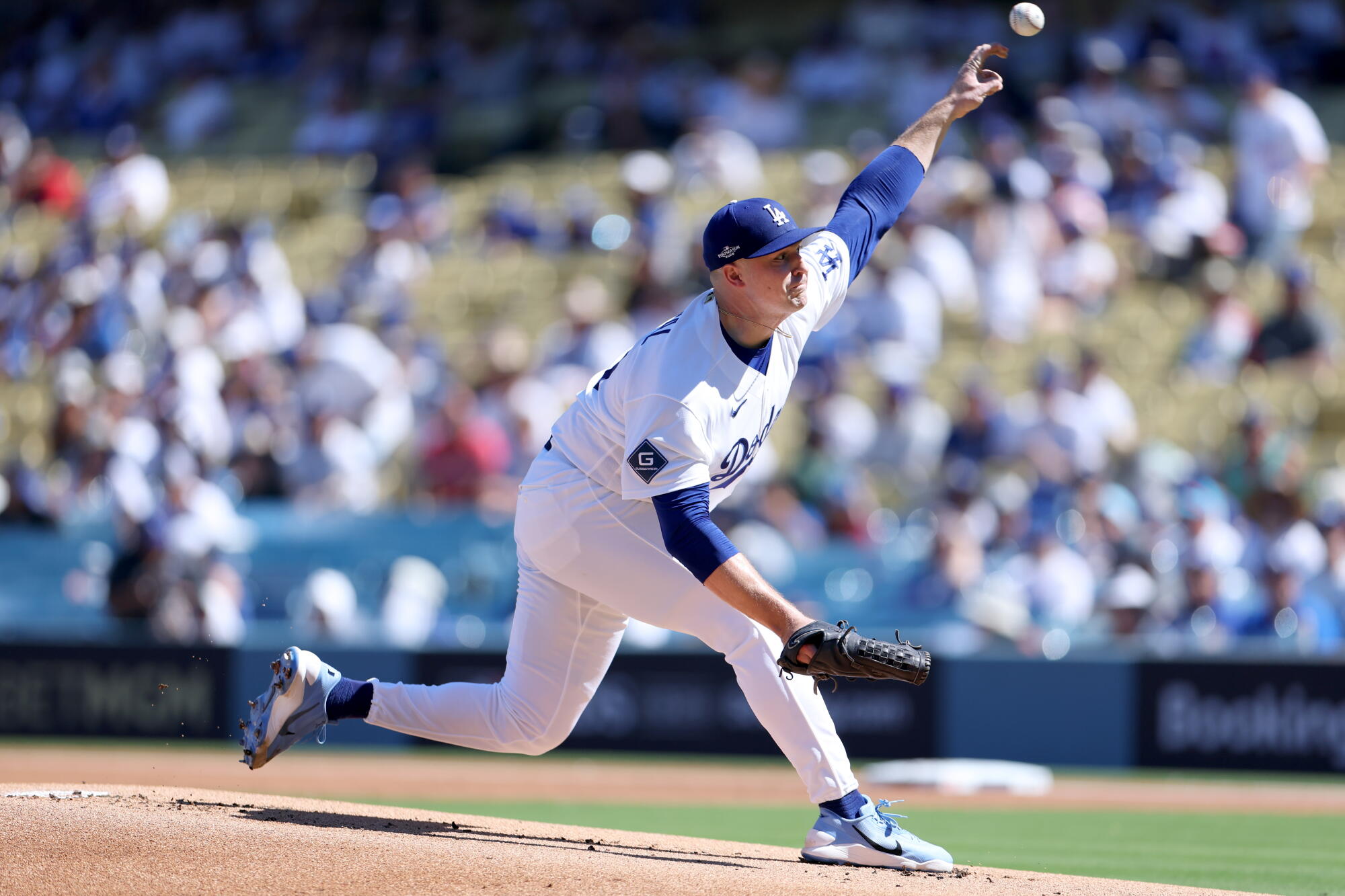
Skubal in his first Dodger postseason start after being traded here from Detroit on Aug. 2? Six innings of brilliance, 15 batters in a row retired at one point, only one three-ball count in the first five innings, two allowed hits, seven strikeouts, two walks and only nicked by a Sean Murphy homer.

Dodgers pitcher Tarik Skubal

Dodgers pitcher Tarik Skubal delivers during the first inning Saturday against the Braves.

(Eric Thayer / Los Angeles Times)

Teoscar Hernández, almost benched during a rocky regular season? Same old Teo, the guy who leads the Dodgers with 27 RBIs over the last three postseasons, this time opening the scoring with a two-run homer in the fourth.

Max Muncy, the forgotten stalwart who always seems to show up huge in October? Same old Max, blasting a ball over the right-field fence in the sixth to give the Dodgers a 5-1 lead.

But Kyle Tucker? This was not the same old Tucker. Nobody saw this coming. Certainly, he finished the regular season strong with a .969 OPS in September with six homers and 13 RBIs, but he was awful for most of the previous five months after joining the team this winter with baseball’s highest annual salary of $60 million.

Tucker batted .196 at home. He seemingly jogged after fly balls, wildly swung and missed at fastballs, and who would have thought he would take control with one out in the sixth and the Dodgers leading 2-1?

There was one out. This was a big moment. Skubal was out of the game and the Dodgers had lost all their early momentum when Hernández popped a single to center, bringing up Tucker.

On Smith-Shawver’s second pitch, he connected, and after Tucker trotted across home plate, the most amazing thing happened.

He smiled.

“I think that we all know — it’s been well talked about — the struggles he had this year,” said Roberts. “I give him a lot of credit for grinding through it, not running from it, always posting and kind of getting to the other side of it.”

It was an otherwise ordinary Dodger playoff win that began with a rare bit of Dodger second-guessing.

Many questioned the Dodgers choosing to pitch Skubal in Saturday’s opener while slotting Blake Snell into Sunday’s spot and leaving last season’s playoff hero Yoshinobu Yamamoto on the bench until Game 3.

The reasoning was that Skubal could get two starts in this series on full rest while Yamamoto, who requires an extra day’s rest, was only getting one start in the series regardless. Furthermore, by holding him back in this series, the Dodgers ensured that Yamamoto would get two starts in the National League Championship Series.

Still, you have to wonder, how do you take a guy with a 7-0 postseason record with a 2.25 ERA and put him third in the rotation?

Turns out, the Dodgers knew what they were doing, and before the game, even Andrew Friedman acknowledged this was their best pitching staff of this era.

“I feel like this is the best and deepest pitching staff we’ve ever had going into October,” said the Dodgers president of baseball operations. “I think we had some tough conversations in leaving some guys off the roster. That would have never happened before.”

There were also pregame question marks surrounding the health of Shohei Ohtani and Freddie Freeman.

Those questions remain, as the two future Hall of Famers went two-for-seven with two singles and not much power.

Ohtani, fighting arm and leg injuries, entered the game batting .157 since Aug. 18 with zero home runs during that time.

“As of now, it’s something I’m just going to have to manage,” he said through interpreter Will Ireton.

Ohtani and Freeman are going to have to manage better than this for the Dodgers to three-peat.

Maybe they should take some advice from the Dodgers’ latest candidate to be christened Mr. October.

Kyle Tucker? Yeah, him.

Source link

Shohei Ohtani gets a hit in his return, but Dodgers fall to the Padres

Shohei Ohtani’s swing was a little out in front of a slider delivered by Padres left-hander Robbie Ray. But Ohtani held back his hands long enough to extend them to the pitch and shoot it through the right side of the infield.

It wasn’t flashy. But considering it was his first at-bat in more than two weeks, in a tough matchup no less, it was a promising sign.

“It’s been a while since he’s played in a game, but it just felt like he wasn’t sped up at all,” manager Dave Roberts said after the Dodgers’ 5-1 loss to the Padres. “And I think he came out of it pretty well.”

The good news quickly dried up for the Dodgers after that, as they missed a chance to clinch a first-round bye with a win. But Ohtani’s return was still significant, and the success of his end-of-season tune-up will have playoff implications.

Ohtani did not address reporters Wednesday and has only done so once in the last five weeks, despite multiple requests.

The Dodgers activated Ohtani, who went one-for-four Wednesday, from the 15-day IL before the game and optioned rookie Josue De Paula to Triple A. De Paula is still under consideration for the National League Division Series roster as a bat off the bench.

“This was the original thought, that once Shohei gets back, we’re going to send him out,” manager Dave Roberts said. “We had a runway to give him, which we gave him and he performed more than admirably. This also, as far as the timing, just gives us an opportunity to potentially have him back for the postseason. He’s a part of the conversation, and he’s earned that, and that’s what I told him last night.”

De Paula joined triple-A Oklahoma City for Game 2 of the PCL Championship on Wednesday. And Ohtani slid into the Dodgers lineup, hitting second in the batting order for the first time this season, with Mookie Betts leading off against the Padres southpaw.

“I know Shohei, Mookie, they’re always on board with whatever I decide to do,” Roberts said. “I think it just makes it tougher to navigate versus left. There’s a Mookie tax [to get to Ohtani]. If you want to get to Freddie [Freeman], there’s a Will Smith tax. I like that. And versus a right-hander, I like kind of flipping those two for the same reasons.”

Ohtani, welcomed back in his first at-bat by a partial standing ovation, walked in his second plate appearance. And with two out and the bases loaded in the bottom of the fourth inning, he appeared to have walked again.

Then Padres catcher Ethan Salas tapped the top of his head to challenge the ball call. And an ABS review showed the fastball had clipped the top of the strike zone. Ohtani fouled off the next two pitches before whiffing on a sinker to end the inning.

That missed opportunity rolled right into a sloppy fifth inning for the Dodgers defense.

Starting pitcher Yoshinobu Yamamoto had given up a two-run homer to Manny Machado the previous inning but had otherwise avoided damage.

To open the fifth, he induced Salas to hit the ball on the ground, but it got away from second baseman Tommy Edman as he dove up the middle, for a single.

Yamamoto then got a soft grounder out of Fernando Tatís Jr. But it was too soft, giving Tatís time to reach first before third baseman Max Muncy could get off a throw.

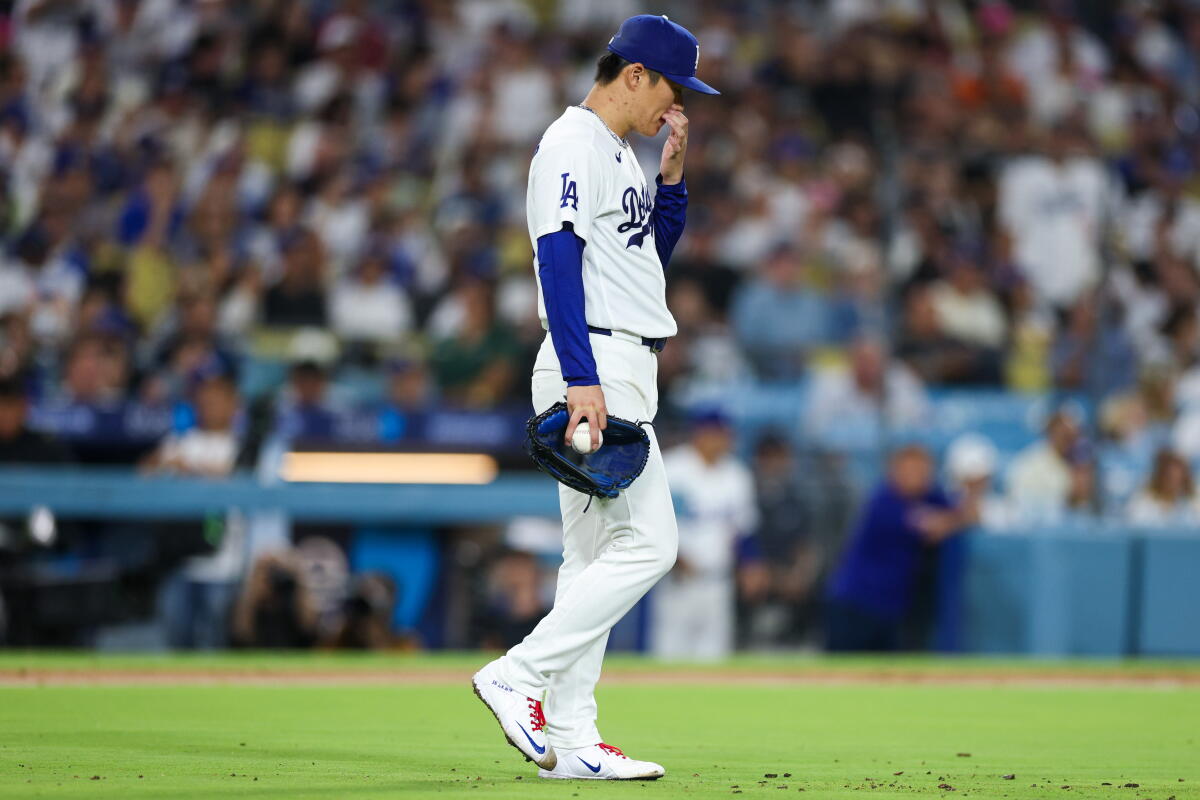
With runners on first and second, Yamamoto had a chance to contribute on defense, fielding Dustin Harris’ comebacker bunt. But Yamamoto’s throw to third sailed wide, allowing a run to score. Machado then made it a 4-1 game with a sacrifice fly.

Yoshinobu Yamamoto reacts after a throwing error to third base in the fifth inning.

Yoshinobu Yamamoto reacts after a throwing error to third base in the fifth inning.

(Ronaldo Bolaños / Los Angeles Times)

Ohtani came up to the plate again in the seventh inning and put Dodgers fans on the edge of their seats by sending a long fly ball to straightaway center field. But the cheers died down as it fell shy of the fence.

“I think if you look back at the last couple weeks when he was active, he wasn’t really getting to that pitch,” Roberts said of the high fastball. “I think there might have been one pitch late that he squared up to left field that was at the top of the zone. But outside of that it was hard for him to catch up. I think tonight showed that he’s in a good spot physically.”

The top of the Dodgers order got one last chance to start a rally in the ninth inning, against star closer Mason Miller. Only Will Smith reached base, on a walk, and advanced to third on defensive indifference. Ohtani struck out on a slider.

“[Ohtani] certainly feels way better with the rest,” president of baseball operations Andrew Friedman said before the game. “The biggest thing with five games to go is get him as many at-bats as we can, some rhythm and timing.”

Ohtani could get a day off in that span, Friedman said, but the Dodgers will make those decisions based on how he’s feeling.

“Just getting as many at-bats as he can and that rhythm and timing back before we head into October is going to be really helpful,” Friedman said.

Ohtani was not in rhythm before he landed on the IL. In the last three weeks before the Dodgers finally shelved him, he had a .130 batting average. And he only had two hits in his last seven games (26 at-bats) before the move.

“You end up making subconscious adjustments where you’re protecting yourself,” Friedman said, “and there’s just slight degradation as that’s happening that compounds over time.”

Though the Dodgers downplayed the correlation before Ohtani landed on the IL, they now hope that Ohtani’s improved health will go hand-in-hand with better performance.

“Shohei says he feels back to where he was earlier in the year, which is great, which is a good start,” Friedman said. “As they are coming back, it’s important for them to feel that way … now the question is, as you start to load on real games and that intensity and that workload, it’s making sure that what we’ve done keeps guys in position to be at their best.”

Source link

Dodgers’ Dalton Rushing will have chance to make case for postseason roster spot

The Dodgers plan to give catcher Dalton Rushing a chance to make his case for a spot on the postseason roster, after playing just four games in the last seven weeks because of a right elbow injury.

He’s set to be activated from the injured list before the end of the season, manager Dave Roberts said, and he’ll serve as a left-handed bat off the bench.

“Just showing them that I can swing it, and it’s an option,” Rushing told The Times after taking live batting practice Tuesday for the first time since landing on the IL earlier this month. “I know that you kind of tie [the team’s] hands up when you can’t play defense. So, I’m not expecting anything… just continue to take at-bats and see where we go from there.”

The slight tear in Rushing’s ulnar collateral ligament made headlines after he landed on the IL on Aug. 3. But Rushing’s MRI scans suggest the UCL — which is associated with Tommy John surgery — is not the issue.

The pain in his elbow seems to stem from a flexor strain. The small tear in his UCL has remained the same size since 2022, he said.

Rushing received platelet-rich plasma injection after aggravating the flexor injury a second time while working through a throwing program at the beginning of the month.

“I’m pretty confident I can still avoid surgery after the shot,” he said, noting that he’s been getting regular scans to monitor his healing. “Obviously, when I re-injured it the second time, I was almost 70-30, thinking that I was for sure going to need surgery. But after I got the shot and it ran its course, I feel as close to healthy in my arm as I have in a pretty long time.”

This time, Rushing has abandoned the throwing program. But he said he doesn’t regret trying to return to the field the first time around.

“In my eyes, me trying to throw is me showing them that obviously I want to help the team win,” he said. “I want to give us the best available option that we have at that moment, and that was my whole plan all along. So I hope they see there wasn’t any selfishness in that.”

The Dodgers will need a left-handed bat off the bench in October, but Rushing now has competition.

Rookie Josue De Paula replaced Shohei Ohtani on the roster when the superstar landed on the 15-day IL two weeks ago. His first major-league hit was a three-run home run, and he entered Tuesday with a .974 OPS in 10 games.

Even if the Dodgers option De Paula on Wednesday when they reinstate Ohtani, 10 days before the NL Division Series, he will be eligible to be added to the NLDS roster via petition to the Commissioner’s Office.

“It’s going to be a good debate,” Roberts said. “Hitting off the bench is very difficult, and so you’re just trying to figure out who gives us the best chance. To be quite frank, it’s going to be tougher for Dalton given the time that he’s missed, and … you have three games to get back in the playoff form, which is tough to do. It’s not a knock on him. He’s been great for us. But it’s still tough given that also you’re talking about the consistency of at-bats recently from Josue. We have to have those conversations and make a decision.”

Rushing played a large role in the Dodgers’ regular season. In his second year in the majors, he was thrust into the primary role behind the plate for two months because of Will Smith’s lingering neck injury. Now, he might not see the field in the postseason.

“It sucks,” he said of the injury derailing him down the stretch. “I mean, that’s really the only thing I can say about it, it’s not what I wanted — by no means.”

Looking beyond the playoffs, Rushing plans to evaluate his routine, hoping to set himself up to be available for more of 2027.

“I don’t even want to talk about it right now because we still have obviously a bigger task at hand,” Rushing said. “But my main plan moving into playing every day in the future is, make sure that my body can hold whatever stress or whatever is needed for this team — first base, behind the plate, whatever they need. I want to make sure my body can handle it and do it for 162.”

Source link