Key Iranian Bridge Severed By Airstrikes (Updated)

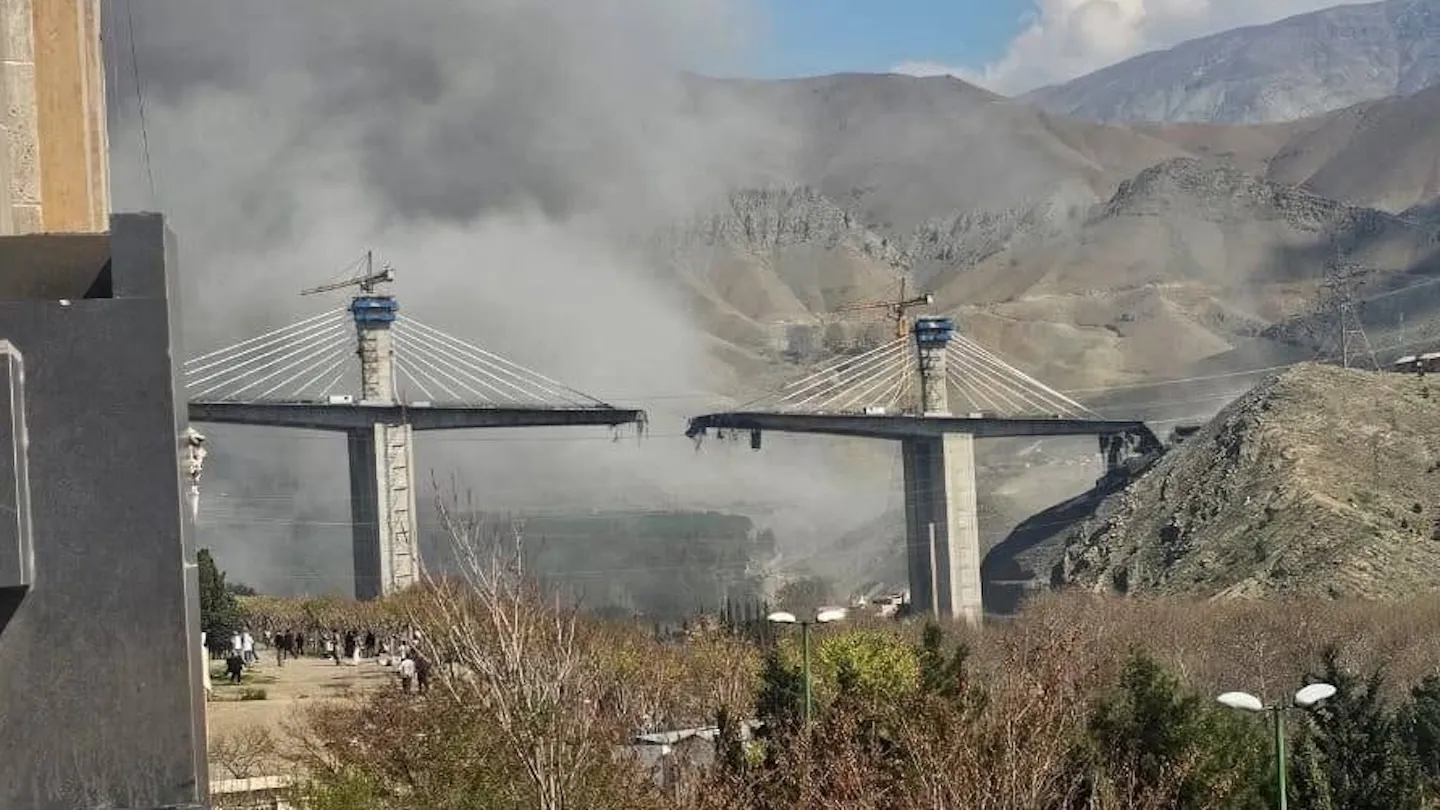
A major bridge near Tehran was struck today by what Iran has said were U.S.-Israeli strikes. The B1 bridge in Alborz province, one of the tallest in the Middle East, was hit in two waves of attacks, separated by around an hour, Iranian state TV reported. The bridge provides a critical link between Tehran and Karaj. The attack comes a day after U.S. President Donald Trump’s threat to bomb Iran “back to the Stone Ages.”
“A few minutes ago, the American-Zionist enemy once again targeted the B1 bridge in Karaj,” a city west of Tehran, state TV said earlier today, adding that the first strike had caused two civilian casualties.
It said the a later attack took place as emergency teams were deployed to the site to help victims of the first strike. We cannot confirm this claim.
Imagery posted to social media showed a clear breach in the road bridge, which connects Tehran and Karaj. While a key logistics node between the two regions.
Earlier this week, Trump’s threatened to “completely obliterate,” all Iranian electrical-generation plants and oil wells. This led to questions about whether the U.S. military was being primed to commit potential war crimes under international law, with the campaign expanding to include civilian targets as a matter of policy.
When asked about this point, White House press secretary Karoline Leavitt said that Trump’s statement showed that Iran’s “best move is to make a deal.”
“The United States Armed Forces has capabilities beyond their wildest imagination, and the president is not afraid to use them,” she said.
In response to the bridge strike today, Iran has threatened to hit regional bridges, including in Israel.
Iranian statements also referenced potential targets in Kuwait, Abu Dhabi, Jordan and Iraq, signaling a possible widening of threats to regional infrastructure.
UPDATES
UPDATE: 3:15 PM EST –
In a post on his Truth Social site, Trump confirmed that the U.S. attacked the B1 bridge and said there will be more such strikes unless Iran agrees to a peace treaty.
“The biggest bridge in Iran comes tumbling down, never to be used again — Much more to follow!,” Trump proclaimed. “IT IS TIME FOR IRAN TO MAKE A DEAL BEFORE IT IS TOO LATE, AND THERE IS NOTHING LEFT OF WHAT STILL COULD BECOME A GREAT COUNTRY!”
UAE Maj. Gen. Major Nasser Al Humaidi told MSN News Now that his country is not ruling out joining Epic Fury as a combatant.
UPDATE: 3:00 PM EST –
Unverified footage claims to show the impact of an Iranian ballistic missile in the Israeli city of Petah Tikva, to the east of Tel Aviv, this evening.
UPDATE: 2:45 PM EST –
Israel is receiving conflicting messages about U.S.-Iran negotiations to end the war, Ynet reports.
According to Israeli officials familiar with the situation, the talks are proceeding along two separate tracks. On one front, U.S. Vice President JD Vance is engaging with Pakistan’s army chief, Asim Munir, who is regarded as a crucial intermediary with Tehran. At the same time, U.S. envoy Steve Witkoff has been communicating directly with Iran’s foreign minister, Abbas Araghchi.
Based on this still photo, the legitimacy of which cannot be fully confirmed, airstrikes against the B1 bridge earlier today involved 2,000-pound class Joint Direct Attack Munitions (JDAM), weapons widely used by Israel and the United States.
Adm. Brad Cooper, the commander of U.S. Central Command (CENTCOM), has laid out his assessment of Operation Epic Fury, with the campaign against Iran now in its fifth week.
“It is my operational assessment that we are making undeniable progress,” Cooper said. “We don’t see their navy sailing. We don’t see their aircraft flying, and their air and missile defense systems have largely been destroyed.”
Another U.S. Air Force’s prized E-3 Airborne Warning and Control System (AWACS) aircraft appears to be heading toward the CENTCOM region. Publicly available flight-tracking data showed the aircraft heading out over the Atlantic this morning. This comes after an E-3 was destroyed in an Iranian attack on Prince Sultan Air Base in Saudi Arabia on March 27 — another example may also have been damaged in the same raid.
The E-3 AWACS are critical for spotting incoming barrages and coordinating the air war. The U.S. sent six to the Middle East prior to the war beginning, and additional airborne early assets have been sent to the region. Satellite imagery shows E-2D Hawkeyes at Prince Sultan Air Base, where the E-3 was destroyed. The U.S. only had 16 E-3s remaining, with the rickety fleet nearly cut in half as it struggles to maintain readiness in its old age.
Speaking last night, U.S. President Donald Trump once more laid out a “two to three week” timeframe as he justified his choice to engage in the war.
In his first national address since the conflict with Iran began, Trump defended the burden the war is placing on both the United States and the global community, while still insisting that an end to the fighting is within reach.
Speaking on Wednesday night, Trump claimed that Iran had been severely weakened and that the most difficult phase of the conflict was over. However, he also warned that the U.S. military would continue to strike Iran “very aggressively” over the coming two to three weeks.
“Tonight, I’m pleased to say that these core strategic objectives are nearing completion,” Trump said. “In these past four weeks, our armed forces have delivered swift, decisive, overwhelming victories on the battlefield — victories like few people have ever seen before.”
In response to Trump’s address, Iran vowed to launch “crushing” attacks on the United States and Israel, and fired missiles at Tel Aviv. Israeli air defenses were in action, and police responded to “several” impact sites. Four people were reportedly lightly injured in the Tel Aviv area.
The Iranian military command center Khatam Al-Anbiya put out a statement carried on state TV warning the United States and Israel to expect “more crushing, broader, and more destructive actions.”
“With trust in Almighty God, this war will continue until your humiliation, disgrace, permanent and certain regret, and surrender,” said the statement.
According to the semi-official Tasnim News Agency, the commander of the Iranian Armed Forces has now ordered operational headquarters “to ensure that no invading forces survive if the enemy launches a ground offensive.” The commander has reportedly also issued a directive to units calling for “highly cautious monitoring of hostile movements and timely execution of counterattack plans.”
Meanwhile, another bellicose statement came from Mohammad-Bagher Ghalibaf, the speaker of the Islamic Republic of Iran’s parliament, under the warning “You Come for Our Home… You Meet the Whole Family.”
Russia also issued an Ironic statement in response to Trump’s speech, with Kremlin spokesman Dmitry Peskov saying: “President Putin is a staunch supporter of the idea that all disagreements should be resolved exclusively through political and diplomatic means.”
Meanwhile, Israel has continued to strike targets in Iran, with the Israel Defense Forces (IDF) stating that the latest attacks have targeted, among others, an Islamic Revolutionary Guard Corps (IRGC) Ground Forces base and a mobile command post used by regime commanders in Tehran, as well as a ballistic missile storage site in the Tabriz area.
The Israeli military says it has completed its planned strikes on critical military-industrial and nuclear-related targets in Iran, claiming that nearly all sites designated in advance as “vital and strategic” have now been put out of operation.
A video showing a column of black smoke apparently rising from the vicinity of Mashhad International Airport in Mashhad, Razavi Khorasan province, suggests that a fuel depot located there may have been among the recent targets of U.S.-Israeli airstrikes. The airport is a dual-purpose civilian/military facility.
The semi-official Tasnim News Agency has published photos that is claims show wreckage of U.S. military MQ-9 Reaper drones brought down by Iranian air defenses in the Shiraz area. While multiple MQ-9s have been lost over Iran in the conflict so far, it seems that the wreckage actually shows the Chinese-made Wing Loong 2, a drone that is operated by Saudi Arabia and the United Arab Emirates.
China stated today that the effective closure of the Strait of Hormuz to commercial traffic stems from U.S. and Israeli strikes on Iran, following a call by President Trump for affected nations to take control of the vital maritime route.
Trump argued that countries dependent on oil shipments through the Strait of Hormuz should “handle the security of that corridor,” which Tehran has effectively shut down in response to the joint U.S.-Israeli attacks, the Straits Times reports.
According to Reuters, around 40 countries are now discussing joint action to reopen the Strait of Hormuz, the U.K. government has said.
British Foreign Minister Yvette Cooper said Iranian “recklessness” in blockading the waterway was “hitting our global economic security” as she chaired the virtual meeting, which included France, Germany, Canada, the United Arab Emirates, and India.
Concerns over the possibility of prolonged Iranian control of the Strait of Hormuz are prompting Gulf states to reconsider expensive pipeline projects designed to bypass the strategic chokepoint and maintain oil and gas exports.
According to the Financial Times, officials and energy sector leaders consider that building new pipelines may be the most viable way to lessen the region’s long-term exposure to disruptions in the strait, despite the high costs, political challenges, and lengthy timelines such infrastructure would involve.
The Philippines says that Iran has pledged to allow the safe passage of oil shipments through the strait.
Officials said a “productive phone conversation” between the Philippine foreign secretary, Theresa Lazaro, and her Iranian counterpart, Abbas Araghchi, had opened the door to crucial oil shipments.
The effect on the global energy, industrial, and financial markets of the more than 4,000 Iranian projectiles launched against the Gulf Cooperation Council (GCC) states since March 19 is analyzed by the International Institute of Strategic Studies (IISS) in one of its latest reports.
The IISS notes that, while only a few of these projectiles hit their intended targets, “Iran’s decision to strike its neighbours will reshape how they define their security and defence priorities.”
The Iran-backed Lebanese militia, Hezbollah, also launched another round of rocket attacks on Israel on Thursday, as residents marked the Passover holiday.
According to the Magen David Adom emergency service, two men sustained minor injuries from a Hezbollah strike, DPA reports.
The following video purports to show Hezbollah employing rocket launchers hidden within civilian homes and firing from residential areas.
As well as rockets, Hezbollah appears to now be using a previously unknown Iranian jet drone design. The drone looks to draw inspiration from the Do-DT25, a target drone originally developed by EADS of Germany and now an Airbus product.
A senior Houthi official told Al-Monitor that the group could seek to shut down the Bab el-Mandab Strait if any Gulf states join the U.S. and Israeli military action against Iran.
The official indicated that such a move would be a possible response to regional involvement in the strikes, escalating pressure on key maritime routes.
“We bear a religious, moral, and humanitarian responsibility that precludes us from standing idly by,” Houthi Deputy Information Minister Mohammed Mansour said.
You can read our post on the possibility of the Houthis closing the Bab el-Mandeb from yesterday by clicking here.
While the footage cannot be verified, a video has been shared on social media with the claim that it shows an overnight drone strike on the U.S General Consulate in Erbil, Iraq, launched by Iran-backed Iraqi militia.
Also in Iraq, the U.S. Embassy in Baghdad has issued a warning that pro-Iran armed groups in the country may launch an attack against the city in the next one or two days.
A statement from the embassy on X requests help to “stop the terrorist attacks against the United States Embassy in Baghdad or anywhere else.”
The video below claims to show an airstrike against an Iranian-backed Iraqi militia, specifically the Popular Mobilization Forces (PMF), in the Mosul region.
Meanwhile, Iranian media outlets have released satellite imagery that they claim shows damage at a U.S. military complex in Tell Beydar, northern Syria. If verified, these strikes were likely also carried out by pro-Iranian militias in Iraq.
Publicly available ship-tracking data shows the movement of several U.S. Navy warships around the Strait of Gibraltar, the point of access to the Mediterranean in recent hours. The vessels comprise the Arleigh Burke class destroyers USS Gonzalez, which departed Naval Station Norfolk, Virginia, last month. The other vessels are an unidentified landing ship and an unidentified Arleigh Burke class destroyer.
Also en route to the Middle East is the aircraft carrier USS George H.W. Bush, which is expected to relieve the USS Gerald R. Ford, which was damaged by a fire and is now undergoing repairs in Crete.
The Australian Daily Telegraph reports that a contingent of elite soldiers from the Special Air Service Regiment, a special forces unit of the Australian Army, has been deployed to the Middle East amid fears the conflict in the region could escalate.
The Chief of Staff of the Army, General Pierre Schill, has confirmed that the French Army is deploying Tigre attack helicopters to the Middle East for the counter-drone mission. Unconfirmed reports suggest that a pair of the rotorcraft have already been deployed to the United Arab Emirates.
The final group of 200 Russian employees at the Bushehr nuclear plant, along with their families, will be evacuated from Iran this week, according to the head of Rosatom, the Russian state nuclear corporation.
As well as nuclear sites, it appears that other facilities connected to the potential production of weapons of mass destruction (WMD) continue to be hit in Iran, including an apparent strike on the Pasteur Institute. The institute has been listed by the United Kingdom and Japan for potential WMD-related procurement and proliferation, specifically for biological and chemical weapons proliferation.
Contact the author: thomas@thewarzone.com