The Dept. of Justice is investigating the NFL’s media deals with streaming companies as more of its games go behind subscription pay walls.
The investigation first reported by the Wall Street Journal centers on the financial impact of live sports streaming on consumers and whether the league’s traditional broadcast partners are getting fair treatment.
The Justice Dept. did not respond to a request for comment. A government official told NBC News the DOJ’s investigation into the NFL is “about affordability for consumers and creating an even playing field for providers.”
Early last month, Sen. Mike Lee, R-Utah requested the investigation in a letter to the DOJ, and issued a statement Thursday on X saying he was glad to see it move forward.
The Sports Broadcasting Act passed by Congress in 1961 allowed professional football teams to collectively license the TV rights of their games to national broadcast networks without running afoul of anti-trust laws. Lee noted that courts have recognized the act refers to broadcasts “financed through advertising and made available free to the public.”
Lee said sports packages that go behind subscription paywalls “no longer align” with the intention of the act which was passed when the public only had access to three TV networks.
The NFL has not received a letter from the DOJ saying it is under investigation, according to a person familiar with the matter who was not authorized to comment. But the league issued a statement asserting that fans can see every NFL game played by the teams in their markets for free on broadcast TV unlike every other major sport.
“The NFL’s media distribution model is the most fan and broadcaster-friendly in the entire sports and entertainment industry,” the league said. “The NFL has for decades put our fans front and center in how we distribute our content.”
The NFL said 87% its games can be watched on free TV. The other 13% on streaming and cable platforms are made available on the local TV stations of the teams involved in those contests.
The sports rights landscape has shifted dramatically in the last 10 years as deep pocketed tech companies such as Amazon, Google and Netflix have provided the NFL with significant leverage in its negotiations with its longtime TV partners NBC, CBS, Fox and ESPN.
While streaming companies initially eschewed live sports because of the high cost of rights fees, they have found them to be an effective way to bring a massive number of viewers to their platforms.
Amazon Prime Video is paying $1.5 billion a year for the rights to “Thursday Night Football,” a package that was a money loser when carried by the broadcast networks. Netflix has picked up the rights to games on Christmas Day, while Google’s YouTube became the home of the Sunday Ticket package that gives subscribers access to out-of-market games.
The pressure from the newer competitors comes at a time when companies with traditional TV networks depend on the NFL more than ever as it provides the highest rated programming by a wide margin. The NFL packages also give TV station groups with leverage in negotiating carriage deal fees with cable and satellite companies.
Tensions over the rising rights fees are growing as the NFL has the right to open up the deal with Paramount, because the company underwent an ownership change last year when acquired by Skydance Media. The league is reportedly looking for another $1 billion annually from Paramount which is already paying $2.1 billion a year for its package of games on CBS.
The league has also made it clear it plans to exercise its option in 2029 to open the current 10-year media rights contract that runs through the 2032-33 season.
Fox Corporation — home of the Trump-friendly Fox News Channel — heavily depends on the NFL for programming on its TV stations — has already raised concerns about the renegotiation.
Executive Chairman Lachlan Murdoch has said he believes the $2.5 billion a year Fox pays the NFL is “fair market value.” But he has also told Wall Street analysts the company may have to re-examine its other sports deals in preparation to pay more to the NFL going forward.
Last week, Fox and station group owner Sinclair Broadcasting filed a statement with the FCC asserting that the NFL’s antitrust exemption does not apply to streaming platforms that require paid subscriptions.
“Congress provided a valuable exemption from the antitrust laws for leagues that bargain collectively for sports broadcasting,” wrote Joseph Di Scipio, Fox Corp.’s senior VP, legal and FCC compliance. “But on its face, the statute does not exempt negotiations that the leagues may have with streaming services.”
Michael Gates is basing his run for California attorney general on his decade-long reign as Huntington Beach’s top lawman.
When we met at a Starbucks a block away from City Hall, he rattled off his hometown’s bona fides: A drop in crime and homelessness. Tourists from across the world. A thriving Main Street. A small-town feel “almost like the Midwest.”
His biggest obstacle in trying to convince voters that he should replace Rob Bonta, besides his Republican Party membership? Um, Huntington Beach.
Their antics made Huntington Beach a national laughingstock — but Gates and his pals so far have had the last giggle.
They ran as a slate in two elections that transformed the City Council from a narrow Democratic majority in 2022 to an all-Republican body in an era when Orange County is turning more and more purple. The takeover became a sensation among California conservatives looking for victories in a state where Democrats maintain a supermajority in both legislative chambers and have held every statewide office for 15 years.
“We’ve morphed into this epicenter of fighting back,” said Mayor Casey McKeon, a third-generation Huntington Beach resident who’s up for reelection this year. “We are the model every city can follow. If I were running for state office, I’d run it on that.”
That’s exactly what the architects of MAGA-by-the-Sea plan to do this November.
The Huntington Beach red revolution now includes conservative commentator Steve Hilton, who launched his campaign for governor last spring near the city’s world-famous pier — even though he lives in Silicon Valley.
Hilton told me he has long loved Huntington Beach because it reminds him of Brighton, the seaside British town where he grew up. His affection for Surf City deepened the more he talked to people like Gates and Strickland, who sold him on their vision to stick it to Sacramento.
“There’s such a joy about it — it’s a place where it’s well-run and clean and orderly,” said the candidate, who has consistently led in polls as his Democratic opponents cannibalize each other’s share of the vote. “When I was thinking where to launch my campaign, it made sense [in Huntington Beach], because it felt like home.”
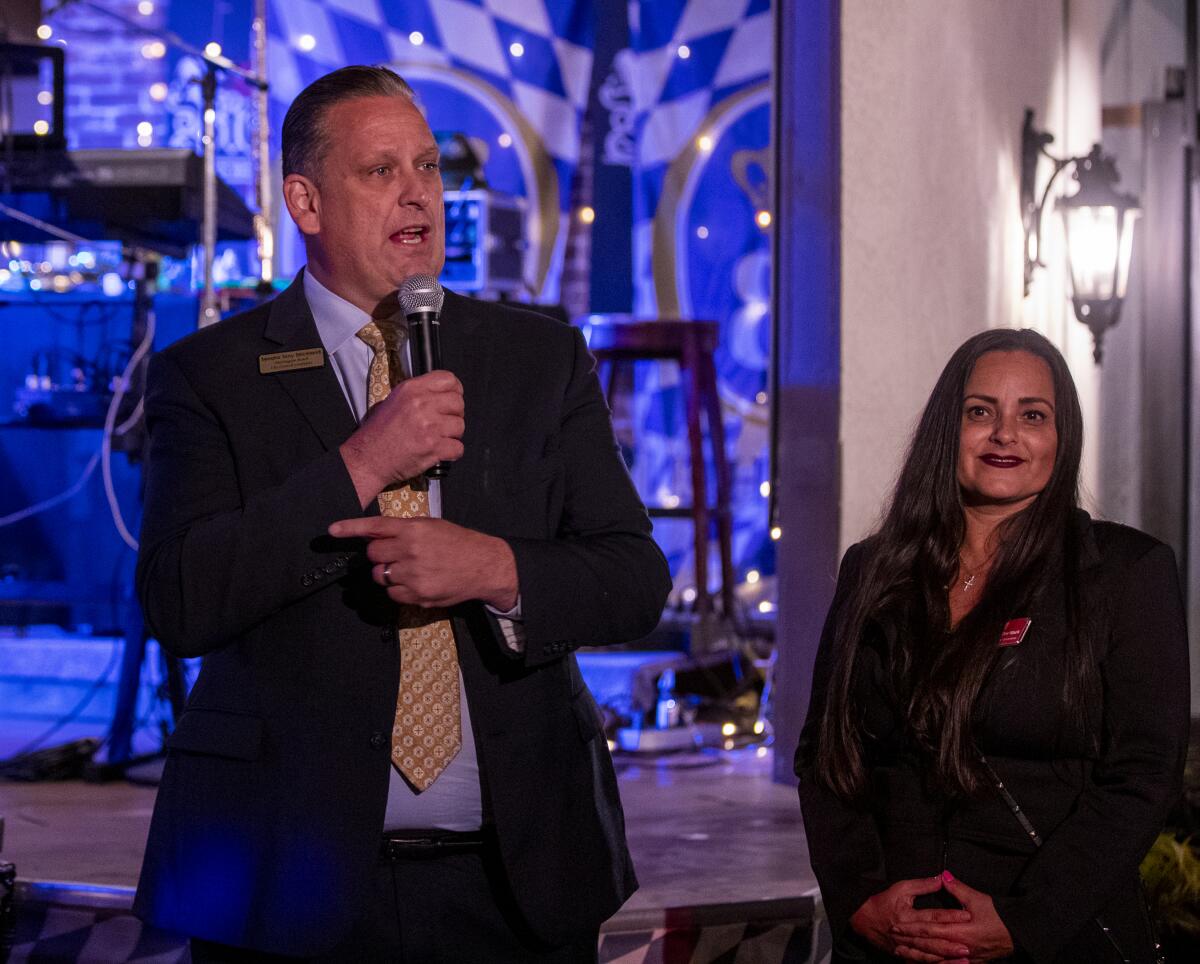
Then-City Council candidates Tony Strickland, left, and Gracey Van Der Mark attend a “meet and greet” event in Huntington Beach in 2022.
(Allen J. Schaben / Los Angeles Times)
Better not tell anyone in H.B. you’re an immigrant, Steve!
California Republican Party Chairwoman Corrin Rankin is confident the Huntington Beach crew can win.
“What happened there proves that conservative leadership works,” she said. “Currently, we have a former mayor of San Francisco who’s the governor. You look at the contrast of how each of those cities are.”
Strickland, who is Hilton’s campaign chair, swears that he and his former colleagues didn’t plan to take their crusade statewide, but “when you do a great job, other opportunities present themselves.”
“I think California is on the wrong track — most think that,” he added. If his team pulls off a November sweep — governor, attorney general, Assembly seat and the voter ID proposition — “it would be known as the major turnaround in the Golden State that made it golden again.”
Does drinking Surf City’s water grant you magical powers, too?
It’s easy to dismiss what Strickland, Gates and the others have created as a lucky local run that’s about to crash into the reality of running statewide as a Republican. Even in Huntington Beach, residents tired of perpetual culture wars rejected two ballot measures last year seeking to give the City Council more control over a municipal library system that Van Der Mark long claimed was essentially providing pornography to children.
But if there’s one thing I’ve learned while tracking H.B.’s ever-aggrieved conservatives for a quarter century, it’s to never underestimate them — the more you do, the more they fume, the more they scheme. They plan with the discipline of a Dodgers World Series team and brawl like hometown hero and mixed martial arts legend Tito Ortiz, who was on the council for a few months in 2021 before stepping down because he said the job “wasn’t working for me.”
Gates, 51, is so Huntington Beach that he looks it: Bull-necked. Blue-eyed. Bro-y. No-nonsense haircut. An aw-shucks countenance barely hiding a righteous anger that seeks to pile-drive progressive California into submission.
“I know what it looks like to be from a working-class family, a hardworking family, and find it very difficult to make ends meet,” said Gates, noting that his Irish American parents sometimes had to grab food and diapers for their children from the St. Bonaventure Catholic Church pantry. “So frankly, let’s take control away from the government and give control back to the working-class people.”
Fullerton College political science professor Jodi Balma teaches her students about Huntington Beach as an example of how “the power of a slate can really work” in an era of polarization. But when I asked if she thought the Surf City insurgents could upend California politics, the professor quickly said, “No.”
A majority of California voters think the state is heading in the wrong direction, and the number of undecided voters in elections ranging from California governor to the L.A. mayor’s race is putting the fear of God into Democratic leaders. But how deluded can Strickland and company be to think that aligning themselves more with President Trump — who just endorsed Hilton — is a winning strategy in a state where Democrats outnumber Republicans by nearly 2 to 1? And propping up Surf City — a wealthy beach town so full of itself that it makes Santa Monica seem as humble as Santa Ana — as the last, best hope to save California?
Hilton demurred when I asked if he agreed with everything his pals on the City Council have done over the years. “I’m not there, so I don’t see the day-to-day operation,” was his weak salsa reply.
Gates was more forthright.
“I think probably everybody in city leadership would admit the library thing got out of control,” he said. By then, Gates was working for the Department of Justice in Washington as a deputy assistant attorney general in the civil rights division, resigning after just 10 months because he said he missed home.
Sand art at Huntington City Beach in 2020.
(Raul Roa / Los Angeles Times)
Gates talked a good talk for most of our hourlong conversation. He and Hilton are pushing especially hard for Latino voters — they “can save California because they understand that new leadership can turn the state around.”
But for everything Gates said that might appeal to a frustrated Democrat like me, his Huntington Beach braggadocio continually won out.
He alternately hailed his own political astuteness (“You be patient, bide your time, be disciplined, keep your mouth shut. The long game will win.”), brought up transgender issues (“I want to protect our young girls. I want to stop all the mutilation surgeries happening in hospitals to our young people.”) and inveighed against out-of-control Democrats (“[Californians are] abused. And honestly, we’re pissed off. We’re getting really mad.”).
Most of all, Gates proclaimed time and time again just how darn special Huntington Beach is.
“We love our freedoms. We love flying our American flags,” he said. “We love our beach. I don’t know, it’s a different culture here.”
SCOTT Mills will not be performing DJ sets at Boyzone concerts this summer after being removed from the lineup.
Mills, 53, was sacked from the BBC two weeks ago following a probe into his personal conduct – seven years after a police probe into alleged sexual offences with a boy under 16 that was later dropped for lack of evidence.
Sign up for the Showbiz newsletter
Thank you!
Scott Mills was sacked by the BBC two weeks agoMills has now been removed from summer DJ setsThe gigs were due to be held at Arsenal’s Emirates StadiumCredit: EPA
The former BBC presenter had been lined up to spin the decks at Boyzone’s massive shows at the Emirates Stadium in June.
Back in February, Arsenal announced Mills would support the Irish boyband across two nights of their “Two For The Road” concerts.
But in a dramatic U-turn, the club has scrubbed any mention of Mills from its site and it is understood he will no longer appear at the North London venue.
On promotional material, Mills was quoted as saying: “What a dream to support the lads this summer, it’s going to be 2 nights of big tunes, big singalongs and plenty of 90s nostalgia. I hope you’re ready!”
Last week the BBC launched an internal investigation into why he was allowed to stay on air.
In a statement they confirmed The Sun’s exclusive that bosses were aware Mills was being investigated by the Metropolitan Police years ago and was now trying to unravel who knew what and when.
Mills later released his own statement and said: “An allegation was made against me in 2016 of a historic sexual offence which was the subject of a police investigation in which I fully cooperated and responded to in 2018.
“As the police have stated, a file of evidence was submitted to the Crown Prosecution Service, which determined that the evidential threshold had not been met to bring charges.
“Since the investigation related to an allegation that dates back nearly 30 years and the police investigation was closed seven years ago, I hope the public and the media will understand and respect my wish not to make any further public comment.”
The BBC are expected to announce Mills’ replacement for his Radio 2 Breakfast Show in the coming weeks.
He was honoured with the silver plaque on his final day at Radio 1 in 2022, with the 82A studio he broadcast from renamed as 82 Mills.
Insiders said the plaque, which was up in the studio, had quietly been removed over the Bank Holiday weekend.
Mills was axed on March 24 after new evidence emerged relating to an investigationMills said in a statement that he fully co-operated with a police investigation in 2018Credit: Shutterstock Editorial
SACRAMENTO — Former Assemblyman Tom McClintock, a Ventura County conservative Republican and anti-tax crusader, today will announce plans to run for state controller.
A staunch critic of waste in government spending, McClintock is trying to recapture public office after losing a congressional bid last year to Democratic Rep. Anthony C. Beilenson in a district that encompasses most of Thousand Oaks.
McClintock, 37, a Republican who represented Ventura County in the Legislature for a decade ending in 1992, said Wednesday that he considers the controller’s post the perfect outlet for his vision of government reform.
“The more I looked at the controller’s office, the more it became clear that everything I want to accomplish in public office falls in its purview,” McClintock said. “And that is to identify, expose and eliminate waste throughout the state bureaucracy.”
Up to this point, the outspoken director of the Center for the California Taxpayer had been mentioned in conservative circles as a possible challenger to Gov. Pete Wilson in next June’s Republican primary.
McClintock admitted he was tempted to seek the governor’s seat, but decided the state controller’s office was more winnable.
“I came to the conclusion that Wilson can probably be beaten in the Republican primary and (Democrat Kathleen) Brown can probably be beaten in the general election, but they can’t both be beaten.”
Just as he often assailed fellow state lawmakers during budget debates, McClintock has not been shy about criticizing the governor. In a scalding opinion article published earlier this year, McClintock said Wilson was so tainted by tax increases, deficit spending and state budget shell games that former Democratic Gov. Edmund G. (Jerry) Brown Jr. actually made a better Republican than Wilson.
Sometimes described as strident and unyielding in his views, McClintock is also known for putting forth specific proposals to cut through what he contends is a thicket of government overspending and excessive taxation.
“I have issued very precise warnings of the deterioration of the fiscal condition of the state and proposed literally hundreds of spending reforms totaling billions of dollars of savings,” he said Wednesday. “The controller’s office is the ideal office from which to wage a crusade to eliminate government waste.”
But other lawmakers have at times accused McClintock of using inaccurate data to drive home his points. Two years ago, for example, state Sen. Gary K. Hart (D-Santa Barbara) asked Legislative Analyst Elizabeth Hill to check McClintock’s figures, and she was unable to verify them.
While pursuing the office of California’s chief fiscal watchdog, McClintock said he plans to take a leave of absence next spring from the taxpayer advocacy group he heads in Sacramento. He said he will continue to maintain his Thousand Oaks residence, although he lived and worked in the Sacramento area for the past year.
He is the first prominent Republican to enter the race for state controller, the $90,000-a-year post that accounts for and disburses state money. Democratic State Controller Gray Davis is leaving the job to run for lieutenant governor.
Also running for state controller are Democrats Rusty Areias, an assemblyman from San Jose, and Brad Sherman of Granada Hills, who is chairman of the State Board of Equalization.
It’s not the first time the comedian has spoken out about his friendship with Britain’s Got Talent judge Amanda Holden, after fans raised the same question
13:26, 22 Mar 2026Updated 15:45, 22 Mar 2026
Amanda Holden was surprised that fans had doubted their chemistry
Amanda Holden‘s co-star and friend Alan Carr has set the record straight about their on-screen chemistry. The duo front a BBC travel series, in which they help renovate properties across Greece, Italy, and Spain. Along with their hard work, viewers have warmed to the pair’s humorous ways and heartfelt conversations – including a recent sad discussion about Amanda’s stillborn son Theo.
Joining Alan on the latest edition of his podcast, Life Is A Beach, Bob Mortimer discussed what it was like working with his co-star Paul Whitehouse on their series Mortimer and Whitehouse: Gone Fishing.
After admitting that they couldn’t present in a traditional way, he said the duo decided to take a more natural approach – one that has worked well over the years. “They just like it when we’re chatting,” he told Alan, to which he agreed.
“Yes, that’s true – it’s the chemistry people want, and you can’t fake that,” he went on to say.
Alan added that he’s often asked whether he genuinely likes Amanda, despite their obvious camaraderie on TV. “I mean, people go, ‘Do you really like Amanda?’ I couldn’t be in 40-degree heat in Greece knocking down a partition wall with someone I hate.
“Why would I sign up for that? You have to actually like the person, more than like, you have to really go, ‘Oh hello Amanda, right let’s have a laugh, what have you been up to?’ And I think you can’t actually fake that,” he clarified.
This isn’t the first time Alan has addressed questions about their friendship. On a previous episode of the show, Amanda was surprised that fans had doubted their chemistry.
Alan joked that viewers often comment on her distinctive laugh and ask how he “puts up” with it, to which she quipped: “This is an outrage!”.
Clarifying any lingering doubts, Alan added: “No, no, no. We couldn’t do this job if we didn’t like each other – it would be hell.” Amanda added: “There’s not a single other person I could do it with,” to which he replied: “No, it would have to be you.”
While the pair have enjoyed a successful run on the BBC show, they recently snubbed the idea of presenting Strictly Come Dancing together.
Amid speculation that they might replace Tess Daly and Claudia Winkleman, Amanda confirmed on her Heart Radio Breakfast Show with Jamie Theakston: “I want to say now that me and Alan are 100 per cent not doing Strictly. We’re so flattered to be in that mix, but we both are not doing it.”
Speaking to The Daily Mail, the Britain’s Got Talent judge insisted she also wouldn’t be able to fit the role into her already busy schedule juggling family life and her career.
“You see, I am already part of a big show, and I’ll happily carry on watching Strictly from the comfort of my lounge, but it takes up too many weekends, I’ve got to remember that I have children and a husband,” she revealed.
“But I just hope that they still have two females doing it, that’s my big thing. They need somebody super funny, and somebody that you wouldn’t expect.”
Putting forward who she believes could be good for the positions, she suggested The One Show’s Alex Jones, BBC Radio star Zoe Ball and comedians Katherine Ryan and Daisy May Cooper.
Movsar Evloev rallies after a point deduction against the unbeaten Lerone Murphy to win the contest in London.
Published On 22 Mar 202622 Mar 2026
Russia’s Movsar Evloev overcame a point deduction for a foul to edge a majority decision win over Lerone Murphy at Saturday’s UFC Fight Night 270 at the O2 Arena, likely punching his ticket to a title fight against featherweight champion Alexander Volkanovski in his next bout.
With the two fighters putting their undefeated records on the line to decide who will face the 37-year-old Australian Volkanovski for the belt, the bout turned into an intriguing clash of styles.
Recommended Stories
list of 3 itemsend of list
Evloev, who is known for his wrestling, tried to showcase his striking, while Murphy displayed some superb defensive work on the ground.
Murphy evaded the fearsome grappling attack of his Russian opponent for the first two rounds of the five-round bout, using a selection of stiff right hands to keep him at bay. Evloev took the chance to exhibit some of the dangerous spinning strikes he has added to his repertoire since his last fight in December 2024.
Evloev finally managed to take the fight to the mat early in the third round, but Murphy was quickly back to his feet, uncorking a spinning back kick of his own shortly afterwards.
However, it was his opponent who finished the frame strongest with a big overhand right, followed up by a flurry of strikes.
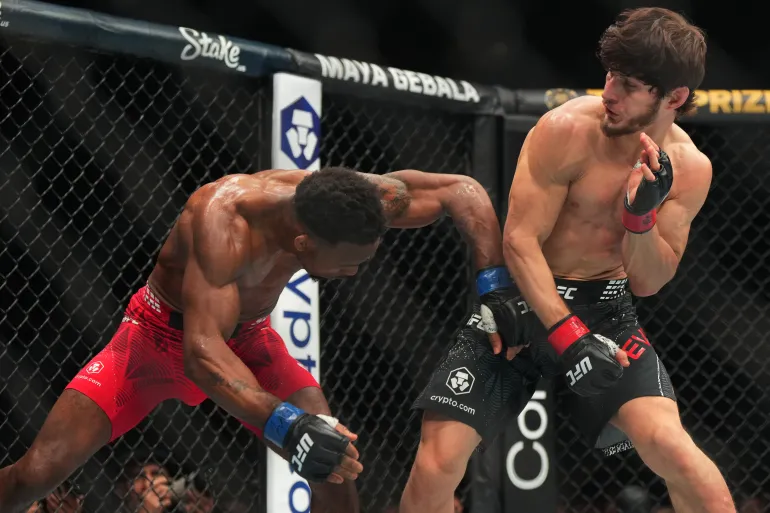
Evloev, right, lands a punch against Murphy during the UFC Fight Night 270 main event at the O2 Arena [Peter van den Berg/Imagn Images via Reuters]
His momentum was derailed somewhat when he landed a second kick to Murphy’s groin early in the fourth round, and referee Marc Goddard deducted a point from Evloev for the foul.
Knowing that the deduction could be decisive if the fight went to the judges’ scorecards, Evloev turned up his energy-sapping grappling attack in the fifth and final frame as he chased a finish, but again Murphy was able to get back to his feet with relative ease.
Despite not really threatening to submit his opponent on the ground, it proved to be enough for the 32-year-old Evloev, with two of the judges scoring the fight 48-46 in his favour and the third scoring it a draw 47-47 after the point deduction was taken into account.
Murphy reacts following his first career defeat in UFC [Jasper Wax/Getty Images]
Walt Disney Co.’s incoming president and chief creative officer, Dana Walden, has unveiled her leadership team, which includes several familiar faces from the company’s film, television and marketing units.
Walden will become Disney’s first woman president on Wednesday. She will report to Josh D’Amaro,who will succeed Bob Iger as Disney’s chief executive, following the company’s annual meeting with shareholders and its high-profile leadership handoff.
Walden’s senior team includes her longtime creative partner, Alan Bergman. As chairman of Disney Entertainment and Studios, Bergman will continue to oversee Disney’s film studios, including production, marketing and distribution.
Bergman also will retain oversight of Disney’s streaming programming in concert with Walden.
Disney executives Joe Earley and Adam Smith were named co-presidents of Disney’s entertainment direct to consumer offerings — Disney+ and Hulu. Both executives will be responsible for strategy and financial performance and report to Walden and Bergman.
Earley and Walden worked together when they were Fox executives; Earley will also serve as head of content strategy.
Smith continues in his role as Disney Entertainment chief product and technology officer. He also will continue to collaborate with ESPN Chairman Jimmy Pitaro on matters related to ESPN and ESPN+.
Debra OConnell will step into a newly-formed role as chairman of Disney Entertainment Television.
She will have a broad TV portfolio that includes ABC Entertainment, Disney-branded cable channels, Hulu Originals as well as programming from National Geographic, 20th Television and 20th Television Animation.
OConnell will continue to oversee ABC News and the ABC-owned television stations, including KABC-TV Channel 7 in Los Angeles.
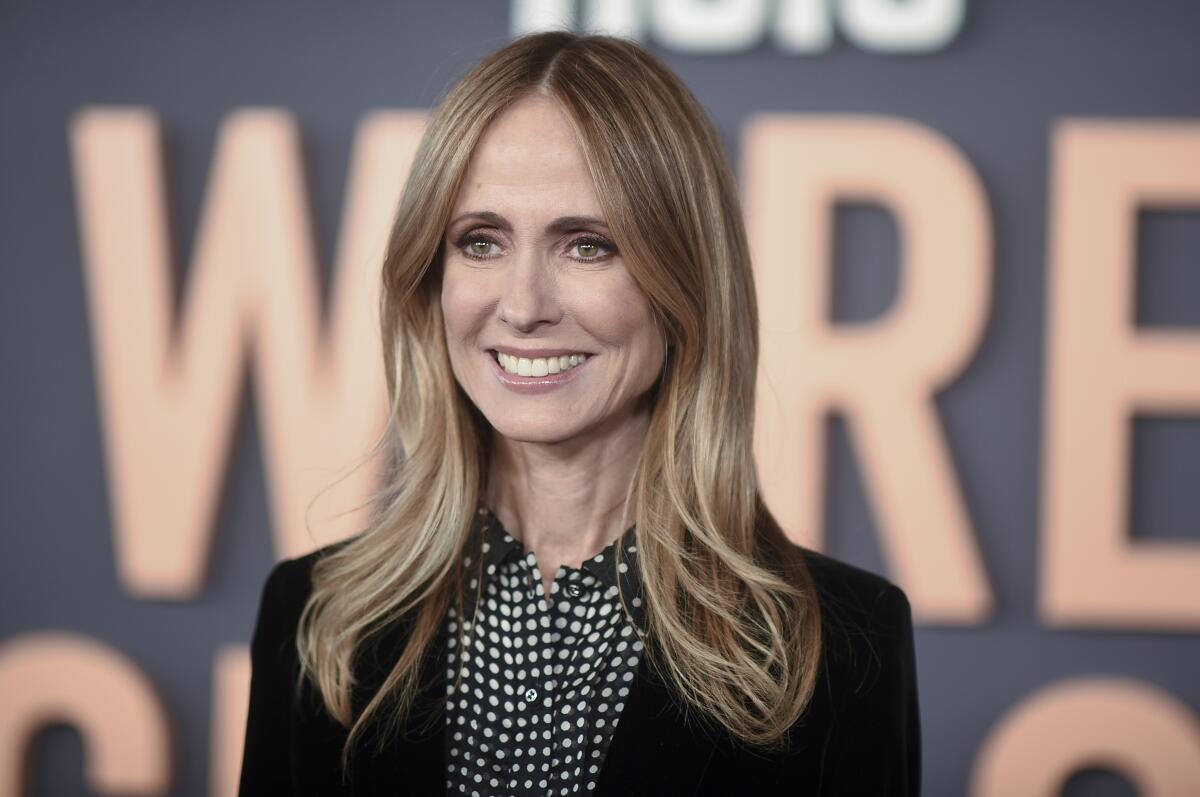
Disney’s incoming president Dana Walden has established her senior leadership team.
(Richard Shotwell/Richard Shotwell/Invision/AP)
Sean Shoptaw, who serves as executive vice president for games and digital entertainment, and his organization, will shift from Disney Experiences and into Walden’s division.
Shoptaw oversees Disney’s games business and its collaboration with Epic Games to develop a Disney universe connected to Fortnite.
John Landgraf remains chairman of FX and will continue to report directly to Walden.
Asad Ayaz, who is chief marketing and brand officer, has an influential remit across Disney’s various business segments. He will report to D’Amaro and Walden.
“The strength of Disney has always been the emotional connection between our stories and the people who love them,” Walden said in a statement. “As fans engage with Disney across more formats and platforms than ever before, we are bringing together the full power of our creative businesses to build an even more connected experience for audiences.”
Iran stepped up its targeting of Gulf neighbors, attacking and setting on fire a fuel tank close to Dubai International Airport, forcing flights to be suspended, and the key Fujairah oil export hub on the UAE’s east coast, on the supposed “safe” side of the Strait of Hormuz. Photo by Stringer/EPA
March 16 (UPI) — Emergency services in the United Arab Emirates were battling a major blaze at the country’s strategically key Fujairah oil export hub on Monday morning after the second drone strike on the facility in two days.
Emirate of Fujairah authorities said in a post on X that no one had been hurt in the attack on the Fujairah Industrial Petroleum Zone and that efforts were ongoing to bring the fire under control. They appealed to people to refrain from spreading misinformation.
“Civil defense teams in the Emirate immediately responded to the incident and are continuing their efforts to control it. The competent authorities call on the public not to circulate rumours and to obtain information only from official sources,” wrote the Fujairah Media Office.
The facility is strategically important because it is the only oil export terminal on the UAE’s eastern coast, located on the Gulf of Oman, the “good” end of the Strait of Hormuz.
Critically, it means oil tankers servicing the port do not need to run the gauntlet of the 21-mile-wide sea lane that Iran has effectively closed.
An approximately 250-mile-long cross-country oil pipeline from Habshan, a key onshore field 80 miles southwest of Abu Dhabi, feeds as much as 1.8 million barrels per day of crude into Fujairah.
However, Iran’s Islamic Revolutionary Guard Corps threatened ports, docks, military facilities and other “legitimate”U.S. targets in the UAE while the state media uged workers and residents in and around Fujairah, Jebel Ali and Khalifa ports to evacuate due to the presence of U.S. military forces.
Monday’s incident, following on from a separate strike and fire on Saturday, highlighted how exposed Fujairah — one of the world’s key crude oil and fuel storage hubs — was to Iranian threats.
The UAE has been repeatedly targeted by Iranian drones and missiles since the United States launched its airborne offensive against Iran on Feb. 28.
A drone attack earlier Monday that forced the temporary grounding of all flights at Dubai International Airport after a fire erupted in a fuel tank close by and an announcement by Israel that it was nowhere near done with hitting Iran indicated the war was likely headed into a third week.
Israel also announced plans for an expansion of its ground offensive in Lebanon against Hezbollah operatives and strongholds after the Iranian proxy group attacked Israel with rockets and missiles on March 2, two days into the war.
An Israeli bombing campaign and targeted actions by ground forces has already forced hundreds of thousands of civilians in the country to flee their homes and killed more than 850, more than 170 of them women and children, according to the Lebanon Health Ministry.
European Union foreign ministers were set to meet on Monday in Brussels to discuss the situation in the region as oil prices continued their upward trajectory with the benchmark Brent crude futures briefly hitting $106 per barrel during trade on Monday.
Shipping of oil, gas and all cargo through the Strait of Hormuz remains stalled despite calls by U.S. President Donald Trump at the weekend for countries that get their oil from Gulf producers to step up and help restart movement of ships in and out of the Persian Gulf.
Iranians attend a funeral for a person killed in recent U.S.-Israel airstrikes at Behesht-e Zahra cemetery on the southern outskirts of Tehran in Iran on March 9, 2026. Photo by Hossein Esmaeili/UPI | License Photo
Medvedev, who arrived in the US after leaving the UAE via Oman amid Iranian attacks, ends world number one’s 16-match run.
Published On 15 Mar 202615 Mar 2026
Share
Daniil Medvedev has handed top-seeded Carlos Alcaraz his first loss of the year and advanced to the final at the Indian Wells Open after arriving at the tournament from the midst of the ongoing conflict in the Middle East.
The 11th-seeded Medvedev advanced with a 6-3, 7-6 (3) victory on Saturday and will face second-seeded Jannik Sinner, who beat Alexander Zverev 6-2, 6-4 in the California-based tournament.
Recommended Stories
list of 3 itemsend of list
Alcaraz had won 16 straight matches this year, including titles at the Australian Open and Qatar Open, but Medvedev ended the possibility of an Alcaraz versus Sinner final.
Medvedev had dropped his last four meetings against Alcaraz, including a loss in the Indian Wells final in 2024. This was Medvedev’s first victory over him since the US Open semifinals in 2023.
The Russian player was stuck in the United Arab Emirates for three days following his title win at the Dubai Tennis Championship on February 28, the day the United States and Israel attacked Iran to launch a region-wide conflict.
Medvedev’s participation in the premier US West Coast-based tournament looked doubtful after he was unable to leave Dubai for two days due to airspace closure.
The 30-year-old was able to exit on the third day by crossing over into Oman by land after a six-hour drive along with fellow players Andrey Rublev and Karen Khachanov.
From Oman, the players boarded a flight to Istanbul before leaving the Turkish city to arrive in the US two days before their opening matches at Indian Wells.
“You feel like you’re in a Hollywood movie,” Medvedev told the Russian media outlet Bolshe of his multi-leg journey to arrive at the tournament that he seemed likely to miss.
Medvedev had been scheduled to play in the Eisenhower Cup, a one-night Tie Break Tens doubles event alongside fellow Russian Mirra Andreeva on March 3, but missed the exhibition event.
Alcaraz, right, congratulates Medvedev after their semifinal in Indian Wells, California [Mark J Terrill/AP Photo]
Meanwhile, Sinner made quick work of Zverev in the second semifinal, beating the German in one hour, 23 minutes. Sinner notched six aces against the fourth-seeded Zverev.
Zverev won his first eight points on serve. But Sinner broke Zverev in the fifth and seventh games to secure the first set. Sinner now leads the head-to-head series against Zverev 7-4.
Neither Medvedev nor Sinner has dropped a set yet in this tournament. Sinner has won his last three matches against Medvedev, including the US Open quarterfinals in 2024.
In the women’s doubles final, Taylor Townsend and Katerina Siniakova beat Anna Danilina and Aleksandra Krunic 7-6 (4), 6-4. The victory marked Townsend’s first at Indian Wells and Siniakova’s second. Siniakova also won in 2023 alongside longtime partner Barbora Krejcikova.
In the men’s doubles final, Guido Andreozzi and Manuel Guinard topped Arthur Rinderknech and Valentin Vacherot 7-6 (3), 6-3. In mixed doubles, Belinda Bencic and Flavio Cobolli beat top-seeded Gabriela Dabrowski and Lloyd Glasspool 6-3, 2-6, 10-7.
Sinner celebrates after his win over Zverev [Mark J Terrill/AP Photo]
Iranian President Masoud Pezeshkian has laid out terms for ending the war with the United States and Israel in what analysts say is a possible sign of de-escalation from Tehran as the US-Israel war on Iran entered its 13th day on Thursday.
In a post on Wednesday on social site X, Pezeshkian said he had spoken to his counterparts in Russia and Pakistan, and that he had confirmed “Iran’s commitment to peace”.
Recommended Stories
list of 4 itemsend of list
“The only way to end this war – ignited by the Zionist regime & US – is recognizing Iran’s legitimate rights, payment of reparations, and firm int’l guarantees against future aggression,” Pezeshkian wrote.
This is a rare posture from Tehran, which has maintained a defiant stance and initially rejected any possibility of negotiations or a ceasefire when war broke out nearly two weeks ago.
Pezeshkian’s statement comes as pressure mounts on the US to halt what has become a very costly mission. Analysts say speculation from Washington that Iran would quickly submit after the killing of Supreme Leader Ayatollah Ali Khamenei were misguided.
Tehran is likely going to determine the end of this war, not the US or Israel, because of its ability to inflict economic pain broadly, they say.
Amid a military pummelling by the US and Israel, Iran has launched heavy retaliatory strikes at US assets and other critical infrastructure in Gulf countries, upsetting global supplies. It has also adopted what analysts call “asymmetric” tactics – such as disrupting the critical Strait of Hormuz and threatening US banking-linked entities – to inflict as much economic pain on the region and wider world as it can.
This is what we know about Pezeshkian’s stance and what the pressures are on both sides to draw the conflict to a close, quickly.
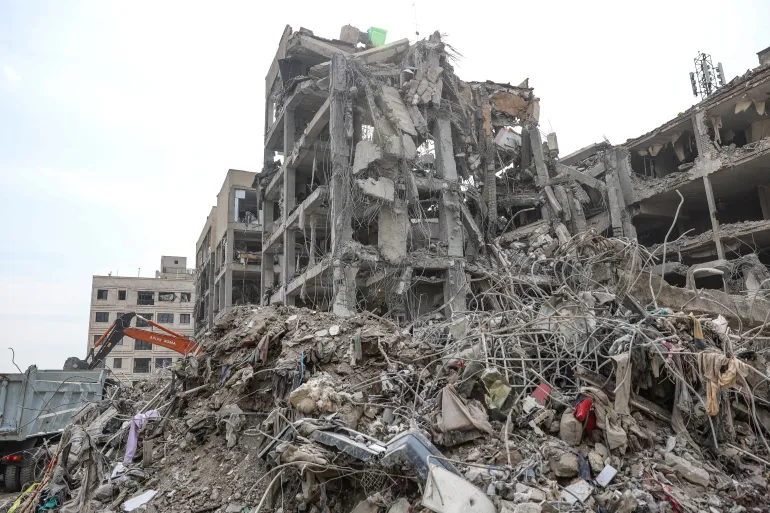
A building lies in ruins after a strike, amid the US-Israeli conflict with Iran, in Tehran, Iran, on March 12, 2026 [Majid Asgaripour/WANA (West Asia News Agency) via Reuters]
What has the war cost so far?
Economically, both sides have weaponised energy. Israel first targeted Iran’s oil facilities in Tehran on March 8, prompting an outcry from global health experts over the potential risk of air and water pollution.
Iran has, meanwhile, tightened its chokehold on the Strait of Hormuz shipping route – the only route to open sea for oil producers in the Gulf – with its military promising on Wednesday that it has the capabilities to wage a long war that could “destroy” the world economy.
Attacks on ships in the strait, through which about 20 percent of global oil and gas traffic normally passes, have effectively closed the route.
Oil prices rocketed above $100 per barrel late last week, up from around $65 before the war, with ordinary buyers feeling the increases at pumps in the US, Europe and parts of Africa.
On Wednesday, Iran upped the ante, saying it would not allow “a litre of oil” to pass through the strait and warned the world to expect a $200-per-barrel price tag.
“We don’t know how quickly it’ll revert back,” Freya Beamish, chief economist at GlobalData TS Lombard, told Al Jazeera. “We do think it’ll revert back to $80 in due course, but the ball is to some degree in Iran’s court,” she said, adding that because Iran needs oil revenue, the price hikes are expected to be time-limited.
The International Energy Agency agreed on Wednesday to release 400 million barrels from the emergency reserves of several member states but it is not yet clear what impact that will have, nor how quickly this quantity of oil can be released.
Tehran has also been accused of directly attacking oil facilities in neighbouring countries this week. Iraq shut all its oil port operations on Thursday after explosive-laden Iranian “drone” boats appeared to have attacked two fuel tankers in Iraqi waters, setting them ablaze and killing one crew member.
A drone was filmed striking Oman’s Salalah oil port on Wednesday, although Tehran has denied involvement.
What are Iranian officials saying about ending the war?
There has been conflicting messaging from the Iranian leadership.
Iran’s elite army unit and parallel armed force, the Islamic Revolutionary Guard Corps (IRGC), continues to show defiance, issuing threats and launching attacks on Israel and US military assets and infrastructure in neighbouring Gulf countries.
However, the political leadership has appeared more inclined towards diplomacy, analysts say. On Wednesday, President Pezeshkian said that ending the war would take the US and Israel recognising Iran’s rights, paying Iran reparations – although it’s unclear how much is being asked for – and providing strong guarantees that a future war will not be waged.
In a video recording last week, he also apologised to neighbouring countries for the strikes and promised that Iran would stop hitting its neighbours as long as they do not allow the US to launch attacks from their territory.
“I personally apologise to the neighbouring countries that were affected by Iran’s actions,” the president said, adding that Tehran was not looking for confrontations with its neighbours.
However, it is not known how much sway the political leadership has over the IRGC. Hours after the president’s apology last week, air defence sirens went off in Saudi Arabia, Qatar, the UAE and Bahrain, as strikes continued on the Gulf.
So, what is Iran’s actual position?
“Iran wants to go to the end to make sure that the United States and Israel never attack Iran again … so this has to be the final battle,” Al Jazeera’s Resul Serdar Atas explained.
Indeed, the IRGC sees this as an existential war, but the timing of Pezeshkian’s statement about ending the conflict also shows Tehran is pressured economically, politically and militarily, Zeidon Alkinani of Qatar’s Georgetown University told Al Jazeera.
“These differences and divisions [between IRGC and political leaders] always existed even prior to this war but we may notice it now more, given the fact that the IRGC believes that it has the right to take the front seat in leading this regional war, which is why a lot of the statements and positions are contradicting with the official ones from Pezeshkian,” he said.
The IRGC reports directly to Iran’s Supreme National Security Council (SNSC) and not to the country’s political leadership. That council is led by Ali Larijani, a top politician and close aide to the late supreme leader, Ali Khamenei, who analysts describe as a “hardliner”.
In a post on X on Tuesday, Larijani responded to threats from Trump about attacks on the Strait of Hormuz, saying: “Iranian people do not fear your hollow threats; for those greater than you have failed to erase it … So beware lest you be the ones to vanish.”
The newly elected supreme leader, Mojtaba Khamenei, was once in the IRGC and was put forward by the unit as the next ayatollah after his father was killed on the first day of the war, analysts say. He is thus not expected to follow the reformist, diplomatic ideals of President Pezeshkian and other political leaders which his father managed to marry with the IRGC militarised stance, they say.
Mojtaba Khamenei, son of Iran’s late Supreme Leader Ayatollah Ali Khamenei, attends a gathering in Tehran on March 2, 2016. Iran marked the appointment of Ayatollah Mojtaba Khamenei to replace his father as its supreme leader with a barrage of missiles against Israel and the Gulf states [File: Rouhollah Vahdati/ISNA via AFP]
What do the US and Israel say about ending the war?
There have also been conflicting messages from the Trump administration and Israel regarding when the war mission on Iran, codenamed Operation Epic Fury, is likely to end.
Trump told US publication Axios on Wednesday that the war on Iran would end “soon” because there’s “practically nothing left to target”.
“Anytime I want it to end, it will end,” he added. He had said earlier on Monday that “we’re way ahead of our schedule” and that the US had achieved its goals, even as speculation mounts about a possible US ground mission.
On the other hand, Israel’s Defence Minister Israel Katz said on Wednesday that the war would go on “without any time limit, for as long as necessary, until we achieve all the objectives and decisively win the campaign”.
Analysts say Trump’s stance that the conflict will be quick reflects increasing pressure on his administration ahead of upcoming mid-term elections in November.
Trump’s advisers privately told him this week to find a quick end to the war and avoid political backlash, according to reporting by The Wall Street Journal. That came as polls from Quinnipiac University and The Washington Post suggested that most Americans are opposed to the war in Iran.
In his 2024 presidential campaign, Trump promised to lower prices, and inflation had stabilised at 2.4 percent ahead of the war, according to government data released on Wednesday. Analysts speculate the conflict will likely push it back up.
The US spent more than $11.3bn in the first six days of the war, Pentagon officials told lawmakers in a classified briefing on Tuesday, Reuters reported this week – nearly $2bn a day.
The Washington-based think tank, Center for Strategic and International Studies (CSIS), estimated that the war cost Washington $3.7bn in its first 100 hours alone, or nearly $900m a day, largely due to its expenditure on costly munitions.
“It’s quite ironic that [Trump] chose a war that would make affordability worse, not better,” Rebecca Christie, a senior fellow at the Bruegel think tank, told Al Jazeera’s Counting the Cost.
“Every time the US loses even one object, air defence or a plane or something like that, that represents an awful lot of money that could have been used on some of these issues that have an impact on people’s day-to-day lives in the United States.”