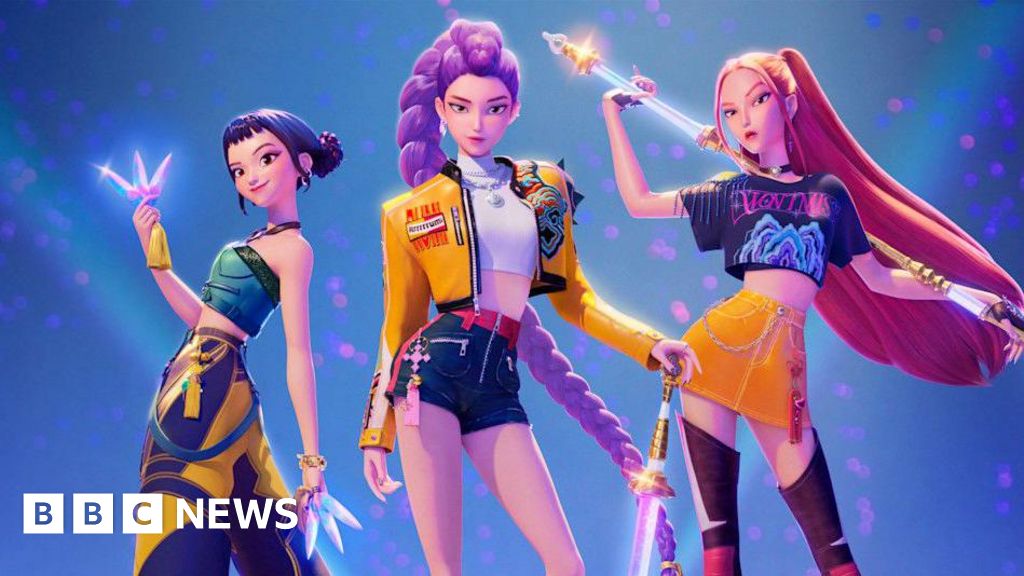
KPop Demon Hunters to return as Netflix announces sequel
The sequel brings back the co-directors of the first film, which was a smash-hit for the streaming service.
Source link
The sequel brings back the co-directors of the first film, which was a smash-hit for the streaming service.
Source link

Everyone’s getting into podcasts — even demons.
“undertone,” a muted, personal and static microbudget horror debut by Ian Tuason, takes place in the writer-director’s actual childhood home where he tended to both of his parents before they died. Both hospice and inspiration, it’s a stifling place decorated with floral wallpaper and crucifixes. The pain and exhaustion and grief are so real and oppressive, the camera never dares set a foot outside.
Upstairs, Evy (Nina Kiri), watches over her own terminally ill mother (Michèle Duquet). Tuason funneled his emotional gloom into this movie; Evy co-hosts a horror podcast with her overseas best friend Justin (voiced by Adam DiMarco). “This is the only thing keeping me sane right now,” she says. They’re words she’ll regret within the week.
Kiri and DiMarco have the comfortable, convincing chemistry of two old pals who have done a show for a while. One snippet seems to be an episode on Elisa Lam, the real-life tourist found dead in the rooftop water tank of Los Angeles’ Cecil Hotel. There’s also a reference to a website with a red-faced ghoul who hypnotizes victims into cutting off their ears. The latter may be Tuason seeding his idea for a sequel.
Here the central story is that Justin, who lives in London, has received an email with 10 audio files recorded by a couple named Mike and Jessa (Jeff Yung and Keana Lyn Bastidas) who are trying to understand what she’s saying in her sleep. The sender is unknown. (Possibly an evil spirit hoping for the exposure of a mattress ad?) Justin, the believer, is instantly alarmed by how these eerie tapes escalate from cute banter to ghostly crying babies and backward incantations. Evy is the skeptic who dismisses the noises as either an online hoax or bad plumbing.
Due to the time zone differential, Evy and Justin record their show just before he heads out to work in the morning, which for her is 3 a.m. Most of the movie takes place in that witching-hour window, an airlessly silent time where an at-home podcaster doesn’t worry about being interrupted by a leaf blower, an ice cream truck or a dog. Sound-designed by David Gertsman, “undertone” is so quiet that a tea kettle sounds like a fire alarm. Story-wise, it’s equally inert. One of the biggest action shots in the first hour comes when — eek! — a sink turns on.
I’d love to understand why horror films that I find excruciatingly dull give others the heebie-jeebies. My working theory is that they tap into audiences with a preexisting suspicion that the world is wicked — they prove paranoia to be well-founded. My mental default is that the world is neutral-good, and that may be why I prefer movies with active villains scaring me out of my complacency. I spent “Paranormal Activity” and “Skinamarink” restlessly admiring the production design; here, my main thrill came from the soundscape, like when a vibrating cellphone made my chair rattle like it was a tractor, or a noise that can only be described as death-rattle ASMR.
When Evy slips her on headphones, she’s so focused making sense of the latest scary tape, playing it forward, reversed and slowed-down, that she’s oblivious to the bumps in the night in her own house, upstairs near her comatose mother’s bedroom. I suspect Tuason deeply relates to Evy, to the disassociation of living with death every day, and uses her resistance to explore denial. She refuses to admit that the supernatural is real, even as she repeatedly takes a break to steady herself and, as she puts it, “get back into character.” Her stifled panic makes it obvious that fear is taking over.
The screenplay also has a passing reference to Evy’s useless, off-screen boyfriend Darren (voiced by Ryan Turner). Their miserable dynamic is compelling but overall comes off like a plot point Tuason stuffed in his pocket and never got around to using. Our one peek into it comes when Darren phones Evy to pressure her to ditch her mom and come to a party. He claims he’s throwing a kegger to cheer her up. (A frozen lasagna on the doorstep would be better, dude.)
Evy does reluctantly leave the house — we don’t follow her there — and that one moment says as much about crossed-signals communication as anything else in the movie. It’s bullseye-accurate about how isolating it is to lose a parent earlier than your peers.
The film is so committed to its rigors — the two-person cast, the glacial camera pivots, the moody lighting — that it teeters on the line of becoming monotonous. When Tuason eases up a bit, say in a scene in which Evy pops on a sleep podcast that begins by describing a babbling brook and rapidly becomes a nightmare tale of bobbing corpses, he finally shows you that he has the potential for range.
But “undertone” is rooted in that slow-and-still horror discipline that holds its breath waiting for something to happen. It requires the audience to bring their own bad vibes to shots of religious icons on the wall and long takes of Evy clacking on her laptop, unaware of a flickering light behind her. (Rumor is Tuason has already signed on to shoot the next “Paranormal Activity” sequel.)
Mostly it puts the audience in the position of watching a protagonist so passive that chunks of the running time are watching her sit at a table waiting for Justin to look up things for her on Wikipedia. Like amateur detectives, we learn alongside them as they click around pages about Sumerian devils, Catholic saints and the origin of the nursery rhymes “London Bridge” and “Baa, Baa, Black Sheep.”
As visuals go, “undertone” is so far removed from anything resembling the cinematic experience that I left with a fresh appreciation for campfire storytelling. At least then the listener gets to use their own imagination. But production designer Mercedes Coyle does dig up two satisfyingly creepy props: one, an antique speaking doll, the other, a small white statue that appears to be the Virgin Mary until we get a better look at her mouth, deformed by a hungry scream.
Despite my quibbles with how her character reacts when things really go awry, Kiri’s Evy has a clarity of purpose that holds our attention despite not having that much to do. In her strongest sequence, she and Justin take a few live callers on their podcast, some of whom bear bad news about Mike and Jessa, and another who phones up in the middle of a crisis that’s too big for these self-positioned experts to handle. Real violence is coming and these armchair ghosthunters are totally out of their depth. Yes, everyone is into podcasts. Maybe they shouldn’t be.
‘undertone’
Rated: Rated R, for language
Running time: 1 hour, 34 minutes
Playing: Opens Friday, Mar. 13 in wide release
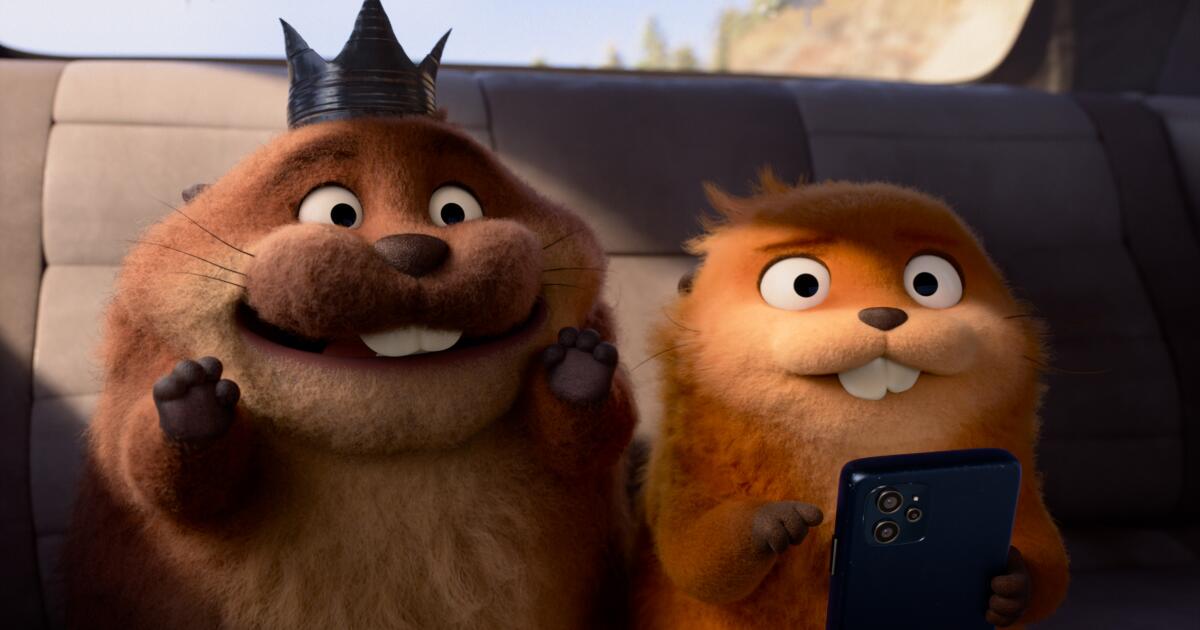
In 2020, “We Bare Bears” creator Daniel Chong came to Pixar leaders with an idea.
He had seen documentaries in which robotic animals with eyeball cameras captured footage of natural habitats. But what if that technology was so good that no one could tell the difference? And to make it even more zany — what if someone went undercover in that animal body?
That idea became the basis of Walt Disney Co. and Pixar’s new animated movie, “Hoppers,” which debuts this week. The film is Pixar’s latest attempt to break through at the box office with an original story, something that has been a struggle for the storied animation studio since the pandemic.
The pressure of Pixar’s legacy can be a little overwhelming and coming up with an original idea is difficult, said Chong, who directed “Hoppers” and also serves as a writer on the film.
“For a Pixar movie, it’s very high stakes,” he said. “But I just felt like I had a really funny idea, and I thought as long as we made it really funny and had characters you loved, to me that’s the key to every Pixar movie — really awesome characters that really connect emotionally with people.”
Recent theatrical success for Pixar as well as other animation studios has come from sequels, such as 2024’s “Inside Out 2,” which grossed $1.7 billion globally. But the reputation of Emeryville-based Pixar is built on its string of blockbuster originals, including 1995’s “Toy Story,” 2001’s “Monsters, Inc.” and 2004’s “The Incredibles,” making new stories crucial to the studio’s future.
People like coming back to familiar characters like Woody and Buzz from “Toy Story,” but the studio can do only so many sequels, said Pete Docter, Pixar’s chief creative officer. And some films don’t lend themselves to new chapters, he said, noting the studio’s efforts to look at “Monsters, Inc.”
“We’ve been trying, struggling for a long time to get somewhere with that, and we’ll see in the future how things go, but it’s been an uphill battle,” he said. “For whatever reason, that movie seems to be self contained and doesn’t want to go forward without repeating some of the same themes, which I think would be disappointing.”
Opening weekend expectations for “Hoppers” are wide-ranging, from $25 million to $40 million, on a production budget of $150 million. So far, the reviews have been strong, with a 96% approval rating on aggregator Rotten Tomatoes.
“If we don’t continue to do originals, we’re going to run out of stuff,” Docter said. “If ‘Hoppers’ can really catch on, it could show that audiences still want original movies. They’re still excited to see things that surprise them, that are not just following through on characters and worlds that they’ve seen before.”
It’s been a tough time for original animated movies — and new films in general. As the theatrical market continues to find its footing after the pandemic, audiences still largely have gravitated toward familiar fare, including sequels and reboots, even as they profess to want new stories.
Pixar’s previous original film, 2025’s “Elio” cratered at the box office, partially beset by the tough climate for new animated stories as well as strong competition from other kids’ movies such as live-action adaptations of Universal Pictures’ “How to Train Your Dragon” and Disney’s “Lilo and Stitch.”
The pandemic played a major role in Pixar’s recent track record with originals. When COVID-19 hit, original films like 2020’s “Soul,” 2021’s “Luca” and 2022’s “Turning Red” all were sent straight to the Disney+ streaming service to give families something to watch during the stay-at-home orders. But that also got audiences accustomed to waiting to watch Pixar films at home, and as theaters started opening up again, families were some of the last groups to return because of concerns about health and safety.
“There had been a conditioning process,” said Heather Holian, a professor of art history at the University of North Carolina at Greensboro. “It was challenging to turn the ship around a little bit, or getting people to rethink how they engage with Pixar films and getting them back to theaters.”
To connect with audiences, Pixar films need to feel familiar in some way, but with a surprising twist — something that is incredibly difficult to do, Docter said. “Hoppers” also involved extensive, early stage collaboration with the studio’s story artists. Chong would give them a rough idea of his thoughts, which the artists would then use to develop dialogue and other details that expanded on his vision. That’s a bit of a departure from Pixar’s typical process, which involves writing pages and giving them to the artists, who then go to work..
Chong worked as a story artist at Pixar before he went on to create Cartoon Network’s “We Bare Bears” and then returned to the studio in 2019.
“Hoppers” could get strong tailwinds from the success of Sony Pictures Animation’s “Goat,” which was produced by Golden State Warriors star Stephen Curry and tells an original story set in an all-animal world about an undersized “roarball” player who pushes to make it in the big leagues.
That film has netted nearly $75 million in the U.S. and Canada, with a global total of more than $131 million..
The two movies are the beginning of a potentially big year for animated films. After “Hoppers,” Nintendo and Universal Pictures’ sequel “The Super Mario Galaxy Movie” is out in April, followed by Pixar’s “Toy Story 5” in June and Universal Pictures and Illumination Entertainment’s “Minions & Monsters” in July. In the fall, Warner Bros. Pictures Animation plans to release “The Cat in the Hat.”
High-performing years at the box office traditionally are anchored by strong family movies, said Shawn Robbins, director of movie analytics at Fandango and founder of the site Box Office Theory.
“A lot of us are so optimistic about what the box office can do overall this year because of the animated releases,” he said. “When there is appealing content out there, families are a big driver for this industry.”