Host Mexico City declares itself the ‘soul of the World Cup’
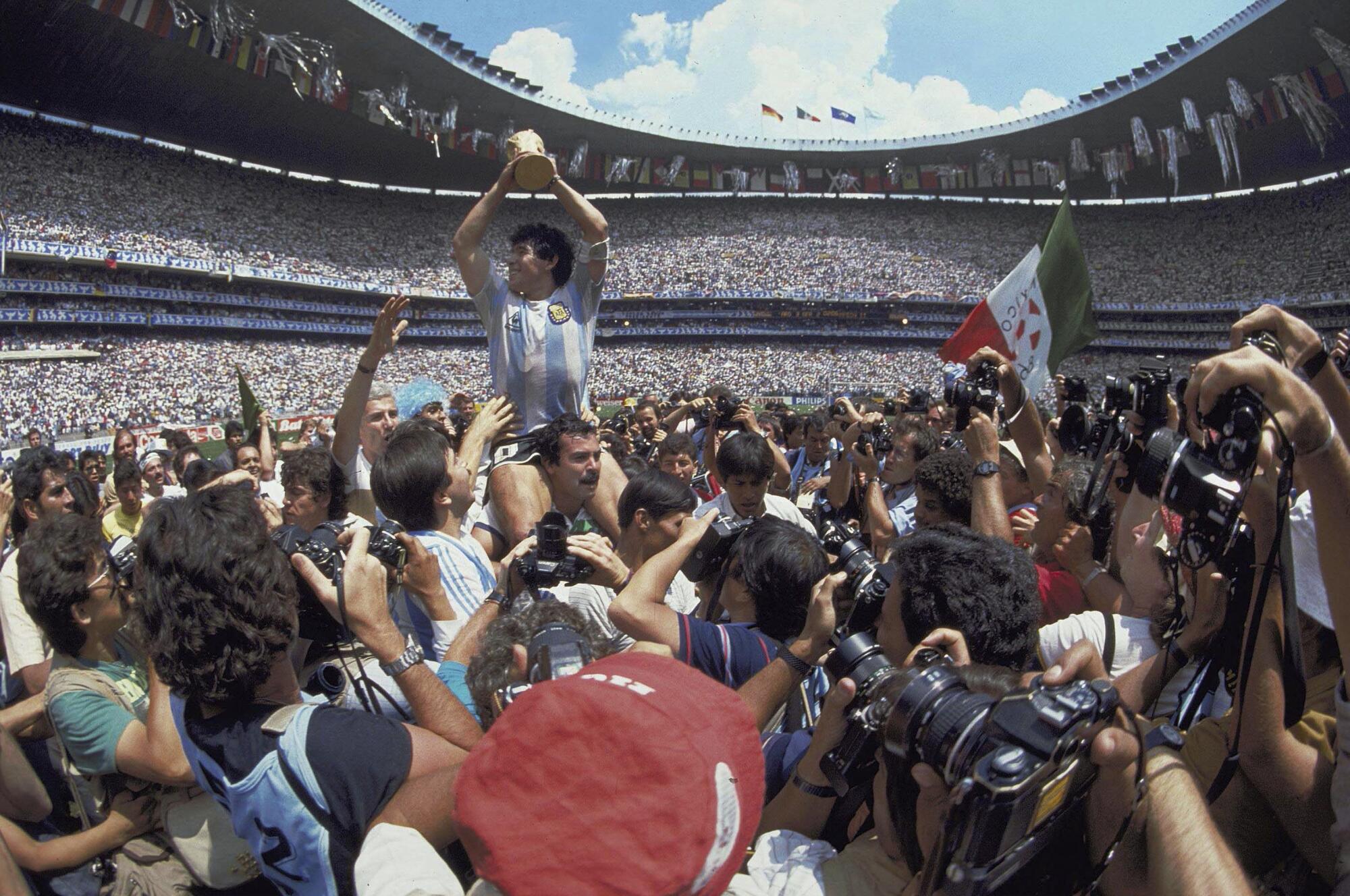
WASHINGTON, D.C. — Mexico City is finalizing preparations for the 2026 World Cup, with Estadio Azteca set to become the first venue to host matches during three World Cup tournaments. It was previously the scene of Pelé’s triumph in 1970 and Diego Maradona’s Cup win in 1986.
Neither of the other two Mexican venues existed when Mexico hosted the tournament before: The Estadio Akron in Guadalajara was founded in 2010 as the home of Liga MX team Chivas de Guadalajara, and the Estadio BBVA was inaugurated in 2015 as the home of the Liga MX team Rayados del Monterrey.

Diego Maradona holds up the World Cup trophy after Argentina beat West Germany in the World Cup final at Estadio Azteca on June 29, 1986.
(ASSOCIATED PRESS)
Mexico will face South Africa during the first match of the 2026 World Cup at Estadio Azteca, which has undergone about $80 million in renovations.
“The stadium is coming along nicely. We are working hard every day to be ready for the inauguration in March. Everything is going smoothly,” said Estefanía Padilla, head of marketing and operations for the Mexico City World Cup headquarters.
Organizers are preparing to open the renovated stadium on March 28 when Mexico will face Cristiano Ronaldo’s Portugal in a friendly match that will mark the end of the work that began in the middle of last year. The organizers also had to resolve a dispute over luxury boxes. After 18 months of litigation, the luxury box owners won the right to use them during the World Cup without paying additional fees. They demanded that an agreement dating to the stadium’s construction six decades ago, which grants them unlimited access to their seats for 99 years, be honored.
Mexico City expects to receive around 5.5 million tourists, so improvements also have been made to infrastructure, airports and transportation. Beyond that, Padilla said, the World Cup will be an opportunity to show the world the cultural richness of Mexico’s capital. In addition to the stadium, the city has developed three pillars to attract fans: culture, entertainment and experiences, with more than 36 activities planned.
“Mexico City is the soul of the World Cup,” Padilla said. “Hopefully, everyone will be able to visit. Mexico is very famous internationally for its culture and gastronomy.”
In the cultural sphere, more than 12 museums will participate in World Cup events, including the Museo Franz Mayer. There also will be an exhibition by Annie Leibovitz at the National Museum of Anthropology.
The fan festival will be set up in the Zócalo, the main public square in the historic center of Mexico City, and will feature the largest video screen among all the World Cup venues. It is expected to attract 60,000 spectators per day, more than 100,000 during Mexico’s matches and a total of about 2.5 million during the tournament.
In terms of entertainment, concerts are being planned at the National Auditorium featuring international artists and a fashion show highlighting clothing made in Mexico.

A young Mexican soccer fan blows a horn while watching a 2014 World Cup match on big screens in Mexico City.
(Rebecca Blackwell / Associated Press)
However, security concerns remain ever present in the capital, as organized crime violence has continued to plague the country in recent months, with a new wave of violence linked to drug trafficking that has affected the popularity of President Claudia Sheinbaum.
“We have developed a comprehensive plan that coordinates all levels of government. Our goal is to ensure that this event takes place in a safe environment for everyone,” said Gabriela Cuevas, federal coordinator for the World Cup, during a recent presentation alongside Sheinbaum.
Sheinbaum joined President Trump and Canadian Prime Minister Mark Carney during the World Cup draw ceremony Friday at the Kennedy Center in Washington.
Guadalajara is the ‘most Mexican venue,’ organizers say

Pelé holds a ball before Brazil’s World Cup practice in Guadalajara, Mexico, on June 5, 1970.
(GB / Associated Press)
Guadalajara will host Mexico’s second match, and it will be the first time the national team played there in a World Cup. The city’s Estadio Jalisco did previously host one of Brazil’s great teams led by Pelé in 1970.
Preparation of a newer stadium, Estadio Akron, for this World Cup began five years ago and is 85% complete. According to the organizers, the venue, which will be called Estadio Guadalajara during the tournament, is ready to host two playoff tournament games in March to determine the last World Cup spots, and then actual World Cup matches in June.
So far only minor adjustments have been made, mainly to bring the pitch up to FIFA standards.
Ainara Zatarain, director of stadium operations, said the city seeks to project itself as “the most Mexican,” with distinctive gastronomic and cultural offerings. She also highlighted the FIFA fan festival that will be set up in the city center. The state of Jalisco expects to attract 3 million tourists during the tournament, which is why 40 new hotels have been built.
Zatarain recalled that Estadio Akron was designed in the early 2000s specifically for a World Cup, completing the vision of the late Chivas owner Jorge Vergara.
“After 15 years we are fulfilling Jorge Vergara’s dream, which was to have a World Cup in the Guadalajara Stadium. For us, the changes have been minimal, and it has been more because, of course, several things have been updated over the years, such as the field that we now have in our stadium,” Zatarain said in Washington prior to the World Cup draw.
Guadalajara seeks to stand out for its cuisine, tequila, mariachis and cultural traditions.
“We say that we are the most Mexican city or the most Mexican venue,” Zatarain said. “We have an impressive gastronomic variety, and we invite you to try all the traditions and culture that we have in our state and in our city. Guadalajara is something unique.”
However, the city also faces problems with violence and transportation difficulties around the stadium.
Local authorities estimate that the World Cup will generate $1 billion for Jalisco.
Monterrey focuses on completing improvements
Monterrey, Mexico’s third host city, made significant investments in infrastructure, the airport and Estadio BBVA for the World Cup. The investments include more than $6 million in stadium renovations and $416 million in airport renovations as well as upgrades to public transportation, urban image projects and security.
Monterrey will have the newest stadium of the three Mexican venues and also will host playoff tournament matches to be played from March 23 to 31.
“The most important challenge is mobility, without a doubt … and security,” said Francisco Rodríguez, head of television and commercial rights for the Monterrey venue.
“The challenge is to coordinate mobility, provide good security and keep the city clean.”
This article first appeared in Spanish via L.A. Times en Español.