
scream

From ‘Heroes’ to ‘Scream’: Hayden Panettiere in 6 essential roles

Hayden Panettiere spent much of her life in front of a camera, beginning her acting career before she was even a year old, starring in commercials. At the tender age of 4, she landed her big break with a recurring role on the ABC soap opera “One Life to Live,” which led to a role on another soap opera, CBS’ “Guiding Light.” Over the years, she performed in a number of films and TV series, landing notable roles that made her a staple of network television. In addition to her onscreen work, she did voice acting for animated films like “A Bug’s Life” and “Dinosaur,” as well as the video game franchises “Kingdom Hearts” and “Until Dawn.”

The actor, who died Sunday at 36, was a versatile performer whose no-nonsense attitude and vocal range added depth to roles. Here is a guide to some of her notable work.

‘Remember the Titans’

Disney’s 2000 sports drama was based on the real story of Herman Boone, a Black football coach who was installed as head coach at the desegregated T.C. Williams High School in Arlington, Va., and led the team to a perfect season and state championship. In the film, Panettiere plays Sheryl Yoast, the young daughter of coach Bill Yoast (Will Patton), whose job Boone is given by the school district to placate Black community members as racial tensions rise. Panettiere’s Sheryl makes an impression right away, with a fiery speech directed at an official who comes to tell Yoast that Boone will now be head football coach of T.C. Williams. “You can’t just walk in here and take my daddy’s job away,” she cries as she stomps away, but not before kicking said official in the back of the leg. Later, she understands the implications of the decision, even if it comes at the cost of her father’s selection into the high school football hall of fame, preferring to put the team and their teamwork first: “Bunch of old rednecks … Let’s knock ‘em dead at state, coach.” (Watch on Hulu and Disney+.) — Maira Garcia

‘Ice Princess’

In Disney’s 2005 film, Panettiere was a little too good at playing the popular mean girl. She was even better at playing the popular mean girl who lets her icy walls melt away to welcome in the new girl. As talented figure skater Gennifer Harwood, Panettiere faithfully portrayed the evolution of friendships — especially for young women — in highly competitive sports and the tension between young athletes and their well-intended, but overbearing parents. While Panettiere could stand on her own talents, her performance was even more memorable for the dynamic she shared with screen partner Michelle Trachtenberg. The latter played Casey, a student with Ivy League ambitions whose interest in physics brings her to the figure skating world. Trachtenberg died in 2025 at 39. (Watch on Disney+.) — Alexandra Del Rosario

‘Heroes’

A teenage girl in a black pea coat stands next to a tall man in a dark coat outside.

Claire Bennet (Hayden Panettiere) with her father Noah (Jack Coleman), also known as H.R.G., in NBC’s “Heroes.”

(Chris Haston / NBC)

This superhero series was a hit from the moment it debuted in 2006. An international cast fueled a show that featured people gifted with superpowers around the world that had a mysteriously ominous connection. At its heart was Panettiere’s Claire Bennet. An unbreakable high school cheerleader, she embraced the role of hero, facing pushback from a shadowy government group, serial killers and a twisted family dynamic. Panettiere became the face of NBC’s freshman ensemble success story, and despite an industry work stoppage and dwindling fan support afterward, the show’s viral campaign — “Save the cheerleader, save the world” — centered her, and her character’s courage, on a bona fide fandom-generating ride that ended way too soon in 2010, after four seasons. (Watch on Netflix and Tubi.) — Jevon Phillips

‘Scream’ franchise

A woman in a black coat and dress stands in front of a wall with Ghostface and the word scream repeated across it.

Hayden Panettiere at the premiere of “Scream VI” in New York City in 2023.

(Nina Westervelt / Variety via Getty Images)

The actor joined the hit horror franchise in 2011’s “Scream 4” as Kirby Reed, a Woodsboro High student who is a horror film buff. One of that film’s memorable scenes featured Kirby in a tense trivia telephone showdown with the Ghostface killer, rushing through the titles of several slasher films while attempting to save one of her friends.

Although Kirby was seemingly killed off, she returned as an FBI agent in 2023‘s “Scream VI” when the franchise continued with younger characters and moved its setting to New York. “Scream” fans cheered during an early screening when Panettiere’s character appeared — she and Courtney Cox were one of the few “Scream” veterans to return for the new film.

Panettiere’s hair was longer and her role was expanded in the new “Scream.” Kirby explained that she had survived the Ghostface attack: “I was technically dead for four minutes. When I was revived, I got mad … I wanted the monsters to be afraid of me.”

Kirby also engaged in another trivia back-and-forth with Mindy Meeks-Martin (Jasmin Savoy Brown) where they agreed on the best “Nightmare on Elm Street” (“the original”) and that “Psycho 2” was “underrated,” but disagreed on the best “Friday the 13th” sequel. Although she is investigating a new set of Ghostface killings, Kirby later becomes a prime suspect. (Watch all on Paramount+.) — Greg Braxton

‘Nashville’

A smiling blond woman in a purple knit dress stands at a soundboard holding a pair of headphones.

In ABC’s “Nashville,” Juliette Barnes’ storyline was infused with personal struggles similar to Panettiere’s.

(Katherine Bomboy-Thornton / ABC)

Panettiere was noticeably more mature when she became a co-lead role in ABC’s “Nashville” as Juliette Barnes, a crossover singer with more than a few similarities to Taylor Swift. The music-flavored drama, which premiered in 2012, starred Connie Britton as country star Rayna Jaymes, whose career was on the downturn at the same time Barnes was climbing the charts.

The actor injects her “Nashville” character with a mix of sexiness, snark and edge as Barnes becomes rivals with Jaymes. When the two first meet in a dressing room during the pilot, Jaymes is gracious while Barnes is condescending.

Panettiere said in an interview that she was tense during that scene. particularly since it was the first time the two actors had met. She said she apologized to Britton repeatedly saying, “‘I am so sorry!’ Because it was our first experience together, and I didn’t want to step on toes. Sometimes it gets real, very real, you know?”

While filming the series, Panetierre gave birth to her daughter in 2014. She detailed her struggles with postpartum depression in interviews, saying the condition was “scary and needed to be talked about.” In the series, Barnes also suffered from postpartum depression during the show’s third and fourth seasons. (Watch on Pluto TV and Netflix.) — G.B.

‘Kingdom Hearts’

Square Enix’s beloved video game series was my personal introduction to Panettiere and her acting abilities. In the first two installments, Panettiere voiced the kind island kid turned princess Kairi for the games’ English dub. Before protagonist Sora’s (voiced by a young Haley Joel Osment) world descends into darkness, Panettiere’s Kairi is playful and tender early in “Kingdom Hearts 1.” In the slightly more complicated “Kingdom Hearts 2” Panettiere’s older Kairi is contemplative, defiant and desperate to help all her friends. Kairi’s scenes are often accompanied by the powerful score from composer Yoko Shimomura, amplifying the emotion that has driven the games’ fanbase for more than two decades.

“Don’t ever forget. Wherever you go, I’m always with you,” Panettiere’s Kairi says in a memorable cut scene. — A.D.R.
Source link

Gillian Anderson lets her inner scream queen rule

Gillian Anderson was once a young person experimenting.

“I don’t even know if I was questioning my sexuality but there were a couple of moments during my teen years where I was with women,” Anderson tells me candidly on a recent afternoon at a Beverly Hills hotel. “I haven’t really spoken about that very much.”

Though she won’t go into details about those early interactions, she remembers the isolation that plagued her. “In interviews, I’ve alluded to a relationship that I had later in my post-college life, but not about that particular time and how not even confused, but just alone I felt and how different I felt to the rest of the kids in my high school,” she adds.

For some time now, the once and forever “X-Files” star has leaned into episodic television (Netflix, she says, has become a great partner). She earned her second Emmy in 2021 for her blistering turn as polarizing British Prime Minister Margaret Thatcher in “The Crown.” Yet a major shade of her public persona has become her activism around sex positivity, encouraging women to open up about their needs and wants, both in the bedroom and as individuals in every aspect of their lives.

“It seems to still be an important topic for women to hear other women speak about,” she says. “I have come to love talking about it in the context of women’s empowerment, finding ways to embrace their own integral agency.”

Clad in a sleeveless bright green dress, Anderson, 57, radiates an ageless grace, undeniably sophisticated yet unpretentious in her demeanor. Her hair in a braid evokes the look of a figure from ancient Rome. When speaking in her unmistakable throaty voice, her expressive body language (hand movements often complement her sentences) reveals her assertiveness. That confidence makes it difficult to imagine she ever was a fragile teen.

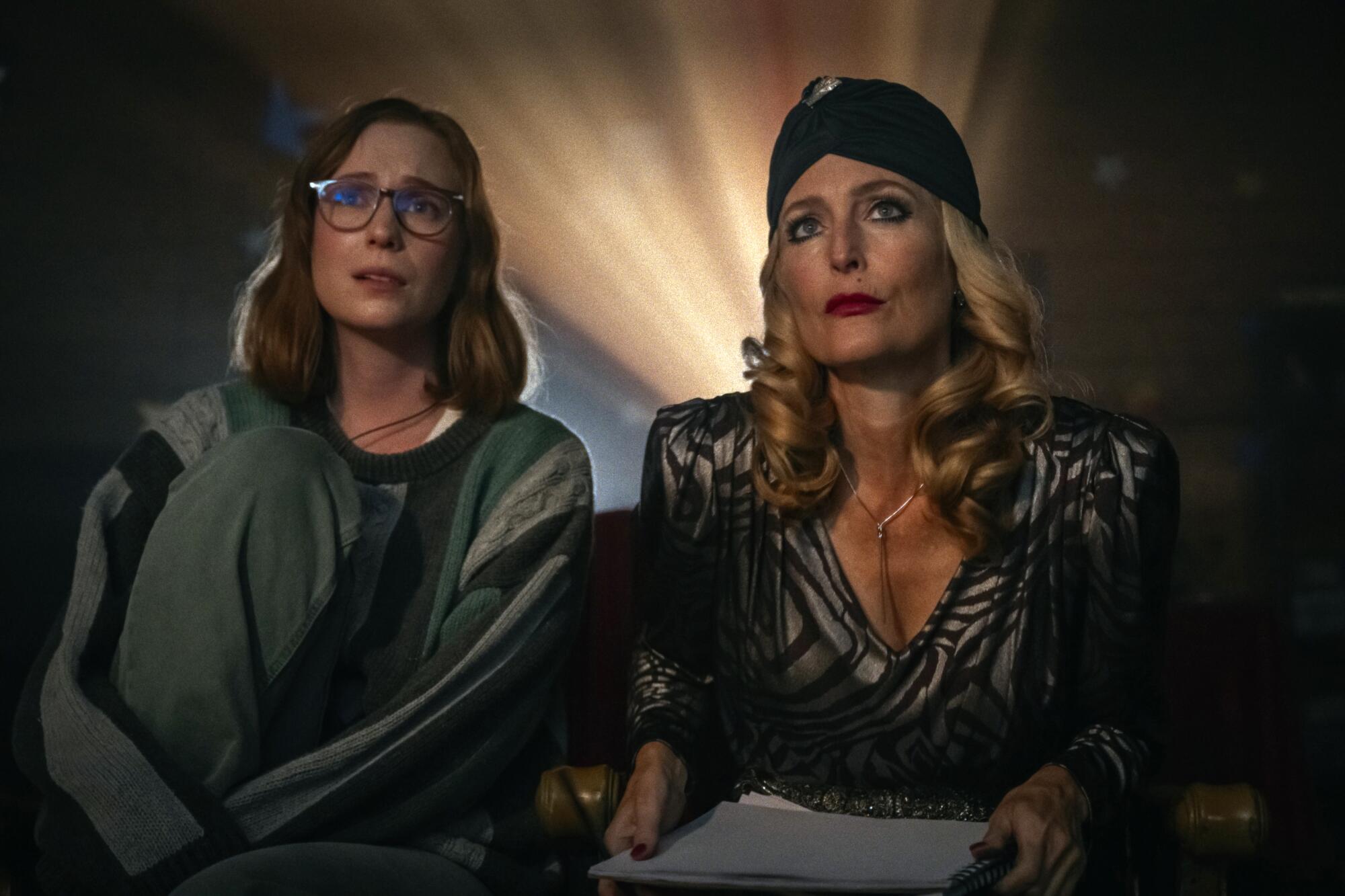
Two women watch a movie projected.

Hannah Einbinder and Gillian Anderson in the movie “Teenage Sex and Death at Camp Miasma.”

(Mubi)

In Anderson’s latest movie, the horror-tinged, dreamlike “Teenage Sex and Death at Camp Miasma” (in theaters Friday), Anderson plays Billy Presley, a reclusive former scream queen who was one of those “final girls” from a popular 1980s slasher horror franchise in which the killer was aptly called Little Death (a nickname for an orgasm, derived from a French phrase). Now Billy spends her days alone living in the woodsy location where her breakout movie was filmed long ago.

That is until auspicious indie filmmaker Kris (“Hacks” star Hannah Einbinder) comes to visit Billy with the intention of persuading her to act in a reboot. The two develop a friendship that empowers Kris to dive into her unspoken sexual yearnings — desires drenched in fear, violence and curiosity — with Billy as her mentor and, eventually, patient lover.

On top of her ability with accents (she does a Southern one here), Anderson physically commands the screen from the moment she makes an entrance worthy of a timeless diva. Her regal aura contrasts with the grotesque sensuality of a scene where fried chicken and dipping sauces take on an almost pornographic lure. Her Billy, a woman who can fluctuate between a loud cackle and an introspective speech about the lust-inducing “flesh and fluids” of horror movies, feels equal parts otherworldly and tethered to earthly urges.

“I knew on a deep level that I wanted to be a part of it, but it’s only in retrospect that I completely understand why it was so meaningful to me,” Anderson says. “It feels like such a salve for so many.”

Two blood-soaked women smile and embrace in a mini-mart.

“She put everyone at ease during those moments in a really beautiful way,” says director Jane Schoenbrun of Anderson’s work with Einbinder on their most daring scenes. “She is so physically tapped into her own abilities.”

(Mubi)

Einbinder, with whom Anderson shares scenes of blood-soaked eroticism, describes the veteran star as meticulous and diligent while also having a “lot of access to spontaneity.”

“I was a fan of her from, of course, ‘The X Files’ and a lot of her other work, so she just held this significance to me as an artist,” Einbinder tells me over the phone, “but meeting her, my expectations were surpassed because she’s really cool.”

“I didn’t want Billy to come across as a predator,” Anderson says. “I didn’t want her to be creepy or too maternal and so there were moments where she shows care, and it was a really fine line of how to play those beats. Even our first kiss and our sex scenes were very specific so that it didn’t feel not OK to be witnessing or representing.”

To Jane Schoenbrun, the movie’s writer and director, Anderson has the “elegance of old Hollywood, a classic mystique.” The filmmaker describes meeting her as a “strange coming home feeling,” since her “X-Files” character Scully held a special place in Schoenbrun’s formative years. “I spent as much time with her as I did with my siblings,” they add.

Schoenbrun credits Anderson as a “calming and nurturing presence” during the sex scenes between her and Einbinder — the first sex scenes the filmmaker had ever directed.

“Gillian had such an elegant, serious, professional but also caring perspective on how to talk about it and how to guide through it in a way that felt like it was going to be very present and alive on screen,” Schoenbrun recalls. “She put everyone at ease during those moments in a really beautiful way. She is so physically tapped into her own abilities.”

A blood-soaked actor and her director watch a take in the monitor together.

Anderson, seated with director Schoenbrun on the set of “Teenage Sex and Death at Camp Miasma.”

(David Astorga / Mubi)

Anderson found her way into playing Billy through the character’s distinct accent. Having played the tragically romantic Blanche DuBois from “A Streetcar Named Desire” on stage in the past, she aimed for a different version of Southern. “What I liked about it was this particular pitch that holds strength and vulnerability in it, which I think is very much where Billy lives at all times, from minute to minute,” she says.

Other recent TV roles have steered Anderson in the direction of an unabashedly queer storyteller like Schoenbrun. Jean Milburn, Anderson’s humorously matter-of-fact sex therapist from the series “Sex Education,” represented a watershed beginning in 2019.

It was because of the success of that show that she was approached to write “Want,” a 2024 book that collected the sexual fantasies of anonymous women (a follow-up, “More,” is out in September from Abrams Press).

“Sex Education” also inspired Anderson to launch her own brand of soft drinks cheekily called G Spot (they are caffeine-free and infused with vitamins and minerals). Some retailers, she says, have refused to use the drink’s name. “We’ve had so much pushback on the name and I refuse to be cowed, to be shut down, to be told that it’s a dirty word or that it shouldn’t be in public spaces,” she says.

A woman in a sleeveless green dress smiles for the camera.

“The strange thing is I don’t identify with Scully in the same way I do with other characters that I played for much less time,” Anderson says. “Part of that is because of how square she was. I have such an intrinsically rebellious nature.”

(Ian Spanier / For The Times)

For Anderson, humor is an important component of the conversations she wants people to have about sex and sexuality. During her time on “Sex Education,” she started posting pictures on Instagram of props on set that resembled both male and female genitalia. Some of her posts kept getting blocked.

“There were all these amazing things, from chess pieces that were phallic to a soap holder that was a yoni,” she says, smiling. “We started to call them ‘penis or yoni of the day.’ Then fans started posting back to me pictures of penises or yonis of the day they would see in nature.”

Anderson doesn’t quite understand the swath of Gen Zers who deride sex in movies and is, in general, uncomfortable with the subject of physical connection.

“For my younger kids, who are late-teens, the thought of picking up a phone to [call] somebody that they’re interested in feels so intimate,” Anderson says. “If a phone call is intimate and your conversations on a regular basis are snapshots of your face making funny images, then the idea of going into deep intimacy must be absolutely terrifying.”

She’s hopeful that young people might start to turn toward in-person activities to bond. But while the subjects of pleasure and open-mindedness captivate her, on screen Anderson is not letting the industry pigeonhole her.

Anderson’s recent output includes playing a shadowy operative with icy conviction in the thriller “Animals” opposite Ben Affleck, and a Nazi guard in the limited series “The Boys From Brazil,” both coming to Netflix in the near future. And in last year’s “Trespasses,” another TV show, she became a Northern Irish alcoholic mother. “I wouldn’t have guessed that at my age I would be having so many different and varied opportunities,” Anderson says.

In the aftermath of her time on “The X Files,” Anderson moved to London, both because she longed for the city where she partially grew up and for a chance at reinventing herself professionally.

“I’d never had my own publicist before that,” she says. “Had I had one, they probably would’ve tried to convince me that moving to London was the worst thing I could do for my career.”

For a long time, Anderson’s relationship with Dana Scully was complicated. “I felt like everything that I did was in an effort to get away from Scully,” Anderson admits. “Then when people would bring it up or I would do a 45-minute interview and they would ask one question about ‘The X-Files,’ they would use my refusing to talk about it as an excuse to make it the headline.”

It made it challenging for her to be considered for film roles and even for TV projects of a different vein.

“Now you have A-list actors, the Nicole Kidmans, moving between TV and film,” she says, “but back during ‘The X-Files,’ if you were on telly, it was the B, if not C version of what an actor’s life could be.”

In England, though, the likes of Judi Dench, Maggie Smith or Glenda Jackson had always navigated effortlessly between the big and small screen and the stage. “That’s the life that I wanted,” Anderson adds. “The minute I moved there, the quality of the stuff and also the range of characters that I was being offered was so different from what I’d been doing for almost 10 years as Scully.”

“The House of Mirth,” Terence Davies’ 2000 period drama based on the satirical 1905 novel by Edith Wharton, represented a breakthrough. “At the very beginning, I remember I was so surprised that there were other people who thought that I might be able to do something else other than Scully.” (When I tell her how extraordinary she is in “Mirth” as a socialite caught between stability and something more passionate, Anderson replies with a bashful, whispered “Thank you.”)

And while she can now think of “The X Files” as the “blessing” that it signified in her career, Anderson is clear that she has more often seen herself reflected in other women she’s inhabited, such as Blanche or Stella Gibson, the detective she played in the series “The Fall” starting in 2013.

“The strange thing is I don’t identify with Scully in the same way I do with other characters that I played for much less time,” Anderson confesses. “Part of that is because of how square she was. I have such an intrinsically rebellious nature. I can, obviously, play square, but I think because of that, she didn’t necessarily get her hooks inside me in the way that some of these other characters that really push against the establishment did.”

Anderson is not entirely opposed to appearing on Ryan Coogler’s just-announced “X-Files” reboot, but she is far more excited about several sci-fi projects she is currently developing (one of them she describes as “huge” in scale). They will bring her back to similar territory, but this time on her own terms.

“It’s the first time that I’m properly going into the genre and embracing it and instigating that work,” Anderson says. “I’m very excited about those but no doubt when it comes time to do press around them, there’s going to be a lot of ‘X Files’ talk, inevitably.”

She’ll be ready for it. At once pragmatic and playful, Anderson seems to be taking on the world these days like someone who’s unraveled a deeper mystery.


Source link