For seven innings on Friday night, the much anticipated college baseball showdown between No. 1 UCLA and rival No. 12 USC, lived up to expectations before an overflow crowd at Jackie Robinson Stadium. There were three home runs, diving catches, two elite starting pitchers competing at a high level and both teams refusing to let the other separate itself.
UCLA sent up 12 batters and scored seven runs to turn a tight game into a rout and come away with a 12-4 victory in the first game of a three-game series.
“It’s a cruddy way to end it,” USC coach Andy Stankiewicz said. “We were right there and it went sideways fast.”
UCLA (27-2) took a 5-4 lead in the seventh on an RBI single from Will Gasparino. In the eighth, the Bruins loaded the bases with none out on a walk, hit batter and infield single. Then came a two-run single from Mulvai Levu, an infield single from Roman Martin and a two-run single by Payton Brennan. The inning kept going and going. There was a dropped pop fly in foul territory, a misplayed ball in center that went for a triple by Phoenix Call, wild pitches and walks.
“At the end of the day, it was a very tight game that doesn’t look like a tight game,” Savage said.
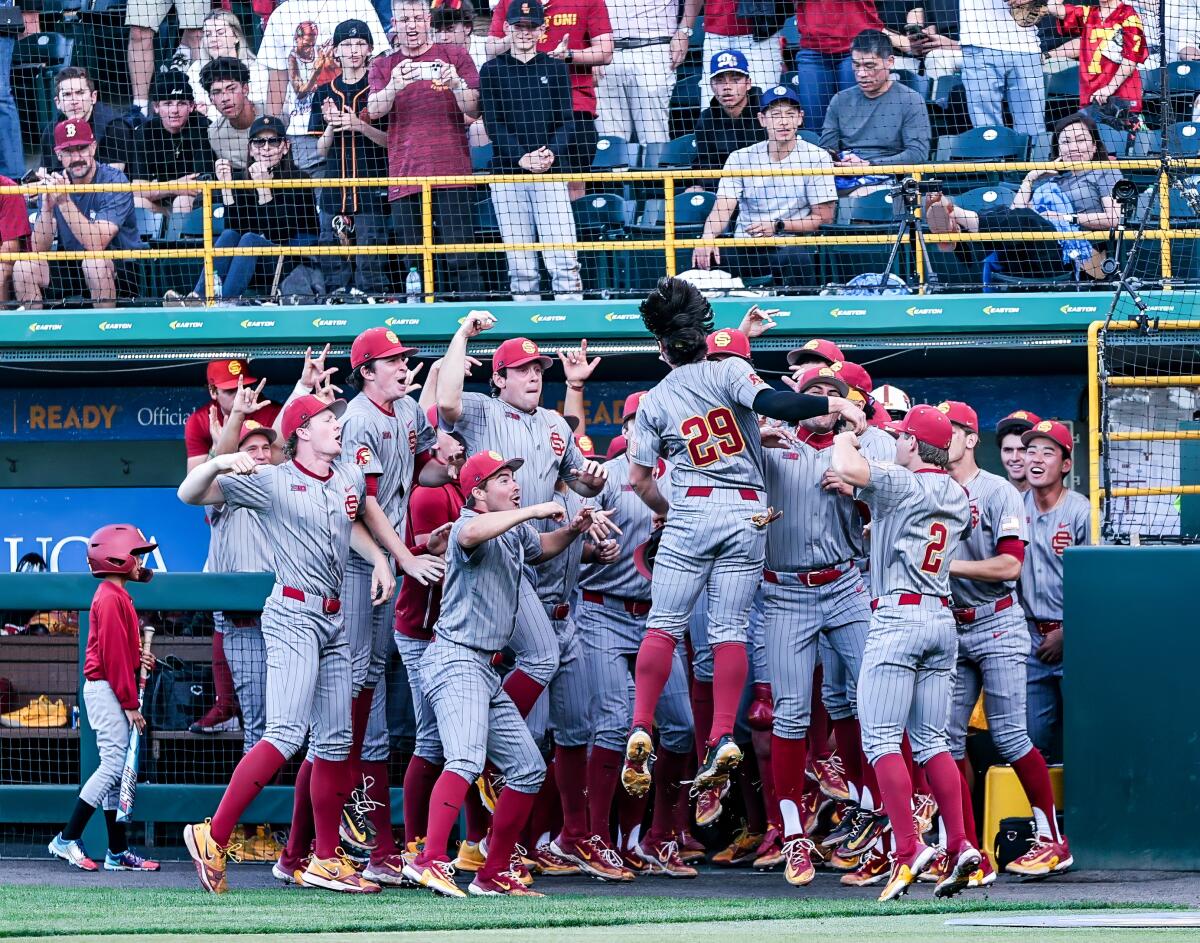
USC celebrates a second-inning home run by Andrew Lamb (29).
(Craig Weston)
Two of the top pitchers in the nation, Logan Reddemann of UCLA and Mason Edwards of USC, each gave up home runs and faced challenges from top hitters. Reddemann gave up a two-run home run to Andrew Lamb and a solo home run to Augie Lopez. UCLA scored three earned runs off Edwards, doubling the run total he has given up all season. Martin had a home run.
“I thought you had two premier pitchers against two really good offenses,” Savage said. “They had to fight for every out. Mason is clearly the best pitcher in college baseball the first half of the season. We did a good job making him work.”
UCLA pulled off a rare pick off play when USC stole second with a man on third. Catcher Cashel Dugger did an acting job worthy of an Academy Award throwing the ball hard to Reddemman on the mound, who then got the runner on third leaving the bag.
“I thought it was executed perfectly,” said Miller, the third baseman on the play.
It doesn’t happen often, but UCLA had to find a sign gathering cobwebs in the ticket office to post at the entrance of Jackie Robinson Stadium on Friday night: “Game sold out.”
The same sign will be posted again on Sunday. Some 2,000 people were allowed in.
“I wish the ballpark was bigger,” Savage said.
Tickets were going for more than $100 on the secondary market. The auxiliary bleachers were filled. The UCLA versus USC baseball series hasn’t received this much attention and interest since the days of Rod Dedeaux winning 11 College World Series titles at USC, the last in 1978. Savage won an NCAA title in 2013 and was drawing big crowds in 2010 when future first-round picks Gerrit Cole and Trevor Bauer pitched UCLA to Omaha.
“We’re a competitive team,” Savage said. “They like challenges. This was a big challenge. USC has played as well as any team in the country. It was two really good teams playing in the first game of a series. The city of Los Angeles was excited. It’s good for Southern California, it’s good for recruiting, it’s good for people to come in and see the talent USC and UCLA have.”
UCLA’s relief pitching continues to be a major strength. Freshman Zach Strickland and sophomore Easton Hawk combined for three hitless innings to finish out the victory. And UCLA didn’t have to use its best reliever this season, Wylan Moss, giving Savage options for the rest of the series.
Gasparino and Brennan each finished with three hits. USC dropped to 27-4.
When UCLA baseball coach John Savage scouts prospects, he looks at their projections and skill upside. Most important, he wants players dedicated to the culture he’s developed during his 22 years as a coach.
“We want people that fit into our program, that want to be a part of a winning culture,” he said.
Most of his current roster consists of players who came up short in last year’s College World Series. This year, the No. 1 team in the country has its eyes set on winning a national title in Omaha. The Bruins (21-2 overall, 9-0 in the Big Ten) are coming off a three-game weekend home sweep of Maryland.
Sign up for UCLA Unlocked
A weekly newsletter offering big game takeaways, recruiting buzz and everything you need to know about UCLA sports.
By continuing, you agree to our Terms of Service, which include arbitration and a class action waiver. You agree that we and our third-party vendors may collect and use your information, including through cookies, pixels and similar technologies, for the purposes set forth in our Privacy Policy such as personalizing your experience and ads.
The Times spoke to Savage about the expectations the Bruins set for themselves and his longevity with UCLA. The following interview has been edited for length and clarity.
Your team entered the year ranked No. 1 nationally and has gotten off to a strong start. How have you managed expectations?
Savage: It’s really about the people you have in the clubhouse. They’ve been born and raised through our program. Now it’s their junior years. They went to Omaha their sophomore year. They had a difficult year their freshman year. It’s been a work in progress, and I think the expectations are probably the heaviest inside our room. Everybody’s held to a very high standard and they believe in one another, they believe in the program. It’s refreshing to coach people that want to be coached, and to have people that love UCLA, and want to stay at UCLA.
After returning a large percentage of last year’s production, what differences have you noticed in this roster compared to previous teams?
UCLA shortstop Roch Cholowsky.
(Kyusung Gong / Associated Press)
Savage: I think the leadership is fantastic. Roch Cholowsky, Cashel Dugger, Michael Barnett, Jack O’Connor — our captains, they do a wonderful job of making sure guys are accountable. Everybody’s a year older. Everybody’s a little stronger. Everybody’s a little faster. A lot of guys that work extremely hard to upgrade their physicality, and then certainly it’s a mental game. We’ve worked really hard on the mental side of things to make sure that we’re combining both phases.
What has allowed your program to retain so much of its core talent year to year?
Savage: I would say loyalty, personal relationships, wanting to be at UCLA, to get a degree from UCLA, coaching staff, facilities, location. But, I would say most importantly, relationships. We didn’t win a national championship last year and these guys seem to be on that sort of mission.
Last season’s run to Omaha ended just short of the championship series. How much has that experience motivated this year’s group early in the season?
Savage: You see where you’re going. People always talk about Omaha, but if you never go, it’s hard to really envision what it looks like. It’s something that if you experience, you want to go back. It’s the mecca of college baseball and the city of Omaha has done a wonderful job of developing this tournament over 75 years. It’s an experience that you go and you definitely want to go back as a player and certainly as a coach.
How has recruiting or roster construction changed, if at all, now that UCLA is competing in the Big Ten instead of the Pac-12?
Savage: It’s still UCLA. I’ve been here 22 years, we’ve produced 30 major leaguers. It’s a place that you certainly could go and enjoy your college life and go play in the major leagues. The Big Ten is getting better in baseball, with the addition of UCLA, USC, Oregon and Washington. Obviously, it has helped the baseball side of things quite a bit. But there’s a lot of programs that are investing throughout the Big Ten in baseball and it’s only going to get better. Baseball is baseball. You gotta go play any time, anywhere.
With the travel demands that come with a conference like the Big Ten, what adjustments have you made to keep players fresh and focused?
Savage: We don’t charter. We’re all commercial. We fly out of LAX on Wednesday morning and we get back late Sunday night. It’s a challenge and it’s certainly one that it’s a daily and weekly operation. In terms of managing school, they all go to class. Not a lot of remote classes, really, so we love the challenge and the opportunity to grow as a young player and a young person.
You’re now in your 22nd season leading the Bruins. What has kept you motivated to continue evolving as a coach after more than two decades in Westwood?
Savage: I love being at UCLA. I love what it stands for. It’s a combination that I’m really looking for in terms of baseball, schedule, league, school — it’s just an elite combination. You have to make sure you’re grounded. You have to make sure you’re very consistent. You have to make sure that you have true values that are consistent with the university and that equates to winning. Winning is really, really difficult, especially now at the Power 4 level.
When players leave UCLA after their careers — whether they go to pro baseball or move on to other careers — what do you hope they carry with them from their time in your program?
Savage: That they understand how to be a contributor to an organization, to a business, how to lead a family, how to lead a group in work. Just be a person that people like to be around and a person that has a vision, that they want to get better and they want to do well in their lives and they want to have impact on other lives. That’s ultimately what we’re looking for, that they can handle themselves in any phase of life.
UCLA men are out, UCLA women stay strong
UConn’s Tarris Reed Jr. tries to get through UCLA’s Trent Perry, from left, Donovan Dent and Eric Dailey Jr. in the first half Monday.
(Matt Rourke / Associated Press)
UCLA coach Mick Cronin never wavered.
If senior forward Tyler Bilodeau felt any pain, he was not playing the NCAA tournament.
The No. 7 seed Bruins could not overcome No. 2 seed UConn’s interior game and suffered a 73-57 loss. The Bruins kept it close early, trailing by just five at halftime.
Cronin will help UCLA cope with the sudden end to its season and then immediately work on sorting out next season’s roster.
While fans questioned Cronin’s aggressive coaching style, the Bruins did play significantly improved defense through the final four weeks of their season and his players never wavered in their support of him.
Now Cronin will start over, working to forge comparable buy-in from the next wave of players.
The UCLA women walk to the bench during a time out against Cal Baptist.
(Gina Ferazzi / Los Angeles Times)
It’s rare for a No. 1 seed in the women’s NCAA tournament to miss the Sweet 16, but the Bruins (32-1) say they expect a big test when they face No. 8 seed Oklahoma State (24-9) at 7 p.m. Monday night at Pauley Pavilion.
It will be the final game the Bruins’ celebrated senior class will play at Pauley Pavilion.
UCLA coach Cori Close provided the following scouting report on Oklahoma State.
“I think that what stands out is their ability to shoot the three, their versatility, their work down the tunnel with the high ball screen,” Close said. “They’re extremely good in transition. It’s going to be so important for us to make them play later into the shot clock, which is going to be easier said than done. But I guess with the exception they don’t have like a really tall big, but they actually remind me in terms of their style and some of the actions that they run of Oklahoma. Their guard play.
“And one of the big things that we talk a lot about is trying to make them play later in the clock than they’re comfortable with. Now we go through all the analytics, and the later you have them play in the shot clock, the less efficient they become. They’re 13th in the country in offensive efficiency. They’re really, really good.
“Defensively I think that we obviously need to really hunt the paint. We’ve got some advantages with our size there. But they’re a really good team.”
Survey says
We asked “How far will the UCLA men advance in the NCAA men’s tournament. After 648 votes, the results:
They lose in the second round, 36.5% They lose in the Sweet 16, 27.5% They lose in the Elite Eight, 17.3% They win it all, 12.6% They lose in the first round, 3.2% They lose in the Final Four, 2.5% They lose in the championship game, 0.4%
Do you have a comment or something you’d like to see in a future UCLA newsletter? Email newsletters editor Houston Mitchell at houston.mitchell@latimes.com. To get this newsletter in your inbox, click here.