‘Begin Again’ review: 2013 film gets musical makeover at Old Globe
“Heartwarming” is a cliche of theater reviewing that I have studiously tried to avoid, but I’m tempted to use the word in my review of “Begin Again,” the new musical based on the 2013 John Carney romantic comedy about two dreamers trying to rekindle the love of making music that the industry nearly destroyed.
The show, which is having its world premiere at the Old Globe’s Donald and Darlene Shiley Stage, is just so damn heartwarming that I can’t help but resort to the language of blurbs. But let the ticket buyer beware: Heartwarming is a feeling, not a complete verdict.
Featuring a book by Jenna Clark Embrey and Molly Beach Murphy and a score by Pat Monahan and his bandmates from Train (Jerry Becker and Matt Musty), “Begin Again” does a pretty good job of distilling and updating the movie. Carney’s film, notable mostly for the vibrantly gritty New York setting, the Oscar-nominated song “Lost Stars” and the lived-in performance of Mark Ruffalo, couldn’t help languishing in the shadow of the filmmaker’s breakout hit “Once,” which later became a Tony-winning musical.
“Begin Again” the musical is likely to suffer a similar fate. It lacks the quirky originality that made “Once” an unexpected Broadway juggernaut. But the new show, directed by Lorin Latarro and choreographed by David Neumann, has heart — there I go with that overused word again!
I succumbed to the show’s charms despite being aware that the comedy isn’t as freshly articulated as it should be and the music, while exuberant, doesn’t seem to emanate from the soul of Gretta, a reworked American version of the singer-songwriter character indifferently played by Keira Knightley in the movie.

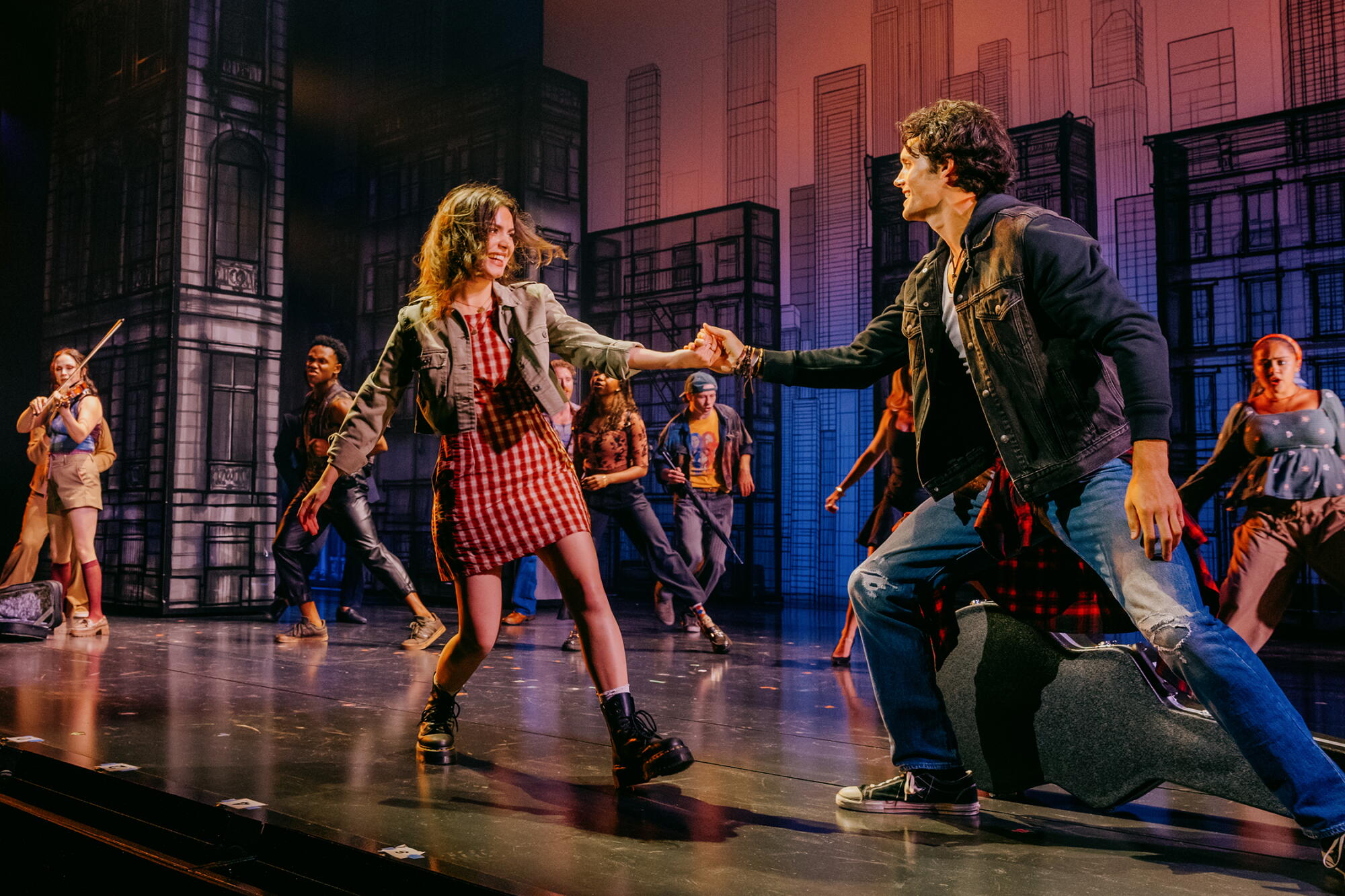
Emma Busse as Gretta, center left, and Kevin William Paul as Max with the cast of “Begin Again.”
(Jeff Lorch)
Gretta relates to her songs as though she were the next Joni Mitchell, but the new material she’s composing on the fly with her new friends doesn’t seem particularly intimate or revealing. I liked the indie rock sound, but mostly for the collaborative liftoff. Lyrically, I wasn’t drawn in. But who could resist the ecstatic momentum of her ad hoc band members buying into her grassroots dream?
Gretta, played with folksy innocence by Emma Busse, has traveled to New York from Pennsylvania with her boyfriend Max (Kevin William Paul). A musician with frontman good looks, he’s about to be packaged into a rock star. Gretta’s songwriting has paved the way for this opportunity, but Max is told that he’s being signed as a singer-songwriter and sharing credit is a deal-breaker.
Selfless, naive Gretta gives Max her blessing and her rights, and almost immediately he betrays her with another woman. Perhaps even more disloyally, he allows his producers to run her song “Don’t Let Go” through a pop blender that drains it of all its personal meaning and artistic integrity.
Alone in the big city, she takes refuge at the Queens apartment of college friend Stevie (Casey Whyland), formerly Steve in the movie, the comic sidekick role played by James Corden. Stevie, conveniently, is a sound engineer with an analog heart. She’s not only how Dan (an electric Patrick Heusinger), a washed-up music executive with a broken marriage and a drinking problem, discovers Gretta. But without Stevie’s technical ingeniousness, the prospect of recording an album in outdoor New York locations would never have been possible.
The professional meet-cute between Gretta and Dan happens at an open-mic night at a dive. Stevie calls a heartbroken Gretta to the stage to perform, and she reluctantly complies before giving up in embarrassment. She thinks she’s bombed, but Dan, who has “magic ears,” hears what the song could be.

Patrick Heusinger as Dan, left, and Adrienne Walker as Miriam with the cast of “Begin Again.”
(Jeff Lorch)
Just as Dan glimpses Gretta’s raw potential, she sees his lost purpose, and the two launch a mutual rescue mission. He brings Gretta to meet Saul (Nik Walker), who co-founded Distressed Records with him and just fired him for his erratic behavior. Saul doesn’t have Dan’s ability to spot future talent, but he agrees to give the singer a listen if they cut a demo. And so off Dan and Gretta go, with no budget, to make memorable music together.
Friends are their main resource — and that proves an inexhaustible boon. “Begin Again” really comes alive as Gretta, Dan and their expanding, can-do music network starts pooling its expertise.
You can hear the songs germinating from lonely inspiration to group transformation — and the sound is exhilarating. The process of songwriting, rather than being a solitary slog, is a collective joy, rapturously captured in the number “Write a Way.” And “Twilight Summer Sky,” the number performed on the rooftop of Stevie’s apartment building in Queens, represents perhaps the fruit of all the group’s effort.
“Begin Again” is a musical fantasy, not a work of realism. Gretta and Dan are seemingly brought together by fate to heal one another. As they separately go about their business in New York before they’re introduced, they continually pass like ships in the night in a New York that scenic designer Derek McLane summons in a shifting comic-strip landscape of high-rises that gives the city an industrial quaintness.
The action rewinds from Gretta and Dan’s initial meeting at the bar, and later fast–forwards to speed up some of the more boring bits of the album-writing process. The ensemble moves backward and forward with these narrative jump-cuts.
This literalness can seem overly cute. (I prefer the idiosyncratic yet fully integrated movement direction Steven Hoggett brought to John Tiffany’s Broadway production of “Once.”) But Latarro’s staging and Neumann’s choreography keep the storytelling moving at a pleasantly brisk clip. And Skylar Fox’s illusion design adds an element of visual sorcery.

The cast of “Begin Again.”
(Jeff Lorch)
It’s the actors, however, who elevate the material, supplying a depth of feeling where the writing offers something more general. Heusinger makes it possible to leave Ruffalo’s fine portrayal behind. This is a different and more dynamic Dan, at least in terms of the musical demands placed on the character. Paul’s Max is every bit a rock star, but Dan is convincing as both a burned-out music mogul with a self-sabotaging streak and a gifted artist in his own right who just needs someone to believe in his producing instincts again.
Adrienne Walker, who plays Miriam, Dan’s estranged wife, and Charlotte MacLeod, who plays Violet, Dan’s disaffected daughter, endow their characters with more lineaments than the book provides. Walker’s Saul doesn’t do what Yasiin Bey managed in the movie — make Distressed Records seem like a real New York record company — but his singing compensates for some of the clumsier aspects of his reduced role.
Whyland’s Stevie, serving as emcee when the occasion calls for one, combines genuine camaraderie with comic relief. The gender switch makes sense, and Whyland embodies the spirit of artistic cooperation that makes “Begin Again” such an invigorating experience.
I wish that the musical didn’t amplify Gretta’s artistic insecurities and distress over the breakup with Max. The character seems less self-assured and more wounded than she did in the movie, making her fervently held idealistic beliefs about creative independence seem borrowed from another character. But Busse brings an American innocence to the role, and her ardor about music and community seems genuine.
“Begin Again” transcends its limitations through the kinetic connection of the cast. When all the elements of the music come together, a triumphant feeling — call it uplift — charges the air.
‘Begin Again’
Where: Donald and Darlene Shiley Stage at Old Globe Theatre, 1363 Old Globe Way, San Diego
When: 7 p.m. Tuesdays-Fridays, 2 and 8 p.m. Saturdays, 2 and 7 p.m. Sundays. (Check for exceptions.) Ends Oct. 18
Tickets: Start at $61
Contact: TheOldGlobe.org or (619) 234-5623
Running time: 2 hours, 15 minutes (with one intermission)