saturday night

L.A.’s latest viral party spot is … Seafood City. Yes, you read that right

Under the glow of fluorescent lights at Seafood City market in North Hills, packages of pre-made adobo, salted shrimp fry and and dried anchovies glisten in meat coolers.

A DJ, dressed in a traditional barong, blasts a dance remix of Whitney Houston’s “I Wanna Dance with Somebody” as a crowd gathers to take a shot of fish sauce together.

“That was disgusting!” a man shouts into the mic, flashing a grimacing expression.

Two men smiling gather behind a man in front of a laptop.

At Seafood City, DJs 1OAK, left, EVER ED-E and AYMO spin in barongs, the Philippines’ national formal shirt.

The smells of lechon and lumpia float through the air. Smiling children munch on halo-halo (a Philippine dessert made with ube ice cream, leche flan and shaved ice). Flags of the Philippines wave in the air as a man in UCLA Health scrubs hops into the center of an energetic dance circle. Employees shoot store coupons out of a money gun and toss bags of Leslie’s Clover Chips into the crowd. Fathers hold their children on their shoulders as a group of college students perform a Tinikling routine, a traditional Philippine dance in which performers step and hop over and between bamboo poles.

“This is so Filipino,” a woman says, in awe of the scene.

Two women dance in the middle of a circle.

Sabria Joaquin, 26, of Los Angeles, left, and Kayla Covington, 19, of Rancho Cucamonga hit the dance floor at “Late Night Madness” in North Hills.

“I came here for groceries,” explains an elderly man, adding that he decided to stay for the party.

Seafood City, the largest Philippine grocery store chain in North America, typically closes at 9 p.m. But on certain Friday and Saturday nights, its produce or seafood aisle turns into a lively dance floor for “Late Night Madness.” On social media, where the gathering has exploded, it looks like a multigenerational nightclub that could use dimmer lighting. But for attendees who frequent the store, it’s more than that. It’s a space for them to celebrate their Filipino heritage through food, music and dance in a familiar setting.

“This is something that you would never expect to happen — it’s a grocery store,” says Renson Blanco, one of five DJs spinning that night. He grew up going to the store with his family. “My mom would [put] us all in the minivan and come here, and she’d let us run free,” he adds. “It’s comfortable here. It’s safe here.”

1

A woman in a night dress walks behind a lady pushing a cart.

2

Two women in front of bananas eat late night snacks.

3

Two people dance in a grocery aisle.

1. Rhianne Alimboyoguen, 23, of Los Angeles follows an employee through the produce section. 2. Allison Dove, 29, left, and Andrea Edoria, 33, both of Pasadena, enjoy Philippine street food. 3. Katie Nacino, 20, left, Daniel Adrayan, 21, and Sean Espiritu, 21, of the Filipino American Student Assn. at Cal State Northridge, practice tinikling, a traditional Philippine folk dance, in an aisle.

The first Seafood City location opened in 1989 in National City, a suburb of San Diego, which has a nearly 20% Asian population including a rich Filipino community. For its founders, the Go family, the mission was simple: to provide a market where Filipinos and people within the diaspora could comfortably speak their native language and buy familiar products. It’s since become a community anchor. Of the nearly 40 locations in Northern America, at least half of them are based in California, which has the highest population of Asian Americans in the United States.

  • Share via

The first “Late Night Madness” event happened in September in Daly City, Seafood City’s newest location. The company wanted to launch a street food program at the store’s food hall in a fun and creative way.

The DJ played a selection of hip-hop, pop, soul and classic Pinoy records like VST & Company’s “Awitin Mo, Isasayaw Ko.” Hundreds of people showed up, and videos of people of all ages turning up in the popular supermarket spread like wildfire. So the company decided to continue hosting the event in October during Filipino American History Month and for the rest of the year. It’s since expanded to more locations around the country and in L.A., including Eagle Rock.

By 10 p.m. at the Seafood City in North Hills, at least 500 people are dancing in the produce section, next to rows of saba bananas, fresh taro leaves and bok choy. The lively crowd forms dance circles throughout the night, taking turns jumping in the center to show off their moves to songs like Earth, Wind & Fire’s “Let’s Groove,” “Nokia” by Drake and Justin Bieber’s “I Just Need Somebody to Love.” At one point, TikToker and artist Adamn Killa hops on the mic and says “If you a Filipino baddie, this is for you,” before doing his viral dance.

Trays of street food for sale.

Among the Philippine street food offerings were pandesal sliders, lumpia-style nachos, lobster balls and various skewers.

A group of employees dance behind the counter as they serve hungry patrons who fill their trays with various Filipino street food including pandesal sliders (soft Philippine bread filled with adobo, lechon or longganisa) and Lumpia Overload (think nachos, but a bed of lumpia instead of tortilla chips), lobster balls and barbecue chicken skewers. (No alcohol is served.) Meanwhile, a few lone shoppers sprinkle into the store to get their weekly groceries as music blasts through the speakers.

First-generation Filipino American Andrea Edoria of Pasadena says “Late Night Madness” reminded her of the family parties she attended as a child in L.A. and in Manila, where her parents are from.

“Growing up as a child of immigrants, I was kind of self conscious about displaying too much of my culture,” she says between bites of spiral fried potato. She went to the Eagle Rock event with her mother last month as well. “So it kind of fed my inner child to see so many people celebrating this shared culture and experience that we each grew up [with].”

Children and adults dance in a circle.

A multi-generational crowd is drawn to the dance floor. At center is Jade Cavan, 44, of Chatsworth.

Dancers perform between bamboo staffs.

Members of the Filipino American Student Assn. at Cal State Northridge perform a tinikling performance.

She adds, “I think it’s so important especially now at a time where our country is so divisive and culture is kind of being weaponized, I think it’s a beautiful reminder that we can come together and find something that unites us.”

About 10 minutes before midnight, the grocery store is still bustling with activity. A dance battle breaks out and people begin hyping up the young women. The DJ transitions into slower tracks like Beyoncé’s “Love on Top” and Mariah Carey’s “All I Want for Christmas is You.” The remaining folks sing along loudly as they walk toward the exit, smiles imprinted on their faces. Staff rush to clean up, then huddle together for group photos to memorialize the evening.

Employees clean up a grocery store.

After the final song is played, employees rush to clean up the supermarket.

Patrick Bernardo, 34, of Van Nuys looks at the counter, where a man had been chopping lechon, before stepping outside.

“There’s barely anything left on that pig,” he says, pointing to it as proof that the night was a success.


Source link

Santa Margarita wins state football title for coach Carson Palmer

In a high school football season full of surprises, the biggest was a Heisman Trophy winner guiding his alma mater to a state championship in California’s toughest division in his rookie season of coaching.

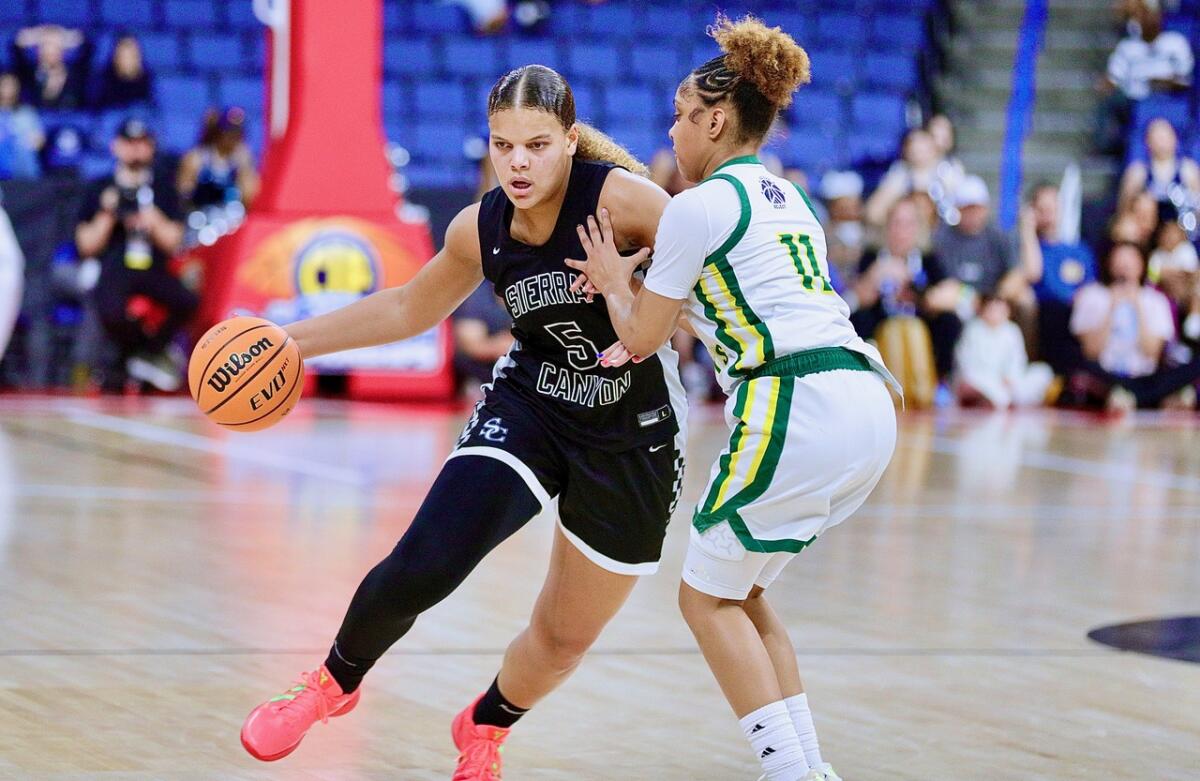
Who had Carson Palmer and Santa Margarita on their bingo card toppling Sierra Canyon, Orange Lutheran, Corona Centennial and Corcord De La Salle in a four-game postseason stretch that left the Eagles as Southern Section Division 1 and CIF Open Division state champions?

The final piece of the puzzle was solved with Santa Margarita’s 47-13 win over De La Salle on Saturday night at Saddleback College, the ninth consecutive season a Southern California team won California’s highest bowl game.

It’s been fruitless to think anyone was beating Santa Margarita (11-3) over the last month with a healthy Trent Mosley. Two weeks ago he dazzled Corona Centennial in the Division 1 final with 10 catches for 292 yards. On Saturday, even though De La Salle knew what he could do, Mosley still was unstoppable. In the first half, when Santa Margarita opened a 35-7 halftime lead, Mosley had eight catches for 134 yards and touchdowns from 34 and six yards and also ran seven yards for another touchdown. He finished with 11 receptions for 183 yards.

With his underrated speed, upper-body strength and skills to play multiple positions, Mosley has been the best player in California for weeks. Santa Margarita has been getting him the ball much more in the postseason, and opponents have had no answers for defending him.

“Mosley is incredible,” De La Salle coach Justin Alumbaugh said of the USC commit. “He does some special things on the football field.”

Said Mosley: “It feels great. We’ve worked hard. I wanted to come out and do my best. It’s sad to go but a what a great way to end it.”

Leki Holani of Santa Margarita was throwing down De La Salle running backs all night.

Leki Holani of Santa Margarita was throwing down De La Salle running backs all night in the CIF state final.

(Craig Weston)

How Santa Margarita rose to the top with Palmer at the helm is an equally compelling tale. Palmer was hired with little coaching experience but his decision-making, judgment and connections from the NFL world became clear with the all-star coaching staff he put together, none more important than retaining defensive coordinator Steve Fifita, last season’s interim coach. With nine returning defensive starters and three defensive line transfers, the Eagles had no weaknesses on a defense that repeatedly neutralized the best offensive players game after game.

“It’s been an unreal year from start to finish,” Palmer said. “I could not be more proud of these guys, could not be more proud of our coaching staff and support system.”

Quarterbacks were pressured by a line that had Isaia Vandermade recording nine sacks in the postseason. The linebackers, led by Dash Fifita and Leki Holani, were able to move freely and make tackles with blockers preoccupied by the line. The secondary, led by sophomore star Ca’ron Williams, had the freedom to be aggressive knowing quarterbacks wouldn’t have much time to release the ball. Siua Holani closed the scoring with an interception return with 1:36 left in the fourth quarter.

De La Salle (12-1) thought it would have a chance to end Northern California’s losing streak. Santa Margarita had not seen the Spartans’ veer-option attack. Steve Fifita even had dreams about the veer watching so much film to prepare his players. But the Eagles were ready for quarterback option plays and power runs up the middle. And De La Salle didn’t help matters by committing four personal fouls in the first four minutes. The only touchdowns for De La Salle came on short runs by Jaden Jefferson after recovering Santa Margarita fumbles.

The reason Santa Margarita became so dominant over the last month was the improvement in the offense. Quarterback Trace Johnson became comfortable and injured players came back, including tight end Luke Gazzaniga, who had touchdown receptions from 20 and two yards Saturday. Johnson ended his brief stay at Santa Margarita after transferring from Florida by completing 17 of 20 passes for 247 yards and four touchdowns.

Source link