Sasaki

Ryan Ward has solid Dodgers debut, bullpen blows it again at Rockies

What do you know? The once-stampeding Dodgers have been caged by the Colorado Rockies.

With a 9-6 loss Sunday at Coors Field, the two-time defending World Series champions lost back-to-back games for the first time this season. The Dodgers again couldn’t hold a lead, letting the Rockies tee off for 15 hits.

Nor could the Dodgers keep up offensively at the hitter-friendly park — though they put some pressure on in the ninth inning, when Shohei Ohtani led off with a ground-rule double and the Dodgers scored twice to cut the lead to three runs. Then the new guy, Ryan Ward, made the final out in his big league debut, robbed of a hit and a chance to keep chipping away by a diving Troy Johnston in right field.

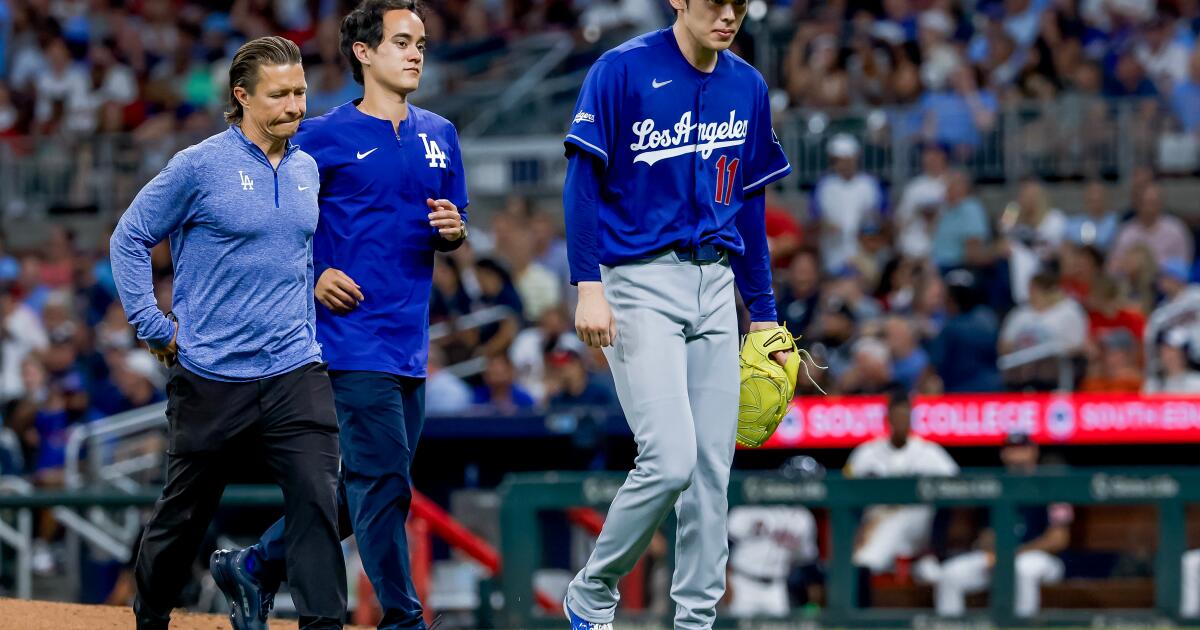
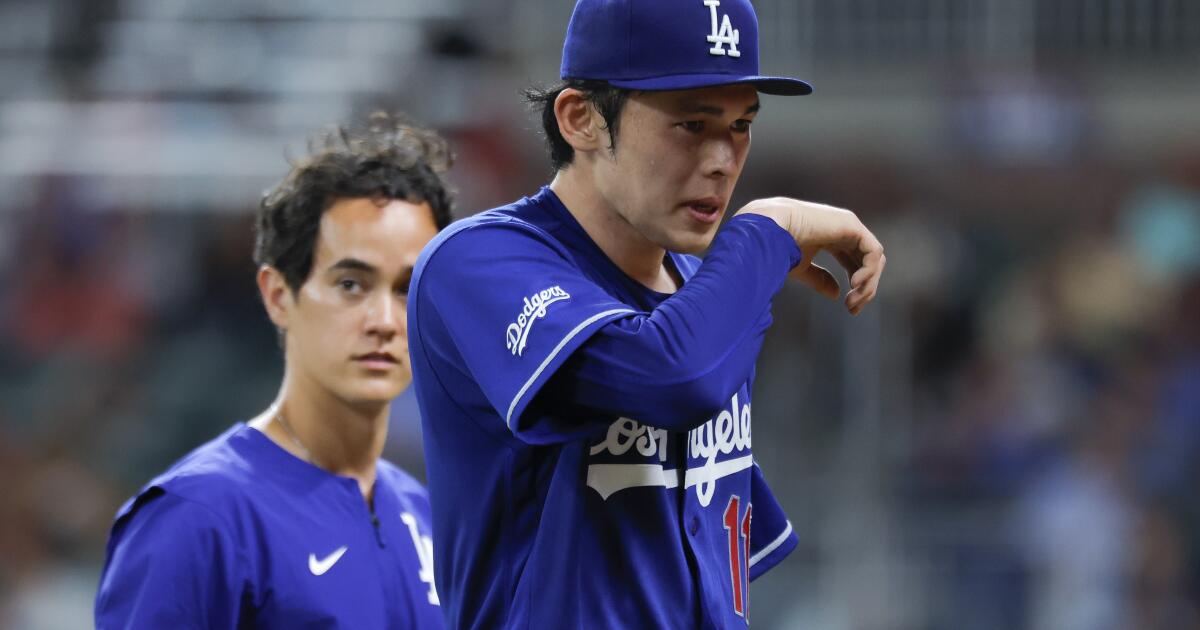
Before that, the Rockies — who beat the Dodgers twice in 13 meetings all of last season — chased starter Roki Sasaki from the game in the fifth inning and then ruffled the Dodgers’ relievers. That included closer Edwin Díaz, who came on in the eighth and promptly gave up three singles, a walk and two runs before being pulled with the Dodgers trailing 8-4.

Dodgers starting pitcher Roki Sasaki follows through on a throw during a game in Denver.

Dodgers starting pitcher Roki Sasaki gave up three runs on seven hits in 4-2/3 innings Sunday against the Rockies in Denver.

(David Zalubowski / Associated Press)

He and Blake Treinen combined to face eight batters without getting an out.

“They both weren’t sharp,” said manager Dave Roberts, who had theories but not many answers — though he did have real concern, especially about Díaz, who recently had his right knee checked out by the medical staff.

Roberts said the closer wanted to pitch after nine days off, even though it wasn’t a save situation. But his velocity was slightly down (95.4 mph vs. 95.8) and so, “today was a tough evaluation,” the manager said.

“It really was,” Roberts said. “Because, you know, I know what it’s supposed to look like, and when it doesn’t look like that, it gets a little concerning, really.”

And losing for the second time to the Rockies, who are now 9-13? Being in danger of losing their four-game series, after arriving in Denver without having lost to a National League opponent, against a club that hasn’t made the postseason since 2018?

It’s well below the bar the Dodgers have set, and it added a bitter note to Ward’s otherwise sweet debut.

Ward punched a big league clock for the first time wearing No. 67 and cranked his first hit off Rockies starter Michael Lorenzen in the fourth inning, lining a changeup to right field for a single that scored Andy Pages, made it 3-0 and got the 20-some members of Ward’s party up, jumping in place, hugging and high-fiving.

“When I was on first base, I got to see them all jumping around up there,” Ward said. “That was a pretty special moment.”

He also singled in the sixth and swung on the first pitch in his first at-bat, a fly out in the third inning.

The Dodgers gave Sasaki a 2-0 lead in the third. Alex Freeland drove in Hyeseong Kim, and Shohei Ohtani doubled in Freeland — and extended his career-best on-base streak to 51 games, moving past Willie Keeler into third place in Dodgers history.

Sasaki went 4-2/3 innings, threw 78 pitches and gave up three runs on seven hits, striking out two and walking two. His ERA after his fourth start: 6.11, worst in the six-man rotation.

The Dodgers fell behind 6-4 in the seventh when Treinen — who was cleared Friday after he was struck in the head by a batted ball during batting practice — gave up four consecutive hits, including a two-run home run by Mickey Moniak.

The result likely will be a minor detail when Ward tells the story years from now about getting the call after first baseman Freddie Freeman was placed on the paternity list.

The Dodgers’ No. 19 prospect and reigning Pacific Coast League MVP spent the last seven years in the minors. Last season, he hit 36 home runs and drove in 122 runs with a .937 on-base-plus-slugging percentage for triple-A Oklahoma City, and he has a 1.020 OPS and four homers this year.

Ward made it a point to improve his chase rate, draw more walks and get on base more frequently, everything the Dodgers asked of him. He also passed the broadest patience test.

“The plate discipline, being a better hitter … he’s done all that,” Roberts said. “He’s improved his defense. But honestly, for me, just not to let his lack of opportunity in the big leagues deter him. That’s easy when you get frustrated and let it affect performance, and he hasn’t done that.”

If anything, Ward said, the waiting made him better.

“I used it to keep going. ‘OK, if I’m not there yet, what do I have to do to get there?’” he said. “‘What part of my game do I need to work on to keep getting better?’

“I used it as fire to keep working.”

That will be the Dodgers’ assignment too.

In the finale of the four-game series Monday, the Dodgers are expected to start left-hander Justin Wrobleski (2-0, 2.12) against Colorado left-hander Jose Quintana (0-1, 5.63).

Source link

It’s time for Dodgers’ Roki Sasaki to take next step

Dodgers right-hander Roki Sasaki got up to 94 pitches Sunday and limited the Rangers to two runs. What a showing, right?

Well, there was a major caveat. That pitch count only got him through four innings.

“It’s not that many,” Sasaki said through Japanese interpreter Kensuke Okubo after the Dodgers’ 5-2 loss Sunday against the Rangers at Dodger Stadium. “So my goal is [to] go deeper in the game a little more.”

Sasaki’s inefficiency seemed to stem from the command issues that plagued him all spring. Manager Dave Roberts challenged him then to find a way to compete even when he didn’t have his best stuff.

In three starts, he’s done that for the most part, though he’s had several innings that have teetered on the edge of completely spiraling.

Especially with the Dodgers committed to a six-man rotation, which by definition limits the number of arms in the bullpen, that’s not going to be enough long term. In order to avoid regularly taxing the bullpen Sasaki is going to need to show that he can be more efficient.

“With the stuff that he had today, the six strikeouts and the swing-and-miss and all that stuff, that sets up for going deeper in the game,” Roberts said. “So that’s something that I talked to him about, and challenging him to, when you take the baseball, we’re trying to go five innings or more. So I think that’s the next progression for him, to be consistently able to do that.

“But I do feel the growth part of it is to hang in there and make pitches when he needs to.”

Even Sasaki’s line displayed that push and pull of good stuff but inconsistent command. He recorded six strikeouts, the most he’s had in a game in parts of two seasons in MLB. He also walked five, tying his major-league career high.

“Honestly, some of the misses were just off, certainly with the fastball,” Roberts said. “So I think that maybe trying to be a little bit too fine. … Where before, there were some bad misses and maybe a little too (much) running from the strike zone. Where I don’t see that now.”

After giving up a leadoff single to Brandon Nimmo and walking Evan Carter to begin the game, Sasaki struck out the next three batters he faced.

He put away Corey Seager and Jake Burger with fastballs, getting away with one down the middle to Seager and getting Burger to chase up. And then he showcased the splitter as strike three to Joc Pederson.

“I think I was able to throw it on the plate, and also had a good depth,” Sasaki said.

Sasaki’s splitter generated six whiffs and three called strikes Sunday, a season high. One of them fooled Burger so thoroughly that he had to catch himself from falling forward. So, that development was promising.

As for Sasaki’s efficiency issues, walks were never an issue for him in Japan (2.0 walks per nine innings). And coming out of the bullpen late last season and through the playoffs, he showed he could take a more aggressive approach to attacking hitters. So, he at least has a blueprint.

“That’s kind of the mindset of a reliever, because you’re going to go shorter and you’re not going to throw as many pitches, so you can kind of empty the tank,” Roberts said. “With starters, they train for more pitches, more innings. And you have to have it in your head to still have that same mindset and trust that your work can sustain 90-100 pitches with the same mindset and effort. So that’s something that we’ve got to get to that point.”

Source link

Roki Sasaki puts in encouraging start, but Dodgers still lose

A fastball up and off the plate to Guardians left-handed hitter Steven Kwan was an inauspicious beginning to Dodgers right-hander Roki Sasaki’s season debut.

The arm-side miss fell in line with a persistent spring-training pattern for Sasaki, who struggled with command from his first Cactus League start through his Freeway Series appearance last week.

Over the course of a seven-pitch strikeout, however, Sasaki adjusted — something he failed to do during game action this spring.

“I actually didn’t have confidence at all before this game started,” Sasaki said through an interpreter Monday. “But I was just focusing on doing what I can control.”

In the Dodgers’ 4-2 loss Monday, Sasaki’s first start of the season was something of a best-case scenario. He held the Guardians to one run and four hits in four-plus innings. And the biggest difference from his spring training struggles was he issued just two walks.

The Dodgers squandered the effort with a lack of offense, in their first loss of the season.

Sasaki will have more to prove against stronger offenses than Cleveland’s. But his performance at least suggested that the Dodgers’ faith in him wasn’t misplaced.

“We know he can do it here, and especially now that his velocity is back to closer to where it used to be,” Dodgers general manager Brandon Gomes said last week. “I feel like he puts us in a great position to win.”

Dodgers manager Dave Roberts removes starting pitcher Roki Sasaki from the game.

Dodgers manager Dave Roberts removes starting pitcher Roki Sasaki from the game in the fifth inning Monday against Cleveland.

(Ronaldo Bolanos / Los Angeles Times)

The Dodgers had seen Sasaki bounce back before. He had a middling start to last season and pitched through shoulder discomfort before landing on the injured list last May. His average fastball velocity plummeted from 98 mph in his MLB debut to 94.9 mph in his last start.

He returned from the IL in time for two relief appearances in September, his fastball sitting above 99 mph, and a dominant postseason run. He didn’t allow a run in eight of his nine playoff outings, and he posted a 0.84 ERA.

“He could have cashed in last year,” manager Dave Roberts said before the game. “Given his health early, the lack of performance towards the middle of the year, towards the end he could have just written it off and started fresh in the offseason.

“But he was willing to pitch out of the bullpen, ramp back up and give us whatever we needed. So for me, that was something where he put himself out there. That’s why I have a lot of confidence right now [that he can] turn the corner from spring training.”

Sasaki still threw some non-competitive pitches Monday. That inefficiency brought his pitch count up to 78 pitches twice through the Guardians’ batting order, and Roberts pulled him when the lineup turned over again.

Sasaki also reigned in his misses, used both sides of the plate, and effectively deployed his new cutter as a put-away pitch early.

“I couldn’t get through five innings, but the results overall felt pretty good,” Sasaki said. “I kind of have confidence about that.”

Through the first two innings, Sasaki held the Guardians scoreless, and to just one bloop single. But in the third, he threw a four-seam fastball down the middle to Austin Hedges and hung a cutter to Kwan for a pair of doubles and a run.

Dodgers outfielder Kyle Tucker rounds second base after a Mookie Betts double during the ninth inning.

Dodgers outfielder Kyle Tucker rounds second base after a Mookie Betts double during the ninth inning against the Guardians at Dodger Stadium on Monday.

(Ronaldo Bolanos/Los Angeles Times)

Next, Sasaki walked Chase DeLauter, and the inning threatened to spiral. But Sasaki locked in to strike out José Ramírez and induce Kyle Manzardo to line out, escaping without further damage.

With no outs and one runner on in the fifth inning, Sasaki handed the ball over and left-hander Tanner Scott took over. Dodgers fans sent Sasaki, who’d been booed during his last spring start, off with a warm ovation.

“I think it should be a big boost to his confidence,” Roberts said after the game. “… When you don’t have success, it’s hard to have real confidence. That was certainly an honest admission. But when you perform, you start to have true confidence. So hopefully he can build on this one.”

After Scott, Dodgers left-hander Justin Wrobleski, who is in line to join the rotation when the schedule isn’t so packed with off days, provided four innings. He gave up three runs, all in the seventh.

The Dodgers didn’t score until the final inning, with the help of a little luck. Kyle Tucker reached base on a chopper that squeaked through the infield and then advanced all the way to third on a wild pitch. Mookie Betts then drove him in with a line-drive double. Two batters later, Betts scored as Freddie Freeman grounded out to first.

“The takeaway is, we’re 3-1 and the guys that we expect to swing the bats aren’t swinging the bats right now,” Roberts said. “So that’s a good thing; they’ll hit.”

Source link

Why the Dodgers are preaching patience with Roki Sasaki as a starter

By the time Dodgers right-hander Roki Sasaki reached the blue backdrop set up in the Surprise Stadium interview room, he’d diagnosed the issue.

“I think it’s because of the two-seamer,” Sasaki said through an interpreter. “It kind of caused my forearm to pronate a little more. Also my arm slot was a little down.”

Those arm-side misses had, after three straight walks, prompted manager Dave Roberts to temporarily pull Sasaki from his most recent spring training appearance. But even though that start, marred by a wild third inning, brought Sasaki’s Cactus League ERA to 13.50, he’ll enter his Freeway Series start Monday with a spot in the regular-season rotation already secured.

Roberts has repeatedly made that point clear.

However, when asked directly if Sasaki was one of the Dodgers’ 13 best pitchers right now, Roberts gave an indirect answer: “He is going to start the season in the rotation.”

Answering why the organization has been so bullish on the decision requires zooming out.

“As we look out two, three, four, five, six years, it is imperative for us to integrate talented young players under our roster,” president of baseball operations Andrew Friedman said during an interview with The Times last week. “And that requires patience. And we have to have that even with the insanely high expectations we have.

“We have to be able to balance those two things, or there are a lot of cautionary tales of large-revenue teams who have had a run of success, and then they fall off the cliff.”

Sasaki, 24, is one of those young players the Dodgers are counting on to bridge the gap.

When Sasaki was posted by Nippon Professional Baseball’s Chiba Lotte Marines before last season, upward of 20 teams expressed their interest in the young phenom who was coming to the United States through amateur international free agency.

In his debut season, he produced a 4.72 ERA through eight starts — before an injury the Dodgers described as a right shoulder impingement sidelined him for much of the rest of the season. When Sasaki returned, it was as a reliever, a role he thrived in through the postseason.

Sasaki enters Year 2 with just 47 major-league innings under his belt, including the regular season and playoffs.

“On top of all those other things that you’re adapting to and learning, you’re also learning a new ball,” Friedman said. “Roki could really command his fastball in Japan, and right now it hasn’t been as good. So how much of that is the ball, how much of it is mindset, how much of it is delivery just getting out of whack? All of those are fair questions, but I think it speaks to, we have to have a level of grace with this and work with him to continue his development.

“Because we’ve seen it at an extremely high level, and now it’s on all of us to help him get back to that.”

NPB baseballs are slightly smaller, tackier and have higher seams than MLB baseballs. Players making the transition to MLB also have to adjust to a different strike zone, style of play and the off-the-field challenges of living in a foreign country.

The season before Sasaki signed with the Dodgers, his future teammate Yoshinobu Yamamoto and the Cubs’ Shota Imanaga set the bar high with relatively smooth transitions. But they were also coming over at later stages in their careers.

“We’re very mindful that this guy is essentially two years, three years behind Yamamoto,” Roberts said, “as far as on the progression side, the development side.”

Sasaki has shown he can be effective out of the bullpen, but pigeonholing him in a relief role at this stage of his career would be a disservice to him and the organization.

The Dodgers have identified the addition of the two-seamer as a development that could help Sasaki stick as a major-league starter.

“It’s our job as coaches to get a player to understand the value of having a ball bear in and get in on right-hand hitters to keep them off the outside part of the plate,” Roberts said. “There’s a little bit of trying to pronate too much — trying to make the ball move, versus trusting his grip and his throw. But that’s a coach’s responsibility to [figure out,] how do we get him there, along with him feeling comfortable.”

The Dodgers have decided that, at least for now, the best setting for that growth is the major leagues. Across the industry, there’s an understanding that the gap between Triple-A and the big leagues is bigger than ever. That makes evaluating players in Triple-A all the more difficult.

“He’s not close to a finished product,” Roberts said. “But he’s 24. … You could look at a team that would potentially sign a veteran, turnkey starter, but we’ve got to get him to cut his teeth and deal with some things. That’s part of the growth.”

Source link

Ohtani, Yamamoto, Sasaki honored in 12-story Dodgers mural

Robert Vargas is in a bit of a time crunch.

The Los Angeles-based artist has embarked on one of his most ambitious murals. Titled “Samurai of the Diamond,” it features the Dodgers’ trio of Japanese stars — two-way player Shohei Ohtani and pitchers Roki Sasaki and Yoshinobu Yamamoto — in larger-than-life fashion on a 12-story wall of the DoubleTree Hotel in Torrance.

A man in a paint-spattered jacket extends one arm in front of a partially painted Dodgers mural on a building

Artist Robert Vargas takes a break from painting Saturday to show his progress on his newest mural.

(Genaro Molina / Los Angeles Times)

As of early Saturday afternoon, Vargas still had a lot of painting to do in order to have the mural finished by the official unveiling at 10 a.m. Tuesday. Anyone familiar with Vargas and how he works, however, knows he will get it done.

“It may be finished at 9:59, but at 10 o’clock we will unveil this,” Vargas said

Koreatown resident Diego Guerrero is one of those who knows Vargas’ style. After witnessing the artist working on his massive Fernando Valenzuela mural in Boyle Heights during the fall of 2024, Guerrero said he had “full faith” Vargas would meet his deadline this time around.

“I know he’s got this,” Guerrero said while visiting the DoubleTree site Saturday. “Last time he was doing this, it was raining and even that time he pulled it off. So I have no doubt he’ll finish it.”

Vargas said the new piece was conceived as a follow-up to the massive mural of Ohtani he painted on the side of the Miyako Hotel in Little Tokyo soon after the former Angels pitcher signed with the Dodgers prior to the 2024 season. In two seasons with L.A., Ohtani has won two National League MVP awards and helped the Dodgers win two World Series championships.

The Dodgers signed Yamamoto during the same offseason and Sasaki a year later. Both pitchers played key roles in the team’s 2025 postseason run. Yamamoto went 7-1 with two complete games and pitched for the final out in Game 7 of the World Series against the Toronto Blue Jays. Sasaki moved to the bullpen for the playoffs and recorded three saves and two holds.

“If [the Ohtani] mural was about ushering in a new era and a new face here in Los Angeles, this mural is about building a cultural bridge from Los Angeles to Japan and really emphasizing the greatness that these foreign-born Japanese players are contributing not only to the team, but to this community’s identity,” Vargas said. “And also inspiring to kids who can look up and see heroes that look like them from this community.”

A man standing on a riser and painting a huge Shohei Ohtani face on a textured wall

Robert Vargas paints an image of Shohei Ohtani as part of the local artist’s ‘Samurai of the Diamond’ mural Saturday at the DoubleTree Hotel in Torrance.

(Genaro Molina / Los Angeles Times)

Known for its large Japanese American population and concentration of Japanese businesses, Torrance signed friendship city agreements with Bizen (Yamamoto’s hometown) in August 2024 and Oshu (Ohtani’s hometown) in October 2024.

Vargas, who has a home in Japan because of the frequent mural work he does there, came up with the idea of a Torrance mural honoring the Dodgers’ Japanese stars around that time.

“I feel that they are examples of how to do things right on and off the field,” Vargas said of the three players. “Their work ethic is really reflected in the culture. That’s why Ohtani is so respected out there on the field, not just for what he’s doing with the bat or with the baseball but just how he conducts himself. It’s refreshing.”

His idea received support from local leaders, such as Mayor George Chen and city council member Jon Kaji.

“Ever since the Dodgers signed Shohei Ohtani in December, 2023, the community has rallied around Ohtani, Yoshinobu Yamamoto and Roki Sasaki giving us all a sense of pride,” Kaji said in an email to The Times. “…’Samurai of the Diamond’ exemplifies the unifying power of sports that transcends borders and nationalities.”

Chen wrote in a separate email: “There are many Dodgers fans in the City of Torrance and the greatness of these 3 players have been great role models to young and old. They are performing at the highest levels in MLB, yet they have shown us that even great athletes and celebrities can maintain a certain level of maturity, respectful to others, picking up trash, not retaliating when attacked, and always showing great sportsmanship.”

The wall will include an interactive feature: When visitors scan a QR code, they will see each player come to life and throw a strike, with animation provided by the AR Firm. Also, lights are being installed in the parking lot to illuminate the mural at night.

“It’s going to be a destination,” Vargas said.

DoubleTree general manager Linda Amato, who is also the executive chairperson of the Discover Torrance visitors bureau, said the hotel plans to create “opportunities for guests to gather outdoors, enjoying [Dodgers] games under the stars alongside the interactive mural.”

“The response from the community has been incredible,” Amato said in an email. “There’s a real sense of excitement — people are stopping by daily to watch the progress and engage with the project. It’s brought a new energy to the city. Robert Vargas has been amazing throughout the process, often speaking with visitors about his vision and techniques, which adds to the overall experience.”

A man looking to the side while wearing a straw sun hat and holding a paint brush in his mouth

Vargas hand-picked the DoubleTree Hotel in Torrance as the location for his latest mural, despite the wall’s deep ridges, which make it difficult to paint.

(Genaro Molina / Los Angeles Times)

Vargas hand-picked the DoubleTree as the site, even though he said the hotel’s exterior “presents the most difficult surface challenge” he has faced. The wall is lined with thick, vertical grooves, described by Vargas as “almost like a lattice surface because the corrugation is so deep.”

Because of that, Vargas — who always works freehand and does not use spray paints — has to carefully paint each section with a brush, as even a roller will not work on that surface. He calls the process “very exciting.”

Actor Edward James Olmos, who was visiting Vargas at the site Thursday morning, thinks his longtime friend is nuts.

“That’s the worst f— texture I’ve seen in my life,” the 79-year-old “Stand and Deliver” actor said of the wall’s surface. “Not one artist I’ve ever known would even want to try to do this. He chose it. I told him he’s off his a—. Have you ever seen that texture before? Never.”

Vargas he said he’s not thinking about that or any other challenges when he’s several stories in the air working on a project he knows will mean a lot to many people.

“When I’m up there and I think about the community that’s down here and how excited they are to see an image like this — not only because of what the content is, but that it’s happening here in Torrance and not just in Little Tokyo — they feel very, very proud,” Vargas said. “So the wind conditions, the heat conditions, the scaling, all of that becomes secondary when you think about why you’re creating it.”

On Saturday afternoon, East Los Angeles resident Edgar Reyes came out to see the super-sized artwork being created in real time.

“It’s just amazing to be able to witness it and see how people are coming together,” said Reyes, who described himself as a “big Robert Vargas fan.” “I think for Torrance this is a good thing because you see a lot of murals in the east side of L.A. because there’s a lot of graffiti artists and all that, compared to over here. So it’s something really huge for Torrance, I believe.”

Koreatown resident Diego Guerrero, who also visited the site on Saturday, said it is “mesmerizing” to watch Vargas work and called the mural “mind-blowing.”

“It’s so huge,” Guerrero said. “You could see it from miles away. And it’s like, hey, I know them — they’re part of the Dodgers. But not just that. They’re part of the minority. They’re Japanese players, we’re Hispanics, but we’re the same. We want to feel like we’re represented and we’re here. The world will see us, you know?”

A man wearing shades, a hat and a paint-covered jacket stands in front of a massive mural featuring three Dodgers players.

Robert Vargas plans to finish his ‘Samurai of the Diamond’ mural in time for its official unveiling Tuesday at 10 a.m.

(Genaro Molina / Los Angeles Times)

Around midday Saturday, Vargas faced another delay when high winds caused him to temporarily come down from the wall. He had already made arrangements to be able to work through the night on Saturday and said he was prepared to work nonstop, if necessary, to be finished in time for the unveiling two days before the Dodgers’ season opener Thursday against the Arizona Diamondbacks.

“I’m going to get it done,” he said.

“My time frames are pretty ambitious, but I also know what I’m capable of when it comes to my speed,” Vargas added. “And also I think that my process is really charged by my intention of why I’m creating these pieces, and that is what fuels me to completion.”

Source link

How did Shohei Ohtani pitch in his first spring training outing?

p]:text-cms-story-body-color-text clearfix”>

A sparse crowd braved the heat, which was approaching 100 degrees when Dodgers right-hander Shohei Ohtani walked off the mound at Camelback Ranch. But those who did were treated to a dominant pitching performance from the four-time MVP in his first start of spring training.

They repaid the favor with a standing ovation.

Ohtani limited the San Francisco Giants to one hit and overshot the innings goal manager Dave Roberts laid out Wednesday morning by pitching to one batter in the fifth inning. Ohtani didn’t give up a run in those 4 ⅓ innings, and the only other blemishes on the performance were a pair of walks and a hit batter.

“I was pretty happy with the pitch count today,” Ohtani said through interpreter Will Ireton. “In terms of the next outing, I do want to be better at executing in two-strike counts. I just didn’t finish off hitters as much as I wanted to.”

Ohtani is scheduled to make a start in the Freeway Series against the Angels before his first start of the season. If the rest of spring training goes smoothly, Roberts said he expects Ohtani to be ready to throw about five innings in his first regular-season start.

At that length, the Dodgers won’t need to designate long relievers to piggyback Ohtani’s starts. But Roberts stressed the importance of still carrying relievers who can throw multiple innings as the starters continue to build up early in the season.

“Once the season starts you’ve got to see how he’s feeling, how his stuff looks, how he’s throwing the baseball,” Roberts said after the Dodgers’ 5-1 win that was stopped after the eighth inning due to the heat.

Most of Ohtani’s build-up has taken place outside of competition, as he balanced playing in the World Baseball Classic for Team Japan as a position player, and addressing pitching on the side. By last week, he’d ramped up to a four-inning live batting practice session against his teammates on the national team in Miami.

“It actually didn’t feel like it was my first spring training outing,” Ohtani said. “I do see this as more of an extension of a live BP situation. So it didn’t feel too bad going into this game.”

Ohtani didn’t hit on Wednesday. With the heat and his unique spring, the team wanted to let him focus on pitching. He’s expected to be the designated hitter in Cactus League play Friday.

“In terms of the hitting, it did help that I played in an atmosphere that was pretty intense and competitive,” Ohtani said. “So the fact that I had to get things going earlier in the offseason maybe was the only thing that really affected my preparation. But I think it helped me more so than it hurt me, as I played through these meaningful games in the World Baseball Classic.”

Ohtani used a wide range of his arsenal Friday, landing an especially effective curveball for a called third strike against Heliot Ramos in the fourth inning.

“Never really surprised with him,” catcher Dalton Rushing said. “Everyone knows what he’s capable of. Everyone knows his main goal when he goes out there. He expects perfection every single time. And I think he was very, very close to it today.”

Source link

Dodgers’ Roki Sasaki makes strides in outing against minor leaguers

p]:text-cms-story-body-color-text clearfix”>

It hasn’t been the smoothest spring training for right-hander Roki Sasaki as he prepares for his second season with the Dodgers.

Sasaki’s first two starts in Cactus League play featured some problems with command and plenty of hard contact. But with left-hander Blake Snell and right-hander Gavin Stone sidelined with shoulder issues, Dodgers manager Dave Roberts left no doubt where Sasaki stood as he got ready to pitch in a B-game against White Sox minor leaguers on Tuesday.

“Having Blake [Snell] late to the season, which we know, [and] Gavin Stone, late to the season, as we know, we’re going to need Roki,” Roberts said. “With the buildup, I just don’t see a world in which he doesn’t break with us as a starter, and so, we’re going to need those innings.”

Sasaki took a promising step forward on a minor-league field at Camelback Ranch.

The hard-throwing right-hander threw 59 pitches, 40 for strikes, across four innings while striking out nine of the 13 batters he faced and allowing two to reach base.

Although Roberts did not see Sasaki’s outing, he heard rave reviews from members of the organization who attended.

“They said it was electric,” Roberts said after the Dodgers’ 4-1 win over the Arizona Diamondbacks at Camelback Ranch. “They said [he was touching] 98 to 100 [mph]. The fastball was spraying a little early, but then he locked it in. And then the split was on-play, short, lot of swing-and-miss. Couldn’t have asked for a better day.”

Sasaki surrendered a single through the right side of the infield to the first batter he faced, then proceeded to strike out the next seven batters. His only other hiccup came in the third inning, when he hit Jason Matthews with a stray breaking ball on a full count.

“I actually felt pretty bad the last couple days, but today I was able to make an adjustment, so that’s what I really need for right now,” Sasaki said via an interpreter after his outing. “I think I can keep moving forward.”

Sasaki was shelled in his second Cactus League start last week, yielding four runs, three walks, a single and a grand slam to the Cleveland Guardians at Goodyear Ballpark. He was lifted from the game without recording an out, only to get re-inserted in the second inning to complete two scoreless innings.

Sasaki noted mechanical issues as the reason for his struggles after the game. Tuesday, he said he felt much better, focusing on his core and obliques.

“I was actually focusing on core, oblique stuff,” Sasaki said. “I think it’s all about mechanics. If my mechanics are really good, my command is good too.”

Roberts took away plenty of value from the outing, even one against a lineup of minor leaguers.

“There’s still value in getting hitters out and seeing guys swing and miss,” Roberts said. “I think we accomplished what we wanted to today, we built him up. Obviously, built up some confidence. So, just go from there.”

Source link