Samuel Alito

Supreme Court shoots down Hawaii’s private property gun restriction

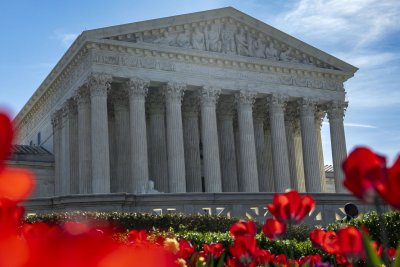
June 25 (UPI) — The U.S. Supreme Court on Thursday struck down a Hawaiian law that required people to ask permission to carry a concealed firearm onto a private property.

The Court’s majority, in a 6-3 ruling, said that Hawaii cannot block a properly licensed person from carrying a concealed weapon on private properties that are open to the public.

Hawaii was one of five states that enacted similar laws after the Court in a 2018 ruling said that states could not limit gun licenses to “exceptional cases” because it violated the 2nd Amendment right to carry a firearm.

The law required people who wanted to carry their firearm in places such as gas stations, restaurants, grocery and other stores, dry cleaners and other properties that are “open to the public” to get permission to carry their gun.

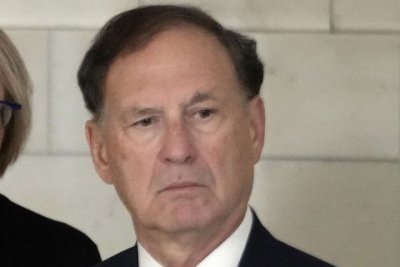
“Under the new Hawaii law, no one carrying a firearm may enter without the property owner’s express authorization,” Justice Samuel Alito wrote in the majority opinion.

“The effect of this new rule is to impose severe restrictions on the daily activities of residents who have satisfied the State’s rigorous requirements for the issuance of a carry permit,” Alito wrote.

In a dissenting opinion, Justice Ketanji Brown Jackson disagreed with the majority that the Hawaii law is an “attempt to end-run our Second Amendment precedents,” suggesting instead that it applies the first principle of property law, the right to exclude.

In addition to noting that Hawaii has a long history of restrictive gun laws, Brown Jackson said it enacted the permission law in order to prevent confusion among property owners that federal law had affected traditional expectations in the state.

“The public might well have an implied license to enter private property open to the public, and such permission might generally include the ability to enter armed,” she wrote in the dissent.

“But,” she wrote, “any such license is not a matter of right — a license is a creature of state law and custom, and it can vary accordingly.”

Source link

Supreme Court rules against Louisiana’s congressional map

April 29 (UPI) — The U.S. Supreme Court ruled against Louisiana’s newly drawn congressional map Wednesday, saying it relied too heavily on race.

The 6-3 decision eliminates one of the two predominantly Black congressional districts established by redistricting from the 2020 census.

Supporters of the redrawn map said it abided by Section 2 of the Voting Rights Act, which prevents lawmakers from packing racial minorities in a limited number of districts or spreading them across too many to diminish their voting power.

Justice Samuel Alito, writing for the majority, described Louisiana’s map as “unconstitutional gerrymander.”

“When §2 of the Act is properly interpreted, it imposes liability only when circumstances give rise to a strong inference that intentional discrimination occurred,” he wrote.

The ruling weakens the landmark Voting Rights Act passed in 1965 to limit racial discrimination in voting. The Supreme Court dealt the act a blow in 2013 when it struck a core provision providing oversight to states with a history of voting discrimination.

With the new ruling by the high court, Republican lawmakers will have an easier time redrawing state maps to more closely align with their party.

Justice Elena Kagan, one of the three dissenters, said such intentional discrimination is hard to prove and that Wednesday’s decision serves to “eviscerate the law.”

“Under the Court’s new view of Section 2, a State can, without legal consequence, systematically dilute minority citizens’ voting power,” she wrote.

It’s unlikely the Supreme Court’s ruling will have an impact on midterm elections later this year as early voting in congressional primaries begin May 16.

Britain’s King Charles III delivers an address to a joint meeting of Congress at the U.S. Capitol on Tuesday. The king and Queen Camilla are on a four-day state visit to the U.S. with stops in Washington and New York. Photo by Bonnie Cash/UPI | License Photo

Source link