Sahel

The Sahel and the UN: a smaller footprint, a different role | Conflict News

For a decade, the United Nations’s most visible role in the Sahel was its peacekeeping mission in Mali.

The United Nations Multidimensional Integrated Stabilization Mission in Mali (MINUSMA) was established by the Security Council in 2013. Its mandate was terminated in June 2023 at the request of Mali’s transitional government, and the mission completed its withdrawal by the end of that year.

But the end of MINUSMA did not end the UN’s engagement with the region.

Its political work continues through the UN Office for West Africa and the Sahel (UNOWAS), while the wider UN system remains involved in humanitarian and development work.

What has changed is the space in which that engagement takes place.

Burkina Faso, Mali and Niger formally left the Economic Community of West African States (ECOWAS) on January 29, 2025. The three countries have also deepened cooperation through the Alliance of Sahel States (AES), putting sovereignty and strategic autonomy at the centre of their political message.

The humanitarian pressures, meanwhile, have not eased.

Displacement, insecurity, food insecurity and other pressures continue to cross borders, even as governments increasingly insist on handling their security and political affairs on their own terms.

The question is what influence the UN can exercise after the departure of the peacekeeping force that once represented its most substantial presence in the region.

What does the UN’s presence look like now?

The UN’s role today is less about troops and more about diplomacy, mediation, humanitarian assistance and development.

UNOWAS is a special political mission rather than a peacekeeping operation. Its work includes preventive diplomacy, good offices, political mediation, conflict prevention and support for political dialogue.

“The influence the UN can actually exercise is narrow. The AES states have stripped away the mechanisms that once gave outside institutions leverage, leaving ECOWAS and the Rome Statute, and building their own confederation and joint force instead,” said Mubarak Aliyu, a political and security analyst in Nigeria.

In February 2026, the Security Council extended UNOWAS’s mandate until January 31, 2029, while requesting an independent strategic review of its mandate and activities, to be finalised by September 30, 2026.

The review comes as West Africa’s political landscape is being reshaped by military governments, new regional alliances and a stronger emphasis on sovereignty.

Russia has also become an important part of that changing security picture.

“What has actually shaped events this year is Russia’s Africa Corps, which helped Mali’s and Niger’s military governments survive shocks the UN was never positioned to influence, functioning mainly as regime protection rather than counterinsurgency,” Aliyu said.

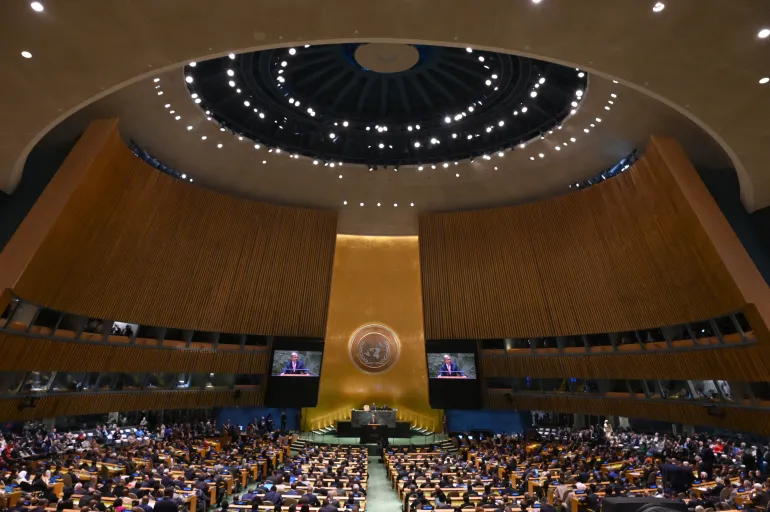
UN continues its engagement in a Sahel where governments are placing greater emphasis on sovereignty and strategic autonomy [File photo: Timothy A. Clary / AFP]
UN continues its engagement in a Sahel where governments are placing greater emphasis on sovereignty and strategic autonomy [File: Timothy A Clary/AFP]

“Moscow’s leverage extends into the Security Council chamber too, since its veto shapes what collective action the Council can attempt on Mali in the first place.”

Kabir Adamu, founder and managing director of Beacon Security and Innovations Limited, an Abuja-based firm that provides security solutions in Nigeria, the Lake Chad Basin and the Sahel, said the UN should shift its approach away from large deployments of UN troops to diplomatic and towards diplomatic and development solutions.

“Looking ahead, the UN’s priorities in the Sahel should promote effective security sector governance and security sector reform. This will mean pivoting from traditional, large-scale peacekeeping to deep-rooted and core preventive strategies and diplomacy that addresses the root causes of fragility, conflict and violence, as well as instability,” Adamu said.

For the United Nations, diplomacy has become more important as governments turn to other security partnerships and regional arrangements.

How has sovereignty changed the political space?

Burkina Faso, Mali and Niger have made sovereignty and strategic autonomy central to their political outlook and built the AES as a framework for closer cooperation.

Their departure from ECOWAS has changed the regional architecture through which West African governments have traditionally dealt with political and security crises.

The UN still works with regional organisations, including ECOWAS and the African Union, but governments no longer share one political framework or the same approach to external engagement.

Consequently, for the UN, maintaining vital political channels has become potentially more difficult.

Adamu said the fragmented security architecture means the UN should seek to work with and through regional organisations and groups, rather than establishing its own large-scale forces.

“As national security structures remain weak and extractive, and regional security architecture fragments, marked by the rise of the Alliance of Sahel States and shifting ECOWAS dynamics, the UN should prioritise pragmatic, inclusive mediation to bridge divides between Sahelian and coastal states, while actively bolstering alternative, functioning frameworks like MNJTF [Multinational Joint Task] and the Accra Initiative,” he said.

Have the problems in the Sahel gone away?

The retreat of peacekeepers has not removed the pressures that brought international organisations into the region in the first place.

Displacement, armed violence, organised crime, food insecurity and climate pressures continue to overlap across the Sahel.

Climate change is perhaps not the root cause of the instability, but environmental and economic pressures can add to existing vulnerabilities, particularly where state institutions are weak and communities are already dealing with conflict and displacement.

For the UN, humanitarian work remains one of the areas where engagement can continue, even when governments reject large-scale military intervention.

Humanitarian work also places greater emphasis on local and regional capacity.

“Crucially, the UN must double down on the core UNISS pillars of governance, resilience, and security by integrating climate-peace initiatives and empowering local capacities, ensuring that international engagement remains flexible, locally owned, and focused on sustainable, multidimensional stability rather than solely militarised responses,” Adamu said.

While the UN cannot determine the security partnerships of sovereign governments or force political processes on authorities that reject them, it can still facilitate dialogue, support humanitarian operations and raise regional crises before the wider international community.

What does UNGA 81 mean for the Sahel?

The 81st session of the United Nations General Assembly opened on September 8, 2026, with its General Debate due to begin on September 22.

The UNGA meets with no UN peacekeeping mission in Mali and with Burkina Faso, Mali and Niger outside ECOWAS, while the AES has become a separate framework for their political and security cooperation.

“That leaves the UN closer to an advocate and service provider than a shaper of outcomes,” Aliyu said. “It can report, brief, fund aid operations and press for access, but it cannot compel it or offer the regime security that has made Russia indispensable to the military governments.”

Yet for the Sahel, insecurity, displacement, humanitarian needs and economic and climate pressures remain.

In the changed regional environment, the UN’s influence is more likely to come through diplomacy than force, through access rather than authority, and through regional relationships rather than a large international security presence.
Source link

Niger mutiny puts Russia’s expanding role in the Sahel to the test | Conflict News

Niger’s military government has contained an attempted mutiny in the capital, but the uprising has exposed tensions inside an army struggling to contain persistent attacks by armed groups.

It has also highlighted the changing nature of Niger’s security partnerships, with Russian personnel helping government forces contain the unrest.

The mutiny began on Saturday at Base 101, a military installation at Diori Hamani International Airport in Niamey, before fighting spread to other sensitive sites, including areas near the presidential palace and the state broadcaster.

Niger’s army said it regained control of the base after hours of fighting. State media reported that dozens of soldiers were killed or arrested, although Reuters said it could not independently verify the figures.

Russia’s Africa Corps was involved in the government’s response.

Russia’s ambassador to Niger, Viktor Voropaev, said Nigerien authorities requested the force’s assistance to neutralise the mutineers. The Associated Press reported that Africa Corps provided ground and aerial support to forces loyal to the government.

The intervention is significant because Russian forces were helping Niger’s military government confront an armed challenge from within its own military.

What happened in Niamey?

The unrest began with a hostage situation at the military base, according to the Associated Press. Soldiers took fellow servicemen hostage before opening fire and attacking what Niger’s Defence Ministry described as “sensitive” sites in the capital.

Gunfire and explosions were heard around the airport, while the state broadcaster was temporarily taken off air. The presidential palace was also targeted, according to Reuters and Al Jazeera.

Government forces eventually regained control of Base 101, while the Presidential Guard remained loyal to General Abdourahamane Tiani, who seized power in a July 2023 coup.

The precise size and leadership of the mutiny remain unclear. Nigerien state media said hundreds of soldiers were involved, but Reuters said it could not independently verify that figure.

Some of those involved were reportedly from areas including Ouallam, Tera and Dosso in southwestern Niger, where the army has suffered heavy losses fighting armed groups.

The uprising appears to be the most serious internal challenge to Tiani’s rule since he came to power.

Why are Niger’s soldiers under pressure?

The precise motives of the mutineers have not been publicly established.

But analysts and security sources have linked the unrest to frustration over worsening insecurity and heavy military losses.

Niger’s army has been fighting groups affiliated with al-Qaeda and ISIL (ISIS), particularly in the country’s west.

Reuters reported that an attack by an ISIL affiliate earlier this month killed 18 Nigerien soldiers. The airport complex where Base 101 is located was also attacked earlier this year, including in January by an ISIL affiliate and in June by Jama’at Nusrat al-Islam wal-Muslimin (JNIM), al-Qaeda’s Sahel affiliate.

The mutiny therefore came against the backdrop of the same security crisis that helped bring the military government to power.

Tiani and other officers who seized power in 2023 accused the elected government of failing to contain armed groups and promised to restore security. But the threat has persisted.

The unrest raises questions about the pressure facing front-line units as Nigerien forces continue to suffer casualties in their fight against armed groups.

Why did Africa Corps intervene?

Africa Corps is a Russian force operating under the Ministry of Defence that took over much of the Wagner Group’s role in Africa after Moscow reorganised its operations following the death of Wagner leader Yevgeny Prigozhin in 2023.

The force includes former Wagner personnel and operates under Russian state control.

Africa Corps personnel are stationed at Base 101, according to AP, which reported that the force has between 200 and 300 personnel in Niger.

Voropaev said Niger had requested Russian assistance during the mutiny.

AP reported that Africa Corps provided ground and aerial support after forces loyal to the government struggled to regain control of the base.

The episode does not establish that Russia controls Niger’s armed forces.

But it demonstrates that when Niger’s military government faced an armed challenge from within its own military, it was able to call on Russian forces already operating inside the country.

That underscores how significantly Niger’s post-coup security arrangements have changed.

What does Russia gain from Niger?

Niger’s relationship with Russia has deepened since the 2023 coup.

The military government pushed French forces out of the country, while United States forces later withdrew. Niger also joined Mali and Burkina Faso in forming the Alliance of Sahel States (AES), as the three military-led governments moved away from the Economic Community of West African States (ECOWAS).

Moscow has cultivated closer military ties with all three governments.

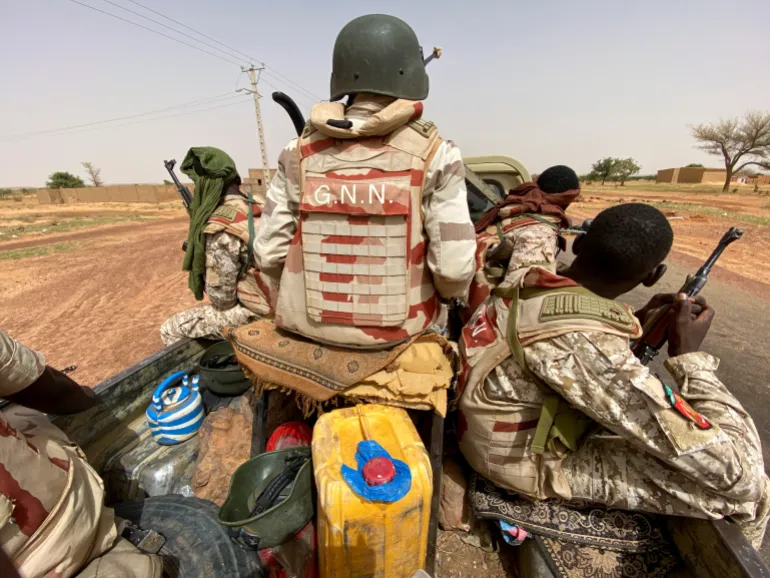
Nigerien soldiers patrol outside the town of Ouallam, Niger [Reuters]

Africa Corps is part of that wider security relationship, taking over much of Wagner’s former role while operating under Russian state control.

Its intervention in Niamey gives that partnership a new dimension.

Russia was not simply helping Niger fight armed groups. Its personnel were involved in helping the government respond to an armed challenge from within the military itself.

Whether that translates into greater Russian political influence over the military government remains unclear.

What role did Algeria play?

Russia was not the only foreign actor to support Niger during the crisis.

Niger’s presidential office said Algeria provided military assistance. Reuters reported that Algeria sent four fighter jets, a transport aircraft and a refuelling tanker.

The Alliance of Sahel States also backed Niger’s military government, while Turkiye expressed solidarity and called for restraint.

It was not immediately clear whether Mali or Burkina Faso provided direct military assistance. Their political support should therefore not be presented as evidence that their forces participated in suppressing the mutiny.

What does this mean for France and the UK?

The crisis highlights the reversal of Western military influence in Niger.

France had a major military presence in the country as part of its wider counterinsurgency campaign in the Sahel, but French forces withdrew after relations with the military government collapsed following the 2023 coup.

The US subsequently withdrew its forces from Base 101 and Niger’s other military installations.

Niger has since moved closer to Russia and strengthened its ties with Mali and Burkina Faso.

There has been no confirmed new French or British military response to this specific mutiny in the latest reporting.

France’s relevance is therefore primarily its withdrawal from Niger and the resulting shift in the country’s security partnerships. The United Kingdom had a much smaller military role in Niger than France.

Can Russia solve Niger’s security problem?

Africa Corps may have helped the military government contain the immediate threat, but its intervention does not resolve Niger’s wider security crisis.

Armed groups linked to al-Qaeda and ISIL remain active, while Nigerien soldiers continue to face heavy losses.

Tiani came to power promising greater security and sovereignty. Yet three years later, the armed-group threat persists, and soldiers have mounted an internal challenge to the government.

Russia can provide personnel and operational support. But there is no evidence from this episode that the Africa Corps can by itself resolve the insecurity driving Niger’s conflict or the pressures facing its military.

The immediate challenge to Tiani has been contained.

But the episode exposes a difficult contradiction for Niger’s military government: it seized power promising to make the country more secure, yet it continues to face a serious rebellion while confronting unrest within the armed forces.

For Russia, meanwhile, the crisis demonstrates the practical value of its growing security relationship with Niger.

When the government faced an internal military crisis, Africa Corps was already on the ground.

That does not mean Russia has replaced Niger’s own armed forces.

But it shows how far Niger’s security architecture has shifted since the 2023 coup, from one heavily reliant on Western partners to one in which Russian forces now have a visible supporting role.

Source link