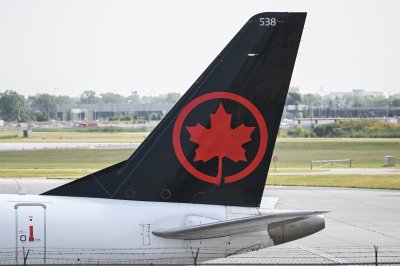
Air Canada jet collides with fire truck on LaGuardia runway; FAA halts traffic

An Air Canada plane was involved in a collision late Sunday at new York City’s LaGuardia Airport. Photo by Graham Hughes/EPA
March 23 (UPI) — An Air Canada regional jet with nearly 80 people onboard collided with a fire truck at LaGuardia Airport, prompting federal officials to halt air traffic to and from the airport.
The FAA ordered the ground stop at 12:04 a.m. EDT, according to a statement from its Air Traffic Control System Command Center. The agency later said the airport would be closed until 2 p.m.
The plane struck the Port Authority Aircraft Rescue and Firefighting vehicle on Runway 4 late Sunday as it was responding to a separate, unknown incident, the Port Authority of New York and New Jersey, which operates LaGuardia, told UPI in a statement.
The National Transportation Safety Board said in a statement the involved vehicle was a fire truck and that it had deployed a team expected to arrive at LaGuardia later Monday to begin its investigation.
The extent of the collision and whether there were any casualties was unclear early Monday.
The Port Authority said the airport was closed to facilitate the response and allow for an investigation. Emergency response protocols were activated and its police force was at the scene working with airline and federal authorities, the agency said.
The New York Fire Department confirmed to UPI that it had responded to an incident.
Air Canada confirmed to UPI that it was aware of the crash involving Air Canada Express Flight 8646 from Montreal, Canada, to New York City.
The flight was operated by Jazz Aviation, which said in a statement that the incident occurred at 11:47 p.m. EST Sunday. The plane was carrying 72 passengers and four crew, the Halifax-based airline said.
All streets and highway exits to the airport have been closed until further notice, according to the New York Police Department.
New York City’s official Emergency Notification System has issued an alert warning residents to expect “cancellations, road closures, traffic delays and emergency personnel near LaGuardia Airport.”
Flight 8646, a CRJ900 regional jet, had departed from Montreal at about 10:35 p.m. EST, according to flight-tracking website Flightradar24.
This is a developing story.