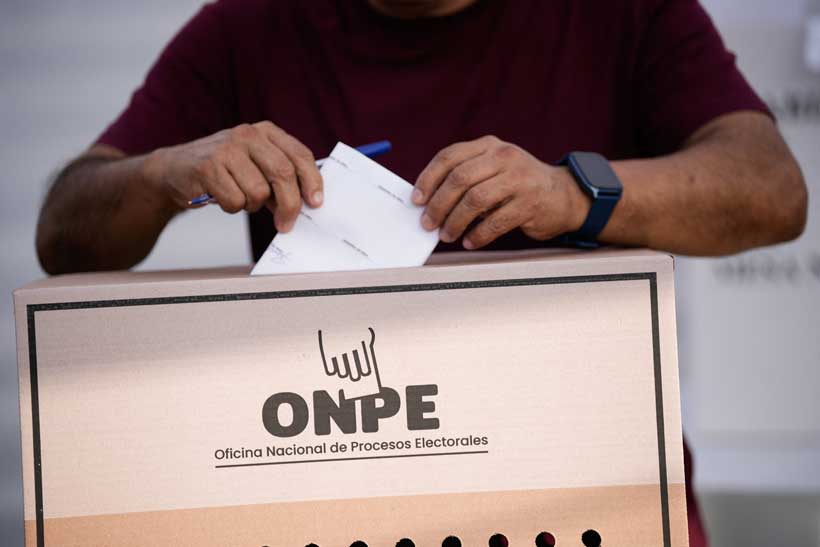
Peru held a presidential election on Sunday, where voters cast ballots for a new president and Congress members from a pool of over 30 candidates. This election comes after years of political instability that have lowered public trust in government institutions. With no clear frontrunner and all major candidates polling below the 50% needed for an outright win, a runoff on June 7 appears likely, posing further uncertainty for the country.
Voting began at 7 a.m. local time with about 27 million eligible voters. Some voters reported issues at polling stations, such as long lines and delayed openings, causing frustration. Voter Margarita Sandoval expressed her discontent, saying, “These elections are a disaster. “
The candidates represent a wide ideological range, including seasoned politicians, a far-right businessman, and a comedian. Notable candidates include conservative Keiko Fujimori, who is making her fourth attempt for the presidency and is known for her promises of order and economic stability amid rising crime. Despite her experience, she remains a controversial figure. Other emerging candidates include Ricardo Belmont from the center-left, who recently gained popularity, and comedian Carlos Alvarez, who is focused on a strict crime-fighting message.
Public safety is the primary issue driving the campaign, as crime rates have increased due to drug trafficking and illegal mining. Most candidates propose enhancing military involvement in domestic security. Furthermore, the election has geopolitical implications, notably due to Peru’s growing ties with China, which are causing concern in the United States. Post-election, the new president will face a fragmented Congress, complicating legislative efforts and increasing the likelihood of impeachment disputes. Polls closed at 5 p.m., with preliminary results expected shortly thereafter.
“Trump’s endorsement would be huge,” said Jon Fleischman, a conservative strategist and former executive director of the state GOP.
“Actually,” he went on, ‘I think it would be determinative” — virtually guaranteeing either Hilton or Bianco finished in the top two in the June 2 primary, ushering them past the rope line into November’s runoff.
If there’s an inside edge in the Trump Endorsement Sweepstakes, it would seemingly go to Hilton.
He’s familiar to the president as a former Fox News host. He’s interviewed Trump several times and the two occasionally text and talk on the phone. Bianco has no such personal connection, which might explain his ballot-seizing stunt.
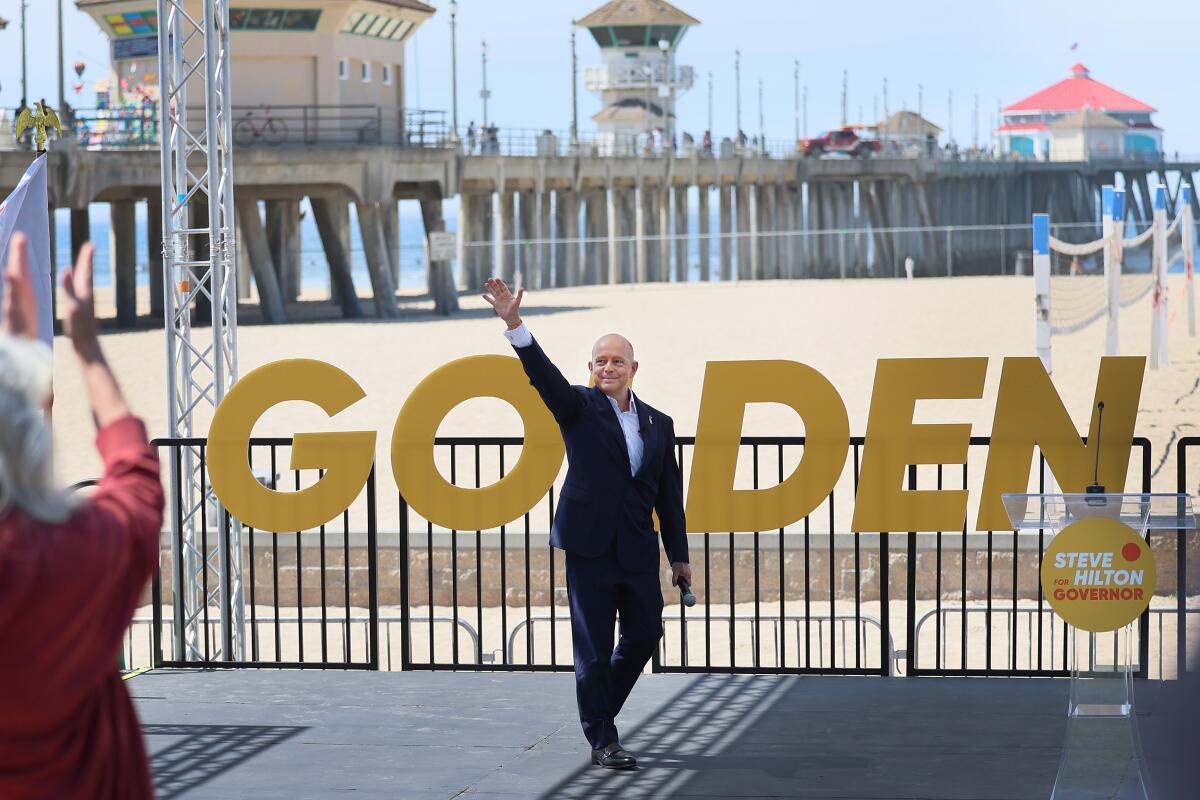
Steve Hilton could have the inside track on a Trump endorsement, given their personal relationship.
A Trump endorsement comes in all sorts of flavors.
As The Downballot recently noted, “His bag of tricks includes dual endorsements, triple endorsements, pre-endorsements, Election Day endorsements, yanking endorsements … belated endorsement of a candidate after initially endorsing just one candidate [and] non-endorsements after promising to endorse.”
There was also the time Trump endorsed “ERIC” when Republicans Eric Schmitt and Eric Greitens faced each other in Missouri’s Senate primary. (Schmitt won and is now the state’s junior U.S. senator.)
Trump’s backing still counts a good deal, even as his approval ratings sink to sub-basement levels. The president remains popular with Republicans and, critically, the kind of GOP loyalists who vote in primary contests, which is why both Hilton and Bianco would welcome a presidential laying on of hands.
There’s good reason, however, to think Trump might pass on endorsing in the governor’s race, or opt to deliver one of his dual he-and-him endorsements.
The GOP’s best — and perhaps only — hope of winning the governorship is the Democratic-freeze-out scenario. So, tactically, Trump’s wisest move may be to bless neither Hilton nor Bianco. Or support both. That would avoid elevating one over the other, which could make it easier for a Democrat to finish among the top two and advance past the June primary.
“I think Trump’s people are smart enough to know that there’s a reason why he may not be served by endorsing a candidate,” Fleischman said. “I wouldn’t be surprised if the prevailing wisdom there is we better not endorse anybody, because we don’t want to tilt this one way or the other.”
If Trump were to back Hilton or Bianco, it’s not hard to imagine Democratic interests seizing upon the president’s benediction and putting significant money behind an ad blitz promoting the president’s favorite in hopes of boosting him — and him alone — into the top two.
In 2018, his main rival was fellow Democrat Antonio Villaraigosa. Two major Republicans were also in the race, John Cox and Travis Allen. There was no real concern about those two nabbing both spots in the June primary. Rather, Newsom and Cox had a shared interest in boxing out Villaraigosa.
So the Newsom and Cox campaigns opened a private back-channel, trading gossip, swapping insights on the race and even sharing some empirical data. One poll, showing Cox getting a bigger boost from a Trump endorsement than Allen, passed from Democratic hands in hopes it would reach the White House and nudge the president into supporting Cox.
Brazilian President Luiz Inácio Lula da Silva (pictured) and right-wing Sen. Flávio Bolsonaro are each polling 41% in a potential runoff election. Photo by Sebastiao Moreira/EPA
March 12 (UPI) — Brazilian President Luiz Inácio Lula da Silva and right-wing Sen. Flávio Bolsonaro are tied for the first time for a potential runoff after the Oct. 4 presidential election, according to a poll released Wednesday. A runoff would be Oct. 25.
The survey found each candidate with 41% support in a hypothetical second round.
Bolsonaro, a member of the Liberal Party and son of former President Jair Bolsonaro, leads among voters who identify as independent, a shift that could give him an edge.
Among independents, Bolsonaro gained 6 percentage points and would lead Lula 32% to 27% in a runoff scenario. Another 36% said they would not vote and 5% were undecided.
The gap between the two candidates has narrowed steadily, from 10 points in December to seven in January, five in February and zero in March, according to the survey conducted by polling firm Quaest and commissioned by Genial Investimentos.
Similar trends have appeared in other recent polls. A Datafolha survey published Saturday showed Lula with 46% support compared with 43% for Bolsonaro.
Quaest tested first- and second-round scenarios with eight potential candidates. In first-round simulations, Lula leads in two scenarios and is statistically tied with Bolsonaro in five others. Lula’s support ranges between 36% and 39%, while Bolsonaro’s support ranges between 30% and 35%.
Felipe Nunes, Quaest’s director, said Bolsonaro’s gradual rise began after his father publicly named him as a potential candidate in December.
“Flávio has managed to consolidate Bolsonaro’s electorate. He has grown among right-wing voters and improved his performance among independent voters,” Nunes said, according to news website O Globo.
The poll also showed worsening public assessments of the government and the economy.
Both Lula and Bolsonaro face high rejection rates, with 56% of respondents saying they would not vote for Lula and 55% saying the same about Bolsonaro.
“The shift over time is striking. In December, Lula had much greater potential and lower rejection. Now, both have similar levels,” Nunes said.
The survey found 48% of Brazilians believe the economy has worsened over the past 12 months, while 24% say it has improved. In February, negative perceptions stood at 43%.