The Sports Report: Rough night locally as Dodgers, Angels and Sparks lose
Dodgers fall to the Mariners
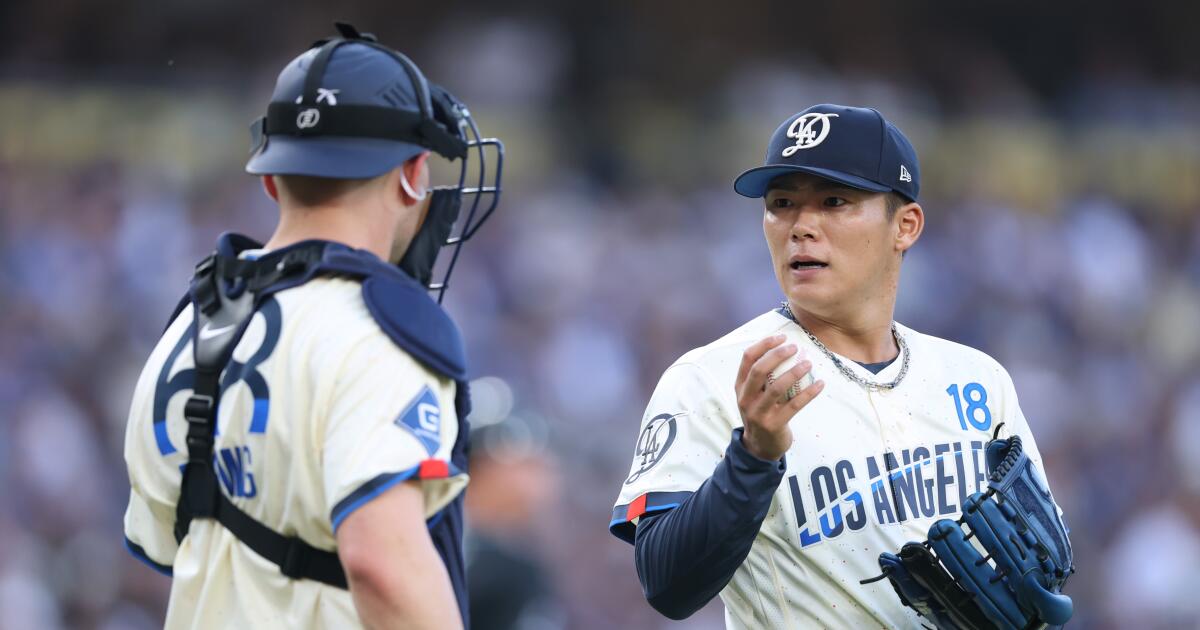
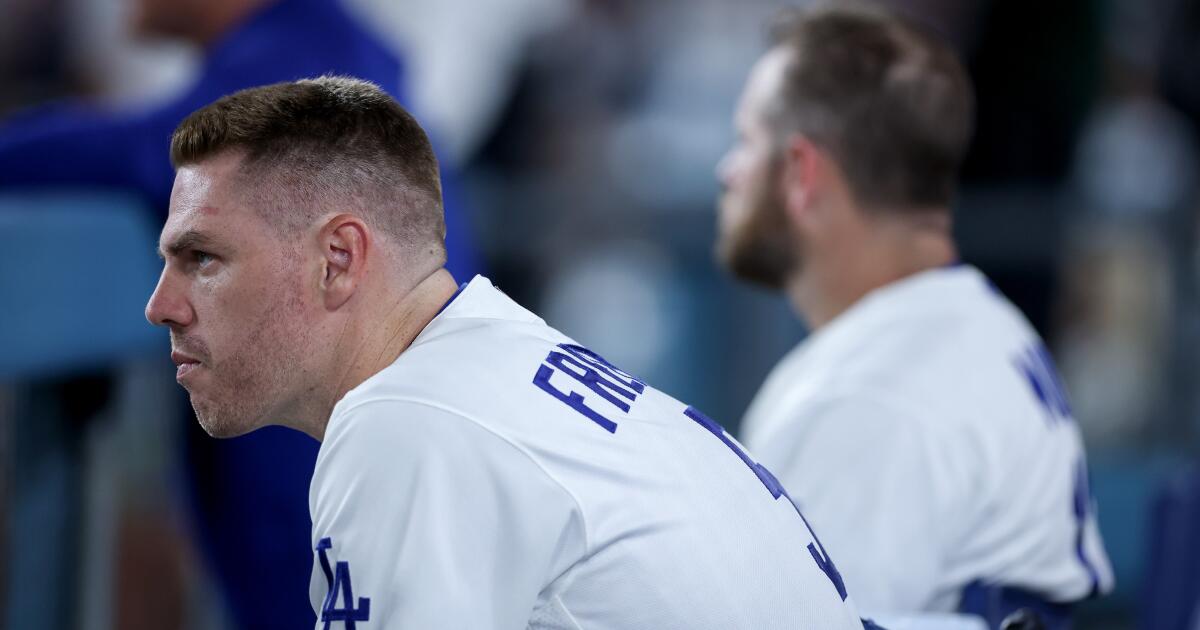
From Joaquin Ruiz: Dominic Canzone’s go-ahead home run in the eighth spoiled a Tuesday night of leaderboard climbing for Max Muncy and Shohei Ohtani as the Mariners beat the Dodgers 7-6 in the first game at Dodger Stadium since before the All-Star break on July 12.
With one out, Julio Rodríguez on first and the score tied at five, Canzone got all of Alex Vesia’s 82-mph slider, sending it 414 feet to center to help lift Seattle to its first win over the Dodgers in five years and first in Los Angeles since June 28, 2009.
“I mean it’s a pitch that’s had different results,” Vesia said. “Obviously it’s not the best pitch. I would have liked to have it more outside or more down. Kind of just flush it and on to the next one. Clearly need to be better in that situation. I felt like my stuff was good after that.”
Added manager Dave Roberts: “Alex made a really bad pitch, [an] 0-1 slider that was middle-middle, and they were hitting the ball out of the ballpark. So, that’s kind of the tale of the run prevention tonight.”
The Dodgers (67-40), with some much-needed help from dubious Mariners fielding, did have Ohtani on third and Muncy on second as the tying and game-winning runs in the ninth. But Seattle reliever Andrés Muñoz survived, putting an end to the thrilling opener of this three-game series.
Seattle won the offensive slugfest with 10 hits and five home runs to the home team’s 13 hits and two homers.
Shaikin: The Dodgers’ three-peat chance may never come again. Trade accordingly
Dusty Baker’s peers expect him to become the first Black manager in the Hall of Fame
Angels fall to the Astros
Yordan Alvarez homered and hit a go-ahead RBI single with two outs in the ninth inning to lift the Houston Astros to a 3-2 win over the Angels on Tuesday night.
Christian Walker added a solo homer while Houston relievers Enyel De Los Santos, Bryan Abreu, Steven Okert and Josh Hader combined for four hitless innings. Okert (4-1) threw a scoreless eighth to earn the win and Hader threw a four-pitch ninth for his 14th save.
The Astros won for the seventh time in eight games to remain two games behind Texas in the American League West. The last-place Angels have lost 17 of 22 games.
Sparks lose to Liberty
From Steve Galluzzo: On a night when a franchise legend had her jersey raised to the rafters, the Sparks played with inspiration and determination but were unable to snap their losing streak, falling to the New York Liberty 113-109 on Tuesday at Crypto.com Arena.
The Sparks (10-17) have lost six straight.
Down 11 with 3:30 left, the Sparks pulled to within 112-109 on Nneka Ogwumike’s three-pointer with 15 seconds left, but Breanna Stewart sank the second of two free throws with 13.9 seconds left to ice it for New York (16-12).
Despite the absence of leading scorer Kelsey Plum, who is averaging 23.9 points a game but has been sidelined with a lower leg injury since the teams’ prior meeting June 25, the Sparks had a balanced attack with six players in double figures.
Rae Burrell led the charge with 24 points, Ogwumike added 21 points and nine assists, Erica Wheeler had 17 points and nine assists, Ariel Atkins had 16, Dearica Hamby had 12 and Cameron Brink had 11 for the Sparks, who squandered a chance to inch a half game in front of Portland for fifth place in the WNBA’s Western Conference. The Fire (11-17) lost to Las Vegas earlier Tuesday.
“I’m proud of my team — we were active and connected,” Sparks coach Lynne Roberts said. “We scored 30 points off of 18 turnovers, we made more field goals than them and we had 35 assists, which is a franchise record. We just didn’t get rewarded with a win.”
Lincoln Riley says USC are ready for next level
From Ryan Kartje: The stage was set this past summer, and Lincoln Riley was a ball of nerves.
The USC coach should’ve been used to weathering pressure by that point. After all, his previous four seasons spent coaching the Trojans had been nothing short of a powder keg, filled with ups and downs, as well as a constant undercurrent of tension and uncertainty. But in this particular case, success was out of Riley’s control. He wasn’t even near a football field.
Rather, he was sitting in the audience of a local dance recital, waiting on his two young daughters, Sloan and Stella, who were each making their solo dancing debut with their company.
“This was the first year, stepping out on their own, no one else to rely on,” Riley said. “But they told me, ‘Dad, we’ve got it.’”
Entering his fifth and most pivotal season yet at USC, their father can relate to that sentiment. While the spotlight burns brighter than ever and the collective college football world is spinning 2026 as a make-or-break moment for Riley, the coach had never sounded so confident that his Trojans had turned a corner than he did Tuesday.
“I’ve felt the pressure to win every single year here,” Riley said during Big Ten media days. “What does feel different is that I think our opportunity to do that is greater than what it has been. It just flat out is. The things you need to win, we have more of than we had in the first four years.”
This day in sports history
1751 — The first International World Title Prize Fight takes place in Harlston, England. The champion, Jack Slack of England, beats the challenger, M. Petit of France, in 25 minutes.
1934 — Paul Runyan beats Craig Wood on the 38th hole to win the PGA Championship at Park Country Club in Williamsville, N.Y.
1956 — Cathy Cornelius wins a playoff over Barbara McIntyre to win the U.S. Women’s Open.
1957 — At the Polo Grounds in New York, Floyd Patterson TKOs Tommy Jackson at 1:52 of the 10th round to retain the heavyweight title.
1960 — The first American Football League preseason game is played in Buffalo, N.Y. The Boston Patriots, led by quarterback Butch Songin, beat the Bills 28-7 before 16,474 fans at War Memorial Stadium.
1979 — Amy Alcott shoots a 7-under 285 to beat Nancy Lopez in the Peter Jackson Classic, later named The du Maurier Classic. The du Maurier is one of the LPGA Tour’s major championships from 1979-2000.
1986 — The U.S. Football League wins and loses in its lawsuit against the NFL. The jury finds the NFL violated antitrust laws, as the USFL claimed, but awards the USFL only $1 in damages.
1989 — Cuba’s Javier Sotomayor becomes the first person to high jump 8 feet, breaking his world record at the Caribbean Championship in San Juan, Puerto Rico. He surpasses his mark of 7-11½.
1990 — Beth Daniel shoots a 66 to overcome a 5-shot deficit and win the LPGA Championship — her first major title in 12 years on the tour. Daniel beats Rosie Jones by one stroke and pockets $150,000, the largest in LPGA Tour history.
1992 — The U.S. 400-meter freestyle relay team wins the gold medal, with Matt Biondi and Tom Jager becoming the first U.S. male swimmers to win golds in three Olympics.
1996 — Michael Johnson sweeps to victory in an Olympic 400-meter record 43.49 seconds, while Carl Lewis leaps into history in Atlanta. Lewis’ long jump of 27 feet, 10¾ inches earns him his ninth gold medal, equaling the American mark held by swimmer Mark Spitz.
2001 — Copa América Final, Estadio El Campín, Bogotá: Defender Iván Córdoba scores winner as home team Columbia edge Mexico, 1-0.
2008 — Disgraced ex-NBA official Tim Donaghy admits he brought shame on his profession as a federal judge sentenced him to 15 months behind bars for a gambling scandal.
2012 — Kimberly Rhode wins the Olympic gold medal in women’s skeet shooting, becoming the first American to take an individual-sport medal in five consecutive Olympics.
2012 — Dana Vollmer of the U.S. sets a world record to win the 100-meter butterfly at the London Olympics. Vollmer hits the wall in 55.98 seconds to shave 0.08 off the mark set by Sarah Sjostrom of Sweden at the 2009 world championships in Rome.
2015 — Russia’s Natalya Ishchenko wins a record 18th career synchronized swimming gold medal at the world championships at Kazan, Russia.
2021 — Sunisa Lee wins the women’s all-around gymnastics gold medal in Tokyo.
Compiled by the Associated Press
This day in baseball history
1908 — Rube Waddell struck out 16, sending the St. Louis Browns past the Philadelphia A’s 5-4.
1911 — Joe Wood of the Boston Red Sox beat the St. Louis Browns with a 5-0 no-hitter in the first game of a doubleheader. Wood fanned 12 and allowed three baserunners on two walks and a hit batsman.
1915 — Honus Wagner, 41, became the oldest player to hit a grand slam as Pittsburgh beat Brooklyn 8-2. The grand slam was an inside-the-park homer. Wagner remained the record holder until 1985, when Tony Perez hit one the day before his 43rd birthday.
1928 — The Cleveland Indians scored eight runs in the first inning and nine more in the second and went on to beat the New York Yankees 24-6 at Dunn Field. Johnny Hodapp singled twice in the second and sixth innings.
1936 — The Brooklyn Dodgers beat the St. Louis Cardinals 22-7 in the first game of a doubleheader, then lost the second game 5-4.
1955 — Smoky Burgess of the Cincinnati Reds hit three home runs and drove in nine runs in a 16-5 rout of the Pittsburgh Pirates at Crosley Field.
1968 — George Culver of the Cincinnati Reds pitched a 6-1 no-hitter against the Phillies in the second game of a doubleheader at Philadelphia.
1983 — Steve Garvey of the San Diego Padres ended his NL record of 1,207 consecutive games played. The streak ended when he dislocated his thumb in a collision with Atlanta pitcher Pascual Perez while trying to score.
2000 — Eddie Taubensee hit a tying homer with two out in the ninth and homered again in the 11th to lead Cincinnati to a 4-3 win over Montreal.
2001 — Craig Monroe homered in his first major league at-bat, and the Texas Rangers beat Tampa Bay 2-0.
2003 — Boston’s Bill Mueller became the first player in major league history to hit grand slams from both sides of the plate in a game and connected for three homers in a 14-7 win at Texas.
2006 — Tomas Perez tied a major league record with four doubles, going 5-for-5 and leading the Tampa Bay Devil Rays to a 19-6 rout of the New York Yankees.
2010 — Anibal Sanchez pitched a one-hitter, leading the Florida Marlins past the San Francisco Giants 5-0. Sanchez retired his first 13 batters and matched a career high with eight strikeouts.
2018 — The Hall of Fame inducts one of the largest classes in its history. Honored are Vladimir Guerrero, Trevor Hoffman, Chipper Jones, Jack Morris, Jim Thome and Alan Trammell.
2022 — Aaron Judge hits two more homers in leading the Yankees to an 11-5 win over the Royals. He now has 41 on the season, tying the American League record for most before the end of July held by Hall of Famers Babe Ruth, Jimmie Foxx and Ken Griffey Jr. Judge will set a new record with another homer tomorrow.
Compiled by the Associated Press
Until next time…
That concludes today’s newsletter. If you have any feedback, ideas for improvement or things you’d like to see, email me at houston.mitchell@latimes.com. To get this newsletter in your inbox, click here.