Rose

Letters to Sports: Back to the Rose Bowl for UCLA

p]:text-cms-story-body-color-text clearfix”>

Thank you, Ben Bolch. In your newsletter, an open letter to UCLA Chancellor Julio Frenk, you have asked all the right questions. On the surface, the proposed move to SoFi Stadium might make some sense. But in the real world, it sure doesn’t. I was at the game vs. Washington, and the sentiment was pretty strong against a move. Also, the word was that possibly 80% of season-ticket holders will not renew if they play in SoFi Stadium. Even though I have had season tickets for more than 40 years, if they do move, I will be part of that 80%. I wonder if that figure has been factored in?

Bruce Fischer
Huntington Beach

The Rose Bowl is the most storied stadium in college football. Nestled just below the San Gabriel Mountains, it is probably the most beautiful as well. It has hosted five Super Bowls (XI, XIV, XVII, XXI, XXVII), men’s and women’s World Cup finals, the Olympics and its annual namesake bowl game — “the Granddaddy of Them All.” There literally isn’t a bad seat in it. Why would UCLA even consider leaving it, especially for the glorified erector set known as SoFi Stadium?

Stephen A. Silver
San Francisco

Source link

UCLA fans at Rose Bowl conflicted over possible SoFi Stadium move

The nostalgia hit Ross Niederhaus in the grocery store as he stocked up for what might be his last Rose Bowl tailgate.

This has been nearly a lifelong tradition for the native of Linda Vista, starting in 2005 when he was 8 years old and UCLA romped over Oregon State. When he got his driver’s license in 2012, Niderhaus started throwing his own tailgates, bringing chicken-in-a-biscuit crackers because he couldn’t afford fancier fare.

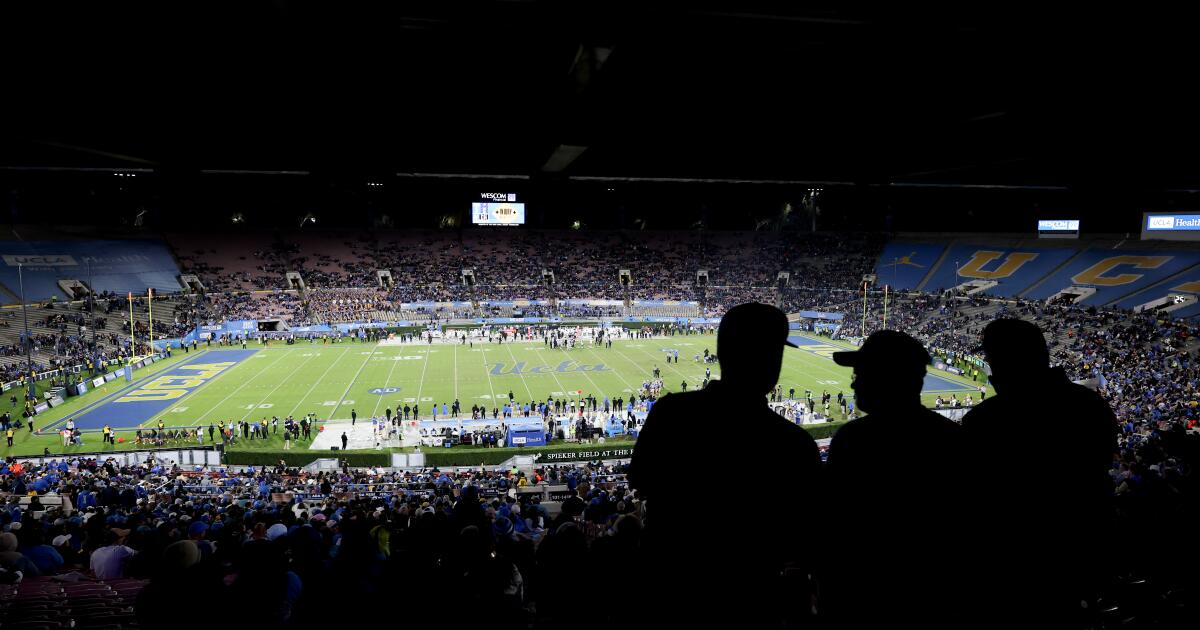
He was back Saturday afternoon underneath a tent on the grass in Lot H, wearing his favorite No. 2 Eric McNeal jersey, possibly here for the last time as the Bruins contemplate whether they will remain at the place they have called home since 1982 or move to SoFi Stadium for the 2026 season.

“I wish we knew whether or not this was the last time,” Niederhaus said, “because if this was the last time for sure I could at least be saying my goodbyes to my favorite tradition. This is my favorite thing to do. My ashes are willed to be spread at the Rose Bowl.”

UCLA fan Ray Hoit sets up a tent while tailgating at the Rose Bowl before Saturday's game against Washington.

UCLA fan Ray Hoit sets up a tent while tailgating at the Rose Bowl before Saturday’s game against Washington.

(Eric Thayer / Los Angeles Times)

On the other side of the stadium, on the sprawling Brookside Golf Course, Nicholaus Iamaleava was prepping his pregame tailgate below four tents alongside his brother Matt, the siblings expecting about 60 family members to indulge in a potluck spread of burgers, hot dogs, wings, fries, hot links, sushi and fried rice.

Both brothers were hoping for more tailgates to come outside the century-old stadium. But just in case, they were preparing for the alternative.

“Today, we’re going to go in early,” said Nicholaus Iamaleava, the father of the UCLA starting quarterback by the same name. “Normally we go in right before kickoff but this time, we’re going to go in and soak it all in, man. It might be the last game, right, so we want to enjoy every bit of it and just hang out.”

Matt Iamaleava said he didn’t think moving to SoFi Stadium would solve the attendance issues plaguing the Bruins at their longtime home.

UCLA fan Nathan Nguyen sets up while tailgating outside the Rose Bowl on Saturday.

UCLA fan Nathan Nguyen sets up while tailgating outside the Rose Bowl on Saturday.

(Eric Thayer / Los Angeles Times)

“There’s nothing like playing at the Rose Bowl,” Iamaleava said. “Hopefully, it works itself out.”

Added Nicholaus Iamaleava: “We’re praying on it. That would be great.”

Nearly 6½ hours before UCLA’s kickoff against Washington, Jamie Hickcox-Baker and Dee Fitzgerald-Cardello lugged a table across the pavement in Lot K, having already unfurled a couple of folding chairs. The UCLA graduates were awaiting the arrival of a massive ice sculpture that would hold margaritas for their group of 25 friends.

“I’m very sad because I live in Altadena and so this is in my backyard and I just hate to see it leave,” Fitzgerald-Cardello said. “It’s just such a tradition. I’m very saddened by it.”

Even though she’s been making the drive from Fresno to tailgate at the Rose Bowl since 1993, Hickcox-Baker was less wistful about a possible move to SoFi Stadium.

UCLA fan Leki Manu throws a football outside the Rose Bowl before Saturday's game against Washington.

UCLA fan Leki Manu throws a football outside the Rose Bowl before Saturday’s game against Washington.

(Eric Thayer / Los Angeles Times)

“I kind of feel like we can talk tradition all we want,” Hickcox-Baker said, “but we left the Pac-12 and the Pac-12 is no longer, so if there’s no tradition in the Rose Bowl game anymore, think about how college football has evolved. I’ve been to a few games at SoFi, it’s a beautiful stadium. The last few years, because our team hasn’t been doing well, we’re stuck in that 100-degree temperature [at the Rose Bowl] and nobody’s coming to the games.”

Back in Lot H, the scene took on the feel of a state fair. The smell of burgers, brats and other grilled delicacies wafted through the air as children played football on the grass and a nearby patch of dirt. One kid kicked a football, commencing a mad scramble as a group of friends converged on the object of their delight.

“This is one of the reasons why people come now,” longtime fan John Anderson said, “is to be here with friends and be able to run around and throw a ball and stuff and if that can’t happen at SoFi, I think it will be a shame. So I don’t think they’re going to get the draw that they think they’re going to get — maybe a little bump for a couple of games and that’s it.”

UCLA fans tailgate before Saturday's game at the Rose Bowl between UCLA and Washington.

UCLA fans tailgate before Saturday’s game at the Rose Bowl between UCLA and Washington.

(Eric Thayer / Los Angeles Times)

Anderson said he missed one home UCLA football game over the last 16 years, and that was to attend a wedding. And if the Bruins move to SoFi?

“I’ll go to a game or two,” Anderson said. “It really depends on what the pricing looks like.”

Neiderhaus said he always would support the Bruins while conceding he might be in the minority.

“I’ll be there,” Niederhaus said, “but I know a lot of people that won’t — a lot of people I know who are season-ticket holders said they’re not coming back, which I think is a big issue that UCLA needs to be acknowledging throughout all of this. A lot of die-hards care about the Rose Bowl just as much as they care about Bruin football, so who knows” how attendance will go.

Source link

UCLA loses in blowout to Washington in possible Rose Bowl swan song

Somebody should check with SoFi Stadium to see if it rescinded its offer.

In what could have been UCLA’s last game at the Rose Bowl after 43 years of calling the place home, the Bruins unfurled the kind of showing that no one would ever want to relive or put in a scrapbook.

If this was goodbye, it was a sad sendoff.

There were lost fumbles, a laughably bad fake field goal that resulted in a touchdown for the other team and a dropped pass that probably cost UCLA its own score. And that was just in the first half.

Adding injury to insult, UCLA quarterback Nico Iamaleava took a crunching hit that sidelined him late in the third quarter, ending his gritty return from a concussion that had forced him to miss his team’s last game.

UCLA quarterback Nico Iamaleava passes in the first half against Washington on Saturday night.

UCLA quarterback Nico Iamaleava passes in the first half against Washington on Saturday night.

(Eric Thayer / Los Angeles Times)

There’s mercifully only one game left for the Bruins this season after a 48-14 loss to Washington on Saturday night led to a fast-emptying stadium, no fond farewells in store for the home fans amid an announced crowd of 38,201 that was too depleted by game’s end to boo.

The site of UCLA’s next home game remains as big of an unknown as its next head coach. School officials have said they are still contemplating plans for where the team will play in the future, though that decision could be up to a court to decide given the Bruins have nearly two decades left on a Rose Bowl lease that doesn’t expire until the summer of 2044.

It’s believed that if school officials have their way, they will move to SoFi Stadium in time for their 2026 season opener.

Wherever the Bruins play, they have a lot of improvements to make. They looked lethargic in falling behind by 34 points Saturday while making one mistake after another on the way to a fourth consecutive defeat.

By the time he entered the game, there was little backup quarterback Luke Duncan could do except make the final score slightly more palatable. He succeeded on that front, firing a 37-yard touchdown pass to Mikey Matthews late in the third quarter that helped UCLA (3-8 overall, 3-5 Big Ten) avoid a shutout.

There was another highlight for the Bruins early in the fourth quarter when Kanye Clark forced a fumble on Washington’s punt return, allowing Jamir Benjamin to pick up the ball and run 13 yards for a touchdown.

But make no mistake: This was complete domination by the Huskies (8-3, 5-3), who rolled up 426 yards of offense while holding the Bruins to 207 yards, including just 57 yards rushing.

Washington alumnus and comedian Joel McHale performed a short recorded bit that was shown on the scoreboard before the game, but the real slapstick was about to come.

The Bruins coughed up two fumbles in the first half and would have lost a third had the Huskies not been called for defensive holding on the play, nullifying the turnover.

UCLA quarterback Nico Iamaleava watches as Washington players celebrate a defensive touchdown in the first half Saturday.

UCLA quarterback Nico Iamaleava watches as Washington players celebrate a defensive touchdown in the first half Saturday.

(Eric Thayer / Los Angeles Times)

UCLA wide receiver Titus Mokiao-Atimalala dropped what could have been a touchdown pass at the Huskies’ 38-yard line with nothing but open field in front of him.

But there was no blunder quite like what happened when the Bruins lined up for a 46-yard field goal late in the second quarter. Holder Cash Peterman took the snap and flipped the ball over his shoulder as kicker Mateen Bhaghani circled behind him, the ball hitting the turf instead of Bhaghani’s hands.

Washington’s Alex McLaughlin picked up the ball and ran 59 yards for a touchdown that put the Huskies ahead, 20-0. It was the second straight game UCLA was held scoreless in the first half.

Things never got appreciably better, the Bruins left adrift without a haven in sight.

Source link

Rose Lavelle leads Gotham FC to its second NWSL title

Rose Lavelle scored in the 80th minute and eighth-seeded Gotham FC beat the Washington Spirit 1-0 on Saturday night to win their second National Women’s Soccer League championship.

Second-half substitute Bruninha drove into the box on the left wing and sent the ball across to Lavelle, whose left-footed shot sailed past Spirit goalkeeper Aubrey Kingsbury into the bottom corner of the net.

It is the first NWSL championship for Lavelle, who scored in the 2023 final playing for the Seattle Reign against Gotham in a 2-1 loss.

After a strong opening 10 minutes of the match for Gotham, with three shots from Jaedyn Shaw, the final began to mature into a tense affair.

There were few chances and the best of the first half came when Spirit midfielder Hal Hershfelt perfectly timed a slide tackle and cleaned out Midge Purce with the follow-through.

Early in the second half, Trinity Rodman was brought off the Spirit bench for Sofia Cantore, bringing the crowd to its feet. The U.S. women’s team star was on a minutes restriction after suffering a knee sprain in October.

Even with Rodman, the Spirit continued to struggle to create chances. They had marginally more control of the ball, 53%, but were outshot by Gotham 12-6 and finished the game without a shot on target. Rodman had zero chances created.

The second-seeded Spirit (14-6-8) suffered a second consecutive defeat in the NWSL final, having lost last year to the Orlando Pride. The Spirit reached this final by overcoming Racing Louisville 3-1 in a penalty shootout in the quarterfinals and then beating the Portland Thorns 2-0 in the semifinals.

Gotham (11-8-9) defied the odds to make the final, going on the road twice to defeat the top-seeded Kansas City Current 2-1 in the quarterfinals and the defending champion Pride 1-0.

Gotham are the first eighth seed to win the championship. In 2023, when there were only six playoff spots, Gotham became the first sixth seed to lift the trophy.

Coach Juan Carlos Amoros has seven playoff wins in his career and two championships.

Source link

Letters: Rose Bowl or SoFi Stadium for UCLA? Split decision

p]:text-cms-story-body-color-text clearfix”>

I have to give it to Bill Plaschke when he’s right. UCLA moving to SoFi Stadium is about as smart as a typical UCLA coaching hire.

This month I was able to attend the Steelers-Chargers game at SoFi on a Sunday, followed the next Saturday by the USC-Iowa game at the Coliseum. Everything about those two places is different and only one of them feels like the college experience.

SoFi crams tailgaters in like sardines. There is no room to enjoy the experience.

The fresh air and scenery at the Rose Bowl are the best maybe in the country. People don’t show up at the Rose Bowl for a very simple reason: The program stinks. Not the venue. This proves the old adage, “the fish stinks from the head down.” Thousands of fans sat in the rain last weekend for a Trojans game because the product on the field was worth it. Simple.

Jeff Heister
Chatsworth

Who can blame UCLA for wanting to play at SoFi Stadium, the ultra-modern sports palace, not to mention great recruiting tool, a mere 15 minutes from campus? As Bill Plaschke waxes nostalgic, the rest of us slog down the 10 Freeway from Westwood, through downtown, up into the far northeast corner of L.A., to the antiquated monument that is the Rose Bowl.

Afterward, those of us sitting on the east side of the stadium, staring into the setting sun until the fourth quarter, stumble with burned-out retinas to the muddy golf course that they call a parking lot, to wait in our stack-parked cars, until everyone else is out, so we can leave, an hours-long ordeal just to get home. My only question is, what genius at UCLA signed a long-term contract to play at a place that was obsolete long before the ink dried?

Art Peck
View Park

UCLA will pay attorneys millions of dollars endeavoring to extricate the university from the ironclad Rose Bowl lease it pledged to honor. Beyond those fees, they’ll pay tens of millions more to Pasadena in order to get out of the deal.

If UCLA takes those same many millions, invests in a top-tier coach, enhances its football programs and facilities, and fills their NIL coffer, that should lead to a winning, sustainable program that brings more fans to the games. Rose Bowl revenue goes up.

Pasadena may get a one-time windfall, but over time without an anchor tenant, revenue will shrink and the stadium’s luster will fade.

Where are the sensible, honorable folks who possess the smarts and the backbone to craft a fair deal?

David Griffin
Westwood

UCLA likely leaving the historic Rose Bowl, home of a million team memories and successes, for the sterile confines of SoFi Stadium is abhorrent to any longtime Bruin fan. Terry Donahue, you have our sincerest apologies.

Jack Wolf
Westwood

Source link

Should they stay or go? UCLA greats weigh in on the Rose Bowl debate

Those who want to stay at the Rose Bowl describe the place as iconic, an ode to everything that’s great about college football. They say it oozes history and tradition. Just the sight of the glowing neon sign is enough to give them goosebumps.

Those who want to go call the place a dump. They say it’s old and decaying by the day, a shell of its former greatness. Why hold on so hard when a futuristic stadium in Inglewood could provide not only a home closer to campus but also an infusion of cash as part of a more favorable lease?

Going into what could be UCLA’s last home game ever at its century-old stadium Saturday night, some with deep ties to the school say they understand each of the dueling perspectives in the debate over a possible move to SoFi Stadium.

“The concern is, are you gonna lose part of your identity, which has been in peril lately already?” said Kris Farris, a former All-America offensive tackle with the Bruins who was among the more than half-dozen former greats and current recruits who spoke with The Times about the situation. “So it’s like you’re taking away another special part of UCLA, but of course everyone understands the upside financially and what the program needs to do in the arms race of college football right now.”

Officially, nothing has been decided. School officials have released two statements in recent weeks, both acknowledging the uncertainty of the situation. It’s believed that if UCLA decided to make a move to SoFi Stadium, the Bruins would want to do so before the 2026 season.

But the courts could have the final say. The Rose Bowl Operating Co. and the City of Pasadena have commenced a legal battle with hopes of forcing the team to stay. Having called the stadium home since moving in before the 1982 season under legendary coach Terry Donahue, UCLA committed to a lease that doesn’t expire until the summer of 2044.

“I just really feel if Terry was here, I think he’d say, ‘What’s the hurry?’ ” said Pat Donahue, one of the late coach’s brothers. “You have a lease, why don’t you underwrite what the issues are and if you feel you made a bad deal, go renegotiate. You know, I just don’t know what the hurry is and it seems to me that UCLA has a lot bigger football problems than the Rose Bowl, right? I mean, the building’s on fire and you wanna remodel the garden.”

Only one thing seems certain: UCLA will not play home games on campus, as so many have proposed over the years. A movement to build a football stadium on the spot now occupied by Drake Stadium died in 1965 amid opposition from students, political leaders and local homeowners. Not only did the University of California regents rebuff the stadium bid, they also decreed that no structure built on the Drake Stadium footprint could later be enlarged into a football stadium.

Thus the current dilemma. Does UCLA keep its word and fulfill a Rose Bowl lease in which it loses millions of dollars annually in opportunity costs because it does not take in suite or sponsorship revenue? Or do the Bruins head to SoFi Stadium for a new beginning flush with cash, if not tradition?

“In the long term, if you look at the UCLA program, SoFi makes a whole lot more sense whether you like it or not,” said former Bruins quarterback Gary Beban, who led the team to an upset of top-ranked Michigan State in the 1966 Rose Bowl and won the school’s only Heisman Trophy in 1967.

Beban played for UCLA teams that called the Coliseum home, long before the Bruins moved to the Rose Bowl. He said initially wasn’t a supporter of UCLA playing in Pasadena because of a 26.2-mile commute from campus, acknowledging the issue seemed to be largely offset by wild early success the team enjoyed while appearing in five Rose Bowl games between 1983 and 1999.

With the Bruins stuck in a decadelong funk, making that long commute has become more burdensome, leading to dwindling attendance at a stadium that’s roughly twice the distance from UCLA than SoFi Stadium.

“It’s a convenience issue for the people at the campus and over a longer period of time,” Beban said, “I think eventually SoFi just makes more sense than the Rose Bowl. … Right now, this is being looked at at a time when the program needs a lot of fresh air. Regardless of how big of a supporter you are, there are a list of things that need to be advanced and this is just one of them. Maybe it’s time to start all over in all directions and try to get going in the right direction.”

One of Beban’s teammates favors holding on more tightly to the past. Jim Colletto, co-captain of the 1966 Rose Bowl champions, said standing on that field makes one feel like he’s playing or coaching with the ghosts of legends.

Before his return to the Rose Bowl as UCLA’s offensive line coach in 2006, Colletto walked to the two-yard line, where former teammate Bob Stiles had made a goal-line stand 40 years earlier by stopping Michigan State fullback Bob Apisa on a potential game-tying two-point conversion.

“I closed my eyes,” Colletto said, “and it all came alive again.”

Which stadium do possible future UCLA players want to call home?

Kenneth Moore III, a wide receiver from St. Mary’s High in Stockton who has verbally committed to the Bruins, said he’d prefer to play at SoFi Stadium. As far as he’s concerned, the stadium that opened in 2020 is closer to campus and would create a better environment than the team has experienced at the Rose Bowl, where it’s averaging only 37,099 fans this season.

“I feel it’ll be more involvement from the fans after going to SoFi,” Moore said, “to have more packed-out stands.”

Cooper Javorsky has remained a constant presence at the Rose Bowl even after decommitting from UCLA in the wake of coach DeShaun Foster’s dismissal. The offensive lineman from San Juan Hills High who is still considering the Bruins has developed an affinity for the place based on his many weekends spent on the sideline watching games.

“I don’t think I’m really in a position to have an opinion,” Javorsky said, “but who wouldn’t think it’s cool to run out at the Rose Bowl on a Saturday?”

One widespread lament is the possible loss of unfettered tailgating on a sprawling golf course and surrounding parking lots. Farris said throwing a football on the grass and cooking food in an open space was the part of the gameday experience that his kids looked forward to most when they were younger.

“At SoFi, just having attended some professional games there, they just don’t have the tailgating experience,” Farris said. “The tailgating at the Rose Bowl is special, it’s unique. You know, it’s not a paved parking lot with a small little stall.”

Hearing that UCLA’s game against Washington on Saturday could be the team’s last one inside the stadium he once called home has motivated Farris to make the drive from Orange County. It could represent one final memory for someone who was part of the last Bruins team to play in a Rose Bowl game.

“There’s nothing like it,” Farris said of the place. “I’ve played in a lot of different stadiums and obviously the backdrop and the size and scale of the Rose Bowl, the history of the Rose Bowl, the energy coming from the fans and just the history in that building and to be able to call it your home as a program and that’s your home field and being able to dominate in that time like we were able to do as a team, I wouldn’t trade that for the world.”

Nearly everyone who weighed in the stadium debate agreed that winning would solve many of UCLA’s problems regardless of where it played, drawing more fans and revenue. But Dave Ball, a former Bruins All-America defensive end, said there was a caveat that should be attached to that sentiment.

“Yes, winning solves everything,” Ball said, “but it’s like to me, the resources are the thing, especially now, that are going to promote winning. It’s like, man, you need to have the players and to have the players you need big budgets and an environment that is like swooning over the kids and Ohio State has that, Alabama has that, a lot of the SEC schools have that, and so a great coach who starts to get the program going will instill more excitement and more money, but you do need a lot of the budget and the resources to get that top-tier coach and those top-tier athletes.

“This thing is a game of moving onto the next and what matters to everybody is, do you win football games, championships, bowl games or not?”

Source link

Shame on UCLA for trying to ditch iconic Rose Bowl for cash grab

On the drive up to the Rose Bowl’s front door, underneath the legendary glowing sign, toward the picturesque purple mountains, there stands the most impactful symbol of the school that plays there.

It is a statue of Jackie Robinson in a UCLA football uniform.

He is cradling the ball in his left hand and warding off impending tacklers with his right, a striking bronze symbol of a university’s resilience and strength. The most formidable figure in American sports history is standing where he grew up, where his team lives and where he forever will embody the epitome of the gutty Bruin.

Nobody represents the mission of UCLA more than Jackie Robinson.

UCLA fans cheer during the game against Penn State at the Rose Bowl on Oct. 4.

UCLA fans cheer during the game against Penn State at the Rose Bowl on Oct. 4.

(Gina Ferazzi/Los Angeles Times)

Nothing is more disgusting than the thought of UCLA leaving him in the dust.

The Bruins are trying to flee the Rose Bowl, did you hear? They’re trying to break a long-term lease and leave Pasadena on the next thing smokin’. Oh yeah, they’re all but gone, it’s all there in lawsuits and court filings and mounds of legal stuff that mask the real message.

UCLA values a quick buck over enduring integrity, fast cash over deep tradition and dollars over die-hards.

The Bruins want to leave the most storied stadium in America, a place where they have played for 43 years, a living monument to Bruins icons, a tailgating paradise with a postcard backdrop … for the shiny toy that is SoFi Stadium, an amazing professional football palace that has no business being the permanent home of a college football team.

This is no knock on SoFi. It’s Super Bowl cool. But it’s an NFL stadium with NFL vibes. It doesn’t work for a struggling university program that would be a third tenant viewed as a last resort.

The Bruins don’t want to move there for tradition. When it comes to college football, SoFi has none. UCLA played there once in a bowl game that drew what appeared to be a handful of fans, the quaint gathering dwarfed by the space-age surroundings.

They don’t want to go there for the increased convenience. There is none. You can’t sell me that 14 fewer miles going south on the 405 on a Saturday afternoon would be noticeably quicker than a longer trek going east on the 134. Especially if there also are events happening at the SoFi-adjacent Forum and Intuit Dome.

They don’t want to go for the game-day experience. There is none. They would be sacrificing lush Brookside tailgating for scarce parking lot tailgating, robbing UCLA fans of their one guaranteed victory every game.

Yes, SoFi has much better seats and bathrooms and amenities but, no, the Bruins want to go for one reason only, and we’ve known what that is from the moment they admitted their athletic department was in financial ruin.

UCLA offensive coordinator Jerry Neuheisel walks back to the sidelines after a timeout at the Rose Bowl.

UCLA offensive coordinator Jerry Neuheisel walks back to the sidelines after a timeout during a game against Nebraska at the Rose Bowl on Nov. 8.

(Gina Ferazzi/Los Angeles Times)

This is all about the money. UCLA long ago agreed to a lousy deal with the Rose Bowl from the outset — the school apparently sign leases like it hires football coaches — and thus the Bruins don’t receive any cut of suite or sponsorship deals, and get just a fraction of merchandise and parking. Some estimate they can make a few multiples of their current revenue by moving to SoFi, and that’s certainly a legitimate motivation, but it’s also the easy way out.

You know how else they could make more money? Win more football games! Did anybody think of that?

Since Terry Donahue retired in 1995, the UCLA football program frequently has dumped a steaming pile of garbage on Pasadena’s prettiest doorstep, and the poor decisions by the athletic department finally are catching up to it.

They’ve had losing records in seven of the last 10 years. They’ve gone through five coaches and endured countless disappointments. Not surprisingly, increasingly fewer fans want to devote their Saturdays to cheering for a team that too often finds itself plopping into a Brookside bunker.

The Bruins’ five worst attendance figures have come in the last five seasons not interrupted by COVID-19. They’ve ranked around the bottom of Big Ten attendance, and the hole just keeps getting deeper.

They’re averaging 37,099 this season entering the Saturday night’s home finale against Washington, a pace which would set the record for the lowest UCLA season attendance at the Rose Bowl.

And all this is the Rose Bowl’s fault? Not since Roy “Wrong Way” Riegels has someone in the Arroyo Seco been so misguided.

The City of Pasadena and the Rose Bowl Operating Co. have lived up to their part of the lease, which still has 19 years remaining on it. Pasadena officials say taxpayers have invested more than $150 million in stadium renovations and they’re ready to write a check on an additional $130 million for improvements.

It shows. The Terry Donahue Pavilion is magnificent. The grounds are pristine. There are plans for a cool field club beyond the south end zone.

The Rose Bowl folks have done everything they agreed to do. That UCLA still is trying to walk out the front door smacks of an entitled, oafish spouse who demands their significant other improve themselves, then leaves anyway.

I’ve been covering UCLA games at the Rose Bowl for nearly 40 years, and I can confirm there’s no better place to watch college football in this country. It’s the Augusta National of football stadiums, a place where they should hold the national championship every year, with its breathtaking skyline and deep green surroundings and that crisp fall breeze that sneaks through the Arroyo Seco like an old friend reminding you of home.

UCLA tailback Derrick Williams celebrates with a cheerleader's megaphone after defeating the USC at the Rose Bowl.

UCLA tailback Derrick Williams celebrates with a cheerleader’s megaphone after defeating the USC 13-9 at the Rose Bowl on Dec. 2, 2006.

(Stephen Dunn / Getty Images)

No, it’s not on UCLA’s campus, but there’s no more room, that ship has sailed. And, no, UCLA doesn’t make an appropriate amount of money in the deal, but the school signed the lease, and those lost dollars can appear in other ways.

By playing at the Rose Bowl, the Bruins are paid in majestic beauty, timeless tradition and a sense of family that their alumni and fans can’t get anywhere else.

I was on the sidelines in the final seconds on that first Saturday in December 2006 for quite possibly UCLA’s greatest Rose Bowl moment. You remember. How could you forget?

The John David Booty drive, the Eric McNeal interception, the stunning 13-9 UCLA victory that denied USC a spot in the national championship game while giving the Bruins their only win over the Trojans in a 13-year span.

What stays with me from that afternoon is the deafening noise that seemed to fill every corner of Pasadena before morphing into arguably the loudest Eight Clap in Bruins history.

“U-C-L-A! Fight! Fight! Fight!”

The Rose Bowl was magical that day. Shame on UCLA for not believing it still can be.

Source link

Ruby Rose blames ‘cretin’ Sydney Sweeney for ruining ‘Christy’

Ruby Rose has entered the ring to take a swing at Sydney Sweeney — blaming the actor, now known for her choice in jeans, for “Christy’s” disastrous debut.

“The original Christy Martin script was incredible. Life changing,” the former “Batwoman” star wrote in a Monday post on Threads. “I was attached to play Cherry. Everyone had experience with the core material. Most of us were actually gay. It’s part of why I stayed in acting.”

Christy” stars Sweeney as Christy Martin, the groundbreaking boxer who raised the profile of her sport during her Hall of Fame career. The movie follows Martin as a closeted lesbian boxer trying to navigate her professional ascent, an abusive marriage to her toxic coach and her identity. It made just $1.3 million at the domestic box office during its opening weekend.

In her Threads post, Rose mentions “losing roles happens all the time” in Hollywood, but doesn’t hold back from expressing her disapproval that Sweeney is the one portraying Martin.

“Christy deserved better,” Rose said. “None of ‘the people’ want to see someone who hates them, parading around pretending to be us. You’re a cretin and you ruined the film. Period.”

Her comments appear to be in response to Sweeney’s Monday Instagram post in which she shared how “deeply proud” she was of “Christy” despite it flopping at the box office.

“[W]e don’t always just make art for numbers, we make it for impact,” Sweeney wrote in the caption accompanying a gallery led by an image of her bloodied but smiling. “[A]nd christy has been the most impactful project of my life. thank you christy. i love you.”

Attitudes regarding the “Euphoria” actor have been increasingly divided since her part in a controversial American Eagle ad campaign around her “good jeans.” Since then, it has been reported that Sweeney registered to vote as a Republican in Florida shortly before the 2024 presidential election and prominent right-wing figures including President Trump and Vice President JD Vance have voiced their support for the actor.

Sweeney, for her part, has avoided discussing her political beliefs. In the lead-up to “Christy’s” release, she told LGBTQ+ news site PinkNews that she was “excited” for the queer community to see the movie because “she is an unbelievable advocate for the community and I believe this is a beautiful story to tell.”


Source link

Essential Politics: Gun deaths dropped in California as they rose in Texas: Gun control seems to work

Time was — not that long ago — that after a mass shooting, gun rights advocates would nod to the possibility of compromise before waiting for memories to fade and opposing any new legislation to regulate firearms.

This time, they skipped the preliminaries and jumped directly to opposition.

“The most effective tool for keeping kids safe is armed law enforcement on the campus,” Texas Republican Sen. Ted Cruz said to MSNBC a few hours after a shooter killed at least 21 people in Uvalde, Texas. “Inevitably, when there’s a murder of this kind, you see politicians try to politicize it. You see Democrats and a lot of folks in the media whose immediate solution is to try to restrict the constitutional rights of law-abiding citizens. That doesn’t work.”

Get our L.A. Times Politics newsletter

The speed of that negative reaction provides the latest example of how, on one issue after another, the gap between blue America and red America has widened so much that even the idea of national agreement appears far-fetched. Many political figures no longer bother pretending to look for it.

Broad agreement on some steps

And yet, significant agreement does exist.

Poll after poll has shown for years that large majorities of the public agree on at least some, limited steps to further regulate firearms.

A survey last year by the Pew Research Center, for example, showed that by 87% to 12%, Americans supported “preventing people with mental illnesses from purchasing guns.” By 81% to 18% they backed “making private gun sales and sales at gun shows subject to background checks.” And by a smaller but still healthy 64% to 36% they favored “banning high-capacity ammunition magazines that hold more than 10 rounds.”

The gunman in Uvalde appears to have carried seven 30-round magazines, authorities in Texas have said.

So why, in the face of such large majorities, does Congress repeatedly do nothing?

One powerful factor is the belief among many Americans that nothing lawmakers do will help the problem.

Asked in that same Pew survey if mass shootings would decline if guns were harder to obtain, about half of Americans said they would go down, but 42% said it would make no difference. Other surveys have found much the same feeling among a large swath of Americans.

The argument about futility is one that opponents of change quickly turn to after a catastrophe. It’s a powerful rhetorical weapon against action.

Esmeralda Bravo, 63, cries while holding a photo of her granddaughter, Nevaeh, during a prayer vigil in Uvalde, Texas.

Esmeralda Bravo, 63, holds a photo of her granddaughter, Nevaeh, one of the Robb Elementary School shooting victims, during a prayer vigil in Uvalde, Texas, on Wednesday.

(Jae C. Hong / Associated Press)

“It wouldn’t prevent these shootings,” Sen. Marco Rubio (R-Fla.) said on CNN on Wednesday when asked about banning the sort of semiautomatic weapons used by the killer in Uvalde and by a gunman who killed 10 at a Buffalo, N.Y., supermarket 10 days earlier. “The truth of the matter is these people are going to commit these horrifying crimes — whether they have to use another weapon to do it, they’re going to figure out a way to do it.”

Republican Texas Gov. Greg Abbott made a similar claim at his news conference on Wednesday: “People who think that, ‘well, maybe we can just implement tougher gun laws, it’s gonna solve it’ — Chicago and L.A. and New York disprove that thesis.”

The facts powerfully suggest that’s not true.

Go back roughly 15 years: In 2005, California had almost the same rate of deaths from guns as Florida or Texas. California had 9.5 firearms deaths per 100,000 people that year, Florida had 10 and Texas 11, according to data from the National Center for Health Statistics.

Since then, California repeatedly has tightened its gun laws, while Florida and Texas have moved in the opposite direction.

California’s rate of gun deaths has declined by 10% since 2005, even as the national rate has climbed in recent years. And Texas and Florida? Their rates of gun deaths have climbed 28% and 37% respectively. California now has one of the 10 lowest rates of gun deaths in the nation. Texas and Florida are headed in the wrong direction.

Obviously, factors beyond a state’s laws can affect the rate of firearms deaths. The national health statistics take into account differences in the age distribution of state populations, but they don’t control for every factor that might affect gun deaths.

Equally clearly, no law stops all shootings.

California’s strict laws didn’t stop the shooting at a Taiwanese church in Laguna Woods earlier this month, and there’s no question that Chicago suffers from a large number of gun-related homicides despite strict gun control laws in Illinois. A large percentage of the guns used in those crimes come across the border from neighboring states with loose gun laws, research has shown.

The overall pattern is clear, nonetheless, and it reinforces the lesson from other countries, including Canada, Britain and Australia, which have tightened gun laws after horrific mass shootings: The states with America’s lowest rates of gun-related deaths all have strict gun laws; in states that allow easy availability of guns, more people die from them.

Fear of futility isn’t the only barrier to passage of national gun legislation.

Hardcore opponents of gun regulation have become more entrenched in their positions over the last decade.

Mostly conservative and Republican and especially prevalent in rural parts of the U.S., staunch opponents of any new legislation restricting firearms generally don’t see gun violence as a major problem but do see the weapons as a major part of their identity. In the Pew survey last year, just 18% of Republicans rated gun violence as one of the top problems facing the country, compared with 73% of Democrats. Other surveys have found much the same.

Strong opponents of gun control turn out in large numbers in Republican primaries, and they make any vote in favor of new restrictions politically toxic for Republican officeholders. In American politics today, where most congressional districts are gerrymandered to be safe for one party and only a few states swing back and forth politically, primaries matter far more to most lawmakers than do general elections.

Even in general elections, gun issues aren’t the top priority for most voters. Background checks and similar measures have wide support, but not necessarily urgent support.

Finally, in an era defined by “negative partisanship” — suspicion and fear of the other side — it’s easy to convince voters that a modest gun control proposal is just an opening wedge designed to lead to something more dramatic.

That leads to a common pattern when gun measures appear on ballots: They do less well than polling would suggest.

The same thing happens to measures in Congress. Nine years ago, for example, supporters of gun control made their last big push for legislation, after the slayings of 26 people, including 20 children, at Sandy Hook Elementary School in Newtown, Conn.

Then, as now, polls showed strong support for requiring background checks for sales that currently evade them. But support for the legislation was sharply lower than support for the general idea, Pew found.

Almost 8 in 10 Republican gun owners favored background checks in general, they found, but when asked about the specific bill, only slightly more than 4 in 10 wanted it to pass. When asked why they backed the general idea but opposed the specific one, most of those polled cited concerns that the bill would set up a “slippery slope” to more regulation or contained provisions that would go further than advertised.

Faced with that sort of skepticism from voters, Republican senators who had flirted with supporting the bill mostly walked away, and it failed.

Then-Vice President Joe Biden led the unsuccessful effort to pass that bill. Nearly a decade later, the political factors impeding action have only grown more powerful.

Texas school shooting

The recent string of devastating shootings has renewed calls for tighter gun restrictions. But as Kevin Rector reported, a loosening of gun laws is almost certainly coming instead, largely because of an expected decision from the Supreme Court, which is likely to strike down a broad law in New York that doesn’t allow individuals to carry guns in public without first demonstrating a “special need” for self-defense.

For all the impassioned speeches and angry tweets, for all the memes and viral videos of gun control proponents quaking with rage, most of the energy and political intensity has been on the side of those who favor greater gun laxity, Mark Barabak wrote.

The shooting has generated a lot of questions from parents about what their own schools are doing for safety. Howard Blume looked at what California officials say about school security.

The latest from Washington

Biden marked the second anniversary of George Floyd’s murder by a Minneapolis police officer by signing an executive order aimed at reforming policing at the federal level. As Eli Stokols reported, Wednesday’s order falls short of what Biden had hoped to achieve through legislation. It directs all federal agencies to revise their use-of-force policies, creates a national registry of officers fired for misconduct and provides grants to incentivize state and local police departments to strengthen restrictions on chokeholds and no-knock warrants.

Sluggish response and questionable decisions by the Food and Drug Administration worsened the nation’s infant formula shortage, agency officials told lawmakers at a congressional hearing. “You’re right to be concerned, and the public should be concerned,” said FDA Commissioner Robert Califf. The agency’s response “was too slow and there were decisions that were suboptimal along the way,” Anumita Kaur reported.

Only a couple of months ago, U.S. and European officials said a renewal of the Iran nuclear deal was “imminent.” But with little progress since then, and a shifting global geopolitical scene, the top U.S. envoy for the Iran negotiations testified Wednesday that prospects for reviving the Iran deal are “at best, tenuous,” Tracy Wilkinson reported. “We do not have a deal,” the Biden administration’s special envoy for Iran, Robert Malley, told the Senate Foreign Relations Committee.

Cuba will not attend next month’s Summit of the Americas, a major conference to take place in Los Angeles, after the U.S. refused to extend a proper invitation, the country’s president, Miguel Díaz-Canel, announced Wednesday. As Wilkinson reported, the decision throws the summit, which is crucial to the U.S.’ ability to demonstrate its influence in the Western Hemisphere, into further disarray.

The latest from California

GOP Rep. Young Kim would seem to have a relatively easy path to reelection in November — the national mood favors her party, she has a lot of money and the newly drawn boundaries for her Orange County district give her more Republican constituents. But Kim is suddenly campaigning with a sense of urgency, Melanie Mason and Seema Mehta report. She’s unleashed $1.3 million in advertising, and outside allies are coming to her aid with more spending. Most of it is aimed at fending off Greg Raths, an underfunded GOP opponent who has been a staple on the political scene in Mission Viejo, the district’s largest city.

Gov. Gavin Newsom and top legislative Democrats pledged Wednesday to expedite gun legislation. Among the bills are measures that would require school officials to investigate credible threats of a mass shooting, allow private citizens to sue firearm manufacturers and distributors, and enact more than a dozen other policies intended to reduce gun violence in California, Taryn Luna and Hannah Wiley reported. “We’re going to control the controllable, the things we have control of,” Newsom said during an event at the state Capitol. “California leads this national conversation. When California moves, other states move in the same direction.”

The Los Angeles mayor’s race has seemingly devolved in recent days into a rhetorical brawl between two of the city’s richest men, Benjamin Oreskes wrote. Hollywood mogul Jeffrey Katzenberg, who supports Rep. Karen Bass, says Rick Caruso’s history of supporting Republican candidates and being registered as a Republican a decade ago disqualifies him from being mayor. That came after Variety published an interview with Caruso in which he attacked the former Walt Disney Studios chairman for “lying” about him in ads by a pro-Bass independent expenditure committee predominantly funded by Katzenberg.

The growing corruption scandal in Anaheim has cost the city’s mayor his job, endangered the city’s planned $320-million sale of Angel Stadium to the team and provided a rare, unvarnished look at how business is done behind closed doors in the city of 350,000. Read our full coverage of the FBI probe into how the city does business.

Sign up for our California Politics newsletter to get the best of The Times’ state politics reporting.


Source link

Court denies Rose Bowl restraining order pausing UCLA move

A Los Angeles County Superior Court judge on Wednesday denied a request from the Rose Bowl Operating Co. and the City of Pasadena seeking a temporary restraining order in their attempt to keep UCLA football games at the Rose Bowl, saying those entities had not demonstrated an emergency that would necessitate such an action.

Judge James C. Chalfant said previous cases in which the New York Yankees, New York Jets and Minnesota Twins were barred from moving games did not apply to this situation because those teams were scheduled to play in a matter of days or weeks and UCLA’s next scheduled game at the Rose Bowl after its home season finale against Washington on Nov. 22 isn’t until the fall of 2026.

The judge also said there was no indication that the Rose Bowl or Pasadena would suffer imminent financial harm because a contract to construct a field-level club in one end zone had not been signed.

The legal saga is far from over. Chalfant suggested the plaintiffs’ attorneys seek discovery information regarding the school’s discussions with SoFi Stadium and file a motion for a preliminary injunction.

Nima Mohebbi, an attorney representing the Rose Bowl Operating Co. and the City of Pasadena, said he had filed a public records request in an attempt to gather information about those discussions and was pleased with the judge’s statements.

“Even though he found that there was no immediate emergency,” Mohebbi said, “he made very clear in a lot of his statements that there’s irreparable harm, that UCLA has an obligation to play at the Rose Bowl through 2044 and we’re very confident in our facts of this case. So I think all in, we feel very, very good.”

After the hearing ended, Mary Osako, vice chancellor of strategic communications, said in a statement that “the court’s ruling speaks for itself. As we have said, while we continue to evaluate the long-term arrangement or UCLA football home games, no decision has been made.”

UCLA has played its home football games at the Rose Bowl since 1982. In 2014, Janet Napolitano, president of the University of California system, signed a long-term lease amendment that did not include an opt-out clause in exchange for the stadium committing to make nearly $200 million in improvements through the issue of public bonds. When the judge asked attorneys representing UCLA if they intended to terminate the agreement, they shook their heads in denial.

But Mohebbi accused UCLA of participating in a shell game in which it had furtively explored options for moving to SoFi Stadium.

“What they really want is to have a back-room discussion where they can offer some certain amount of money and pay the city off without having to account for this publicly,” Mohebbi said. “… UCLA has not only attempted to terminate [the contract], they have indicated in no uncertain terms that they are terminating.”

After Jordan McCrary, an attorney representing UCLA, contended that his counterparts in the dispute refused to engage with the school in resolution discussions, Mohebbi said, “there’s nothing to talk about. They have an obligation — we’re not negotiating a way out of this agreement.”

McCrary disputed Mohebbi’s contention that UCLA attorneys had signaled an intention to leave the Rose Bowl through direct conversations between counsel, saying “we believe they were settlement negotiations and we don’t believe they’re admissible” in future court proceedings.

When a UCLA attorney contended during the roughly 80-minute court session that the school’s relationship with the Rose Bowl was breaking down, Chalfant said, “I don’t know why UCLA can’t just show up and play football at the Rose Bowl. You don’t need to talk to them at all.”

Chalfant said he did not agree with the UCLA attorneys’ contention that the Rose Bowl lease amounted to a personal services contract for which specific performance — essentially an order compelling the Bruins to remain tenants — was not available. The judge said specific performance could be available in a situation involving an actual breach or an anticipatory breach of the contract.

Rose Bowl officials have filed litigation intended to compel the Bruins to honor a lease that runs through the 2043 season, saying that monetary damages would not be enough to offset the loss of their anchor tenant.

They are also seeking to prevent the case from being settled through arbitration.

“I know UCLA really wants to have this out of the public sphere,” Mohebbi said, “but the reality is this is a public interest case and there are issues here that absolutely require this case to be in a public forum.

“We’re talking about two public entities. This is not the Rams, or this is not the Lakers. This is a public institution playing with public money going up against another public institution that relies on this other public institution to protect its own taxpayers from dipping into the general fund that goes to things like police services, fire services. I mean, God forbid there’s a fire like the Eaton fire this last year that we’re not going to be able to even cover the bond payments through the general reserves.”

Source link

Rose Bowl files restraining order to block UCLA move to SoFi Stadium

The City of Pasadena and the Rose Bowl Operating Co. requested a preliminary injunction and temporary restraining order Monday in Los Angeles County Superior Court seeking to prevent UCLA from leaving the Rose Bowl or terminating its stadium lease until pending litigation against the school is resolved.

The filing contends that the plaintiffs would suffer “immediate and irreparable harm if the status quo is not preserved during the pendency of this lawsuit.” A hearing has tentatively been scheduled for Wednesday morning.

Last week, the plaintiffs sued to force the Bruins to honor the terms of the lease that requires them to stay at the Rose Bowl through the end of the 2043 season.

UCLA responded in a statement that it was still evaluating options for its football home, though someone familiar with the university’s thinking on the matter later confirmed to The Times that if the Bruins decided to leave for SoFi Stadium, they would want to do so for the 2026 season.

In their Monday filing, the plaintiffs contended that: “there is no way to sugarcoat it: UCLA has confirmed its imminent departure, severely destabilizing Plaintiffs’ core operations. Those operations are structured around and contingent upon UCLA. Without confirmation that UCLA intends to honor its contractual commitments — at least during the pendency of this litigation — Plaintiffs are deprived of the ability to plan and manage the stadium’s schedule and their ongoing business operations, including cultivating and securing future business partners and opportunities, retaining personnel, and maintaining confidence among the many vendors and sponsors who rely on UCLA Football.

“Equally troubling is the precedent UCLA is setting. Stadium and arena public-private partnerships, and the financing that makes them possible, turn on enforceable, long-term contracts, with terms that typically follow the public debt incurred. UCLA’s attempt to break its contract decades early critically undermines these structures.”

Source link