The Sports Report: Dodgers lose game and Roki Sasaki
Dodgers lose Roki Sasaki
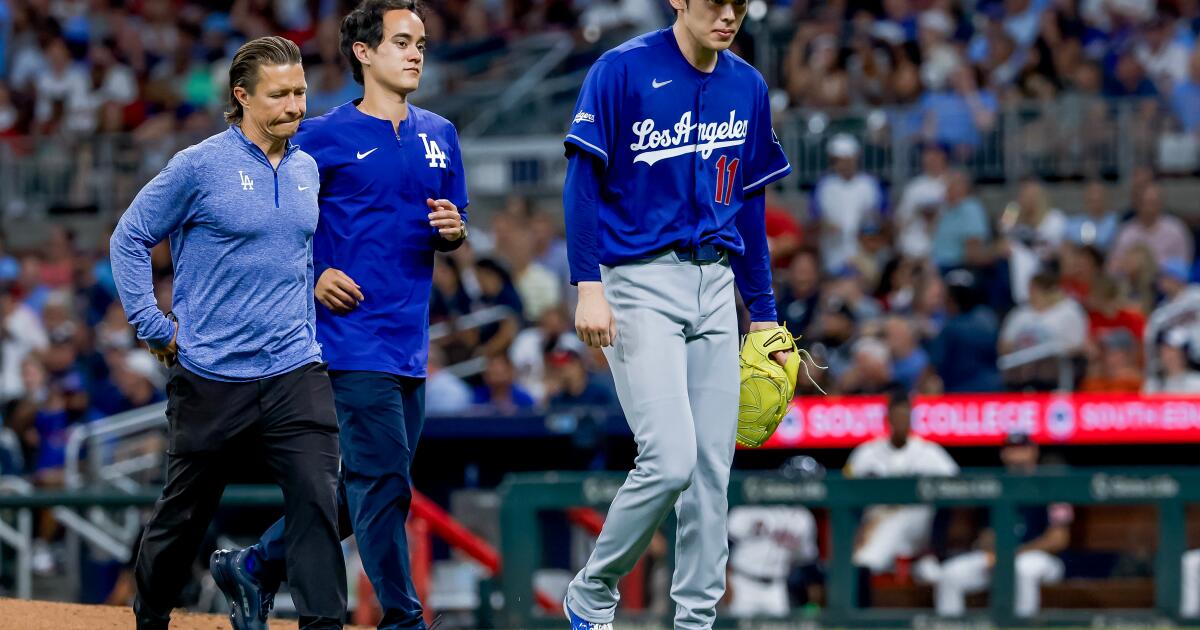
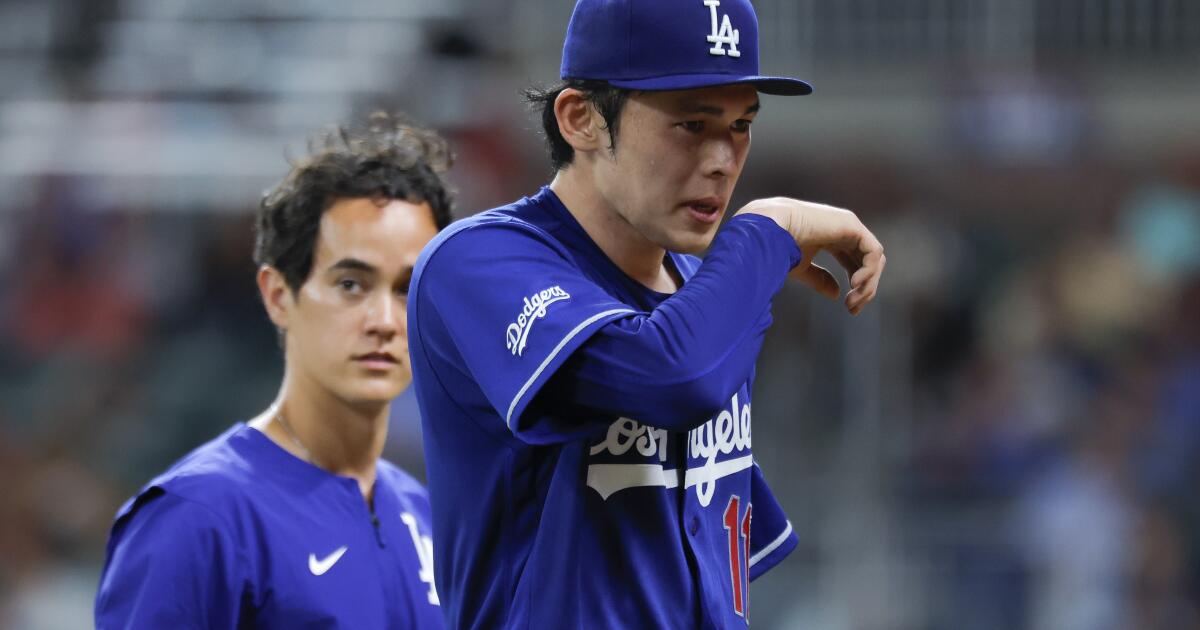
From Maddie Lee: The gathering on the Truist Park mound kept growing. At first, Dodgers right-hander Roki Sasaki was visited by pitching coach Mark Prior and catcher Hunter Feduccia, with the help of interpreter Will Ireton. Then, Prior summoned head athletic trainer Thomas Albert. Then, they called out manager Dave Roberts, who eventually made the pitching change.
The group had been examining the middle finger on Sasaki’s right hand. Sasaki exited the Dodgers’ 6-5 loss to the Braves in the fourth inning with a blister on that finger, which will land him on the 15-day injured list, Roberts said after the game.
“There’s just no way we can avoid it given the severity of the blister,” Roberts said. “So we’ll give him some time. But we can cover it up actually to keep his arm moving.”
Still, it’s unclear how long it will sideline him. In the meantime, Roberts said, left-hander Eric Lauer will return to the rotation, and the Dodgers will add a reliever as the corresponding move.
“It’s more disappointing with Roki because he has been so consistently good,” Roberts said. “And I don’t think he’s dealt with any blister issues. So for it to kind of come out of nowhere was a surprise to all of us. He was on a good run. So now unfortunately, it’s going to be minimum two weeks.”
Mark Walter’s company TWG Global defends Dodgers financing and Lakers sale
Angels swept by Guardians
Steven Kwan hit a tying double in the ninth inning, Travis Bazzana followed with a sacrifice fly and the Cleveland Guardians rallied past the Angels 4-3 on Wednesday for their seventh straight victory.
Hunter Gaddis (2-3) retired the final two batters in the eighth to earn the win. Erik Sabrowski worked a scoreless ninth for his second major league save and first since 2024.
With a runner on second, Sabrowski struck out pinch-hitter Travis d’Arnaud and got pinch-hitter Oswald Peraza to pop up to second as Cleveland completed a three-game sweep.
Jeanie Buss takes siblings to court again
From Thuc Nhi Nguyen: Jeanie Buss is taking her siblings to court. Again.
Attorneys representing the Lakers’ controlling governor filed a petition in Los Angeles Superior Court on Wednesday to block her five siblings from trying to sell the family’s remaining 17.82% of the NBA franchise the Buss family has owned since 1979.
Jeanie contends that her siblings should abide by a 2017 court order that mandated the family’s co-trustees to “take all actions reasonably available to ensure that Jeanie is appointed and remains as the NBA controlling owner of the Lakers.” The 2017 legal battle installed Jeanie’s younger siblings, Janie and Joey, as her fellow co-trustees, two roles that were previously held by her older brothers Jim and Johnny, who were ousted after a failed attempt to wrestle control away from Jeanie.
The 97-page petition accuses Janie, Joey and the other siblings Jim, Johnny and Jesse of “devious behavior” for not including Jeanie in discussions to sell the family’s last stakes in the team earlier this month. While the other siblings elected to sell soon after Bob Iger and Joshua Kushner agreed to a record-breaking transaction with Mark Walter and released a statement attributed to the Buss family, Jeanie “never agreed to any sale, was never consulted and was never even informed,” the petition states.
What to watch for in Rams preseason game against Chargers
From Gary Klein: Under coach Sean McVay, the Rams’ final preseason games routinely are showcases for players vying for spots on the practice squad, not the roster.
But Thursday night’s game against the Chargers at SoFi Stadium will offer another look at perhaps one of the most important players for the Rams’ future:
Rookie quarterback Ty Simpson.
Simpson, the 13th pick in the NFL draft, has been competing with fourth-year pro Stetson Bennett to back up Matthew Stafford, though Bennett took the vast majority of second-team reps during training camp and preseason workouts.
Other things to watch Thursday:
Jim Harbaugh wants to see improvement from Chargers
From Joaquin Ruiz: It’s decision-making time.
With a 53-man roster needing to be finalized by Sunday, the Chargers wrap up the preseason against the Rams at SoFi Stadium on Thursday night.
The Chargers looked sloppy in their 41-17 home loss to the San Francisco 49ers last week, following an inspiring 27-7 road win over the Houston Texans, and now aim for a better on-field product in their final tuneup.
“Just want it to be crisp [and] clean,” Chargers coach Jim Harbaugh said. “Want to see improvement. … Everybody doing what they’re supposed to do.”
Angel City loses to North Carolina
Ashley Sanchez scored twice to break the single-season goals record for the North Carolina Courage in a 2-0 victory over Angel City on Wednesday night.
The former All-American at UCLA leads the National Women’s Soccer League in scoring this season with 15 goals.
Sanchez scored her 14th goal in the 41st minute, tying Lynn Biyendolo’s record for the North Carolina set in 2019. Evelyn Ijeh’s backheel flick found a charging Sanchez, who blasted it into the far corner.
This day in sports history
1884 — Richard Sears beats Howard Taylor 6-0, 1-6, 6-0, 6-2 to win his fourth straight U.S. national tennis championship.
1903 — Britain’s Hugh Doherty is the first non-American to win the men’s singles title in the U.S. Lawn Tennis Assn. championships with a 6-0, 6-3, 10-8 victory over the William Larned.
1909 — William Larned wins his fifth U.S. singles tennis title with a five-set victory over William Clothier in Newport, R.I.
1928 — Helen Wills beats Helen Hull Jacobs to take the fifth women’s singles title in the U.S. Lawn Tennis Assn. championships. Wills needs only 33 minutes, defeating Jacobs 6-2, 6-1.
1957 — Hickory Smoke, driven by John Simpson, Jr., wins the Hambletonian Stakes after capturing the fifth and deciding heat.
1969 — Lindy’s Pride, driven by Howard Beissinger, wins the Hambletonian Stakes in straight heats.
1975 — Onny Parun of New Zealand defeats Stan Smith 6-4, 6-2 in the first night match at the U.S. Open before a crowd of 4,949 at the West Side Tennis Club.
1976 — Transsexual Renee Richards, formerly Richard Raskind, is barred from competing at the U.S. Open tennis championships after refusing to submit to a chromosome qualification test.
1978 — The Cosmos defeat the Tampa Bay Rowdies 3-1 to win the NASL Championship.
1985 — Mary Joe Fernandez, 14, becomes the youngest player to win a match at the U.S. Open. Fernandez beats Sara Gomer 6-1, 6-4.
1996 — Stefan Edberg stuns Wimbledon champion Richard Krajicek at the U.S. Open, winning 6-3, 6-3, 6-3 in his record 54th straight and final Grand Slam event.
1999 — Maurice Greene and Inger Miller win at 200 meters at the world championships, giving the U.S. a sprint sweep. Greene is the first to win the 100 and 200 at a major global meet since Carl Lewis at the 1984 Olympics.
2006 — Marco Andretti, 19, becomes the youngest winner of a major open-wheel event, beating Dario Franchitti by 0.66 seconds to take the Indy Grand Prix of Sonoma.
2015 — Usain Bolt wins his fourth straight 200-meter title at the world championships, finishing in 19.55 seconds in Beijing.
2018 — Simona Halep becomes the first No. 1-seeded woman to lose her opening match at the U.S. Open in the half-century of the pro era. Halep is overwhelmed by 44th-ranked Kaia Kanepi of Estonia 6-2, 6-4.
2023 — Gymnast Simone Biles (26) wins her record eighth U.S. championship.
Compiled by the Associated Press
This day in baseball history
1897 — Roger Bresnahan, later a Hall of Fame catcher, made his major-league debut as a pitcher for the Washington Senators by shutting out the St. Louis Browns 3-0.
1911 — Ed Walsh of the Chicago White Sox pitched a 5-0 no-hitter against the Boston Red Sox. Walsh struck out eight and walked one.
1937 — Brooklyn’s Fred Frankhouse pitched a rain-shortened no-hitter against the Cincinnati Reds. The game was stopped with two out in the eighth inning with the Dodgers leading 5-0.
1977 — Toby Harrah and Bump Wills of the Texas Rangers hit back-to-back inside-the-park home runs on consecutive pitches in the seventh inning in an 8-2 victory over New York at Yankee Stadium.
1978 — Joe Morgan of the Cincinnati Reds hit his 200th home run to become the first player in major league history to have 200 homers and 500 stolen bases.
1982 — Rickey Henderson of Oakland broke Lou Brock’s 1974 record of 118 stolen bases in a season and stole three more bases in the Athletics’ 5-4 loss to the Milwaukee Brewers. It gave Henderson 122 thefts in 127 games.
1999 — Vladimir Guerrero’s hitting streak was halted at 31 games by Cincinnati’s Ron Villone in the Reds’ 4-1 win over Montreal. Guerrero went 0-for-2 with an intentional walk against Villone, ending the majors’ longest hitting streak since 1987.
2005 — Jeff Kent became the first player to hit 300 home runs as a second baseman in the Dodgers’ 8-3 win over Houston. The homer was the 325th of his career.
2010 — Florida led off a game with back-to-back homers for the first time in franchise history in a 7-1 victory over Atlanta. Cameron Maybin hit the first pitch of the game into the left-field seats. Logan Morrison then connected off Tommy Hanson for his first major league home run.
2011 — Justin Verlander became the majors’ first 20-game winner, grinding through six innings in the Detroit Tigers’ 6-4 victory over the Minnesota Twins. Verlander (20-5) became the first pitcher to win 20 games before the end of August since Arizona’s Curt Schilling in 2002.
2017 — Giancarlo Stanton hit his 50th home run to break an eighth-inning tie, helping the Miami Marlins sweep the San Diego Padres with a 6-2 victory. Stanton became the first NL player to reach 50 homers since Prince Fielder hit 50 for Milwaukee in 2007.
2017 — Rookie Rhys Hoskins homered for the fifth straight game and made a diving catch to start a game-changing triple play in the fifth inning, leading Philadelphia to a 6-3 victory over the Chicago Cubs. Hoskins led off the eighth with a drive to left-center to give him 11 home runs in his first 18 games, becoming the fastest in major league history to reach 11 homers. Hoskins was called up from Triple-A Lehigh Valley on Aug. 10.
2018 — Kendrys Morales’ home run streak was ended at seven games by the Baltimore Orioles, who halted an eight-game skid by defeating the Toronto Blue Jays 7-0. Morales went 0 for 3 with a walk and did not hit the ball out of the infield.
Compiled by the Associated Press
Until next time…
That concludes today’s newsletter. If you have any feedback, ideas for improvement or things you’d like to see, email me at houston.mitchell@latimes.com. To get this newsletter in your inbox, click here.