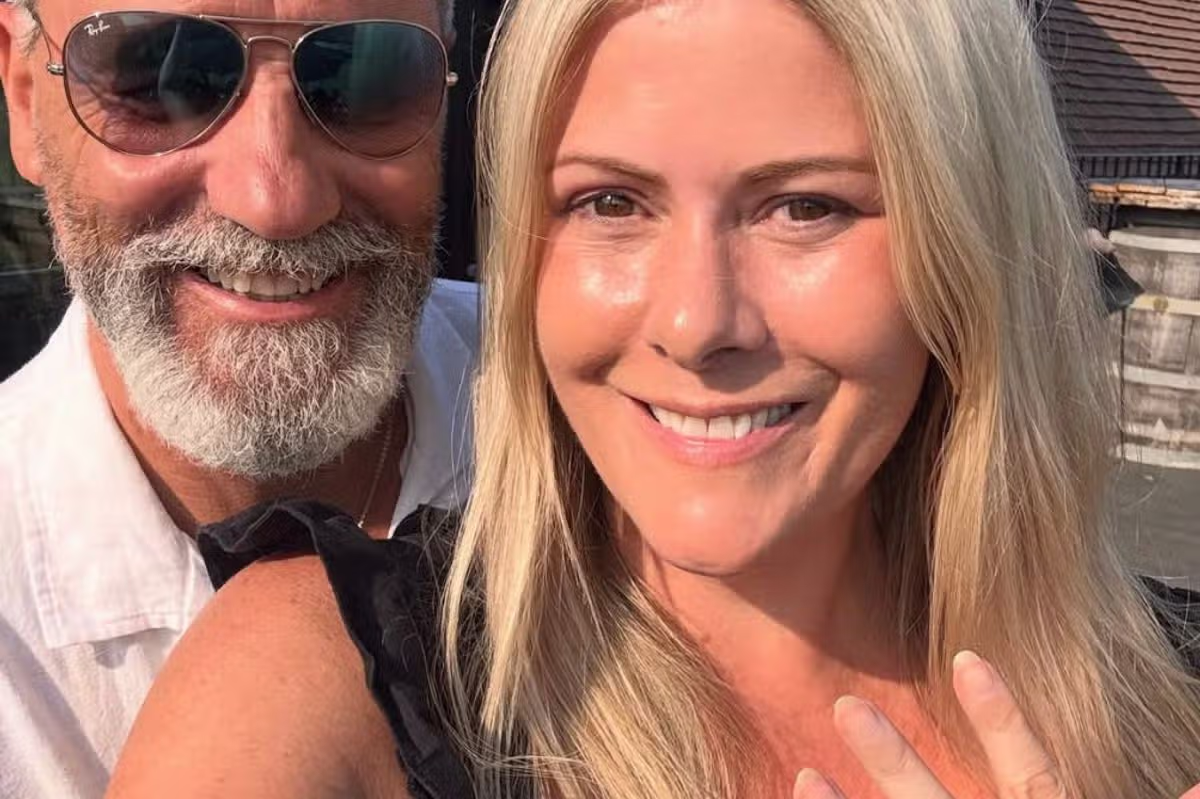
Roger Hawes and Janey Smith are engaged, three years after they found fame, and love, on the first series of Davina McCall’s hit ITV dating series My Mum Your Dad
21:17, 17 Jul 2026Updated 21:18, 17 Jul 2026
Roger Hawes and Janey Smith have revealed they are engaged(Image: Instagram/Janeybombshell)
Roger Hawes and Janey Smith are engaged. The TV stars found fame when the signed up to appear on My Mum Your Dad, which follows Davina McCall as she oversees two single parents try to find love, have been one of the programme’s biggest success stories and appeared all the way back in the very first series when it aired in 2023.
On Friday, the couple took to Instagram to share the news that they are to wed after Roger popped the question just ahead of the weekend.
Roger became a widower when he lost his first wife and it was their daughter Jess who sent off his application off for the show, which was axed in early 2025, in the first place. Meanwhile, Janey went on the show with her son Will, and the happy news comes just weeks after Janey was rushed to hospital.
At the time, she explained in an Instagram post: “They did a CT scan straight away and found my appendix had blown and needed surgery asap. I was in hospital for a week as the infection had filled my stomach.”
After their romance blossomed, the pair made a joint appearance on Loose Women together in 2024, where Roger explained: “It didn’t show on the show itself but she just came in and I obviously liked what I saw straight away.”
“We just hit it off; she just said randomly, ‘What am I like?’ and I said, ‘I know what you’re like!’ And everybody else was just looking at us and we were just off in our own little world!”
At the time, Janey also admitted just how emotional it had been to see her love story play out on screen. She said: “When you see it, it’s like ‘oh no, don’t set me off.’ It was a very emotional time. There was anxiety, it was a big thing. It does take you back. It’s an outer body experience really.”
She also recounted the pivotal advice from her father as she explained: “We like Roger, don’t push him away,” which led her to tackle her personal issues head-on during a live TV appearance.
She added: “They said, ‘So why are you here?’ and I could feel it coming, I wasn’t going to say anything but I thought, ‘I’ve got to be honest here,’ I know I’ve pushed people away in the past. There’s some traits in me and adopted people that you carry and never address it.”
Reflecting on her candid moment, she expressed pride: “I felt for the first time in my life, ‘Well done Janey, you’ve just gone and said it on live TV.’ You don’t even tell people you meet but thank goodness I did.”
Janey previously admitted that she never worried Roger would leave her even though her son was concerned he might not be ready for another relationship after losing his wife.
She said: “It’s funny, I didn’t worry about that with him. With Roger what you see is what you get. He’s definitely a one-woman man and just not out to hurt me at all. I remembermy son [William] being a bit worried that Roger wasn’t quite ready to date yet, but I think because Roger had gone through his own form of grief, we helped each other.
“The only worry I had early on was similar to my son’s – I didn’t want to be an experiment for someone to dip their toe back in.
Shrek’s abs are more defined than some might expect. Or is it that the shade of his green skin makes them appear more chiseled under bright lights? Maybe it’s just disorienting because no one anticipated gawking at his torso inside the historic downtown Los Angeles venue founded by Hollywood legends Charlie Chaplin, Mary Pickford, Douglas Fairbanks and D.W. Griffith.
These are thoughts that swirl in one’s head while attending this year’s Las Culturistas Culture Awards ceremony, held on a recent Saturday night at the United Theater. An offshoot of the popular podcast that actor-comedians Matt Rogers and Bowen Yang have hosted since 2016, the award show aims to celebrate the year’s biggest pop culture moments and plays like a fever dream more dazzling and deliciously random than a late-night scroll session on TikTok.
After launching in 2022 as a live event outdoors at Lincoln Center, the guerrilla awards show reached TV screens for the first time last year. This year’s ceremony, which will air June 17 on Bravo and stream on Peacock, coincides with the podcast’s 10th anniversary and features a kaleidoscopic array of attendees, including screen veterans like Lisa Kudrow and Will Ferrell, reality TV favorites like “Summer House’s” Ciara Miller and “The Real Housewives of Dubai’s” Chanel Ayan, and anthropomorphic icons like Miss Piggy and a certain green ogre. And the prizes? It’s the only place you can find categories like “Real Housewives Award for Best Way to Start a Confrontation,” “Pornhub Category We Would Never Click On” and “Hilary Duff Award for Millennial Excellence.”
Over lunch at the NBCUniversal lot in Universal City, Rogers and Yang discussed the show’s evolution. These are edited excerpts from the conversation.
Matt Rogers, left foreground, and Bowen Yang perform a musical number inspired by “Heated Rivalry” during this year’s Las Culturistas Culture Awards.
(Monty Brinton / Bravo)
I will probably regret starting our conversation this way, but we all have our blind spots and, to thoroughly prepare for this interview, I watched “Shrek” for the first time last night.
Yang: Oh great! The first one?
Rogers: How’d you feel?
I get it now.
Rogers: Get what, that he is attractive or …?
I’m not quite there yet. You guys reference the film a lot on your podcast and Shrek has also been a figure on the awards show, including this year. I was hoping you’d explain Shrek as a heartthrob to me as if we’re in a pop culture class. When did this idea really take shape?
Yang: Over at least a couple years, to my knowledge, there’s been this online meme culture around Shrek, where it’s like, “Oh my God, Shrek is like a sex king,” but now it’s even spilled over into like dating life. I don’t know if you’ve heard of this, but there’s a verb called Shreking in dating, where it has to do with women dating a guy that’s below their league because he will be nice to them; he will be a Shrek to their Fiona. That’s an interesting thing — you date someone slightly in another zone than you, so that you can be like, “Well, that’s my Shrek,” but meanwhile, there’s the tension between that and Shrek being someone that people are actually attracted to. This just speaks to the enduring power of Shrek as a pop culture icon.
Rogers: I think what it is, is he has an amazing accent. It’s a very powerful thing. He’s independent, he’s self-sufficient, he’s a movie star.
Yang: He said it at the awards. I mean, he’s a rich celebrity.
Rogers: We saw the real Shrek at the awards and he looks pretty f—ing good to me.
Yang: He looked good to me. I don’t know what these Gen Zers are talking about with this Shrek being below your league.
What are the calls with publicists like now to get their clients to participate?
Yang: Last year was a communication puzzle to solve. We were like, “OK, we have to really convey this the right way.” We thought, perhaps naively, now that we’ve done it, now that there’s a proof of concept, it’s going to be much clearer. I think it was clearer, but there was still that degree of, “oh, this is …” — not to like give ourselves too much credit, but this is a concentric circle outside of what is very established in the form of an award show. You’ve got publicists who are like, “Well, we would love for our client to win an award.” And you’re like, “No, that’s not really the point.”
Rogers: Presenting is just as good as winning, just as good as performing. But I think it’s weird that we have been so late to stumble on what the show really is, which is it’s a variety show. And, so, in wrapping your head around it that way, it’s actually pretty easy to get across. It just has the drag of an award show, and that’s our way in.
But I do understand the publicist hesitation because I will say, in a world where it’s your job to protect your client, you’re putting them in a situation that is like, “OK, they’re going to an award show — that’s something this town takes very seriously.” So, it’s an ask to be like, “Hey, can you come take the piss out of this concept that you’re then probably gonna spend eight months of the year trying to actually achieve?” I would be lying if I said that we didn’t want one day to win one of those awards. It’s an acknowledgment of your work, but in that, Bowen and I think the No. 1 thing that’s the funniest thing in the world is people who take themselves that seriously. It’s a healthy mix of appreciation for this thing that was actually a big element of the culture that made us say culture was for us, which was watching award shows when we were kids, and also the reality that we now know as people that are in the industry of what they really are, which is they’re just shows. We’re not condemning them, we’re having fun with it.
1
2
1.Scenes from the 2025 Las Culturistas Culture Awards: Jeff Goldblum, left, accepting the award for Most Amazing Impact in Film for his appearance in “Jurassic Park,” alongside presenter Patti Harrison. (Griffin Nagel / Bravo)2.Allison Janney was a guest of honor, receiving the Lifetime of Culture award.(Jordan Strauss / Bravo)
Have you been asked to tweak the name of a category or punch it up even more?
Yang: Last week was the window when our producers could be very honest with us and say if something may not be working. Back to the Shrek [bit in this year’s show], actually, that ended up being much dirtier and bluer than it was on stage.
Really? I already knew I wouldn’t be able to include the award category because of Times standards. So the actual bit was raunchier?
Yang: It was even raunchier. It went for it.
Rogers: But it’s also a testament to how much freedom they give us to make our show. If they were concerned at all about us desecrating the image of Shrek, we certainly did not feel that way. I am really shocked and grateful that we get to do something that it feels like we’re getting away with something.
Take me back in time with young Bowen and young Matt. What do you remember about your enthusiasm for award shows growing up?
Yang: It was watching Billy Crystal at the Oscars do song and dance numbers, zing these things in for a laugh that we’re referencing the year, being in these video packages where he was in the movies. That it was live television and just this pageantry of people congratulating themselves, congratulating each other. I would tune in live every single year to all the award shows and I would follow the host changes. I remember Whoopi’s first year [hosting the Oscars]; I remember Ellen’s first year. I was really obsessive. It opened the door for all these things that I currently love, and that I’ve somehow had a fortunate experience in, which is live television, song and dance numbers — everything that Billy Crystal was doing. It keyed me in on how show business works, down to production elements and how filmmaking comes together.
Rogers: I just remember, I looked at the screen and I was like, “Oh, that’s where I belong. I belong with them. I don’t belong out here.” I was one of those Gold Derby kids — I would be on the forums; I still sometimes look at the odds and rankings and stuff. It was like gay sports, particularly with the best actress and best supporting actress races. And then obviously the Grammys, and all of that. One year I was watching, I think it was the People’s Choice Awards or the American Music Awards or something, and Shania Twain lost to LeAnn Rimes, and I cried for a day. I took it so seriously and my mother turned to me and said, “You need to stop.” But you couldn’t tell me it didn’t matter at the time. [Reporter’s note: Twain lost the favorite country new artist award to Rimes at the 1997 American Music Awards.]
As the profile of Bowen Yang and Matt Rogers’ variety-style award show has risen, getting stars on board is an interesting puzzle: “You’ve got publicists who are like, ‘Well, we would love for our client to win an award,’” Yang says. “And you’re like, ‘No, that’s not really the point.’”
(Jason Armond / Los Angeles Times)
What do you remember about your first experience at a major awards show?
Rogers: He was nominated as writer for “SNL” and took me as his date. We were sitting there — the “Queer Eye” guys were sitting like three rows behind us.
Yang: We watched Phoebe Waller-Bridge sweep with “Fleabag.”
Rogers: We watched Michelle Williams win for “Fosse/Verdon.” It was funny because we had gone to the bar and were double-fisting drinks back to the seats and I said to Bowen, “Oh my God, I’m like the Busy Philipps to your Michelle Williams.”
Yang: And who shows up behind us?
Rogers: Busy Philipps taps on our shoulders and goes, “You guys are killing it with those drinks.” And I’m like, she doesn’t even know I’m her. Cut to minutes later, Michelle walking up and giving a banger of a speech.
Yang: That was like our first brush with it. Even now we go to these, and we’re like, this is really something; it’s incredible. We were at the Oscars last year, front row, witnessing all of it go down, witnessing the moment where upsets would happen, feeling the vibe in the room shift. The benefit of our show is that the vibe is pretty high throughout; it does not decline as soon as there are losers in the room.
Las Culturistas Culture Awards took place in late May and is being telecast roughly two weeks later. Do you see it ever going the live route?
Yang: We don’t know. That is my not so secret dream, is to do it live one day. There’s just something about doing it live — and it occurs to me now that I’ve been very lucky and fortunate to have have my reps in. There’s just something so wonderful about it being this event where everyone is tuning in, enjoying it the same time you are. That is really something special.
Rogers: If he’s down, I’m down.
I’m sure this changes each year, but who’s your dream person to snag for an appearance?
Rogers: I would say the people that make it very apparent that they have sketch comedy and impression skills, and maybe you wouldn’t necessarily know that they do until they show that.
Yang: Ariana Grande.
Rogers: Our dream was for Ariana to come do an original character. We actually floated to her the idea — there was going to be like a Banksy reveal of MsMojo, and it was going to be revealed that it was Ariana Grande was MsMojo. But she actually was in rehearsals for the Eternal Sunshine World Tour. Little did we know she also was recording “Petal.” She was a bit too busy to play MsMojo, I guess, this time.
Yang: These two are forever paired in my head, but it’s because she’s another sketch performer: Cher. And sometimes the dream guests are not big names, it’s the people that we came up with in comedy. And actually one of the consumer research reports that we got back before we started writing this year’s show was that the thing that people loved about the Culture Awards was this crossover of reality talent, A-listers and Oscar winners, and comedy people — that mix, those three [types of] people mingling together is what the viewers want.
Rogers: I’m just so proud in every single way of the diverse array of talent that we were able to bring together. I looked out in the audience and it was just a party of so many friends and people we’ve met in the business — people that I didn’t even get to meet that night, but I was just gagged they’re there, especially in the edit, which you’ll see. This is Bowen’s first year in the edit, he had to miss it last year, but that’s what’s so cool about going through the footage, is you’re like, “Oh my God, there’s someone I’ve loved my entire life next to my cousin.” We were saying to each other that it ended up being like a weird love letter to our younger selves, having Mandy Moore and singing “Only Hope” with her and doing the “Pokémon” theme song and getting to hang out with Pikachu.
Do you worry about it ever getting too big?
Rogers: If it ever gets to a point where it couldn’t be funny, that wouldn’t work. We want it to always stay true to what it is, which is it’s our comedy special together. As long as it doesn’t feel like it’s selling out — and I can understand people watching it and being like, “Oh, they obviously had to have Nintendo characters because it’s NBCUniversal or obviously they had to include “Summer House” — none of that is true.
Yang: There’s no mandate.
Rogers: This is genuinely what we would want the show to be, and so as long as it’s that, we’re good.
So what’s your “I don’t think so, honey” on awards shows?
Rogers: I don’t think so, honey — 10 nominees for best picture at the Oscars. Why?
Yang: Totally. Tea.
Rogers: I actually think it helps things that are weirder win because it’s too many. And the way that they ranked choices. I’m a popular-vote person anyway.
Yang: I need us to really get on the same page about play-off music. Sometimes people are encouraged to go on, sometimes we turn against that. Let’s stop innovating, let’s stop trying to break the mold on them. Let’s just respect that as much as we can, unless it’s egregious.
And it’s always a bit within the show.
Yang: This is what I was about to get to. The hosts now are always trying to bitify that; it’s more of a practical thing to keep the show moving. Don’t try to put a hat on top of a hat by making it a comedic moment too. We’ve never really played with that trope, even though we could, and maybe should. For now, my attitude towards play-off music is, these people might not ever be on this stage again.
How soon do you start planning the next one?
Rogers: Hopefully, they give us the green light.
Ana Gasteyer, left, Jamie Lee Curtis and Patti Harrison at the 2025 Las Culturistas Culture Awards.
(Jordan Strauss / Bravo)
How did you go about deciding which categories would return this year and which you invent along the way?
Yang: We did an audit this year of all the categories from the last few years of doing this.
Rogers: Less made it back last year.
Yang: I think maybe about 30 max previous categories [returned] — that’s a decent ratio, 70-30 is nice. From there, we just kind of molded the clay on the table a little bit. We have the benefit of making this a recursive reinvented show every year; the categories itself are the premise, it’s the micro-premise within the segment or the element. The jokes are the nominees. Why not create new opportunities at every turn.
“Las Culturistas” expanded into a video podcast last year. How do you feel about this evolution we’re seeing to the format?
Rogers: It’s not that when I’m on camera with Bowen doing the podcast, like, “Oh, I wish I could be more relaxed,” I just wish the whole industry hadn’t gone this way because I feel like when you’re on camera, you can’t help but be a little bit more self-conscious, and that is going to come through in the podcast product. If I had my druthers, none of them would be on film. I can understand that it helps a lot and I can note a marked difference in the amount of times I get recognized now that we are on social media. It absolutely “helped” our podcast get bigger. That being said, I don’t think it was a good thing for podcasting that they all became TV shows.
Yang: It changes the register and the tone by nature. You cannot help but be motivated by different things, by the appearance of it, by the presentation of it, beyond what it was, which is just radio, which is a really important American form.
As two people who grew up being connoisseurs of pop culture, what is it like to be on the other side of it, to feel the intensity of it — I’m talking about what happened with the Jasmine Crockett comments — to become part of the conversation? What lesson came from that?
Yang: We are experiencing something in an acute way that I think everyone is experiencing, which is we are seeing ourselves in the third person. Everyone is kind of modulating their behavior based on how they are appearing out of body. It’s the way we all move through the world now, which can be snapshot and projected very widely out into the world for whatever reason.
Rogers: When you’re talking candidly, you can never know what piece of what you’re saying is going to be the piece that gets scrutinized again and again and again and again by what feels like the entire internet. And if you did, you would, of course, be more specific, and you would be able to really clearly say why you are saying what you are saying. We have had learning experiences with that, and so what we can do going forward is be more clear about the things that we do believe and stand by. That is something that even 10 years in the game we are learning how to do.
Yang: And I think on a very large scale, what is going to happen is that we are all going to adjust for the fact that we have behaviorally changed because of this idea that we’re seeing ourselves in the third person constantly. For me, personally, I’ve had to wrestle with this idea after being on “SNL” for seven years and having to evaluate myself and having an audience evaluate me every week. I’ve changed behaviorally; I need to get over this fear of being seen. I need to get better about listening to my own voice.
Rogers: The internet is a very weird place and the thing is, it deliberately ignores nuance. It willfully tries to make something seem lowest common denominator, so that there can be a community based around that thing. And that is not good for the world. It’s not good for discourse. It’s not good for our politics. It’s really bad for our politics. Until we can all get on the same page about the ways in which we are willfully misunderstanding each other and calling it discourse, it won’t get better.
Yang: The misunderstandings are about people’s tones, and not necessarily about the things that people are pointing toward.