rockets

Marine XQ-58 Valkyries Will Launch Via Rockets Or Runways

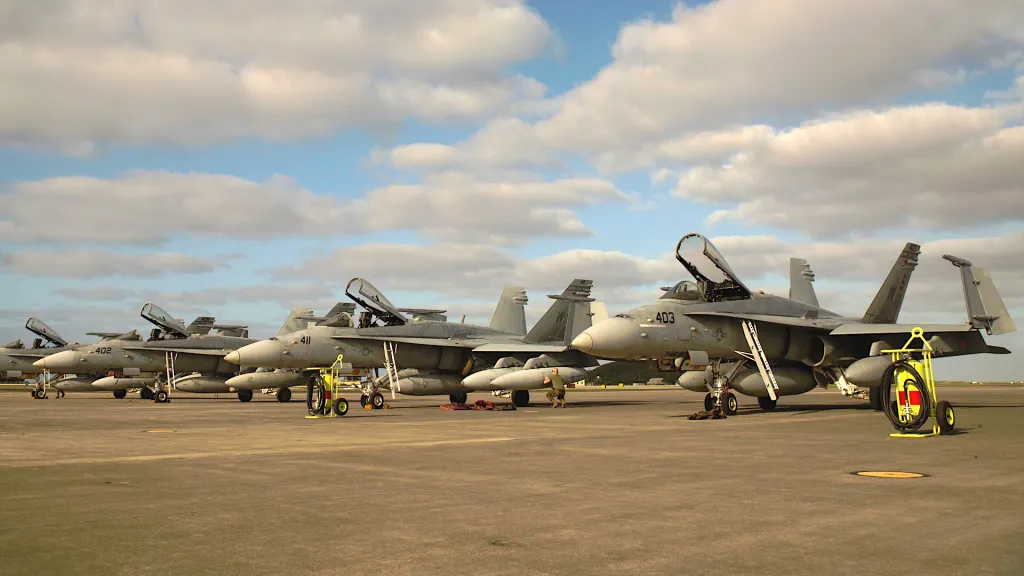
Kratos has confirmed to TWZ that the landing gear-equipped version of its XQ-58 Valkyrie drone being developed for the U.S. Marines will still be able to make rocket-assisted takeoffs from static launchers. This means the new addition to the stealthy Valkyrie family will retain a valuable degree of runway independence, though they will have to touch down on a runway at the end of their sortie. This opens up additional operational possibilities, though there are also tradeoffs.

TWZ had reached out to Kratos yesterday for more details about the CTOL version of the XQ-58. This followed the announcement of a team-up between that company and Northrop Grumman to develop and deliver Valkyrie variants to the U.S. Marine Corps under the Marine Air-Ground Task Force Uncrewed Expeditionary Tactical Aircraft (MUX TACAIR) Collaborative Combat Aircraft (CCA) program. Kratos first disclosed that it was working on a Valkyrie with built-in landing gear last year, and the company now says it is aiming for a first flight early this year.

A previously released rendering of the landing gear-equipped CTOL version of the XQ-58. Kratos

“The initial aircraft for the MUX TACAIR CCA contract will be landing gear version Valkyries, which can take off and land conventionally, or be booster-launched and conventionally landed,” a Kratos spokesperson told us.

When asked if this meant the CTOL Valkyrie would be able to use existing static launchers or if it would require a new launch architecture for boosted takeoffs, that spokesperson also responded: “the same.”

“Unfortunately, [we] cannot share more,” they added when asked for further details about the ongoing development of the CTOL version of the XQ-58, though they did confirm the early 2026 target timeframe for a first flight.

The baseline Valkyrie design, which first flew in 2019, does not have landing gear and is designed to take off via the rocket-assisted method from static launchers. The drone is then recovered via parachute at the end of a sortie.

An XQ-58 seen being launched using the rocket-assisted method. USAF/2nd Lt. Rebecca Abordo
An XQ-58 descends down to the ground via parachute after a sortie. USAF

Before announcing plans for the CTOL version, Kratos had also unveiled a special launch trolley that allows variants without landing gear to take off from traditional runways, though not land back on them.

Kratos Valkyrie Trolley Launch System


Details about the CTOL configuration of the XQ-58 and its comparative capabilities to existing variants remain limited. There have been indications that the landing gear-equipped type may be very similar in many respects to earlier types, which is underscored now by the confirmation that it can still be launched via rocket boosters. Whether or not the CTOL version is larger and, if so, to what degree, is still unknown. That it can make use of existing static launchers would limit how much bigger it could be, both dimensionally and weight-wise. It is also unclear if the parachute recovery system could be fitted, if desired.

“You’ll be able to do a conventional takeoff and land with retractable gear,” Steve Fendley, president of the Unmanned Systems Division at Kratos, had told Aviation Week last year. “You give up a proportion of your payload volume of your internal payload, but you can still maintain all the external.”

Runway-independent configurations do present their own limitations when it comes to maximum takeoff weight, and, by extension, payload capacity, as well as range. Kratos has told TWZ in the past that the versions of the XQ-58 without landing gear get a boost “in the 10s of % for both fuel and payload capacity” just when using the aforementioned launch trolley, and that this “enables quite an advantage for [the] amount of payload and range / endurance of the system.”

Another look at an XQ-58 without landing gear on the special launch trolley. Kratos

What we now know is that the CTOL version offers a single platform with the flexibility to take off from conventional runways, which could allow for heavier overall weights, or to use the existing rocket-boosted method from a much wider array of potential operating locations. In a real-world operational scenario, the drones could fly a rocket-boosted mission to start, recover on a runway at a tertiary site, and then continue to fly sorties from there, or be deployed elsewhere. This would combine the benefits of runway independence, including the difficulties imposed on enemies trying to target what could be widely distributed launch points, during an initial wave, and the advantages offered by normal runway-centric tactical air operations for follow-on sorties.

Furthermore, the runway-independent launch capability would allow forward deployments virtually anywhere for use in that first-day-of-war context. It should be remembered here that Kratos has also previously shown a model of a static launcher for the Valkyrie that fits discreetly inside a standard shipping container.

An XQ-58 that can land like any other fixed-wing aircraft on a runway offers advantages for resetting the drones and getting them back into the fight. It takes far more time and effort to get runway-independent types ready for relaunch after they touch down via parachute. That method of landing also relies on airbags to cushion the impact, and a failure of that element of the system can lead to significant damage. There is, of course, always the potential for accidents while operating from traditional runways. Regardless, a Valkyrie that uses a runway should be able to achieve significantly higher sortie rates.

A US Air Force XQ-58 seen being recovered after a test flight. USAF capture

The CTOL variant’s flexibility could also have benefits outside of a tactical scenario. TWZ has previously noted that a landing gear-equipped version would be easier to integrate, overall, with other tactical air assets that rely on traditional runways, which would also be relevant for training and other day-to-day peacetime activities. That being said, a significant portion of the Marine Corps’ future CCA fleets, as well as those that the U.S. Air Force and the U.S. Navy plan to acquire and field, may not ever be daily fliers.

There are still tradeoffs, especially if the CTOL version of the Valkyrie otherwise remains unchanged in many respects from previous versions. Kratos has been steadily working to expand the performance envelope of the XQ-58 design, but it has been made clear that some degree of internal volume has to be sacrificed to give the drone built-in landing gear. Even if the CTOL design is larger overall, the revised internal configuration could create different payload restrictions that might be further magnified when employed in a runway-independent mode. It’s also important to point out that the rocket-launched method makes use of expendable boosters, a steady supply of which is then required to support those operations.

The rocket boosters can be seen falling away after the launch of an XQ-58 in the video below.

Kratos XQ-58A Valkyrie Test Flight


For the moment, the U.S. Marine Corps looks to be trying to find the optimal mix of flexibility for its future operational Valkyrie fleets. However, a key advantage of the XQ-58 has historically been its total lack of any need for a runway. TWZ has repeatedly highlighted the importance of that kind of total runway independence to the Corps’ still-evolving expeditionary and distributed concepts of operations, which focus heavily on the rapid establishment of forward operating bases in far-flung locales, especially remote islands with limited infrastructure. The Marines expect these operations to be regularly conducted within an adversary’s so-called “weapons engagement zone,” further underscoring the critical need for very high degrees of operational flexibility to survive, let alone fight effectively.

The Marine Corps could still acquire additional versions of the XQ-58 down the line, including fully runway-independent types, or add completely different designs to its future CCA fleets, giving it a further mix of capabilities. The Valkyrie was designed from the outset to be highly modular and to use open architecture systems, making it easier to integrate new and improved capabilities and functionality to existing examples, as well.

“The uncrewed weapons systems under development [as part of the MUX TACAIR program] will enhance Marine Corps Aviation’s lethality and ability to support the Stand-in Force (SiF) by delivering air-to-ground, reconnaissance, and Electronic Warfare (EW) capabilities,” according to official budget documents released last year. “The Marine Corps will use a spiral approach for capability insertion into TACAIR. MUX TACAIR Increment I will rapidly accelerate the time between development and fielding, ensuring rapid and relevant capability delivery of a Minimum Viable Product (MVP) to the warfighter.”

The growing array of options for launching and recovering XQ-58 variants is something that could also easily appeal to other potential operations beyond the Marine Corps. The only other known operator of the Valkyrie currently is the U.S. Air Force, which oversaw the type’s first flight in 2019 and has been using the drones primarily for test and evaluation purposes since then.

XQ-58A Valkyrie Demonstrator Inaugural Flight


Kratos told Aviation Week yesterday that there is another opportunity for XQ-58 sales in the United States, but did not elaborate. The company is not among those known to be under contract now to develop concepts for carrier-based CCAs for the U.S. Navy. It may be one of the nine firms currently competing in the second phase, or Increment 2, of the U.S. Air Force’s CCA program, which that service has so far declined to name. Kratos was notably absent from Increment 1 of that program and had previously expressed interest in taking part in Increment 2.

Valkyrie has also begun making inroads overseas, and Kratos is now working with Airbus on a version for the German Air Force. Whether that will be a landing gear-equipped variant or not is unknown.

More details about the CTOL version of the XQ-58 may emerge as Kratos gets closer to a first flight and as work on the initial prototype for the Marine Corps proceeds. It is very possible, if not probable, that the first example of the CTOL configuration will be the one in the works now for the Marines. The service has previously said it hopes to receive its first MUX TACAIR CCA prototype before the end of the year.

If nothing else, it has been confirmed now that the CTOL type will have an added layer of flexibility by retaining a runway-independent launch capability.

Contact the author: joe@twz.com

Joseph has been a member of The War Zone team since early 2017. Prior to that, he was an Associate Editor at War Is Boring, and his byline has appeared in other publications, including Small Arms Review, Small Arms Defense Journal, Reuters, We Are the Mighty, and Task & Purpose.


Source link

‘We don’t have it right now.’ Takeaways from Lakers’ loss to Houston

p]:text-cms-story-body-color-text clearfix”>

Lakers coach JJ Redick points and direct his team during the fourth quarter of a loss to the Rockets on Thursday.

Lakers coach JJ Redick points and direct his team during the fourth quarter of a loss to the Rockets on Thursday at Crypto.com Arena.

(Katelyn Mulcahy / Getty Images)

When the Lakers were climbing up the Western Conference standings, improbably winning games with LeBron James and Doncic injured and celebrating Austin Reaves’ 51-point performance and ascent into stardom, the vibes were high. Players jumped off the bench to cheer for each other. They championed team bonding exercises such as slideshow presentations that introduced themselves to each other and a field trip to a Porsche driving experience. It all felt surprisingly easy, especially for a team that had several new additions.

“We had it,” Redick said wistfully Thursday. “We had it. I always say this about culture, I always say this about a good team being a functioning organism.”

Redick snapped his fingers.

“It can change like that,” he continued. “We don’t have it right now.”

All three of the Lakers’ most recent losses have been blowouts. With an average margin of defeat of 20.7 points, their total point differential has dropped to minus-15 on the season, which ranks 16th in the NBA.

Forward Jake LaRavia said in the locker room that there felt like a “disconnect” on the team, but couldn’t verbalize more about how things had turned so suddenly. The team’s seven-game winning streak at the end of November feels like a distant memory, although it should serve as a constant reminder of how a team shouldn’t let its guard down, especially when it was collecting wins off teams with losing records.

“This [has] kind of been the trending thing even when we were winning,” forward Jarred Vanderbilt said. “Obviously wins kinda shadow a lot of stuff. But it’s been the same pretty much all year of how we finished games, lose games: transition defense, rebounding and stuff like that. It’s been a trend all year.”

LeBron James, who played in his 13th game this season after missing the first 14 because of sciatica, had 18 points and five assists but declined to speak with reporters after the game, along with Marcus Smart (six points, two rebounds) and Rui Hachimura (zero points, two assists).

To further exasperate the lingering injury bug, Reaves left the game after the first half because of left calf soreness. It was the same calf that sidelined him for three games last week.

Source link

Lakers lose Austin Reaves, then fall to Rockets for another loss

The Lakers felt good about their starting lineup Thursday when Luka Doncic and Rui Hachimura returned from injury to restore their normal starting unit for only the seventh time this season.

But the good times didn’t last long. Coming out of halftime down 10 points to the Houston Rockets, the Lakers announced Austin Reaves wouldn’t play in the second half because of left calf soreness.

With another apparent setback for Reaves adding to the Lakers’ desperate search for continuity, the team put up another inconsistent performance on defense in a 119-96 loss to the Rockets at Crypto.com Arena.

The Lakers, who’ve lost three in a row for the first time this season, allowed the Rockets to shoot 53% from the field. Amen Thompson led the way with 26 points and Kevin Durant scored 25 as the Rockets out-rebounded the Lakers 48-25.

Reaves missed three games with a left calf strain before returning against Phoenix on Tuesday. He scored 17 points off the bench in the Lakers’ loss to the Suns.

Against the Rockets, Reaves started and played 15 minutes in the first half, scoring 12 points on five-for-eight shooting.

Reaves entered Thursday averaging 27.3 points per game, ranking him 11th in league scoring.

Doncic, who had been out with a lower left leg contusion, had 25 points and seven assists and LeBron James had 18 points. Hachimura (right groin injury management) didn’t score in his 28 minutes.

With so many players rotating through the lineup because of injuries, the Lakers have struggled to find solutions to their defensive issues.

They entered Thursday allowing 117.4 points per game, 19th most in the league. They were allowing the 26th highest field-goal percentage (48.4) and the highest three-point shooting percentage (40.1). They were next-to-last in rebounds, averaging 40.1 per game.

That was a real issue against the Rockets team that entered the game first in offensive rebounds (16.1).

And in this game, the Rockets got 17 offensive rebounds.

The Lakers didn’t have key role players Jaxson Hayes (left ankle soreness) and Gabe Vincent (lumbar back strain), adding to their woes.

“It’s the modern NBA where there’s injuries and then there’s not a lot of time to practice,” Lakers coach JJ Redick said. “So, when you have continuity, you can kind of capture what you’re trying to do and you feel comfortable and good about it.”

Source link

Lakers’ defense will get a Christmas Day test vs. Rockets

It’s not the lineups, the injuries or necessarily the system. The cause of the Lakers’ defensive demise is a thousand little decisions gone wrong.

“It comes down to just making the choice,” coach JJ Redick said after the Lakers gave up 132 points in a blowout loss to the Phoenix Suns on Tuesday. “It’s making the choice. There’s shortcuts you can take or you can do the hard thing and you can make the second effort or you can sprint back or you can’t. It’s just a choice and there’s a million choices in a game, and you’re very likely not gonna make every choice correctly. But can you make the vast majority of ‘em correctly? It gives you a chance to win.”

Coming off back-to-back losses for the first time this season, the Lakers (19-9) are ranked 28th in defensive rating in the last 14 games entering a Christmas Day showcase against the Houston Rockets at 5 p.m. PST at Crypto.com Arena.

The Lakers, without any individual shutdown defenders, need a perfectly executed team defense to compete. But 15 different starting lineups in 28 games has delayed some of the team’s ability to build continuity. The Lakers have had their full complement of 14 standard contract players for two games.

Forward Rui Hachimura (groin) and Luka Doncic (leg) could return Thursday. Guard Gabe Vincent, one of the team’s top defensive options on the perimeter, will miss his fourth game with lower-back soreness. Center Jaxson Hayes tweaked his left ankle in the second quarter of Tuesday’s loss and didn’t return.

The Rockets (17-10) limp into the Christmas Day blockbuster with their own struggles. The team thought to be one of the few who could challenge Oklahoma City in the West has lost five of its last seven games. Three of the losses were in overtime and four came against teams currently out of the play-in picture, including Tuesday’s loss to the Clippers.

Led by Kevin Durant’s 25.2 points, the Rockets are a statistical anomaly in the sped up, possession-maximizing modern NBA. They have the third-ranked offense in the league despite being one of the slowest. They shoot the fewest three-pointers per game, but make them at a 40% clip that ranks second, and dominate the glass with NBA-leading 48.7 rebounds and 16.1 offensive rebounds per game.

Houston’s physicality and expertise on the boards could be especially worrisome for a team that still has to consciously choose defense on a possession-by-possession basis instead of consistently living up to a standard of playing hard.

“There’s really no defense, no scheme we can do when we’re giving up offensive rebounds in crucial moments like we are, our [opponents] are getting wherever they want on the court,” guard Marcus Smart said after Tuesday’s loss. “And there’s no help, there’s no resistance, there’s no urgency. … It’s on us.”

The Suns grabbed 12 offensive rebounds against the Lakers on 35 missed shots, an offensive rebounding rate of 34.3%. After the Suns scored a three-pointer by twice grabbing offensive rebounds off tipped balls, Lakers players had an animated discussion in a timeout with Smart was gesturing toward center Deandre Ayton about tipping rebounds. Ayton, who finished with 10 rebounds and 12 points, and Smart ended the timeout with a high-five.

“[I need to] just continue to talk to guys, even though sometimes they might not want to hear it,” said Smart, a free-agent addition the Lakers coveted for his leadership and tenacity on defense. “Especially when we losing, nobody wants to hear it, myself included, but also understand that it’s integral for us to hear those things, to see and to be able to talk to one another and figure it out as players on the court, because we’re the ones out there.”

Redick intentionally built in moments for players to connect and communicate during every timeout this season before coaches speak. The strategy was meant to encourage players to take a larger leadership role. “Championship communication” was one of the team’s three pillars.

Lakers center Jaxson Hayes, left, foulds Clippers guard James Harden on a layup.

Lakers center Jaxson Hayes, left, foulds Clippers guard James Harden on a layup during their game Saturday.

(Gina Ferazzi / Los Angeles Times)

Along with “championship shape,” Redick also asked his team to build “championship habits.” Living up to the mantras is easier said than done.

“It’s not the easy choice,” Redick said. “It’s human nature. … We do it on a daily basis. We make easy choices cause it’s comfortable. Comfortable doesn’t win.”

Source link

Kawhi Leonard scores season-high 41 points in Clippers’ victory

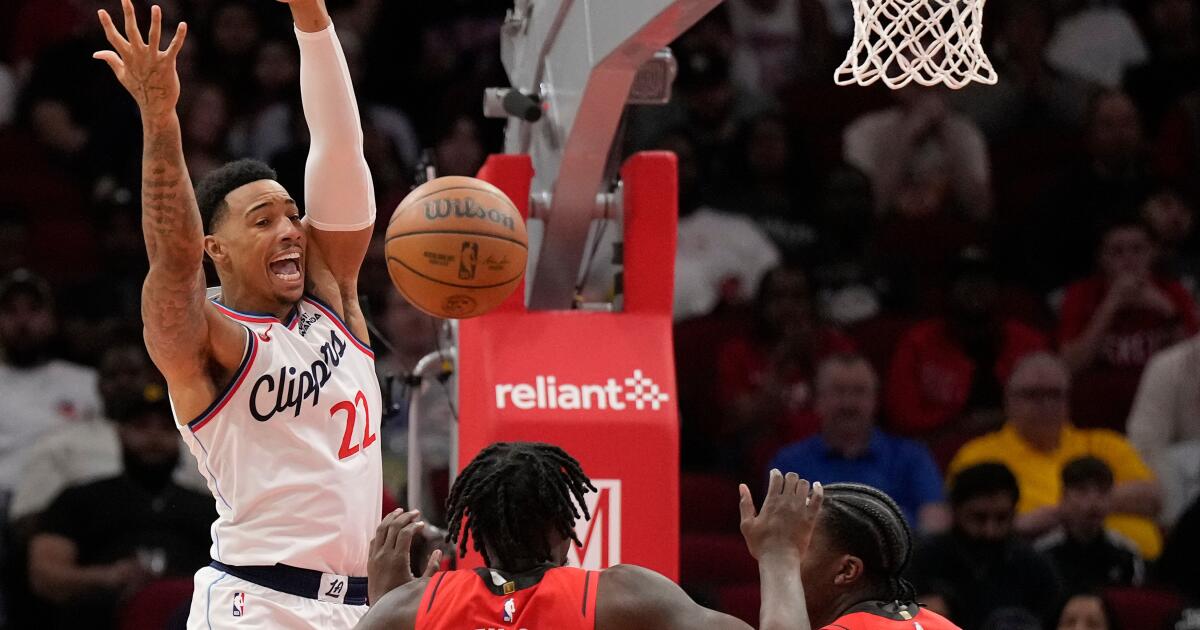
Kawhi Leonard scored a season-high 41 points and James Harden added 29 as the Clippers beat the Houston Rockets 128-108 on Tuesday night.

Leonard shot 16 for 23 from the field and four for five from long distance as the Clippers won consecutive games for just the second time this season. The Clippers were coming off a 103-88 win over the Lakers on Saturday that broke a five-game skid. The Clippers also won consecutive games Oct. 24-26, against Phoenix and Portland.

Harden, who shot seven for 14 from the field and three for eight from long distance, was helped by 12-for-13 shooting from the line.

John Collins and Kobe Sanders added 13 points apiece and Kris Dunn scored 11 for the Clippers (8-21), who shot 54% (20 for 37) from three-point range.

Kevin Durant scored 22 points on eight-for-15 shooting, and Alperen Sengun finished with 19 points and 11 rebounds for Houston (17-10), which was nine for 30 (30%) from long distance.

Amen Thompson added 19 points for Houston, and Jabari Smith Jr. scored 16 for the Rockets, who have lost four of their last five games.

The Clippers, who trailed by six points after one period, outscored Houston 34-23 in the second and led 63-58 at the break. The Rockets were helped by 10-for-22 shooting from three-point range in the first half. Leonard had 18 points on eight-for-12 shooting in the opening quarters and Harden scored 11.

Durant had 17 first-half points to lead the Rockets. Sengun scored 15 and Smith had 11.

The Clippers led 98-82 after three periods.

Source link