roberts

Dodgers’ Andy Pages primed for a potential breakout season

Andy Pages hasn’t forgotten about last postseason, though he’d like to. And he’d surely like you to forget about it, too — or, well, most of it.

Feel free to retain the mental image of his epic smash-and-grab catch over teammate Kiké Hernández.

That stunning play in the bottom of the ninth inning didn’t just save Game 7 of the World Series, it also spared Pages’ reputation. Covered for the ignominy of his historically woeful four-for-51 hitting performance.

You know what will help everyone totally flush those memories? To turn the proverbial page? Maybe keep us from mentioning it ever again?

A steady diet of games like Thursday’s.

In an 8-2 season-opening victory over the Arizona Diamondbacks at Dodger Stadium, Pages stood out among his club’s standouts.

And, as the eighth man in the order, he also served up a reminder that there really will be no rest for weary opposing pitchers this season.

The buoyant bottom of the lineup has bite, too: Let the record show it was Pages who hit the Dodgers’ first home run and drove in the club’s first runs to kick off their pursuit of a third consecutive World Series championship.

That it was he who cracked the code against Diamondbacks righty Zac Gallen in the fifth inning, teeing off on a three-run, 400-foot home run to left-center field.

  • Share via

And that it was his at-bat to lead off the eighth — a full-count single the other way, into right field — that Roberts had to mention postgame.

In spring training, Roberts anointed Pages as this season’s “pick-to-click” candidate, in part because of how hard the 25-year-old center fielder has been working on improving his plate discipline after swinging at 32% of pitches outside of the zone last year.

The pick-to-click distinction previously went to Teoscar Hernández in 2024, before he became an All-Star in his first season with the Dodgers. Last year, Michael Conforto was Roberts’ pick.

Small wonder, perhaps, that Pages isn’t putting too much stock in his manager’s prediction: “It feels really nice for him to say that about me, or to pick me, but obviously I’m not really focused on that,” he said, through an interpreter.

What he’s focused on, he said, “is just trying to do everything I can, every day, to get a little bit better.”

That’s what’s got his manager so revved up.

“He’s a complete player,” Roberts gushed. “And I’m excited to see what he can do this year.”

Is an Andy Pages Breakout Season loading?

Andy Pages celebrates with Teoscar Hernández and Max Muncy after hitting a home run at Dodger Stadium.

Andy Pages, center, celebrates with Teoscar Hernández, left, and Max Muncy after hitting a three-run home run in the fifth inning Thursday against the Arizona Diamondbacks.

(Gina Ferazzi / Los Angeles Times)

Were last season’s 27 home runs — second most on the Dodgers, behind Shohei Ohtani’s 55 — not a breakout?

I think … not?

Not when Pages so clearly has so much more to give.

Now when he does his homework like he did this spring, stationing himself in front of a pitching machine, calling out balls and strikes. (Watch out, Automated Balls and Strikes system?)

Not if the Dodgers can come to trust him at the plate like they now feel secure with him blanketing the outfield.

“Even last year when there were questions if he could play center field at a high level,” Roberts said. “And he’s worked his tail off, he really has. Every single day, he’s putting in work and he just keeps getting better — his jumps, his lines to the ball, and obviously the arm strength is there.”

On Thursday, Pages had another one of his sensational snags, taking an angle that would’ve made a defensive back proud in pursuit of Geraldo Perdomo’s fly ball to start the seventh. Stretched out, Pages slid beneath the ball to add to his opening-day highlight reel.

“I feel good,” Pages said, when I asked him afterward not about last postseason, but about his confidence heading into this season — though his mind went back there anyway.

“It’s something that happened earlier, the postseason is what the postseason was,” he said. “I’m not really focused on that, I’m focused on what I’m doing right now and my confidence is really high right now.”

Keep it up, and all anyone will remember is the heroics — including those to come.
Source link

How Dodgers’ Shohei Ohtani can put himself in the 2026 NL Cy Young conversation

Shohei Ohtani’s three straight strikeouts in the fourth inning of his final spring start Tuesday featured a different putaway pitch for each.

He got Angels slugger Jorge Soler to whiff on a sweeper. Jeimer Candelario went down on a curveball. And Jo Adell struck out on a fastball.

“Just shows the confidence he has and different ways he had to attack guys, to get ahead and also put guys away,” manager Dave Roberts said after the Dodgers’ 3-0 loss to the Angels in the Freeway Series finale. “And today the feel was really good, even better than the first outing.”

Pretty much everything was clicking for Ohtani heading into the regular season, even though it was only his second spring training start on the mound. Ohtani recorded 11 strikeouts in four-plus innings. He held the Angels to four hits, three of which were consecutive singles in the fifth, and was charged with three runs, all scored in the fifth.

For the first time in three years, Ohtani is set to begin the season as a fully healthy pitcher. And it will be the Dodgers’ first time managing his two-way schedule all year. Limited the last two seasons by his recovery and build-up from elbow surgery, Ohtani last made 20-plus starts in 2023 with the Angels.

“The desire is high,” Roberts said when asked about Ohtani’s aim to pitch wall to wall. “I think it’s realistic. Then the bigger question is, how are we going to manage that and navigate it?”

Thinking through the plan going into the season, Roberts floated the idea of giving Ohtani a little extra rest between starts. Dodgers starters are already on a six- to seven-day rotation. But a six-man starting pitching group gives the team flexibility as they map out their pitching plan.

“My intent is to be in the rotation under normal rest, normal circumstances,” Ohtani said through interpreter Will Ireton last week in Arizona. “Now if management thinks that I need extra rest, I’ll take it. But I’ll let management handle that. Just looking at our roster, we have a lot of pitchers. It doesn’t hurt to rest more.”

Ohtani’s in-game limits, after a build-up slowed by his participation in the World Baseball Classic as a position player, will be adjusted before each start. But his Freeway Series outing Tuesday set him up well. He stretched out to 86 pitches.

“When you’re talking about the first game of the season, could he get through six innings? Could he touch the seventh? Yes,” Roberts said Tuesday afternoon. “But he won’t touch the eighth inning. So there’s got to be some responsibility as far as how we manage him.”

When it comes to awards, Ohtani is going after a third World Series title. But his trophy case is well stocked with individual accolades too. He’s won four MVPs, five All-Star selections, four Silver Sluggers and a Rookie of the Year award.

The Cy Young, however, has remained elusive. He came close in 2022, when a 2.33 ERA and league-leading 11.9 strikeouts per nine innings earned him a fourth-place finish in the American League. It was the only time in his career that he crossed the 25-start threshold, with 28.

“I would never want to sacrifice our chance of winning and performing in the postseason,” Ohtani said. “So I think that’s really the No. 1 goal in my mind. Just because I want to try to win the Cy Young and throw more innings, that’s not necessarily the priority over winning a championship. So with that being said, if there’s a situation where there’s some injuries and I do have to pitch on shorter rest, I’m happy to do so.”

Would showing that he can make regular starts all year automatically put him in the Cy Young conversation?

“Oh yeah,” Roberts said. “Because of just talent, ability, will. If he does that, he’ll be in the conversation, absolutely. I have no doubt about that.”

Of course, besides reigning NL Cy Young winner Paul Skenes, Ohtani would also be competing for the award with his own teammate, Yoshinobu Yamamoto, who enters the season with the edge.

If Ohtani continues to pitch like he did on Tuesday, while building up the rest of the way, he and the Dodgers will be in good shape.

“It was another good one for him,” Roberts said, “and he’ll be ready to go.”

Source link

Dodgers reveal their starting rotation pitching plans for season

p]:text-cms-story-body-color-text clearfix”>

The Dodgers’ rotation order is set for the first homestand of the season.

To round out the series against the Arizona Diamondbacks, after Yoshinobu Yamamoto takes the mound Thursday on opening day, he’ll be followed by Emmet Sheehan and Tyler Glasnow. Roki Sasaki is penciled in for Monday against the Cleveland Guardians, followed by Shohei Ohtani on March 31.

Off days on Sunday and April 2 make it possible for the Dodgers to give all their pitchers at least five days’ rest between their first and second starts without needing a sixth starter.

Left-hander Justin Wrobleski is pegged to be that additional starter when the schedule features less frequent days off. In the meantime, he’ll be available to throw multiple innings out of the bullpen.

After starting the season for the Dodgers in Tokyo last year, Yamamoto is looking forward to opening day at Dodger Stadium.

“It’s going to be a different game, and with a different atmosphere,” Yamamoto said through an interpreter. “And then we’re coming off the championship year, then this is the first time I’ll be pitching in front of the Dodgers fans [since then].”

Yamamoto, who was on the mound for the final out of the 2025 season, hasn’t pitched at Dodger Stadium since Game 3 of the National League Division Series against the Philadelphia Phillies.

Sheehan claimed a regular spot in the rotation after returning last June from Tommy John surgery rehab. He had a 2.82 earned-run average through 15 appearances last season.

“I was maybe throwing bullpens right now a year ago,” Sheehan said after his last spring start. “So it’s definitely nice. That’s the main thing, to have my health. Grateful for that every time.”

Sheehan wrapped up Cactus League play with a 5.91 ERA in three starts, but he was encouraged by the progress he made in syncing up his delivery.

Glasnow capped his strong spring with five innings of one-run baseball against the Angels on Sunday.

“When everything’s lined up and feeling good … I think a lot of the other stuff follows,” Glasnow said. “And I was just able to go out and be myself.”

He recorded 11 strikeouts against the Angels, leaning on his curveball as his putaway pitch. It generated a 72% whiff rate, according to Statcast.

“Having my curveball feel so good, I kind of just leaned on it,” Glasnow said. “I’m sure things will change in-season, game to game. But tonight, it was a pretty obvious game plan for me.”

Source link

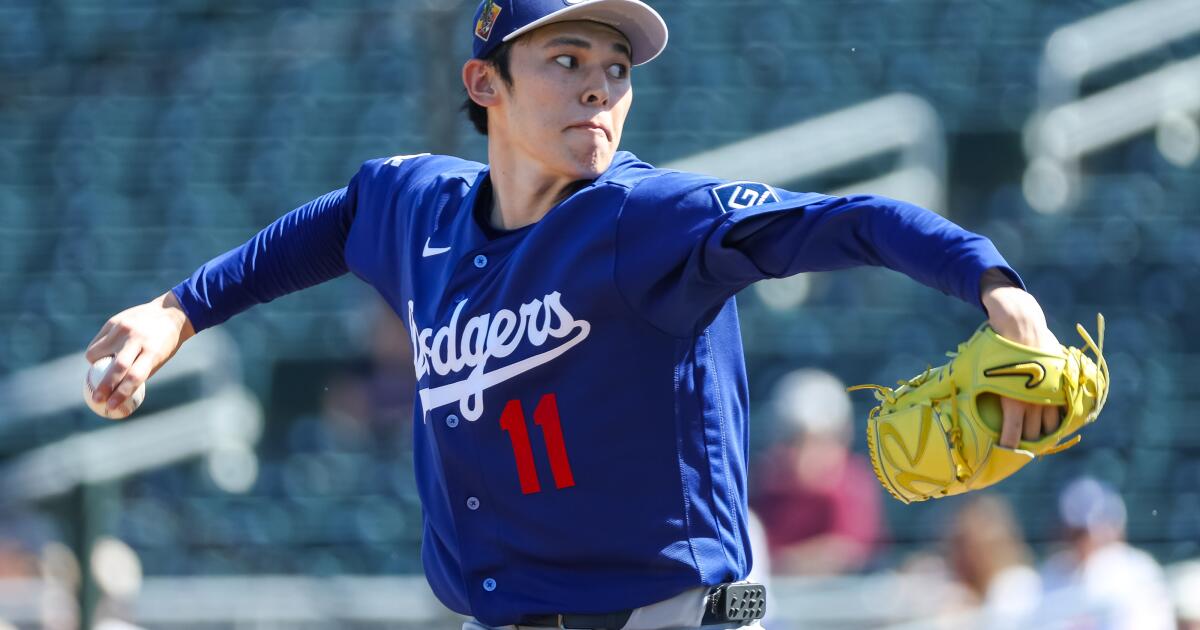
Why the Dodgers are preaching patience with Roki Sasaki as a starter

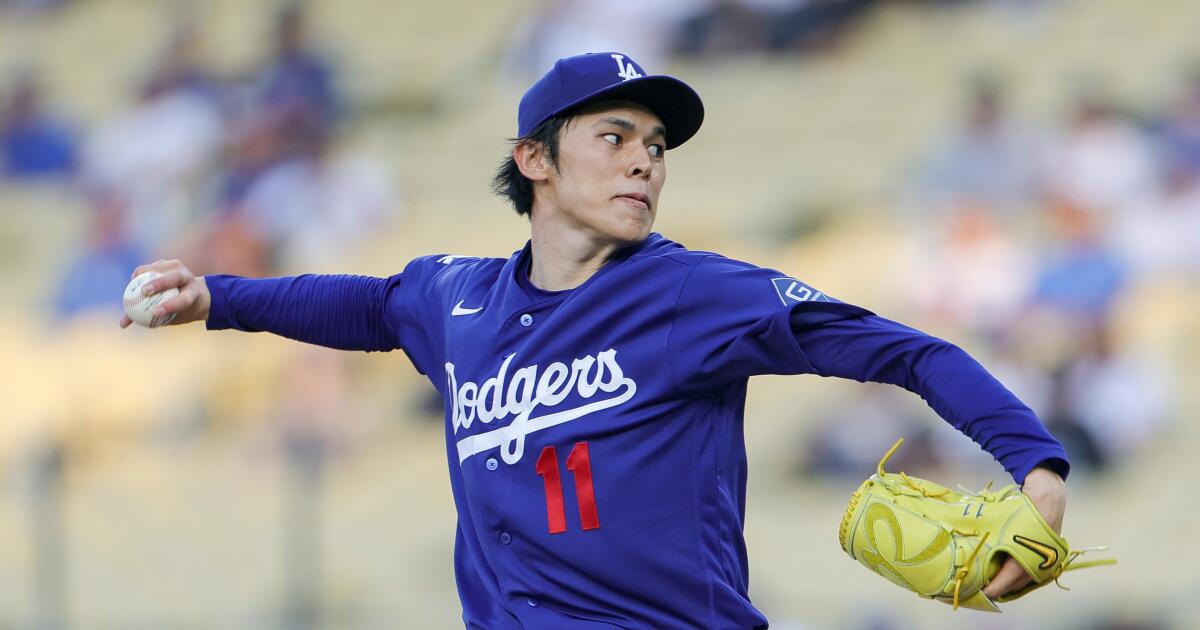
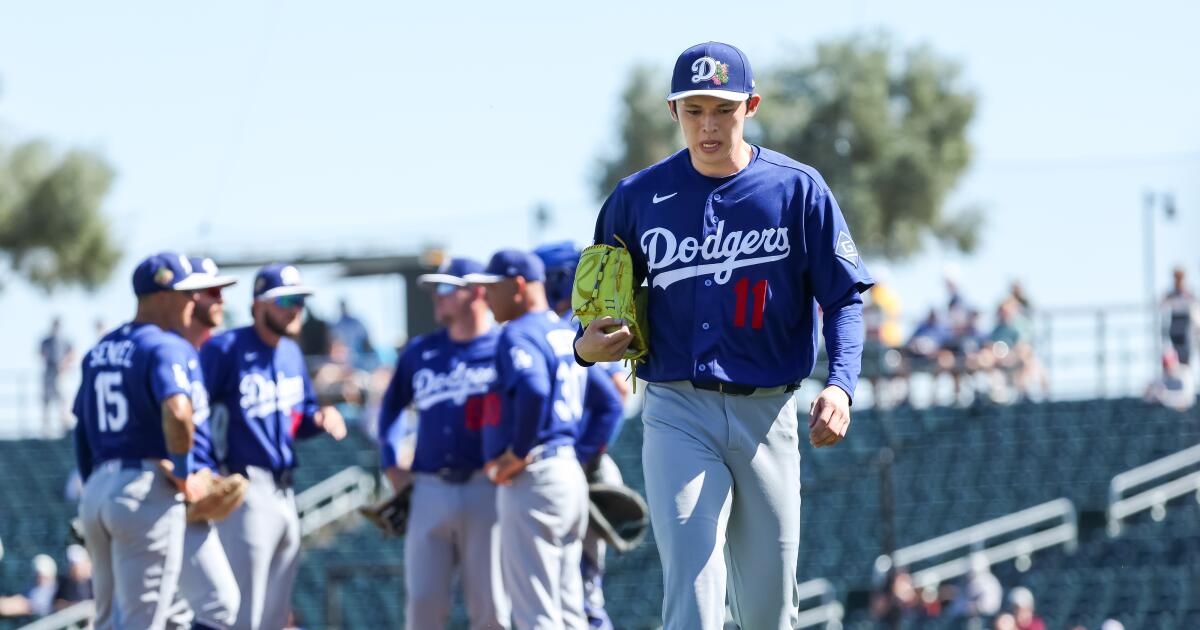
By the time Dodgers right-hander Roki Sasaki reached the blue backdrop set up in the Surprise Stadium interview room, he’d diagnosed the issue.

“I think it’s because of the two-seamer,” Sasaki said through an interpreter. “It kind of caused my forearm to pronate a little more. Also my arm slot was a little down.”

Those arm-side misses had, after three straight walks, prompted manager Dave Roberts to temporarily pull Sasaki from his most recent spring training appearance. But even though that start, marred by a wild third inning, brought Sasaki’s Cactus League ERA to 13.50, he’ll enter his Freeway Series start Monday with a spot in the regular-season rotation already secured.

Roberts has repeatedly made that point clear.

However, when asked directly if Sasaki was one of the Dodgers’ 13 best pitchers right now, Roberts gave an indirect answer: “He is going to start the season in the rotation.”

Answering why the organization has been so bullish on the decision requires zooming out.

“As we look out two, three, four, five, six years, it is imperative for us to integrate talented young players under our roster,” president of baseball operations Andrew Friedman said during an interview with The Times last week. “And that requires patience. And we have to have that even with the insanely high expectations we have.

“We have to be able to balance those two things, or there are a lot of cautionary tales of large-revenue teams who have had a run of success, and then they fall off the cliff.”

Sasaki, 24, is one of those young players the Dodgers are counting on to bridge the gap.

When Sasaki was posted by Nippon Professional Baseball’s Chiba Lotte Marines before last season, upward of 20 teams expressed their interest in the young phenom who was coming to the United States through amateur international free agency.

In his debut season, he produced a 4.72 ERA through eight starts — before an injury the Dodgers described as a right shoulder impingement sidelined him for much of the rest of the season. When Sasaki returned, it was as a reliever, a role he thrived in through the postseason.

Sasaki enters Year 2 with just 47 major-league innings under his belt, including the regular season and playoffs.

“On top of all those other things that you’re adapting to and learning, you’re also learning a new ball,” Friedman said. “Roki could really command his fastball in Japan, and right now it hasn’t been as good. So how much of that is the ball, how much of it is mindset, how much of it is delivery just getting out of whack? All of those are fair questions, but I think it speaks to, we have to have a level of grace with this and work with him to continue his development.

“Because we’ve seen it at an extremely high level, and now it’s on all of us to help him get back to that.”

NPB baseballs are slightly smaller, tackier and have higher seams than MLB baseballs. Players making the transition to MLB also have to adjust to a different strike zone, style of play and the off-the-field challenges of living in a foreign country.

The season before Sasaki signed with the Dodgers, his future teammate Yoshinobu Yamamoto and the Cubs’ Shota Imanaga set the bar high with relatively smooth transitions. But they were also coming over at later stages in their careers.

“We’re very mindful that this guy is essentially two years, three years behind Yamamoto,” Roberts said, “as far as on the progression side, the development side.”

Sasaki has shown he can be effective out of the bullpen, but pigeonholing him in a relief role at this stage of his career would be a disservice to him and the organization.

The Dodgers have identified the addition of the two-seamer as a development that could help Sasaki stick as a major-league starter.

“It’s our job as coaches to get a player to understand the value of having a ball bear in and get in on right-hand hitters to keep them off the outside part of the plate,” Roberts said. “There’s a little bit of trying to pronate too much — trying to make the ball move, versus trusting his grip and his throw. But that’s a coach’s responsibility to [figure out,] how do we get him there, along with him feeling comfortable.”

The Dodgers have decided that, at least for now, the best setting for that growth is the major leagues. Across the industry, there’s an understanding that the gap between Triple-A and the big leagues is bigger than ever. That makes evaluating players in Triple-A all the more difficult.

“He’s not close to a finished product,” Roberts said. “But he’s 24. … You could look at a team that would potentially sign a veteran, turnkey starter, but we’ve got to get him to cut his teeth and deal with some things. That’s part of the growth.”

Source link

Yoshinobu Yamamoto smooth in final start before Dodgers opening day

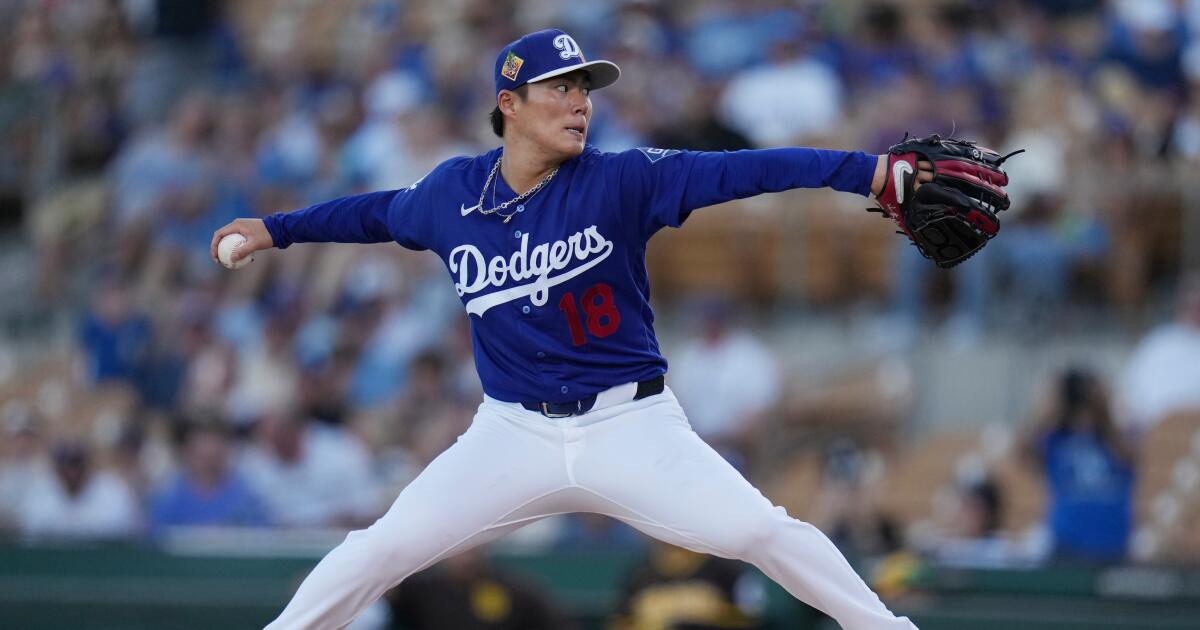
Dodgers right-hander Yoshinobu Yamamoto went into his final start of the spring with a focus on throwing first-pitch strikes, while also hoping to test his composure with men on base.

He achieved both Friday, limiting the traveling half of the Padres’ split squad to three hits in five scoreless innings. The next time Yamamoto takes the mound for a game, it’ll be on opening day at Dodger Stadium against the Arizona Diamondbacks on Thursday.

“There were a few things I wanted to try,” Yamamoto said through an interpreter after his part of the Dodgers’ 4-3 win. “And [Friday] I was able to get into the game very nicely.”

The game featured a possible preview of the Dodger’s opening-day lineup — “I don’t know, we’ll see, it’s some good players,” manager Dave Roberts said with a smile.

Few roster decisions remained, after camp cuts Wednesday included right-handers Kyle Hurt and River Ryan, and infielder Ryan Fitzgerald.

“They’re always difficult with guys hoping, expecting to break with us,” Roberts said of his conversations with cut players. “There’s obviously some good ones where you tell a guy that he’s going to make the club. But I think the main thing that just shouldn’t get lost is, it’s not always just about starting. It’s where you finish.”

As of Friday, Hyeseong Kim and Alex Freeland were still locked in a second-base battle. And the Dodgers had to sort out roles at the back end of the rotation.

Roberts said he expected to carry a swingman who would likely pitch multiple innings out of the bullpen early in the season, when the Dodgers’ schedule includes frequent off days, and later serve as a sixth starter.

Yamamoto, however, had been the clear choice to lead the rotation, long before Roberts made it official Monday.

“It’ll be nice to hand the ball to him and it’s not an elimination game,” Roberts said, referencing Yamamoto’s World Series MVP performance. “That’ll be fun for me.”

Coming off pitching meaningful games in the World Baseball Classic, Yamamoto had one last chance Friday for a tuneup.

He struck out the first three batters he faced, with first-pitch strikes to each.

The next inning, Yamamoto gave up back-to-back one-out singles. He escaped the jam with two more strikeouts. Yamamoto tallied seven strikeouts in an overall smooth performance.

“He came out, really, with a purpose,” Roberts said. “And I thought everything looked good, the fastball — the life to it, the command of it — the cutter, slider, curve ball was good, the split, everything was good. And very efficient. And pretty effortlessly got through five innings, so that was really good to see.”

Source link

How did Shohei Ohtani pitch in his first spring training outing?

p]:text-cms-story-body-color-text clearfix”>

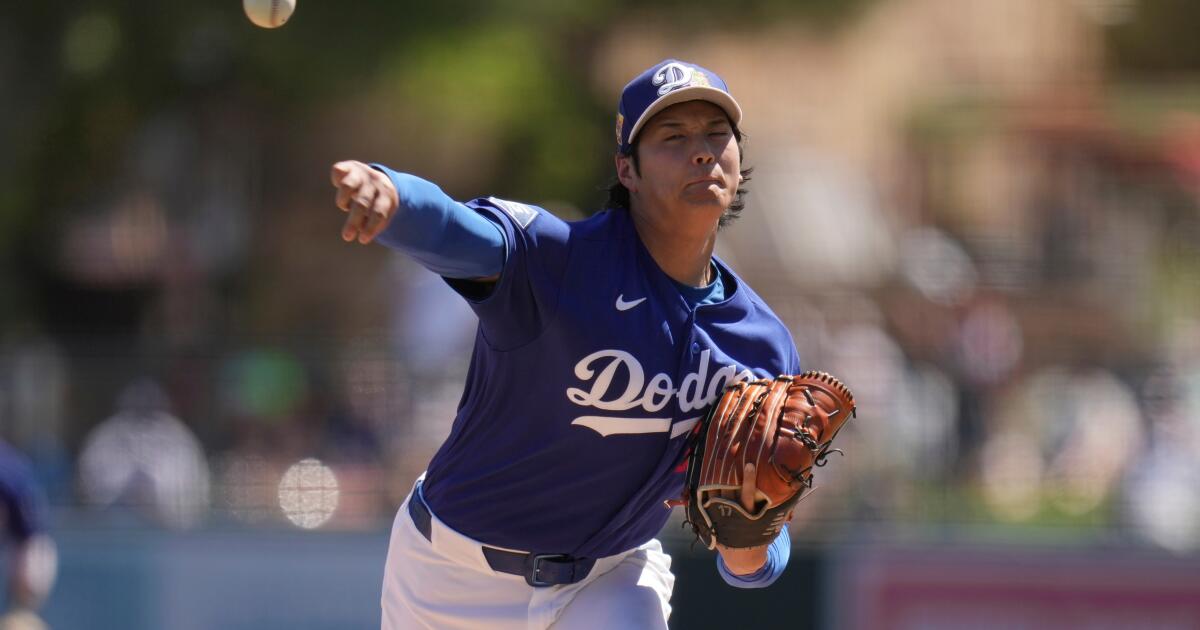
A sparse crowd braved the heat, which was approaching 100 degrees when Dodgers right-hander Shohei Ohtani walked off the mound at Camelback Ranch. But those who did were treated to a dominant pitching performance from the four-time MVP in his first start of spring training.

They repaid the favor with a standing ovation.

Ohtani limited the San Francisco Giants to one hit and overshot the innings goal manager Dave Roberts laid out Wednesday morning by pitching to one batter in the fifth inning. Ohtani didn’t give up a run in those 4 ⅓ innings, and the only other blemishes on the performance were a pair of walks and a hit batter.

“I was pretty happy with the pitch count today,” Ohtani said through interpreter Will Ireton. “In terms of the next outing, I do want to be better at executing in two-strike counts. I just didn’t finish off hitters as much as I wanted to.”

Ohtani is scheduled to make a start in the Freeway Series against the Angels before his first start of the season. If the rest of spring training goes smoothly, Roberts said he expects Ohtani to be ready to throw about five innings in his first regular-season start.

At that length, the Dodgers won’t need to designate long relievers to piggyback Ohtani’s starts. But Roberts stressed the importance of still carrying relievers who can throw multiple innings as the starters continue to build up early in the season.

“Once the season starts you’ve got to see how he’s feeling, how his stuff looks, how he’s throwing the baseball,” Roberts said after the Dodgers’ 5-1 win that was stopped after the eighth inning due to the heat.

Most of Ohtani’s build-up has taken place outside of competition, as he balanced playing in the World Baseball Classic for Team Japan as a position player, and addressing pitching on the side. By last week, he’d ramped up to a four-inning live batting practice session against his teammates on the national team in Miami.

“It actually didn’t feel like it was my first spring training outing,” Ohtani said. “I do see this as more of an extension of a live BP situation. So it didn’t feel too bad going into this game.”

Ohtani didn’t hit on Wednesday. With the heat and his unique spring, the team wanted to let him focus on pitching. He’s expected to be the designated hitter in Cactus League play Friday.

“In terms of the hitting, it did help that I played in an atmosphere that was pretty intense and competitive,” Ohtani said. “So the fact that I had to get things going earlier in the offseason maybe was the only thing that really affected my preparation. But I think it helped me more so than it hurt me, as I played through these meaningful games in the World Baseball Classic.”

Ohtani used a wide range of his arsenal Friday, landing an especially effective curveball for a called third strike against Heliot Ramos in the fourth inning.

“Never really surprised with him,” catcher Dalton Rushing said. “Everyone knows what he’s capable of. Everyone knows his main goal when he goes out there. He expects perfection every single time. And I think he was very, very close to it today.”

Source link

Yoshinobu Yamamoto named Dodgers’ opening-day starter once again

p]:text-cms-story-body-color-text clearfix”>

It’s only fitting that the pitcher who recorded the Dodgers’ final eight outs of the World Series will take the mound on opening day, as the club tries to pick up where it left off in 2025 and chase a third straight championship in 2026.

Dodgers manager Dave Roberts said Monday that World Series MVP Yoshinobu Yamamoto will toe the rubber for the March 26 opener at Dodger Stadium against the Arizona Diamondbacks — the second straight year he’s had the honor and the first time at home, after pitching last season’s opener in Tokyo against the Chicago Cubs.

Roberts added Yamamoto is expected to return to Camelback Ranch soon, after participating in the World Baseball Classic with Team Japan. The Samurai Warriors, seeking a second straight WBC title, were eliminated by Team Venezuela Saturday night in the quarterfinals.

Yamamoto is expected to make one more start in the Cactus League before opening day, although the date has yet to be scheduled, according to Roberts.

Shohei Ohtani returned to Dodgers camp Monday morning, and Roberts plans to have a conversation with him soon about configuring his throwing plan leading up to regular season play. Per Roberts, Ohtani threw four innings in a simulated game while with Team Japan last Thursday.

“He’s going to get here and throw a bullpen,” Roberts said, adding: “I’m trying to figure out when we can get him into a game, but it should be here in the next day or two, to take some at bats. But as far as his progression, there’s going to be a bullpen soon, and [we’re] trying to figure out what day he’s going to pitch this week. It should be this week, but I’m not sure which day yet.”

Ohtani has not pitched in a Cactus League game and did not pitch in the WBC. Roberts does not expect the four-time MVP to be fully stretched out by the start of the regular season. Still, as Roberts notes, he’s further along than he was at this time a year ago, when he was working his way back from Tommy John surgery.

“I think this year we’re certainly north of that, I don’t see how we won’t be able to get to three or four innings in a major league game, so that’s certainly a better jumping-off point than last year, so we’ll see how it goes,” Roberts said.

Beyond Yamamoto, Ohtani and trusty veteran Tyler Glasnow, the Dodgers’ back end of the rotation is still taking shape. Though Roberts had considered a six-man rotation to begin regular season play, he indicated Monday that he expects the club to use a five-man rotation, noting that things are still “fluid.”

Last week, Roberts said he “didn’t see a world in which Roki Sasaki doesn’t break [camp] as a starter.” That would leave one rotation spot up for the taking, with 25-year-old Justin Wrobleski, 26-year-old Emmet Sheehan and 27-year-old River Ryan among those in the running.

Source link

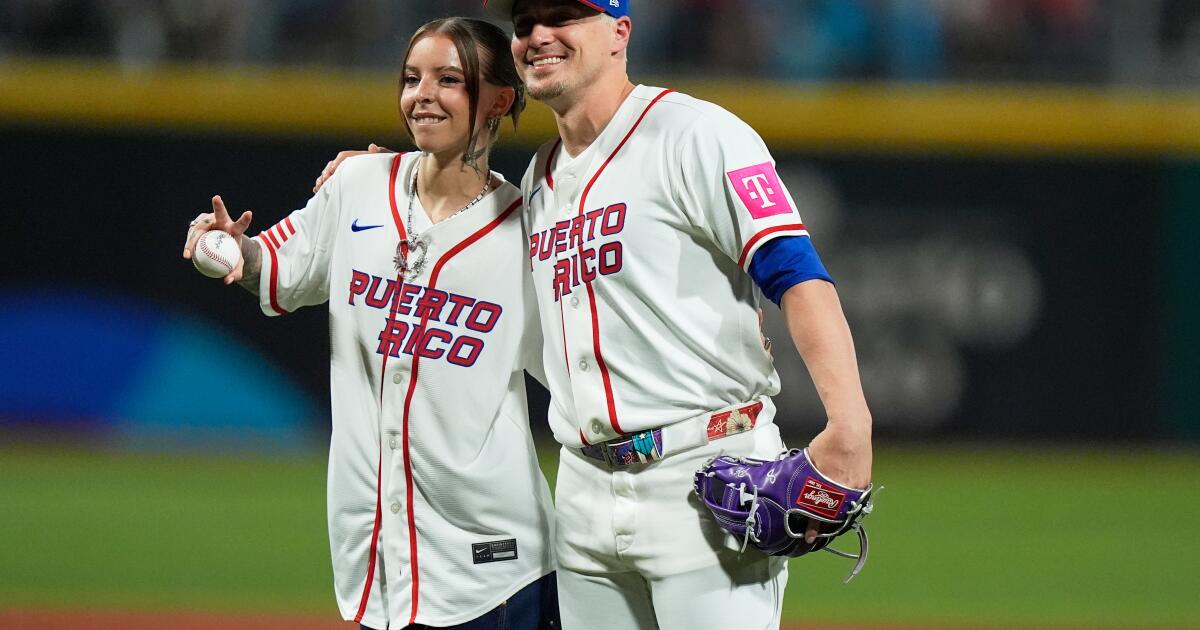
Why being in Puerto Rico for the WBC meant so much to Kiké Hernández

p]:text-cms-story-body-color-text clearfix”>

A three-time World Series champion, Dodgers utilityman Kiké Hernández has had his fair share of clutch hits, home runs and game-saving, series-defining moments that will forever be etched in baseball lore.

Earlier this month, however, he witnessed something new.

On March 7, hours after Atlanta Braves second baseman Ozzie Albies hit the first walk-off home run in World Baseball Classic history to power Team Netherlands past Nicaragua in Miami, Athletics prospect Darell Hernaiz delivered a game-winning blast of his own to lift Team Puerto Rico over Panama in extra innings in San Juan, Puerto Rico.

Hernández stormed out of the dugout at Hiram Bithorn Stadium alongside his teammates to greet Hernaiz at home plate and celebrate the monumental moon shot.

“There had never been a walk-off homer in the history of the WBC, and we [got] to see two in the same day, which was pretty cool,” Hernández said at his clubhouse stall at Camelback Ranch. “For me personally, I was running to home plate, conscious that I wasn’t necessarily part of the team so I couldn’t run laps around home plate, like I did on Freddie [Freeman’s] walk-off homers [in the World Series], but it’s still up there as one of those really cool moments that I’ll always remember.”

Unable to participate in this year’s WBC as he recovers from offseason left elbow surgery, Hernández left Dodgers camp to spend the first leg of the tournament with Team Puerto Rico.

“I got to experience it in a different way this year,” said Hernández, who has played twice in the WBC. “I was just kind of there as a fan, almost in like a coaching role. I get a lot more nervous when I’m not playing, because I really don’t have any power over it. I don’t have any control over what’s going on, so it was pretty nerve-wracking.”

He added: “Obviously, seeing that stadium packed out was pretty special. And of course, I’m still bummed that I don’t get to be a part of it, but I still support my people, and I’m still hoping they can win.”

During a Team Puerto Rico news conference last week, Hernández told reporters in Spanish that the WBC rates above the World Series. Hernández, who’s played in five World Series, elaborated on his statement.

“I said it feels bigger,” Hernández said. “I didn’t say it’s bigger. Atmosphere, crowd, you’re representing your country. You’re not representing a city. You don’t always choose who you play for. Sometimes that’s out of your control and you know, when you’re representing your country, you’re playing along with your homies. Sometimes you’re playing along with people that you grew up with. Your people back home are rooting for you, at times.

“You’re playing in the United States, you’re playing for different teams, and sometimes they’re rooting against you. And for us, coming from our little island, the things that we can do for our island while the tournament is going on, it becomes a lot bigger than baseball, to where, it does not always feel that way when you’re playing for an organization in Major League Baseball.”

Hernández will be in Houston for Puerto Rico’s quarterfinal game against Italy on Saturday, and he said he doesn’t know if he would go to Miami if Puerto Rico reached the semifinals.

“I haven’t had the conversation yet with Andrew,” Hernández said, referring to Dodgers president of baseball operations Andrew Friedman. “I only asked permission to go to Houston. We win in Houston, he might get another text message if I can go along for the ride, but haven’t decided yet.”

As for his rehab from surgery, Hernández said he’s progressing rapidly and hopes to return in late May, when his 60-day IL stint expires.

“I’m not surprised that it’s going well,” Dodgers manager Dave Roberts said. “End of May, beginning of June is probably a safe bet. Something like that.”


Source link

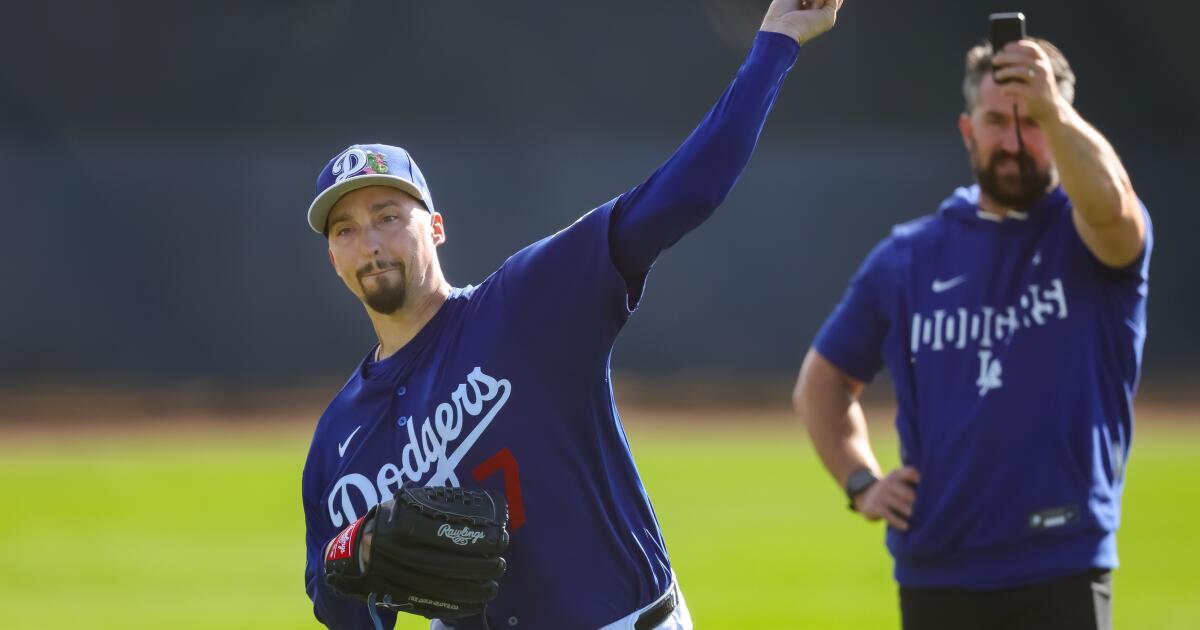
Blake Snell throws his first bullpen session of spring training

p]:text-cms-story-body-color-text clearfix”>

Unable to ramp up through the first month of spring training because of lingering shoulder soreness, Dodgers left-hander Blake Snell took a step toward readiness Thursday, throwing his first bullpen session.

Two hours before Thursday night’s Cactus League game, Snell threw off the mound in front of a group of reporters and fans at Camelback Ranch. Snell threw 15 pitches — all fastballs — sitting between 87 to 89 mph.

“I feel good,” Snell said after his bullpen. “I was very excited to throw off the mound again and pitch. I’ve been looking forward to this for a while. This being like the first one where I actually could have the catcher down. I was still limited to what I could throw. I was throwing 87 to 89 [mph]. It felt effortless, easy, could command the ball, so [I’m] happy with that. [I’m] just happy to continue to grow and get better.”

The two-time Cy Young Award winner says he’s targeting an April return, and that he’s hoping to get back faster than initially expected.

“I want to pitch in April,” Snell said. “That’s my goal. So, I’ve kind of been the one pushing it, and they’re being more cautious. I think we’re just talking a little back and forth, but I think them seeing me throw a pen today, hopefully that just gives them more confidence to keep it going. I think we won’t really know until I throw a live [batting practice], I think that’s when we’ll really know. How do I recover from that? How do I feel? And then that will be like, ‘OK, let’s get him into games.’ That’s what I would envision. I’m not the front office or Dave, but that’s what I would think.”

Dodgers manager Dave Roberts, however, isn’t ready to give a timetable for Snell’s return.

“I think honestly, to think about when he’s going to come back, we’re just a ways away from even really having that conversation,” Roberts said, noting that six weeks is “the floor” when you also account for a potential rehab assignment.

Thanks to the depth of their pitching staff, the Dodgers can afford to be patient with building up Snell. Right-handers Emmet Sheehan and River Ryan, along with left-hander Justin Wrobleski, are all possibilities for starting assignments early in the season.

“We still need him to pitch, and I know he understands that,” Roberts said of Snell. “But we do have the luxury of trying to err on the side of caution. … We are certainly better when he’s pitching for us, when he’s active.”

Snell, for his part, is thankful to be throwing again without shoulder pain.

“The whole offseason, I mean, every throw kind of hurt,” Snell said. “It was just every throw, I could feel my shoulder. It was just cranky and I couldn’t get it going. And I thought I was doing everything I needed to, and I believe I was, and ultimately, I’m feeling better.”

Source link

Dodgers’ Roki Sasaki makes strides in outing against minor leaguers

p]:text-cms-story-body-color-text clearfix”>

It hasn’t been the smoothest spring training for right-hander Roki Sasaki as he prepares for his second season with the Dodgers.

Sasaki’s first two starts in Cactus League play featured some problems with command and plenty of hard contact. But with left-hander Blake Snell and right-hander Gavin Stone sidelined with shoulder issues, Dodgers manager Dave Roberts left no doubt where Sasaki stood as he got ready to pitch in a B-game against White Sox minor leaguers on Tuesday.

“Having Blake [Snell] late to the season, which we know, [and] Gavin Stone, late to the season, as we know, we’re going to need Roki,” Roberts said. “With the buildup, I just don’t see a world in which he doesn’t break with us as a starter, and so, we’re going to need those innings.”

Sasaki took a promising step forward on a minor-league field at Camelback Ranch.

The hard-throwing right-hander threw 59 pitches, 40 for strikes, across four innings while striking out nine of the 13 batters he faced and allowing two to reach base.

Although Roberts did not see Sasaki’s outing, he heard rave reviews from members of the organization who attended.

“They said it was electric,” Roberts said after the Dodgers’ 4-1 win over the Arizona Diamondbacks at Camelback Ranch. “They said [he was touching] 98 to 100 [mph]. The fastball was spraying a little early, but then he locked it in. And then the split was on-play, short, lot of swing-and-miss. Couldn’t have asked for a better day.”

Sasaki surrendered a single through the right side of the infield to the first batter he faced, then proceeded to strike out the next seven batters. His only other hiccup came in the third inning, when he hit Jason Matthews with a stray breaking ball on a full count.

“I actually felt pretty bad the last couple days, but today I was able to make an adjustment, so that’s what I really need for right now,” Sasaki said via an interpreter after his outing. “I think I can keep moving forward.”

Sasaki was shelled in his second Cactus League start last week, yielding four runs, three walks, a single and a grand slam to the Cleveland Guardians at Goodyear Ballpark. He was lifted from the game without recording an out, only to get re-inserted in the second inning to complete two scoreless innings.

Sasaki noted mechanical issues as the reason for his struggles after the game. Tuesday, he said he felt much better, focusing on his core and obliques.

“I was actually focusing on core, oblique stuff,” Sasaki said. “I think it’s all about mechanics. If my mechanics are really good, my command is good too.”

Roberts took away plenty of value from the outing, even one against a lineup of minor leaguers.

“There’s still value in getting hitters out and seeing guys swing and miss,” Roberts said. “I think we accomplished what we wanted to today, we built him up. Obviously, built up some confidence. So, just go from there.”

Source link

How Dodgers’ Roki Sasaki looked in his second Cactus League start

p]:text-cms-story-body-color-text clearfix”>

Roki Sasaki’s struggles from his first Cactus League start carried over into Tuesday’s game against the Cleveland Guardians at Goodyear Ballpark.

The Dodgers right-hander gave up three walks and two hits, including a grand slam to Guardians slugger Kyle Manzardo, before he was lifted after 23 pitches. He displayed no command, missing arm side repeatedly and throwing only eight strikes. None of the five batters he faced in the first inning saw a first-pitch strike.

But then, he flashed the tantalizing potential that the Dodgers saw when they signed him before last season.

Re-inserted into the game to start the second inning, which is allowed in spring training, the 24-year-old settled down and retired all six batters he faced in his last two innings of work while throwing 22 pitches — 13 for strikes — in the Dodgers’ 5-4 win.

Working in a healthy mix of fastballs, cutters and splitters, Sasaki struck out two and was able to limit hard contact, which had been an issue for him in the first inning and in his first start last week against the Arizona Diamondbacks. The home run by Manzardo recorded an exit velocity of 104.6 mph.

“I wasn’t overly concerned,” Dodgers manager Dave Roberts said. “But it was good to see him bounce back.”

Sasaki said through an interpreter after he was lifted from the game that something felt off about his upper-body mechanics. He made a simple adjustment and found success in it.

“It was actually my upper body,” Sasaki said. “My lower half actually felt pretty good. My upper body felt a little off, so I was trying to make an adjustment.”

Said Roberts when asked about Sasaki missing arm side: “Maybe he’s trying to be a little too fine and/or just a little bit out of sync with the delivery. That’s why you have spring training, you work though it, you’ve got to be able to make in-game adjustments. As he gets more experienced, you would expect that to happen in the inning rather than sit for 20 minutes, come in and reset.”

Source link

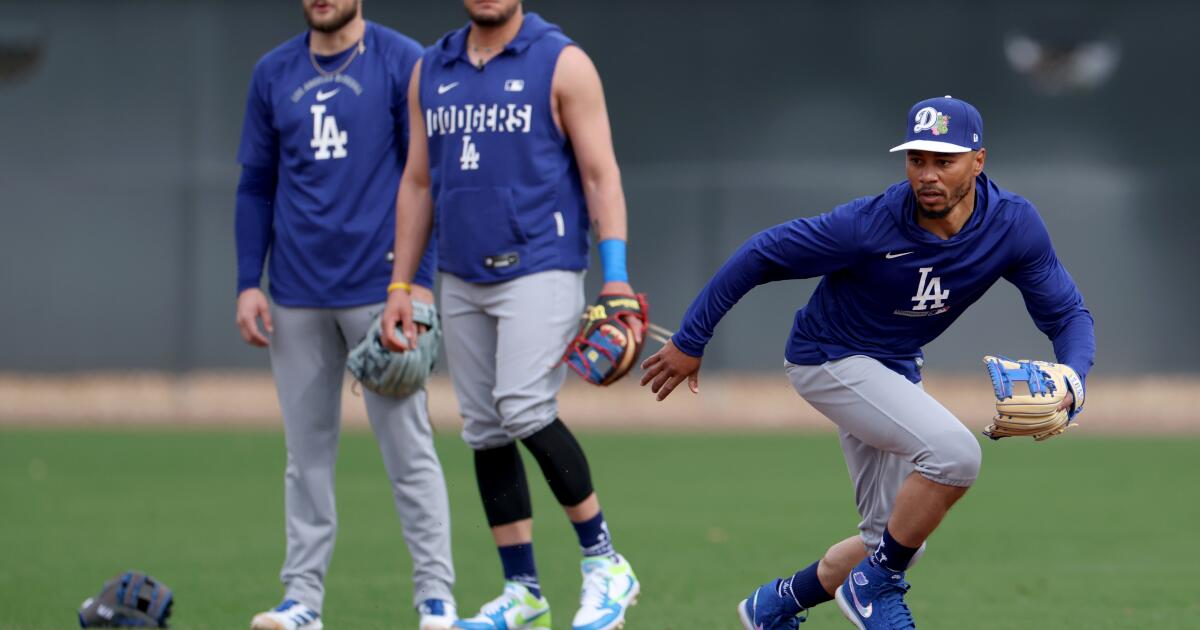
How the Dodgers’ Mookie Betts seeks to regain his All-Star form

p]:text-cms-story-body-color-text clearfix”>

Since his first full season in 2015, Mookie Betts had either been named an All-Star or received votes for most valuable player every year.

That held true until last year. In his sixth season with the Dodgers, Betts posted career lows in batting average (.258), on-base percentage (.326), and on-base-plus-slugging percentage (.732) while playing 148 games at shortstop.

Betts, now 33, believes last year was an outlier and he can get back to his previous form.

“That’s what I expect,” Betts said after making his Cactus League debut Sunday. “I haven’t felt this way in a long time. So, the way I feel now, I’m healthy, my swing’s in a really good spot. My head’s in a really good spot. I haven’t had any bad days in the cage. I haven’t had any bad days [taking batting practice]. Usually by now, I would have taken a thousand swings, trying to fix stuff, trying to get game-ready, and now I’m just cruising. I’m just cruising and I’m ready to go.”

This spring, manager Dave Roberts offered an unequivocal vote of confidence.

“He will be in the MVP conversation this year,” Roberts said. “But again, I think, speaking for Mookie, his main goal is to help us win a championship. So, I think whatever falls out from there, I think that will happen.”

A stomach bug that caused him to lose a considerable amount of weight put Betts behind last spring, and he never quite caught up. Through his first 103 games, he batted .231 with a .302 on-base percentage and .657 OPS. Enduring the longest cold spell of his career, Betts was forced to retool.

“It’s really just going back to what I what I do best, and really just honing in on it,” Betts said. “Instead of trying to fix problems, I was more able to just hone in on what I do best. And kind of groove those patterns instead of trying to fix old habits.”

Betts says in a bizarre way, he enjoyed his season of soul searching.

“I learned a lot about myself,” Betts said. “I learned a lot about how I operate. I was able to get in the right headspace, and sustain the right headspace. And then once I was able to kind of get in the right headspace and stay there, I haven’t been searching, I haven’t been doing anything since I’ve been here outside of just working and preparing.”

Things started to click in late summer. Over his final 47 games, he batted .317 with a .376 on-base percentage and .892 OPS.

It wasn’t the stats that bothered Betts as much as his lack of production through the first four months.

“Once I was able to help the boys, I was fine,” Betts said. But before that, I was really upset, not with the numbers per se, but not being able to help. Not doing my job, carrying my weight. Once I was able to do stuff, especially later on in the season, I was able to just take a step back and say, ‘You did pretty good.’”

Part of the plan for maximizing Betts’ abilities is minimizing his work in camp. Betts was the last healthy position player to appear in a spring game, starting Sunday after sitting for the first nine games. He was back in the lineup Monday, collecting his first hit with a single in three at-bats against the Colorado Rockies.

“It’s intentional,” Roberts said last week. “It’s load management. I wanted Mookie to start a little bit later, as far as not getting into spring training ready to go and kind of use spring training to build up, given it’s six weeks.”

Source link

Edwin Díaz is the Dodgers’ closer. How rest of the bullpen shapes up

p]:text-cms-story-body-color-text clearfix”>

By Game 7 of last year’s World Series, the Dodgers’ faulty bullpen issues were apparent even in the midst of dramatic triumph.

Not only did the Dodgers use all four starters in their postseason rotation — Shohei Ohtani, Blake Snell, Tyler Glasnow and Yoshinobu Yamamoto — they also tapped Justin Wrobleski and Emmet Sheehan, who combined to start 14 games in the regular season, to navigate the 5-4, 11-inning win that secured the team’s second consecutive championship.

The Dodgers shored up the bullpen over the winter, signing three-time all-star Edwin Díaz to a three-year, $69-million contract. With the closer role firmly defined for the first time since Kenley Jansen was on the team in 2021, how the rest of the bullpen falls into place remains a work in progress during spring training.

“Obviously, adding Díaz to the back end is huge for us and getting Alex Vesia [back] is going to be good, and also Blake [Treinen],” Dodgers manager Dave Roberts said. “Blake wasn’t right last year, clearly. He’s throwing the baseball really well. Having guys that you trust is everything for the pen. … You’ve got to count on those veteran guys for sure.”

Now included in that veteran group is left-hander Tanner Scott, who joined the Dodgers before last season on a four-year, $72-million deal. Scott struggled to find his footing, primarily as a closer, before a left elbow injury placed him on injured list in mid-July, causing him to miss a month of action. He returned the final week of August, and never looked quite right. Scott posted a 4.74 ERA across 61 appearances and 57.0 IP in his first year with the Dodgers.

On Saturday against the Chicago Cubs in a split-squad game at Camelback Ranch, Scott made his Cactus League debut and pitched a scoreless inning, recording a strikeout and giving up one hit on 17 pitches. With the ninth inning spoken for, Roberts believes this will allow for Scott to bounce back this season.

“I think being able to use Tanner in any inning of leverage, is going to be good for him,” Roberts said. “And it’s going to be good for us.”

Díaz, for his part, has settled in, making his second appearance of the spring on Saturday. He worked around two walks to pitch a scoreless inning, striking out one. Vesia, who missed the World Series due to the death of his newborn daughter, has pitched two scoreless innings while Treinen pitched a perfect inning on Thursday against the Chicago White Sox in his first Cactus League outing.

The 37-year-old Treinen, who’s been on all three of the Dodgers’ recent World Series teams and was a stalwart in the 2024 postseason, struggled last season, going 1-5 with a 9.64 ERA in September.

“You never know what the body throttles back,” Treinen said earlier in camp. “I had a UCL injury, so I don’t know if that’s part of the problem, but something was different. I mean, velocity was there, movements were there, execution wasn’t, and when pitches were in the zone, it was a harder-hit rate. So, that tells me something was different, how to handle hitters. So, just trying to go back and cleaning things up to where the ball does more of what it has done most of my career.”

On the flip side, right-hander Brusdar Graterol — who has not pitched since the 2024 World Series — remains in a holding pattern during spring training as he works his way back from right labrum surgery. And right-hander Evan Phillips is not expected back for several months after Tommy John surgery ended his season last June. But for the most part, the relievers who are healthy have shown glimpses of what it could look like this season.

“I don’t think that there’s one way to manage a pen,” Roberts said. “But when you have a guy like Edwin Díaz as your closer, I do think it frees up other guys. … I think that’s freeing for me and allows for getting the matchups we need in the prior innings.”

Source link

‘Maybe you’re in the wrong business.’ Blake Treinen fires back at Dodgers’ critics

p]:text-cms-story-body-color-text clearfix”>

Much has been made of the Dodgers’ exorbitant spending, magnified by a pair of World Series titles for the franchise, as Major League Baseball enters the final year of the current collective bargaining agreement.

The Dodgers open 2026 with a record $381 million payroll, while having over $1 billion in deferrals. As if signing Shohei Ohtani, Teoscar Hernández and Blake Snell, and extending Tyler Glasnow and Will Smith weren’t enough, the club once again opened up its wallet this winter, spending a combined $309 million on four-time All-Star outfielder Kyle Tucker and three-time reliever of the year Edwin Díaz.

Relief pitcher Blake Treinen, one of the longest-tenured players on the Dodgers heading into his seventh season with the team, did not mince words when asked about how outsiders view the organization.

“Perception is built from the media and maybe owners that don’t like what the Dodgers are doing because they would have to do something similar,” Treinen said earlier this week. “And I say to that, ‘Maybe you’re in the wrong business.’”

Treinen thinks more teams should spend the way that the Dodgers do.

“Is it a bad thing that the people who pay our checks and our salaries want a winning product?” Treinen said. “If you’re going to complain about a team willing to do what it takes to win, then I think you’re in the wrong business. And, if you win, to say that you lose money by winning is a wild statement, so I think the perception is more or less if you don’t like what the Dodgers are doing, either take a look in the mirror or look at the people who aren’t putting a product on the field.”

Treinen went on to say that teams don’t necessarily need to be lavish spenders in order to compete, pointing to how the Milwaukee Brewers posted baseball’s best record a season ago, with the 22nd-highest payroll. The Brewers bested the Chicago Cubs in the NL Central by five games, despite having a payroll nearly $100 million lower than their rival, and reached the National League Championship Series.

“You don’t always have to spend money to be great, look at the Brewers,” Treinen said. “But to say that you can’t compete — like they did — is a wild thing, because [they had] the best record in baseball last year. Draft and development is a big deal, a lot of teams have leaned into it. So, if you either invest heavily in one or the other, and the Dodgers have done a great job of doing both and that’s why players sign here. If you don’t like it, then maybe find a new business model.”

How the Dodgers operate has garnered some praise — the Padres’ Manny Machado and the Phillies’ Bryce Harper weighed in on the subject early in spring training — but the front office wasn’t really seeking it out.

“We’re not looking externally for validation,” Dodgers general manager Brandon Gomes said earlier this month at Camelback Ranch. “The validation is winning championships and putting out as good a team as we can each and every year, and all we’re trying to do is get a little bit better each and every season, with the goal of winning championships. [Our] coaching staff, our players I think view it as that. Good, bad or indifferent, the external stuff is something we can’t worry about.”

Dodgers manager Dave Roberts, speaking at Cactus League media day earlier this month, said the fixation on the money spent makes people miss the things they do well.

“It does get lost, the things that we do well,” Roberts said. “Scouting and player development, I think we do as well as anybody in baseball … to get superstars to play well every night, to put out a good product every single night, I think we do a good job at that.”

“That’s why the biggest conversation should be that instead of a payroll question,” Roberts added. “Why are we good for baseball? Because our players play the game the right way.”

Source link