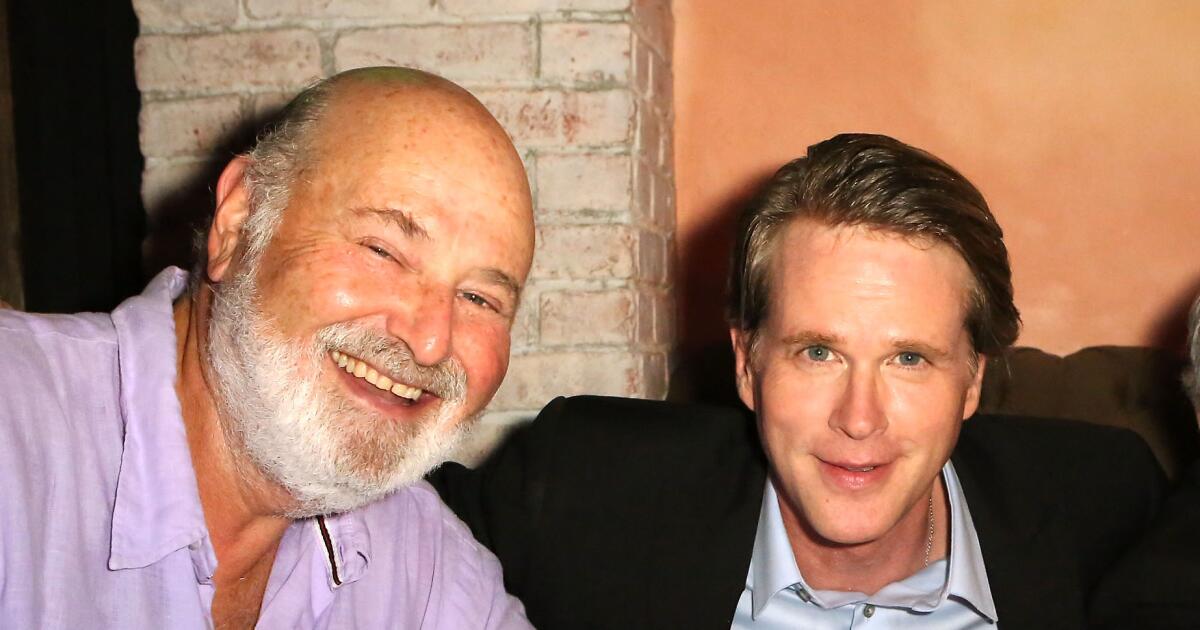
“The Princess Bride” star Cary Elwes says he will remain in mourning long after the shocking deaths of beloved friend Rob Reiner and his wife, Michele Singer Reiner, earlier this month.
“Because my heart still aches every time I think of you, I know the grief of losing you too soon will likely never go away,” Elwes wrote Tuesday in an Instagram tribute to his longtime friends.
Elwes published his heartfelt remembrance of the Reiners more than two weeks after they were found dead in their Brentwood home on Dec. 14. “Enough time has passed that I can finally put my grief into words,” Elwes began his post.
The actor, 63, looked back on his time working with Reiner on 1987’s “The Princess Bride” and their relationship over the years since then, sharing behind-the-scenes footage from filming and a charming snippet from a reunion celebrating the 25th anniversary. He recalled meeting Reiner nearly 40 years ago when he was cast as Westley, the farmboy-turned-hero of the beloved fantasy film.
Elwes, who had been a Reiner fan before working with the filmmaker, wrote that “from that very first meeting I fell in love with him.”
The “When Harry Met Sally…” and “Stand By Me” director was “someone I wanted in my life,” Elwes continued, recalling the filmmaker’s authenticity and efforts to find the best in people. Looking back on his time with Reiner on “The Princess Bride,” Elwes wrote, “I can’t remember a single day without laughter.”
The actor’s social media post also paid tribute to the Reiners’ relationship and their longtime devotion to progressive political causes. “In a town where many talk the talk, they truly walked it,” Elwes wrote.
Elwes celebrated Reiner’s effortless comedy and dedication to “finding the joy.” He also compared making Reiner laugh to winning the lottery.
“His laugh was one of the greatest sounds I’ve ever known,” Elwes wrote, “so heartfelt it still rings in my ears.”
Elwes and Reiner maintained a bond long after “The Princess Bride” and collaborated again in 2015 on “Being Charlie.” Nick Reiner, the filmmaker’s second son, co-wrote the movie about a successful actor with political ambitions and a son addicted to drugs. The younger Reiner, 32, has been charged with murdering his parents after years of struggling with addiction and other issues.
Elwes, the latest Hollywood figure to salute the Reiners, concluded his post channeling a memorable line from his “Princess Bride” character.
“Sure, death cannot stop true love,” he wrote, “but life is pain without you.”
In January 2018, conservative Fox News host Laura Ingraham was having dinner at Toscana, an Italian restaurant in Brentwood, when she spotted the renowned Hollywood director — and unabashed liberal — Rob Reiner.
She asked him to come on her show, “The Ingraham Angle.” He was on set the next day.
After introducing him as “a brilliant director,” who made her favorite movie, “This is Spinal Tap,” Ingraham said: “Last night, the first thing Reiner says is: ‘Are they gonna shut the government down?’’ I’m like, wow, I’m here in L.A.; I wanna talk about Hollywood stuff. But he wants to talk about politics.”
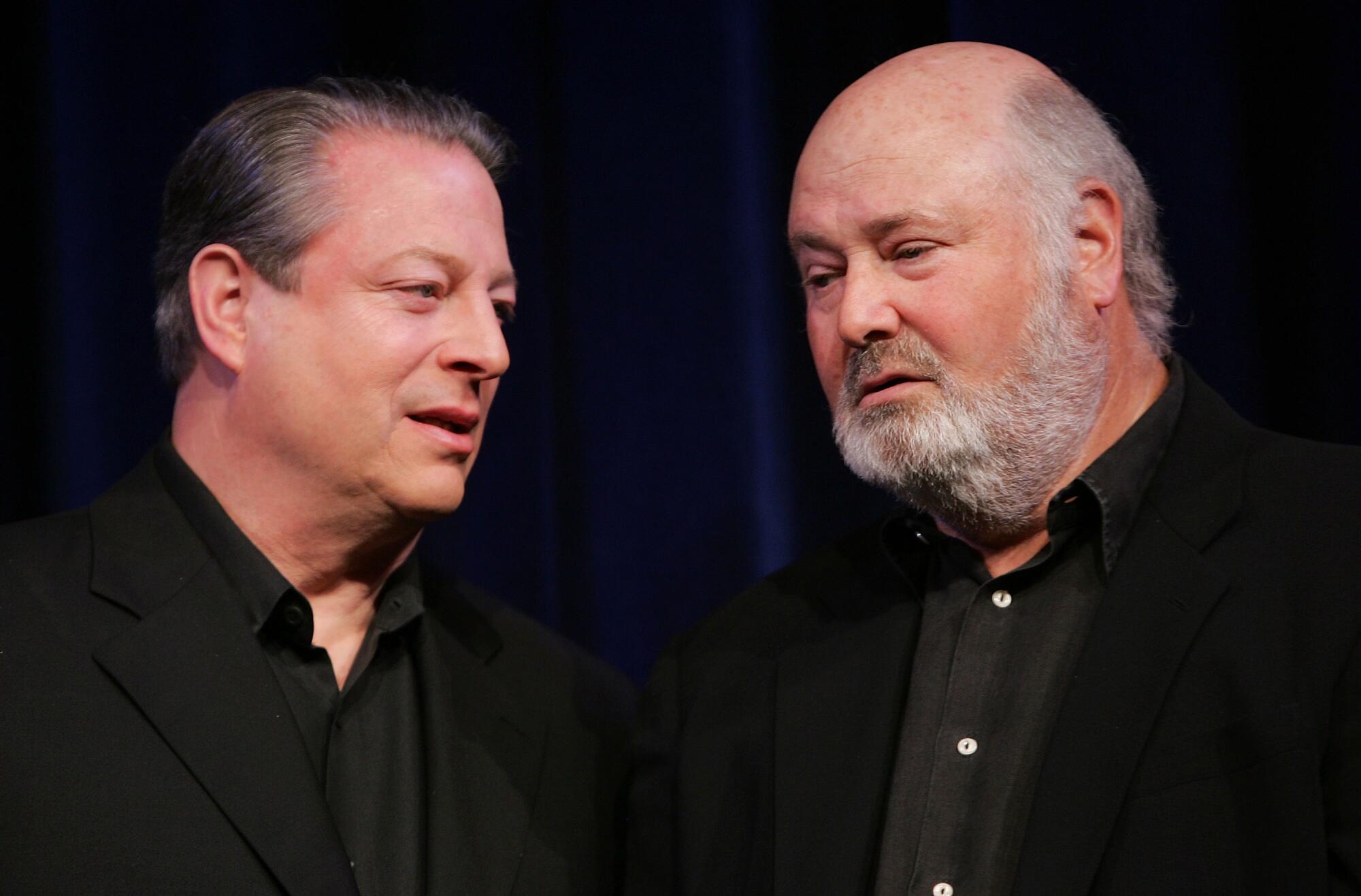
Al Gore and Rob Reiner attend the Tribeca Film Festival in New York in April 2007.
(Scott Gries / Getty Images)
Ingraham and Reiner vehemently disagreed — about alleged Russian influence on the 2016 presidential election, about whether President Trump is racist, about the treatment of conservatives in Hollywood.
But Reiner also called Ingraham “smart as hell.” And Ingraham said Reiner “should be lauded” for being willing to spar with her, unlike many politicians on both sides of the aisle.
It was the kind of blunt but ultimately respectful exchange that added to Reiner’s widespread appeal off-screen, both because of — and in spite of — his views.
Reiner and his wife, Michele, were killed at their Brentwood home last weekend, allegedly by their son, Nick, who has been charged with murder. The couple’s deaths have sent a thunderclap through Hollywood and beyond, partly because the Reiners had so many friends and connections in creative and political circles.
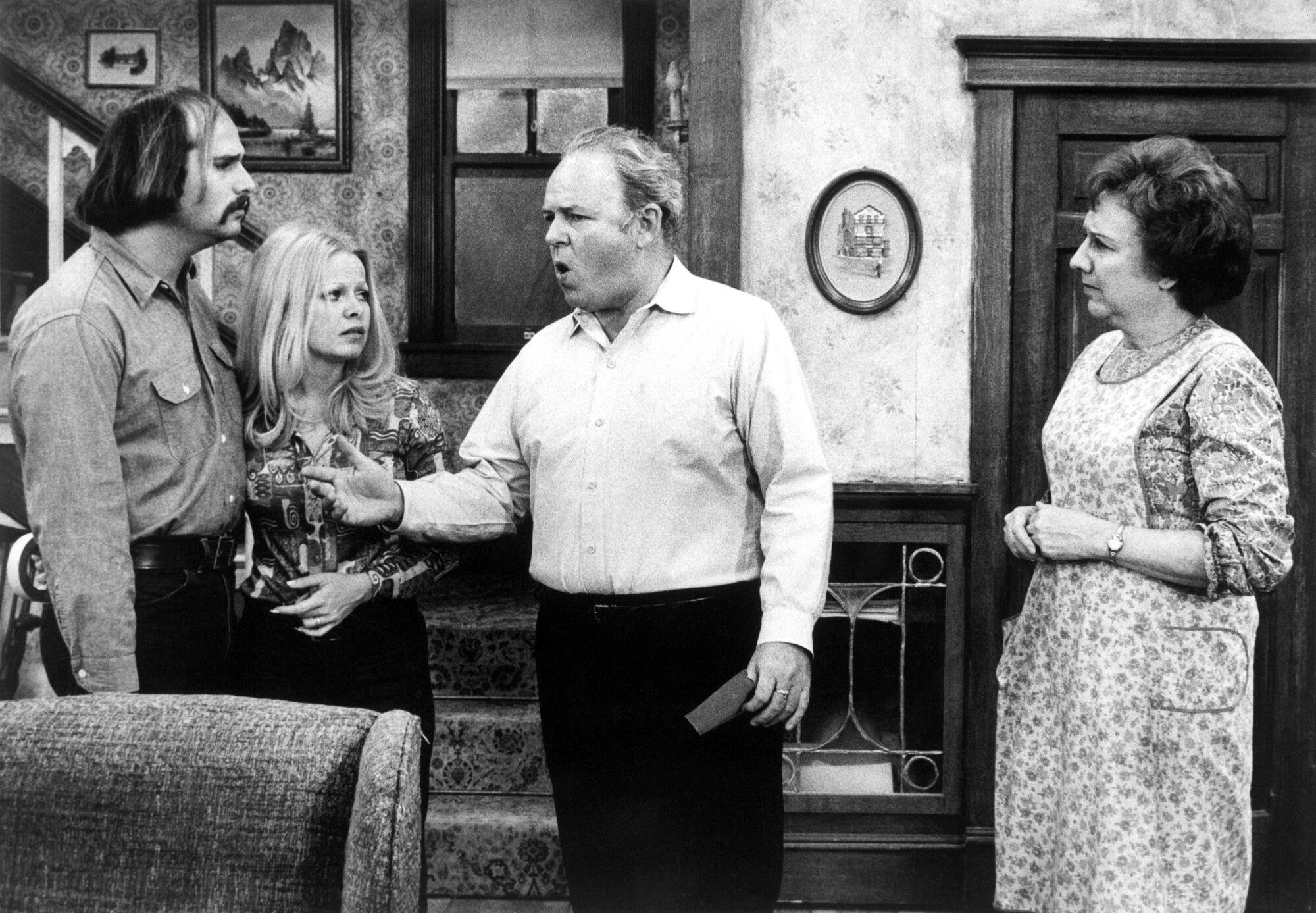
Rob Reiner — who, in the role of Michael “Meathead” Stivic in the groundbreaking sitcom “All in the Family,” played the liberal foil to his bigoted, conservative father-in-law, Archie Bunker — seemed to relish his real-life role as a progressive celebrity activist. That made him a hero to many in blue California but a villain to others, especially the reality-TV-show-star-turned-president, Donald Trump.
In a highly criticized social media post, Trump attributed the deaths to “the anger he caused others through his massive, unyielding, and incurable affliction with a mind crippling disease known as TRUMP DERANGEMENT SYNDROME.”
But while Reiner, a blistering critic of the president, disagreed with many conservatives on policy, he also worked to build relationships with them — in media and entertainment circles, the California State Capitol, and beyond.
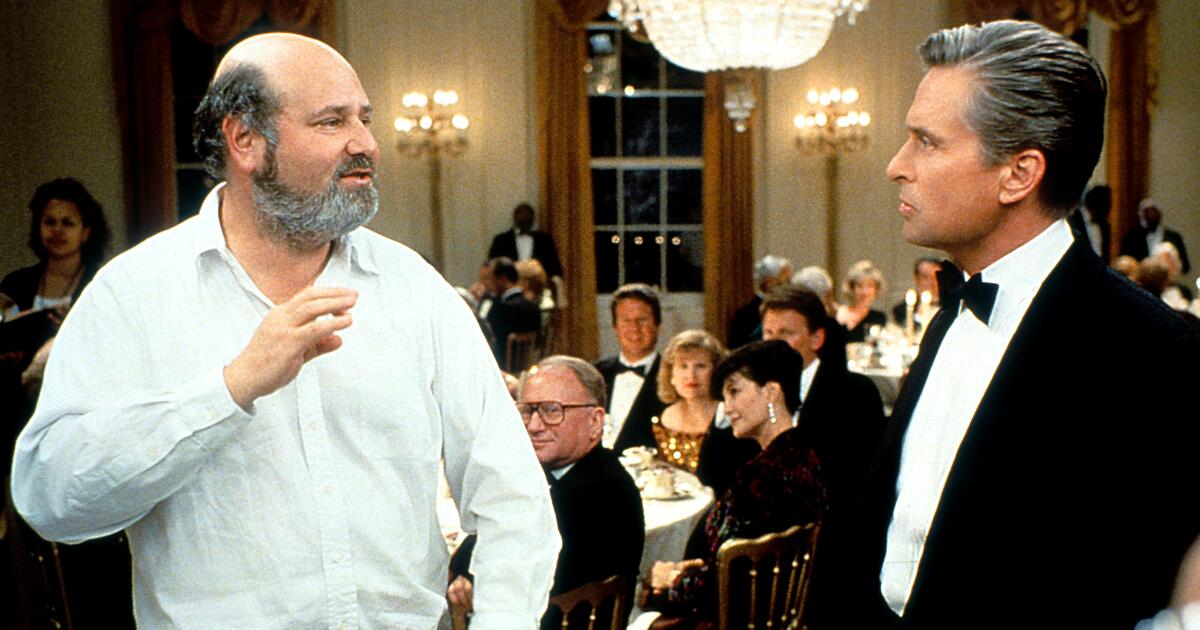
Actors Alec Baldwin and James Woods listen to director Rob Reiner in between scenes for the 1996 film “Ghosts Of Mississippi.”
(Columbia Pictures via Getty Images)
Actor James Woods, a longtime Trump supporter, said in a Fox News interview this week that Reiner saved his career by casting him in the 1996 film “Ghosts of Mississippi” over studio objections. He called Reiner “a great patriot” with whom he shared a mutual respect despite myriad political disagreements.
Andrew Kolvet, a spokesman for conservative powerhouse Turning Point USA, wrote on X that he “shared approximately zero in common with Rob Reiner politically, but I am so saddened by this news” and praying that “justice would be swift and without conspiracies [sic] theories.”
Kolvet said Reiner “responded with grace and compassion” to the September killing of TPUSA founder Charlie Kirk — a violent end that Reiner said nobody deserved, regardless of their views.
Hard-right Republican Rep. Marjorie Taylor Greene, of Georgia, called the deaths “a family tragedy, not about politics or political enemies.” And GOP Sen. Ted Cruz, of Texas, wrote on X that “The Princess Bride” was his favorite film and called Reiner “a comedic and story-telling master.”
Off screen, Reiner had a unique ability to connect with people of all persuasions, in various mediums, at the top of their careers or just starting. He was very much influenced by Norman Lear, the creator of “All in the Family,” who blended his Hollywood career with progressive activism.
Similar to Lear, Reiner didn’t just dabble in social causes and campaigns. He launched them, led them and brought people aboard. “He wasn’t building an operation the way Hollywood typically does, making donations, hosting fundraisers,” said Ben Austin, a former aide to Reiner who worked in the White House during the Clinton administration.
And all the time, he did it while making movies, some of them deeply personal, intertwined with his life as a parent.
Reiner was the driving force behind the successful 1998 California ballot measure, Proposition 10, a landmark policy that put a tax on tobacco products and pumped billions of dollars into preschools, teacher training, and support for struggling families. He enlisted help in that effort from such beloved figures as Steven Spielberg, Robin Williams and his own father, comedy legend Carl Reiner.
After the initiative passed, Gov. Gray Davis, a Democrat, appointed the younger Reiner chairman of the First 5 commission overseeing disbursement of the funds.
Rob Reiner co-founded the group that would help overturn Proposition 8, the 2008 ballot measure that banned same-sex marriage in California.
(Los Angeles Times)
And in 2009, Reiner co-founded the American Foundation for Equal Rights, which led the successful legal fight to overturn Proposition 8, the 2008 ballot measure that banned same-sex marriage in California. The group hired legal luminaries from opposite sides of the political spectrum to overturn the ballot measure: the conservative former U.S. Solicitor General Theodore Olson and litigator David Boies, a liberal who squared off against Olson in the U.S. Supreme Court ruling that gave George W. Bush the presidency in 2000.
Former Los Angeles Mayor Eric Garcetti, a Democrat, said in an interview Wednesday that Reiner successfully rallied people to the cause because he was so adept at humanizing the stories of the plaintiffs and other same-sex couples — and emphasizing love.
“I don’t think you can overstate how influential he was at the national, state and local level and how well-liked he was,” Garcetti said. “Politics and movies share this in common: They both need good stories … and he was such a gifted storyteller.”
Garcetti said that while many celebrities lend money and faces to political causes, prettying up political mailers and email blasts, “Rob built those causes. He wasn’t like the frosting on the cake. He actually was the baker.”
Garcetti, then a Los Angeles City Council member, joined Reiner in stumping for 2004 Democratic presidential hopeful Howard Dean, for whom the director was an early backer. Garcetti crossed paths with him often, including during the push to overturn Proposition 8 — and at the Los Angeles City Hall wedding of Paul Katami and Jeff Zarrillo, two of the plaintiffs in the federal case that struck it down.
Katami wrote in an Instagram post this week that Reiner and his wife “stood with us in court for 4.5 years” and that he and his husband sat at the couple’s table in their home many times.
Rob Reiner chats in 2012 with Paul Katami and Jeff Zarrillo, plaintiffs in the case that struck down Proposition 8, which banned same-sex marriage in California.
(Brian van der Brug / Los Angeles Times)
“Because of them, they were able to sit at our table, at our wedding, on a day and in a moment that would not exist without their belief in who we are and how we love,” Katamami wrote.
He added: “They are brave. They are funny. They are generous. They are deeply human. And they make everyone around them feel seen, protected, and encouraged to be more fully themselves.”
Former L.A. Mayor Antonio Villaraigosa, a Democrat now running for California governor, officiated Katami and Zarrillo’s wedding. He said in an interview that Reiner personally bankrolled much of the legal fight because he genuinely believed it was the right thing to do.
In 2008, Villaraigosa kicked off his successful reelection campaign with a private reception at the Reiners’ home.
“You know, the one thing about Rob Reiner: There was no pretense,” Villaraigosa said. “If you go to his house … he’s a very wealthy man — he has been a director, an actor, co-founder of Castle Rock Entertainment — and yet his house was like a home. It wasn’t a mansion. It was like a ranch-style house, very homey.”
Rob Reiner hugs then-Mayor Antonio Villaraigosa in January 2015. The director had just introduced Villaraigosa at a school as the mayor kicked off his Leadership Tour highlighting his support for universal preschool.
(Al Seib / Los Angeles Times)
Villaraigosa and others said Reiner had a granular knowledge of the policies he supported, garnering the respect — if not always the affection — of those with whom he disagreed.
Gale Kaufman, a veteran Democratic strategist who was a longtime advisor to the influential California Teachers Assn., clashed with Reiner over education policy but admired his commitment to — and knowledge about — the issue.
Kaufman told The Times this week that she was amazed by “his attention to detail and his dogged determination that he was right.”
“This was not just someone giving you a pot of money and saying, ‘Go do this.’ This was a guy who was … in every piece of it.”
Cinematographer Reed Morano was one of several in Hollywood whose career soared because of Reiner.
In the late 2000s, Morano was known for filming low-budget projects — often in a gritty, hand-held style. Many of them premiered at the Sundance Film Festival, including the Oscar-nominated “Frozen River.”
In the early 2010s, Morano got a chance to pitch her talents to Reiner and producer Alan Greisman, who were assembling a team to shoot 2012’s “The Magic of Belle Isle,” starring Morgan Freeman and Virginia Madsen and directed by Reiner.
Barely 15 minutes after leaving the meeting, Morano got a call telling her she had the job.
“The thing that strikes me is he could have had anybody he wanted,” said Morano on a call Tuesday from New York City, noting that “Belle Isle” was the biggest budget project she had worked on up to that point. “It’s just he was so open-minded and so forward-thinking, and I think he could see potential that other people couldn’t see.”
Morano then handled cinematography for Reiner’s “And So It Goes,” starring Michael Douglas and Diane Keaton, released to 2014. Reiner, she said, also wanted her to work on “Being Charlie,” the 2015 addiction drama co-written by his son Nick, but she was unable to because of scheduling conflicts. Separately from Reiner, she would go on to win an Emmy in 2017 for directing on the series “The Handmaid’s Tale” and a prize at Sundance for her second film as director, 2018’s “I Think We’re Alone Now.”
A decade before Morano connected with Reiner, Michael Trujillo, now a veteran campaign consultant, went to work for him as a young communications and policy aide for First 5. He was in his early 20s and was stunned to learn he would be working steps from Reiner’s office in the Beverly Hills headquarters of his legendary Castle Rock Entertainment.
Rob Reiner speaks in 1998 to a child development policy group about Proposition 10, which added sales tax to tobacco products to fund early childhood education.
(Robert Durell / Los Angeles Times)
“I show up to Castle Rock Entertainment as a 22-year-old, in Beverly Hills, off Maple Drive. I’m just a Mexican kid from the northeast San Fernando Valley. My dad was a construction worker. My mom was a secretary … and I’m like, ‘What the f— am I doing here?” Trujillo said with a laugh.
Castle Rock, he said, was simultaneously a Hollywood hot spot and “a classroom in politics.” Trujillo said he once played office golf — blue cardboard for water hazards; brown paper for sand traps — with actors Christopher Guest and Eugene Levy while the movie “A Mighty Wind” was being edited. Politicians were always there, too.
Trujillo regularly joined Reiner on his once-a-month flights from Santa Monica to Sacramento for First Five commission meetings and tagged along to news conferences and school classrooms. He usually carried a Sharpie, knowing fans would show up with DVDs or VHS tapes of their favorite Reiner flicks to be signed.
“Rob was able to have conversations with anyone and everyone,” Trujillo said. “If you’re a Republican or Democratic legislator nationally, or even local or in the state, you were still a fanboy. You still wanted to meet his character from ‘All in the Family.’ You still wanted to shake the hand of the guy that made ‘Princess Bride.’ You still wanted to talk to the guy that made ‘A Few Good Men.’”
I think about Rob Reiner almost every time I put on my socks.
I am old enough to remember the famously hilarious (and largely improvised) bit from “All in the Family” in which Reiner’s Mike “Meathead” Stivic and Carroll O’Connor’s Archie Bunker argue about the correct order of donning footwear — both socks first (Archie’s method) or sock/shoe, sock/shoe (Mike’s).
The straight-faced back and forth was, and is, a pitch-perfect exhibition of how much time and energy we waste judging, and arguing about, personal differences that are none of anyone’s business and matter not at all.
I also think about Reiner whenever my now-adult children and I sit down for a movie night. When all other suggestions fail, at least one of his films — ”Stand by Me,” “The Princess Bride,” “A Few Good Men,” “When Harry Met Sally…,” “Misery” — will achieve consensus, in large part, because of that same understanding.
Reiner was, above all, a compassionate filmmaker, willing to excavate all manner of conflict and tension in search of the essential humanity that connects us all.
Reiner helped shape the culture of my youth and early adulthood with such brilliant empathy that his random appearances on television — as Jess’ (Zooey Deschanel) father in “New Girl” or, more recently, Ebra’s (Edwin Lee Gibson) business mentor on “The Bear” — sparked immediate reflexive delight, as if a beloved uncle had shown up unexpectedly at a family dinner.
It helped, no doubt, that I share his political leanings. Reiner’s advocacy for gay marriage and early education were well-known, as was, in recent years, his unvarnished criticism of President Trump, who Reiner, like many others, considered a danger to democracy.
That criticism should have prepared me for the chilling invective unleashed by some, including Trump, in the wake of the news that Reiner and his wife, Michele Singer Reiner, were found dead in their home on Sunday night, victims of a knife attack, and that their son Nick, who has a history of drug addiction, was in police custody.
Even as the millions who were touched by Reiner’s work struggled to process their shock, grief and horror, Trump responded with a post in which he claimed that the Reiners’ murders were “reportedly due to the anger he caused others through his massive, unyielding, and incurable affliction with a mind crippling disease known as TRUMP DERANGEMENT SYNDROME, sometimes referred to as TDS.”
Even so, between the shocking news of the Reiners’ deaths, the possible involvement of their son and the unhinged and cold-hearted response of the president of the United States, it is difficult to know how to react, short of tearing out one’s hair and screaming up to an indifferent sky.
No person’s life means intrinsically more than any other — many people are killed by violence each and every weekend, often by family members; that we seem to have become inured to mass shootings is another sort of horror.
But Reiner’s work, in film, television and politics, affected millions around the world personally and culturally. In “All in the Family,” his young leftie was far from the hero of the piece — Mike’s values were more humane and progressive than the bigoted Archie’s, but he could be just as narrow-minded as his father-in-law and just as capable of change.
As a director, Reiner championed independent filmmaking, which is to say smartly written movies that told interesting stories about characters that were recognizable in their humor and humanity (which is one reason he was so successful in adapting Stephen King’s work, including the novella “Stand by Me” is based on and “Misery”).
His political activism too was grounded in the desire to make life better for those historically marginalized by policy and culture. He campaigned against tobacco use and for Proposition 10, which increased the tax on cigarettes, and funded early education. In 2009, he used his considerable influence to co-found the American Foundation for Equal Rights and successfully fought to legally challenge Proposition 8, which banned same-sex marriage in California.
As an artist and a public figure, he put his money where his mouth was and remained invariably sincere, a powerful and compelling trait that has become increasingly rare in a time of the sound-bite inanities, muddy thinking, obvious contradictions and outright falsehoods that threaten our public and political discourse.
Reiner mastered many mediums and wielded a broad palette but his signature artistic trait was empathy. No story was too small, or too brutal, to be examined with kindness and an understanding that the most grave injustice we can commit is to choose apathy or revenge when connection and transcendence are always possible.
The news cycle surrounding the Reiners’ deaths is likely to get worse, as details emerge and reactions of all kinds continue. For a long while, it will be difficult to think of Reiner and his wife as anything but victims of a brutal crime of truly tragic proportions and the regrettable heartlessness that our political divisions have created.
Ironically, and mercifully, solace for this loss, and so many others, can be found in Reiner’s work, films and performances that are impossible to watch without feeling at least a little bit better.
As Hollywood and the world mourns, I will try to think of Reiner as I always have. After all, no matter the order, we all put on our shoes and socks one at a time.
And then, as his artistic legacy teaches us, we stand and try to do the best we can with whatever happens next.
Months before his slaying, Rob Reiner talked about the power of forgiveness after the “horrific” assassination of conservative influencer Charlie Kirk.
“Horror. An absolute horror,” the director, actor and political activist said when asked about the shooting in a TV interview with Piers Morgan. “I unfortunately saw the video of it and it’s beyond belief what happened to him, and that should never happen to anybody. I don’t care what your political beliefs are. That’s not acceptable.”
“Rob Reiner, a tortured and struggling, but once very talented movie director and comedy star, has passed away, together with his wife, Michele, reportedly due to the anger he caused others through his massive, unyielding, and incurable affliction with a mind crippling disease known as TRUMP DERANGEMENT SYNDROME, sometimes referred to as TDS,” Trump said in a social media post.
“He was known to have driven people CRAZY by his raging obsession of President Donald J. Trump, with his obvious paranoia reaching new heights as the Trump Administration surpassed all goals and expectations of greatness, and with the Golden Age of America upon us, perhaps like never before. May Rob and Michele rest in peace!”
How is that anyone’s initial reaction to a tragic slaying, let alone an official comment from a sitting U.S. president? That’s a rhetorical question, of course. It’s just another Monday at Trump’s White House.
I’d be screaming into the void if I were to use the rest of this column to argue that the president is not only off his rocker but also has tumbled down the stairs and is in the foyer, mumbling something about speedboats, piggies and ballrooms. In his race to the bottom, he’s broken through the floor. Now we’re in the Trump Upside Down, where empathy and decency are negative attributes.
Even Republican lawmakers were compelled to speak out against their feared leader. “This is a family tragedy, not about politics or political enemies,” said Georgia Rep. Marjorie Taylor Greene in response to Trump’s post.
Rep. Mike Lawler (R-N.Y.) wrote on X, “Regardless of one’s political views, no one should be subjected to violence, let alone at the hands of their own son. It’s a horrible tragedy that should engender sympathy and compassion from everyone in our country, period.”
Don Bacon (R-Neb.) said it short and sweet to CNN’s Jake Tapper: “I’d expect to hear something like this from a drunk guy at a bar, not the President of the United States. Can the President be presidential?”
No, he cannot. When given the chance on Monday to appear leader-like during a White House news conference, Trump doubled down on his dislike for Reiner, saying he “wasn’t a fan” and that the director “was a deranged person.”
Translation: Reiner was a Trump critic and the president has skin so thin it’s practically rice paper at this point. But the filmmaker’s social conscience was evident in everything he did, starting with his role as “All in the Family’s” liberal, hippie son-in law to conservative crank Archie Bunker. It was the 1970s, and Meathead (a.k.a. Michael) consistently called out Archie’s racism, bigotry and sexism on the weekly sitcom. Archie’s rants are now the ugly stuff embraced by feckless politicians and attention-seeking influencers, but back then, his tirades against “queers” and “coloreds” represented old prejudices that needed to be shed if the country were to move forward. Show creator Norman Lear made the ugliness funny by using Meathead to expose Archie’s ignorance. Even back then, Reiner was poking the bear.
Reiner was a staunch critic of Trump and other leaders and movements that sought to curtail the freedoms that were previously believed to be enshrined in the Constitution — until MAGA began shredding them one by one. The comedian was an advocate for democratic ideals, Democratic candidates, same-sex marriage, early childhood education, and government transparency, spearheading California’s Proposition 10 (First 5) to fund early development programs via tobacco taxes. He also helped overturn Proposition 8, California’s brief ban on gay marriage.
Reiner’s understanding that it takes all kinds was evident in his work. He was a director with range, as they say in the industry, helming a string of films that became cultural touchstones, starting with 1984’s groundbreaking mockumentary “This Is Spinal Tap,” a satire that forever changed the language around heavy-metal decibel levels (“Crank it to 11!”). Then came 1986’s coming-of-age drama “Stand by Me,” 1989’s seminal romantic comedy “When Harry Met Sally…,” and the terrifying, psychological horror-thriller, 1990’s “Misery,” about an injured novelist held captive by his biggest fan.
Some of his films directly addressed the inequity and violence that Reiner fought so hard to correct in his lifetime. “Ghosts of Mississippi” explored the 1994 trial of Byron De La Beckwith, a white supremacist accused of the 1963 assassination of civil rights activist Medgar Evers. And Reiner’s 2017 drama “Shock and Awe” told the true story of a team of reporters who countered the Bush administration’s justification for invading Iraq in 2003 when they found evidence of falsified intelligence about weapons of mass destruction.
Though it was already acceptable to speak out against that Middle Eastern war, in the same week of the film’s release, he caught flak for signing a petition led by Palestinian director Annemarie Jacir condemning Trump’s 2017 decision formally recognizing Jerusalem as the capital of Israel. Reiner, who was Jewish, told the National that Trump had “no concept of geopolitical events or how things are interconnected. There was no consideration that went into this decision, no outreach to allies in the Arab world, or even the non-Arab world to see what the impact of something like this is.”
Reiner saw tragedy and sadness in the death of Kirk because he was able to empathize with the loss of life, no matter the difference of opinion.
Rob Reiner was a movie director who began as an actor who wanted to direct movies. The bridge between these careers was “This Is Spinal Tap” in 1984, his first proper film, in which he also acted. His original inclination, based on the music documentaries he had studied, had been not to appear onscreen, but he decided there was practical value in greeting the audience with a face familiar from eight seasons of “All in the Family” as Archie Bunker’s left-wing son-in-law, Michael “Meathead” Stivic.
Reiner’s television career began at 21, partnered with Steve Martin, writing for “The Smothers Brothers Comedy Hour.” As an actor, his early years were characterized by the small parts and guest shots that describe the early career of many performers we come to know well. He played multiple characters on episodes of “That Girl” and “Gomer Pyle, USMC,” a delivery boy on “Batman,” and appeared on “The Andy Griffith Show” and “Room 222.” His last such role, in 1971, the same year “All in the Family” premiered, was on “The Partridge Family” as a tender-hearted, poetry-writing, tattooed biker who becomes attached to Susan Dey‘s character and somewhat improbably takes her to a school dance. It’s a performance that prefigures the tenderness and humanity that would become a signature of his work as a writer, director and performer — and, seemingly, a person.
On “All in the Family,” in his jeans and work shirt, with a drooping mustache that seemed to accentuate a note of sadness, Reiner largely played the straight man, an irritant to Carroll O’Connor’s Archie Bunker, teeing up the issue-oriented dialectic. Once in a while he’d be given a broad comic meal to chew, as when wife Gloria (Sally Struthers) goes into labor while they’re out for dinner, and he accelerates into classic expectant-father sitcom panic. But minus the “Meathead” material, “All in the Family” is as much a social drama as it is a comedy, with Mike and Gloria struggling with money, living with her parents, new parenthood, and a relationship that blows hot and cold until it finally blows out for good. He’s not a Comic Creation, like Archie or Edith with their malaprops and mispronunciations, or even Gloria, but his importance to the storytelling was certified by two supporting actor Emmys.
Rob Reiner, Sally Struthers, Caroll O’Connor and Jean Stapleton in a scene from Norman Lear’s television series “All in the Family.”
(Bettmann Archive via Getty Image)
What Reiner carried from “Family” into his later appearances was a sort of bigness. He could seem loud — and loudness is something Norman Lear’s shows reveled in — even when he’s speaking quietly. Physically he occupied a lot of space, more as time went on, and beginning perhaps with “Spinal Tap,” in which he played director Marty DiBergi, he transformed tonally into a sort of gentle Jewish Buddha. In the 2020 miniseries “Hollywood,” Ryan Murphy’s alternate history of the 1930s picture business, the studio head he plays is not the desk-banger of cliche, but he is a man with an appetite. (“Get me some brisket and some of those cheesy potatoes and a lemon meringue pie,” he tells a commissary waiter — against doctor’s orders, having just emerged from a heart attack-induced coma. “One meal’s not going to kill me.”) He’s the boss, but, in a scene as lovely as it is historically unlikely, he allows his wife (Patti LuPone), who has been running things during his absence, to also be the boss.
Reiner left “All in the Family” in 1978, after its eighth season to explore life outside Michael Stivic. (In 1976, while still starring on “Family,” he tested those waters, appearing on an episode of “The Rockford Files” as a narcissistic third-rate football player.) “Free Country,” which he co-created with frequent writing partner Phil Mishkin, about a family of Lithuanian immigrants in the early 1900s, aired five episodes that summer. The same year, ABC broadcast the Reiner-Mishkin-penned TV movie “More Than Friends” (available on Apple TV) in which Reiner co-starred with then-wife Penny Marshall. Directed by James Burrows, whose dance card would fill up with “Taxi,” “Cheers” and “3rd Rock From the Sun,” it’s in some respects a dry run for Reiner’s “When Harry Met Sally…,” tracking a not-quite-romantic but ultimately destined relationship across time.
Future Spinal Tap lead singer Michael McKean appears there as a protest singer, while the 1982 CBS TV movie “Million Dollar Infield,” written again with Mishkin, features Reiner alongside future Spinal Tap lead guitarist Christopher Guest and bassist Harry Shearer; it’s a story of baseball, families and therapy. Co-star Bruno Kirby the year before had co-written and starred in Reiner’s directorial debut, “Tommy Rispoli: A Man and His Music,” a short film that aired on the long-gone subscription service On TV as part of the “Likely Stories” anthology. Kirby’s character, a Frank Sinatra-loving limo driver (driving Reiner as himself), found its way into “This Is Spinal Tap,” though here he is the center of a Reineresque love story.
After “Spinal Tap,” as Reiner’s directing career went from strength to strength, he continued to act in other people’s pictures (“Sleepless in Seattle,” “Primary Colors,” “Bullets Over Broadway” and “The Wolf of Wall Street,” to name but a few) and some of his his own, up to this year’s “Spinal Tap II: The End Continues.” On television, he mostly played himself, which is to say versions of himself, on shows including “It’s Garry Shandling’s Show,” “Curb Your Enthusiasm” and, of all things, “Hannah Montana,” with a few notable exceptions.
Rob Reiner and Jamie Lee Curtis play the divorced parents of Jess (Zooey Deschanel) in Fox’s “New Girl.”
(Ray Mickshaw / Fox)
The most notable of these, to my mind, is “New Girl,” in which Reiner appeared in 10 episodes threaded through five of the series’ seven seasons, as Bob Day, the father of Zooey Deschanel’s Jess. Jamie Lee Curtis, married to Guest in the real world, played his ex-wife, Joan, with Kaitlin Olson as his new, much younger partner, Ashley, who had been in high school with Jess. He’s positively delightful here, whether being overprotective of Deschanel or suffering her ministrations, dancing around Curtis, or fencing with Jake Johnson’s Nick. Improvisational rhythms characterize his performance, whether he’s sticking to the script or not. Most recently, he recurred in the fourth season of “The Bear,” which has also featured Curtis, mentoring sandwich genius Ebraheim (Edwin Lee Gibson); their scenes feel very much like what taking a meeting with Reiner might be like.
Coincidentally, I have had Reiner in my ear over the past couple of weeks, listening to the audiobook version of “A Fine Line: Between Stupid and Clever,” which he narrates with contributions from McKean, Shearer and Guest. A story of friendship and creativity and ridiculousness, all around a wonderful thing that grew bigger over the years, Reiner’s happy reading throws this tragedy into sharper relief. I have a DVD on the way, though I don’t know when I’ll be up to watching it. I only know I will.
Whether you sat across the table from him or across the aisle, Rob Reiner left no doubt about what he cared about and was willing to fight for.
I had lunch with him once at Pete’s Cafe in downtown L.A., where he was far less interested in what was on his plate than what was on his mind. He was advocating for local investments in early childhood development programs, using funds from the tobacco tax created by Proposition 10 in 1998, which he had helped spearhead.
I remember thinking that, although political activism among celebrities was nothing new, Reiner was well beyond the easier tasks of making endorsements and hosting fundraisers. He had an understanding of public policy failures and entrenched inequities, and he wanted to talk about the moral duty to address them and the financial benefits of doing so.
“He was deeply passionate,” said Ben Austin, who was at that lunch and worked as an aide to Reiner at the time. “He was not just a Hollywood star … but a highly sophisticated political actor.”
Reiner, who was found dead in his Brentwood home over the weekend along with his wife, Michele, was also co-founder of the American Foundation for Equal Rights, which was instrumental in the fight to legalize same-sex marriage in California in 2008.
Michele Singer Reiner was her husband’s “intellectual partner” as an activist, Austin said, even though he was usually the one whose face we saw. But Michele made her voice heard, too, as she did when emailing me about the inexcusable crisis of veterans living on the street, including on the West L.A. veterans administration campus at a time when it was loaded with empty buildings.
I’d check on the progress and get back to her, and she’d check back again when little had changed. At one point, I told her I’d been informed that beds in a new shelter would be filled by the end of the year.
“And if you believe that,” she wrote back, “I’ve got a bridge for you.”
In choosing his causes, Austin said of Rob Reiner, the actor-director-producer “was not jumping on a train that was already moving.” Universal preschool education was barely a fringe issue at the time, Austin said, but Reiner was more interested in social change than making political points.
Reiner’s aggressive instincts, though, sometimes drew pushback. And not just from President Trump, who established a new low for himself Monday with his social media claim that Reiner’s death was a result of his disdain for Trump.
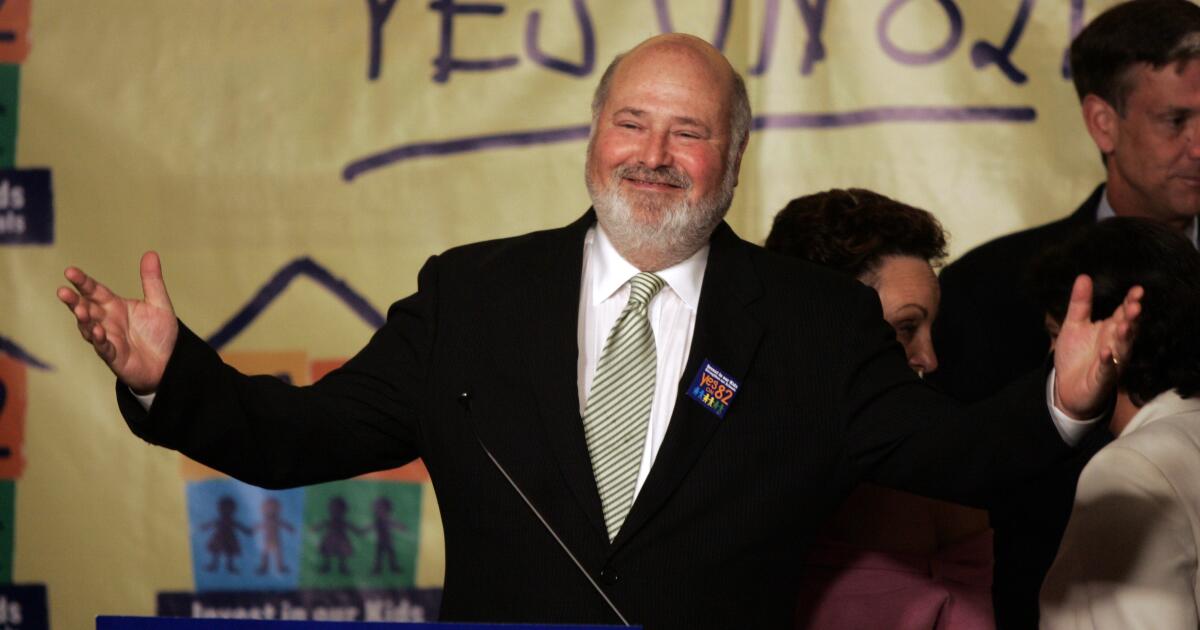
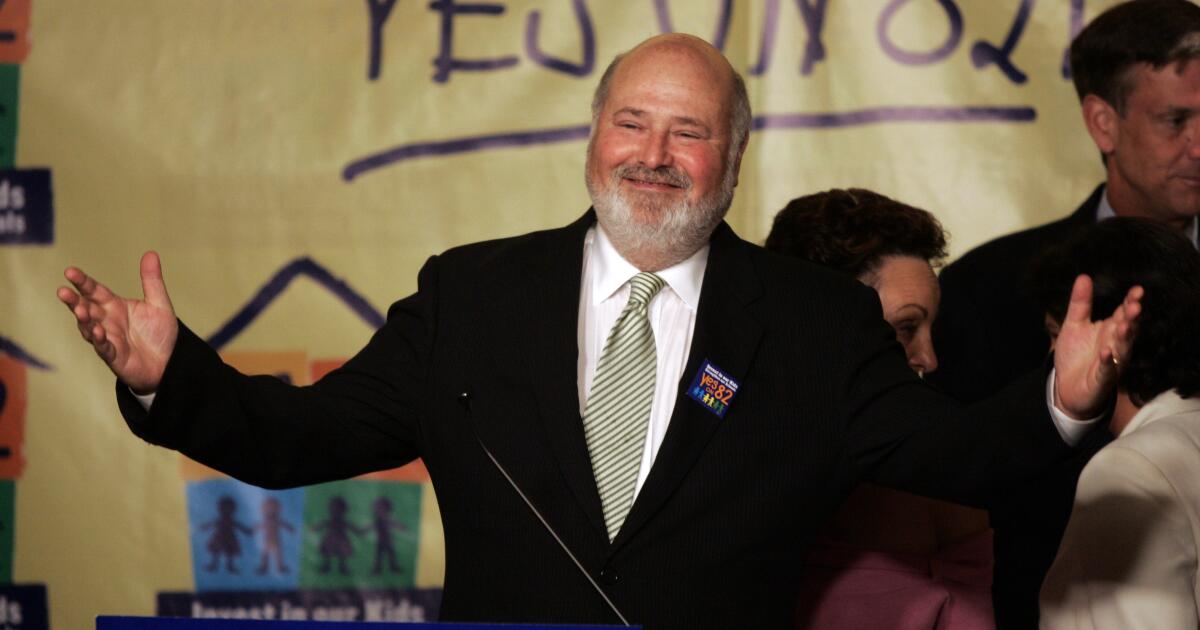
Reiner resigned in 2006 as chairman of California’s First 5 commission, an outgrowth of Prop. 10, after Times reporting raised questions about the use of tax dollars to promote Proposition 82. That Reiner-backed ballot measure would have taxed the rich to plow money into preschool for 4-year-olds.
In 2014, Reiner was at the center of a bid to limit commercial development and chain stores in Malibu, and I co-moderated a debate that seemed more like a boxing match between him and developer Steve Soboroff.
“Rob Reiner and Steve Soboroff came out with guns blazing Sunday night during a Measure R debate that’s sure to be one of the most memorable — and entertaining — Malibu showdowns in recent town history.”
Reiner threw an early jab, accusing Soboroff of a backroom deal to add an exemption to the measure. That’s a lie, Soboroff shot back, claiming he was insulted by the low blow. Reiner, who owned houses in both Brentwood and Malibu, didn’t care much for my question about whether his slow-growth viewpoint smacked of NIMBY-ism.
“I would say there’s a lot of NIMBY-ism,” Reiner snapped. “You bet. It’s 100% NIMBY-ism. Everybody who lives here is concerned about their way of life.”
But that’s the way Reiner was. He let you know, without apology, where he stood, kind of like his “Meathead” character in Norman Lear’s hit TV show “All in the Family,” in which he butted heads with the bigoted Archie Bunker.
Getting back to President Trump, he, too, unapologetically lets you know where he stands.
But most people, in my experience, work with filters — they can self-sensor when that’s what the moment calls for. It’s not a skill, it’s an innate sense of decency and human consideration that exists in the hearts and souls of normal people.
I did not know much about the history of Nick Reiner’s addiction issues and his temporary homelessness. But it became clear shortly after the bodies were found that the Reiners’ 32-year-old son might have been involved, and he was indeed booked a short time later on suspicion of murder.
What I do know is that with such an unspeakable horror, and with the family’s survivors left to sort through the madness of it all, a better response from the president would have been silence.
Anything but a grave dance.
The Reiners died, Trump said, “reportedly due to the anger he caused others through his massive, unyielding, and incurable affliction with a mind crippling disease known as TRUMP DERANGEMENT SYNDROME … .” The deaths occurred, Trump continued, “as the Trump Administration surpassed all goals and expectations of greatness …”
It was a reaction, Austin said, “that makes the case, better than Rob ever could have, about why Trump has no business being president of the United States.”
Hours after Rob Reiner and his wife, Michele, were found dead in their home in what is shaping up to be a heartbreaking family tragedy, our president blamed Reiner for his own death.
“A very sad thing happened last night in Hollywood. Rob Reiner, a tortured and struggling, but once very talented movie director and comedy star, has passed away, together with his wife, Michele, reportedly due to the anger he caused others through his massive, unyielding, and incurable affliction with a mind crippling disease known as TRUMP DERANGEMENT SYNDROME, sometimes referred to as TDS,” President Trump wrote on his social media platform. “He was known to have driven people CRAZY by his raging obsession of President Donald J. Trump, with his obvious paranoia reaching new heights as the Trump Administration surpassed all goals and expectations of greatness, and with the Golden Age of America upon us, perhaps like never before. May Rob and Michele rest in peace!”
Rest in peace, indeed.
It’s a message steeped in cruelty and delusion, unbelievable and despicable even by the low, buried-in-the-dirt bar by which we have collectively come to judge Trump. In a town — and a time — of selfishness and self-serving, Reiner was one of the good guys, always fighting, both through his films and his politics, to make the world kinder and closer. And yes, that meant fighting against Trump and his increasingly erratic and authoritarian rule.
For the last few months, he was laser-focused on the upcoming midterms as the last and best chance of protecting American democracy — which clearly enraged Trump.
“Make no mistake, we have a year before this country becomes a full on autocracy,” Reiner told MSNBC host Ali Velshi in October. “People care about their pocketbook issues, the price of eggs. They care about their healthcare, and they should. Those are the things that directly affect them. But if they lose their democracy, all of these rights, the freedom of speech, the freedom to pray the way you want, the freedom to protest and not go to jail, not be sent out of the country with no due process, all these things will be taken away from them.”
The Reiners’ son, Nick Reiner, has been arrested on suspicion of murder. Nick Reiner has struggled with addiction, and been in and out of rehab. But Trump seems to be saying that if Nick is indeed the perpetrator, he acted for pro-Trump political reasons — which obviously is highly unlikely and, well, just a weird and unhinged thing to claim.
But also, deeply hypocritical.
It was only a few months ago, in September, that Charlie Kirk was killed and Trump and his MAGA regime went nuts over anyone who dared whisper a critical word about Kirk. Trump called it “sick” and “deranged” that anyone could celebrate Kirk’s death, and blamed the “radical left” for violence-inciting rhetoric.
Vice President JD Vance, channeling his inner Scarlett O’Hara, vowed “with God as my witness,” he would use the full power of the state to crack down on political “networks” deemed terrorist. In reality, he’s largely just using the state to target people who oppose Trump out loud.
And just in case you thought maybe, maybe our president somehow really does have the good of all Americans at heart, recall that in speaking of Kirk, Trump said that he had one point of disagreement. Kirk, he claimed, forgave him enemies.
“That’s where I disagreed with Charlie,” Trump said. “I hate my opponent and I don’t want the best for them.”
There’s a malevolence so deep in Trump’s post about Reiner that even Marjorie Taylor Greene objected. She was once Trump’s staunchest supporter before he called her a traitor, empowering his goon squad to terrorize her with death threats.
“This is a family tragedy, not about politics or political enemies,” Greene wrote on social media. “Many families deal with a family member with drug addiction and mental health issues. It’s incredibly difficult and should be met with empathy especially when it ends in murder.”
But Trump has made cruelty the point. His need to dehumanize everyone who opposes him, including Reiner and even Greene, is exactly what Reiner was warning us about.
Because when you allow people to be dehumanized, you stop caring about them — and Reiner was not about to let us stop caring.
He saw the world with an artist’s eye and awarrior’s heart, a mighty combination reflected in his films. He challenged us to believe in true love, to set aside our cynicism, to be both silly and brave, knowing both were crucial to a successful life.
This clarity from a man who commanded not just our attention and our respect, but our hearts, is what drove Trump crazy — and what made Reiner such a powerful threat to him. Republican or Democrat, his movies reminded us of what we hold in common.
But it might be Michael Douglas’ speech in 1995’s “The American President” that is most relevant in this moment. Douglas’ character, President Andrew Shepherd, says that “America is advanced citizenship. You’ve got to want it bad, because it’s going to put up a fight.”
Shepard’s rival, a man pursuing power over purpose, “is interested in two things and two things only — making you afraid of ‘it’ and telling you who’s to blame for ‘it.’ ”
Sound familiar?
That our president felt the need to trash Reiner before his body is even buried would be a badge of honor to Reiner, an acknowledgment that Reiner’s warnings carried weight, and that Reiner was a messenger to be reckoned with.
Reiner knew what advanced citizenship meant, and he wanted badly for democracy to survive.
If Trump’s eulogy sickens you the way it sickens me, then here’s what you can do about it: Vote in November in Reiner’s memory.
Your ballot is the rebuke Trump fears most.
And your vote is the most powerful way to honor a man who dedicated his life to reminding us that bravery is having the audacity to care.
Michele Singer Reiner, who was killed along with her husband, filmmaker Rob Reiner, on Sunday at their home in Los Angeles, was a photographer who moved from still images into filmmaking and later into producing, with work that blended performance, politics and persuasion. She was 70.
Singer Reiner was gigging as a photographer in the late 1980s, visiting film sets as part of her income. One of those sets was “When Harry Met Sally …,” the romantic comedy Rob Reiner was directing in New York, a film that would go on to become one of the era’s defining hits. Having divorced actor and director Penny Marshall eight years earlier, Reiner said he noticed his future wife across the set and was immediately drawn to her.
Scripted by Nora Ephron, the film was originally written to leave its central couple, played by Meg Ryan and Billy Crystal, separate, crossing paths over the years without ending up together. But after meeting Singer Reiner, Reiner reconsidered. He rewrote the final scene so the characters reunite and marry, an ending that helped make the film a beloved classic.
The two married in 1989, months after the film’s release. They went on to have three children: Jake, born in 1991; Nick, born in 1993; and Romy, born in 1997.
Hours after the couple were found dead at their Brentwood home, Nick Reiner — who had struggled for years with substance-abuse issues — was taken into custody and booked into Los Angeles County jail on suspicion of murder, according to jail records. He had spoken publicly about getting sober by 2015, when he worked with his father on “Being Charlie,” a semi-autobiographical film about addiction and recovery that Rob Reiner directed and Nick co-wrote.
After their marriage, Singer Reiner worked on several of Reiner’s films, as a special photographer on “Misery,” his 1990 adaptation of the Stephen King novel, among others. Their marriage also became a working partnership. As Reiner’s career expanded beyond studio films into documentaries and political projects, Singer Reiner — who earlier in her career had photographed the cover of Donald Trump on the photo of his 1987 bestseller “The Art of the Deal” — was closely associated with those efforts, collaborating on films and advocacy campaigns that increasingly overlapped.
Their civic strand emerged early. In the 1990s, she and Reiner started the I Am Your Child project, an effort aimed at raising awareness about early childhood development and expanding access to support services for parents.
The initiative coincided with Reiner’s emergence as one of Hollywood’s most prominent political voices. He was a founding board member of the American Foundation for Equal Rights, which led the legal fight to overturn Proposition 8, the California ballot measure that banned same-sex marriage. He was also a central figure behind Proposition 10, the California Children and Families Initiative, a landmark policy that created an ambitious statewide early childhood development program.
In the last decade, Singer Reiner moved more fully into producing. Her credits included such Reiner-directed projects as “Shock and Awe” (2017), “Albert Brooks: Defending My Life” (2023) and this year’s “Spinal Tap II: The End Continues,” as well as “God & Country,” a 2024 documentary examining Christian nationalism in the United States.
As news of their deaths spread, tributes emphasized the Reiners’ shared public life. Laurie David, an environmental activist and documentary filmmaker who was a close friend of the couple, wrote on Threads that “Rob & Michele — always referred to as Rob & Michele — were an extraordinary couple who worked side by side to make the world a safer, fairer and more just society.”
Former President Bill Clinton and former Secretary of State Hillary Clinton also issued a joint statement calling the couple’s deaths “heartbreaking” and pointing to what they described as the Reiners’ “active citizenship” in defense of “inclusive” democracy. “They were good, generous people who made everyone who knew them better,” the statement said.
Former House Speaker Nancy Pelosi called the loss “devastating,” writing that while Reiner was creative, funny and beloved, Singer Reiner was his “indispensable partner, intellectual resource and loving wife” in all of their endeavors.
Rob Reiner was born into the lineage of comedy thanks to his father, television pioneer Carl Reiner, and he first gained recognition as an actor, including his Emmy-winning role on “All in the Family.” And while there is certainly a streak of humor through almost all of his films, what marks Reiner’s work as a director is his astonishing versatility, able to switch styles from one project to the next with remarkable ease. The run of films that begins with his feature directing debut, 1984’s “This Is Spinal Tap,” on through 1986’s “Stand by Me,” 1987’s “The Princess Bride,” 1989’s “When Harry Met Sally…,” 1990’s “Misery,” 1992’s “A Few Good Men” and 1995’s “The American President” is simply breathtaking for its mastery across the specrum of popular Hollywood moviemaking.
‘This Is Spinal Tap’ (1984)
Harry Shearer, left, Christopher Guest and Michael McKean in the movie “This Is Spinal Tap.”
(Archive Photos / Getty Images)
Though not strictly the first to explore the form, Reiner’s first feature as director more or less cemented the concept of the “mockumentary,” presenting itself as a documentary on the (fictional) rock band Spinal Tap. Reiner appeared onscreen as Marty DiBergi, director of the faux film-within-the-film, forming a neat transition from his career as an actor to director. And while this year’s sequel “Spinal Tap II: The End Continues” was not particularly well received, the legacy of the original, still among the most quotable comedies ever made, remains untouchable. — Mark Olsen
‘The Sure Thing’ (1985)
Made amid the teen sex comedy craze of the 1980s, Reiner’s second film, about two college students sharing a cross-country car trip together, had something special and different about it — namely the performances of John Cusack and Daphne Zuniga, who both brought an openhearted tenderness to a story that might have toppled into cynicism. The emotional earnestness that would often come through in Reiner’s work first emerged here, making what could have been a run-of-the-mill exercise into something more. — M.O.
‘Stand by Me’ (1986)
Wil Wheaton, left, River Phoenix, Jerry O’Connell and Corey Feldman in the movie “Stand by Me.”
(Columbia Pictures)
Based on a novella by Stephen King, “Stand by Me” is about four boys — played by Wil Wheaton, Corey Feldman, Jerry O’Connell and River Phoenix — who find their friendship tested during a particularly eventful Labor Day weekend of 1959. Approaching the story with a mix of dewy nostalgia and incisive clarity, the film earned Reiner the first of three nominations from the Directors Guild of America. — M.O.
‘The Princess Bride’ (1987)
Robin Wright and Cary Elwes in the movie “The Princess Bride.”
(20th Century Fox / Kobal / REX / Shutterstock)
It would be inconceivable to not include “The Princess Bride” in any consideration of Reiner’s best, as the swashbuckling fantasy romance embodies a sense of playful inventiveness and anything-can-happen ethos. An elderly man reads a story to his grandson as the action comes to life in the tale of a farm boy and a princess who are fated to be together, if only they can overcome all manner of trials and challenges. The movie has now enchanted multiple generations of children and adults alike. — M.O.
‘When Harry Met Sally…’ (1989)
Meg Ryan and Billy Crystal in the movie “When Harry Met Sally…”
(Castle Rock Entertainment)
As much as any other movie, “When Harry Met Sally…” (scripted by Nora Ephron) has come to embody the modern romantic comedy with its will they-won’t-they tale of two good friends who come to realize they may also work as something more. Grounded by the charming performances of Meg Ryan and Billy Crystal, as well as a strong supporting cast including Carrie Fisher and Bruno Kirby, the film has a rare warmth. It was Reiner’s mother Estelle who delivered the unforgettable punchline, “I’ll have what she’s having.” — M.O.
‘Misery’ (1990)
Kathy Bates and James Caan in “Misery.”
(Archive Photos / Getty Images)
Reiner named his production company Castle Rock Entertainment in honor of his deep love for Stephen King’s fiction and after making a splash with “Stand by Me,” there was no way he wasn’t going do something scarier as a follow up. (You get a hint in “When Harry Met Sally” — look at the hardcover Crystal is skimming.) King’s captive-author nightmare gets classed up by two knockout performances calibrated in perfect harmony: Kathy Bates’ psycho fan, a turn that earned her an Oscar, and James Caan as the bedbound writer. At the time, Caan was an actor in need of a second chance. Reiner was it. — Joshua Rothkopf
‘A Few Good Men’ (1992)
Jack Nicholson, left, and Tom Cruise in the movie “A Few Good Men.”
(Mondadori Portfolio / Mondadori via Getty Images)
Reiner seemingly conquered yet another movie genre with this tightly wound military courtroom thriller and received his only Academy Award nomination, for best picture. Reiner was also recognized with nominations from the Directors Guild, Producers Guild and Golden Globes for the film. Written by Aaron Sorkin and featuring a cast that includes Tom Cruise and Demi Moore, this has Jack Nicholson’s volcanic delivery of the now-legendary line, “You can’t handle the truth!” — M.O.
‘The American President’ (1995)
Michael Douglas and director Rob Reiner on the set of “The American President.”
(Archive Photos / Getty Images)
A president as a romantic lead? Such things actually happened during the Clinton era. Reiner injects warmth and realism to Sorkin’s swaggering original script, loaded with wonky dialogue and walk-and-talks. But it’s the careful steering of Michael Douglas as a widowed U.S. leader and rising star Annette Bening as an extra-persuasive eco-lobbyist that distinguish this gentle comedy, one that seems positively alien to our current climate. Widely known for his vigilant activism in later years, Reiner’s on-screen politics were no less optimistic. — J.R.
‘Rumor Has It’ (2005)
Jennifer Aniston and Kevin Costner in the movie “Rumor Has It.”
(Melissa Moseley / Warner Bros. Pictures)
Not many would dare to take on a sort-of sequel to a movie as beloved as “The Graduate,” but Reiner brought a casual ease to the tale of a woman, played by Jennifer Aniston, who believes her mother and grandmother were the inspiration for Charles Webb’s original source novel. Though reviews at the time largely savaged the movie, it now seems just the kind of self-assured studio comedy audiences yearn for, buoyed by Shirley MacLaine’s outrageous performance as a woman who may be the real Mrs. Robinson. — M.O.
‘Albert Brooks: Defending My Life’ (2023)
Albert Brooks, left, and Rob Reiner in the documentary “Albert Brooks: Defending My Life.”
(HBO)
Reiner received two Emmy nominations for this documentary tribute to comedian, actor and filmmaker Albert Brooks, a friend of Reiner’s since the two met as teenagers at Beverly Hills High. It’s captured as an expansive conversation with the two sharing a meal in a restaurant. As much as the film is a portrait of Brooks, it also reflects Reiner’s own unique position as someone who knew show business and its ups and downs with a rare intimacy. — M.O.
Rob Reiner, a writer, director, producer, actor and political activist whose career in Hollywood spanned more than six decades and included some of the most iconic titles in movie history, was found dead Sunday with his wife, Michele Singer Reiner, at the home they shared in Brentwood. He was 78.
“It is with profound sorrow that we announce the tragic passing of Michele and Rob Reiner,” a spokesperson for the family said in a statement Sunday. “We are heartbroken by this sudden loss, and we ask for privacy during this unbelievably difficult time.”
Reiner will be remembered as the director of the seminal 1980s rom-com “When Harry Met Sally,” the actor whose character “Meathead” faced off regularly against Archie Bunker, and the political activist who backed early childhood programs in California and railed loudly for years against President Trump.
The oldest child of comedian Carl Reiner and singer Estelle Reiner, Robert Reiner was born March 6, 1947, in the Bronx, N.Y. Raised by a father who won 11 Primetime Emmys and a Grammy in addition to the Mark Twain Prize for American Humor, Rob Reiner attended Beverly Hills High School and studied film at UCLA. He then went to work in Hollywood as an actor and writer before moving on to directing and producing.
Reiner’s writing credits in the 1960s included “The Smothers Brothers Comedy Hour,” “The Glen Campbell Goodtime Hour” and the TV movie “Where the Girls Are.” In the 1970s, he wrote several episodes of “All in the Family” as well as the Primetime Emmy Awards telecast in 1978 and episodes of “The Tonight Show Starring Johnny Carson.”
Reiner married Penny Marshall, star of TV’s “Laverne & Shirley,” in 1971 and adopted Tracy, the daughter Marshall had from a previous marriage. Reiner and Marshall divorced in 1981.
He wrote for the first “Comic Relief,” hosted by Robin Williams, Billy Crystal and Whoopi Goldberg. That and the dozen “Comic Relief” telethons that followed raised awareness and money to fight poverty in the U.S. and elsewhere.
“This Is Spinal Tap” in 1984 further established Reiner’s comedic sensibilities in the American milieu. His work took a dramatic turn when he directed the 1986 adaptation of Stephen King’s novella “Stand by Me,” which starred Wil Wheaton, River Phoenix, Corey Feldman and Jerry O’Connell, but he returned to comedy with 1987’s “The Princess Bride” starring Cary Elwes, Robin Wright and Mandy Patinkin. Also in 1987, he co-founded production company Castle Rock Entertainment.
Then he directed what would emerge as one of the most beloved rom-coms ever — “When Harry Met Sally,” starring Crystal and Meg Ryan.
On the set of the movie he met photographer Michele Singer and the two married in 1989, the year the film came out. They went on to have three children, Jake, Nick and Romy, born in 1991, 1993 and 1997, respectively.
Reiner was finally nominated for a best picture Academy Award in 1994 for “A Few Good Men,” starring Jack Nicholson and Tom Cruise, though the movie lost out that year to Clint Eastwood’s Western “Unforgiven.”
Reiner’s work had sweeping cultural impacts. Three of his movies, “When Harry Met Sally,” “The Princess Bride” and “This is Spinal Tap,” are on the National Film Registry. The phrase “up to eleven,” coined in “This Is Spinal Tap” during an improvised sequence between Reiner and Christopher Guest, is in the Oxford English Dictionary.
“It’s weird that something that we just threw off like that suddenly becomes part of the lexicon of our lives,” Reiner said on NPR’s “Fresh Air” in September. “It’s very strange how these things have taken root.”
In 2015, Reiner was the producer on “Being Charlie,” a drama based on his family’s struggles while son Nick was addicted to hard drugs and rotating in and out of rehabs and homelessness.
“It was very, very hard going through it the first time, with these painful and difficult highs and lows,” Reiner told The Times in 2015. “And then making the movie dredged it all up again.”
Growing up, Reiner balanced conflicting feelings about his relationship with his own father, who was someone he strongly admired. But he also felt as though his father didn’t fully know him. That dichotomy inspired a scene in “Stand by Me” when Gordie declares his father hates him.
“Loving your father and looking up to your father doesn’t necessarily mean you’re feeling that back,” Reiner said on “Fresh Air” in September, recalling how writing that scene made him cry. Reiner, added, however, that he had two “great guides” in his life, his father, who died in 2020, and “All in the Family” creator Norman Lear.
Reiner was a writer on “The 40th Kennedy Center Honors” in 2017, capping a career that included myriad variety show writing credits. “Spinal Tap II: The End Continues,” which he directed, was his final project as a scribe. “Spinal Tap at Stonehenge: The Final Finale,” due out in 2026, was his final directing credit.
Reiner was nominated five times for supporting actor Emmys for his “All in the Family” work, winning in 1974 and 1978. He was up for two Emmys in 2024 for the documentary “Albert Brooks: Defending My Life.”
A staunch liberal, Reiner also emerged as a force in California politics and child welfare and education issues, and campaigned for presidential candidates including former Vice President Al Gore, endorsed former Secretary of State Hillary Clinton for president and spoke up for President Biden’s reelection. Reiner was also an unapologetic critic of President Trump.
He campaigned in California against tobacco use and in 1998 saw the passage of Proposition 10, which called for a tax on tobacco products to be spent on early childhood programs. Reiner became chairman of the First 5 California Children and Families Commission in January 1999. He resigned in March 2006 amid accusations that the commission had used tax money to boost his campaign for the ultimately unsuccessful Proposition 82, which would have raised income taxes on wealthy Californians to pay for preschool for 4-year-olds. An audit later concluded that he and the commission had not violated state law.
“Rob Reiner has always put California’s kids first, and I thank him for the great work he has done over the last seven years,” then-Gov. Arnold Schwarzenegger said in a statement at the time. “Because of Rob’s efforts, California has become a national leader in providing early childhood health and education services for our youngest children and their families.”
Times editor Brittany Levine Beckman contributed to this report.
Rob Reiner was known to millions as a TV actor and film director.
But the Brentwood resident, known for the classic films “Stand by Me” and “When Harry Met Sally,” was also a political force, an outspoken supporter of progressive causes and a Democratic Party activist who went beyond the typical role of celebrities who host glitzy fundraisers.
Reiner was deeply involved in issues that he cared about, such as early childhood education and the legalization of gay marriage.
Reiner, 78, and his wife, Michelle Singer Reiner, were found dead inside his home Sunday, sparking an outpouring of grief from those who worked with him on a variety of causes.
Ace Smith — a veteran Democratic strategist to former Vice President Kamala Harris, Gov. Gavin Newsom, former Gov. Jerry Brown and presidential candidate Hillary Clinton — had known Reiner for decades. Reiner, he said, approached politics differently than most celebrities.
“Here’s this unique human being who really did make the leap between entertainment and politics,” Smith said. “And he really spent the time to understand policy, really, in its true depth, and to make a huge impact in California.”
Reiner was a co-founder of the American Foundation for Equal Rights, the organization that successfully led the fight to overturn Proposition 8, the 2008 ballot measure that banned same-sex marriage. He was active in children’s issues through the years, having led the campaign to pass Proposition 10, the California Children and Families Initiative, which created an ambitious program of early childhood development services.
Proposition 10 was considered landmark policy. Reiner enlisted help in that effort from Steven Spielberg, Robin Williams, and his own father, comedy legend Carl Reiner.
“He wanted to make a difference. And he did, and he did profoundly,” Smith said.
Reiner was also a leading backer of Proposition 82, an unsuccessful measure that would have taxed the wealthy to create universal preschool in California.
Former Los Angeles Mayor Antonio Villaraigosa, who had known Reiner since he was a state lawmaker in the 1990s, worked with him on Proposition 10 and was impressed with how Reiner embraced the cause.
“He was a man with a good answer. It wasn’t politics as much as he was always focused on the humanity among us,” Villaraigosa said. ‘When he got behind an issue, he knew everything about it.”
“Just a really special man. A terrible day,” the former mayor said.
Mayor Karen Bass said in a statement that she was “heartbroken” by the day’s events, saying Reiner “always used his gifts in service of others.”
“Rob Reiner’s contributions reverberate throughout American culture and society, and he has improved countless lives through his creative work and advocacy fighting for social and economic justice,” the mayor said.
“I’m holding all who loved Rob and Michele in my heart,” Bass said.
Newsom added, “Rob was a passionate advocate for children and for civil rights — from taking on Big Tobacco, fighting for marriage equality, to serving as a powerful voice in early education. He made California a better place through his good works.”
“Rob will be remembered for his remarkable filmography and for his extraordinary contribution to humanity,” the governor said.
Los Angeles police are investigating an apparent homicide at the Brentwood home of Rob Reiner, where two people were found dead Sunday afternoon.
The bodies of a 78-year-old man and a 65-year-old woman were found at the home in the 200 block of Chadbourne Avenue, according to Police Capt. Mike Bland.
Law enforcement sources told The Times that a family member was being questioned in connection with the death. .
The sources, who were not authorized to speak publicly about the ongoing investigation, confirmed that there was no sign of forced entry into the home. The names of the victims have not been released.
Margaret Stewart, a Los Angeles Fire Department spokesman, said the department was called to the residence around 3:30 p.m. for medical aid. Inside the home, fire personnel discovered the bodies of the man and woman.
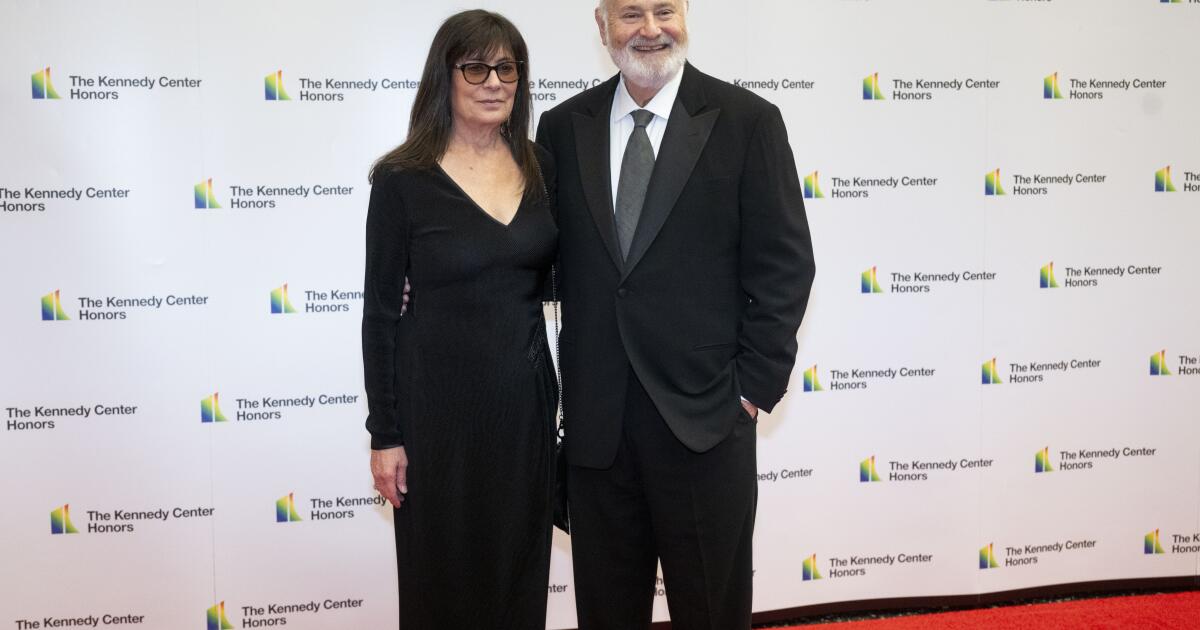
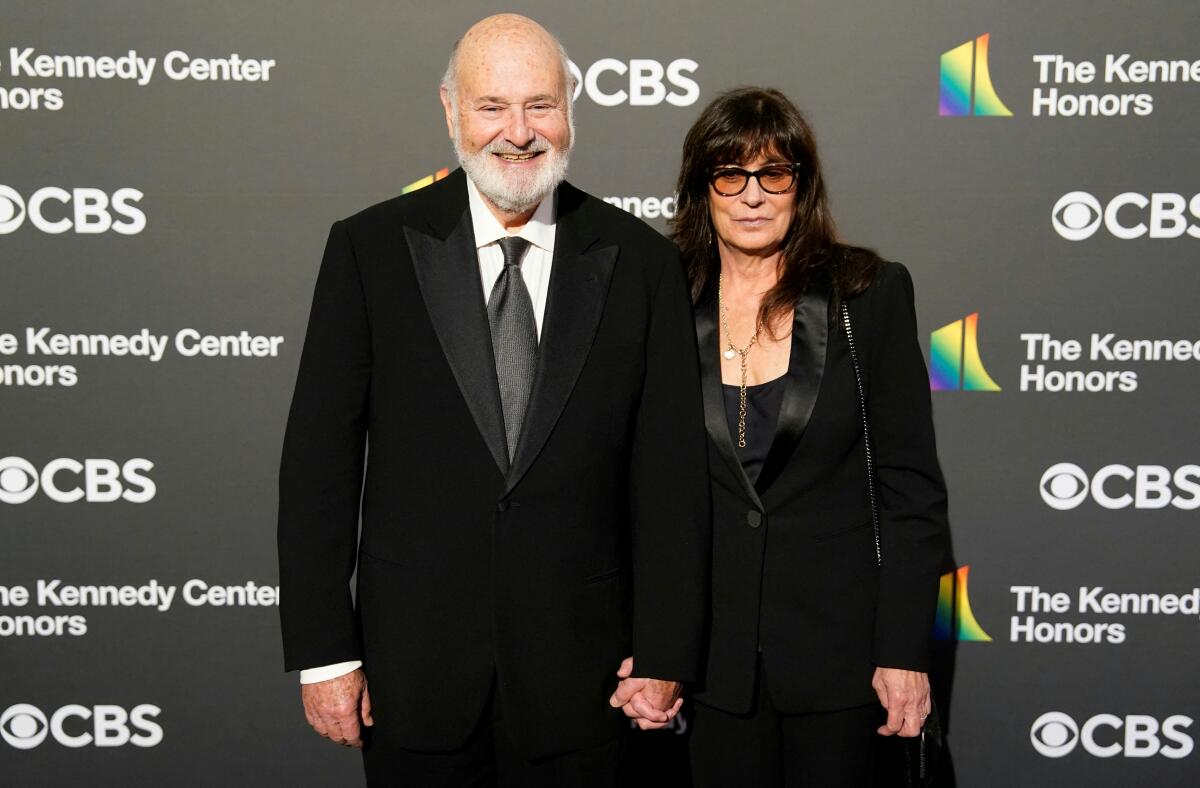
Rob Reiner and wife Michele Reiner attend the 46th Kennedy Center Honors gala at the Kennedy Center for the Performing Arts in Washington in December 2023.
(Kent Nishimulra / AFP via Getty Images)
Reiner, 78, has had a five-decade-long career in Hollywood.
Early in his career, he played Michael “Meathead” Stivic on the iconic sitcom “All in the Family” from 1971 to 1979, alongside Carroll O’Connor as Archie Bunker.
As a director, Reiner helmed a string of hits including “When Harry Met Sally,” “The Princess Bride” and “This Is Spinal Tap.” His work took a dramatic turn when he directed the 1986 adaptation of Steven King’s novella “Stand by Me.”
Reiner was finally nominated for an Academy Award for 1993’s “A Few Good Men,” which starred Jack Nicholson and Tom Cruise, though the movie lost to Clint Eastwood’s western “Unforgiven.”
Reiner also was a leading political voice in Hollywood.
He was a co-founder of the American Foundation for Equal Rights, the organization that led the fight to overturn Proposition 8, which banned same-sex marriage. He’s also been active in children’s issues through the years, having led the campaign to pass Proposition 10, the California Children and Families Initiative, which created an ambitious program of early childhood development services.
Proposition 10 was considered landmark policy. Reiner enlisted help in the effort from Steven Spielberg, Robin Williams, and his own father, comedy legend Carl Reiner.
Reiner was married to Penny Marshall, star of “Laverne & Shirley,” from 1971 to 1981. He met photographer Michele Singer on the set of “When Harry Met Sally” and the two married in 1989, the year the movie came out.
Michele Singer Reiner began producing films over the last decade, including “Shock and Awe,” “Albert Brooks: Defending My Life” and “Spinal Tap II: The End Continues,” all directed by her husband. She also produced “God & Country,” a look at Christian nationalism in the U.S.
By Sunday evening, law enforcement had swarmed Reiner’s sprawling estate in Brentwood, though an eerie quiet hung over Chadbourne Avenue, which had been sealed from the public with yellow crime scene tape.
Police cars were stationed at either ends of the block where the Reiner residence is located while a chopper circled overhead.
Officers spoke to a young man inside of the sealed off area, who left the scene around 7:30 p.m. in a white Tesla and declined to speak to the media.
Councilmember Traci Park, whose Westside district includes Brentwood, said in a statement that the LAPD had increased patrols in the neighborhood “out of an abundance of caution.”
“As we continue to wait for more updates, I want to express my profound concern and sadness at the news coming out of Brentwood,” Park wrote in the statement. “We are in close contact with LAPD as the homicide unit continues their investigation.”
This breaking news story will be updated.
Times staff writer David Zahniser contributed to this report.