To avoid Ned Colletti’s fate, Rob Pelinka has to deliver this offseason
If only. If Rob Pelinka could use the Dodgers’ blueprint to renovate, Lakers fans wouldn’t even be sweating this summer.
But, you know. Baseballs and basketballs, apples and oranges.
The windup and sales pitch are the same, though: Deliver a sustainable, high-rising, championship build. On time and … about that budget. One team has none. The other’s is tight.
In baseball, they wear caps. In the NBA, they’re compelled to stay under them.
In baseball, they can swing freely (for now). In basketball, they’re hamstrung by aprons.
Ned Colletti had it easier, and he lasted only two relatively successful seasons in his role as Dodgers general manager after Mark Walter’s Guggenheim Baseball Management group bought the ballclub in 2012.
Pelinka has it tougher as the Lakers’ general manager and president of basketball operations. But like Colletti before him, with Walter having purchased the majority stake in the Lakers, Pelinka is going to have to crash the hourglass and build a winner with haste. Er, the winner.
If the Lakers lay anything but an 18th brick on their championship foundation in the next couple seasons, Pelinka’s story probably is going to go a lot like Colletti’s.
When free agency opens Tuesday, Pelinka is just going to have to show us how creative he can be, how clever and cunning.
He already hit a grand slam with the Luka Doncic trade in 2025. In one of the NBA’s all-time heists, Pelinka brought the then-25-year-old Slovenian superstar to L.A. from the Dallas Mavericks in exchange for essentially an aging and injury-prone Anthony Davis and just one first-round draft pick.
Before that, Pelinka hit another home run with Austin Reaves; a four-bagger so deep that Doncic’s undrafted backcourt-mate has now procured the proverbial bag. (Four years, $185 million worth of baggage to the Lakers.)
With those pillars cemented, Pelinka’s job is delivering the A-list center Doncic reportedly desires.

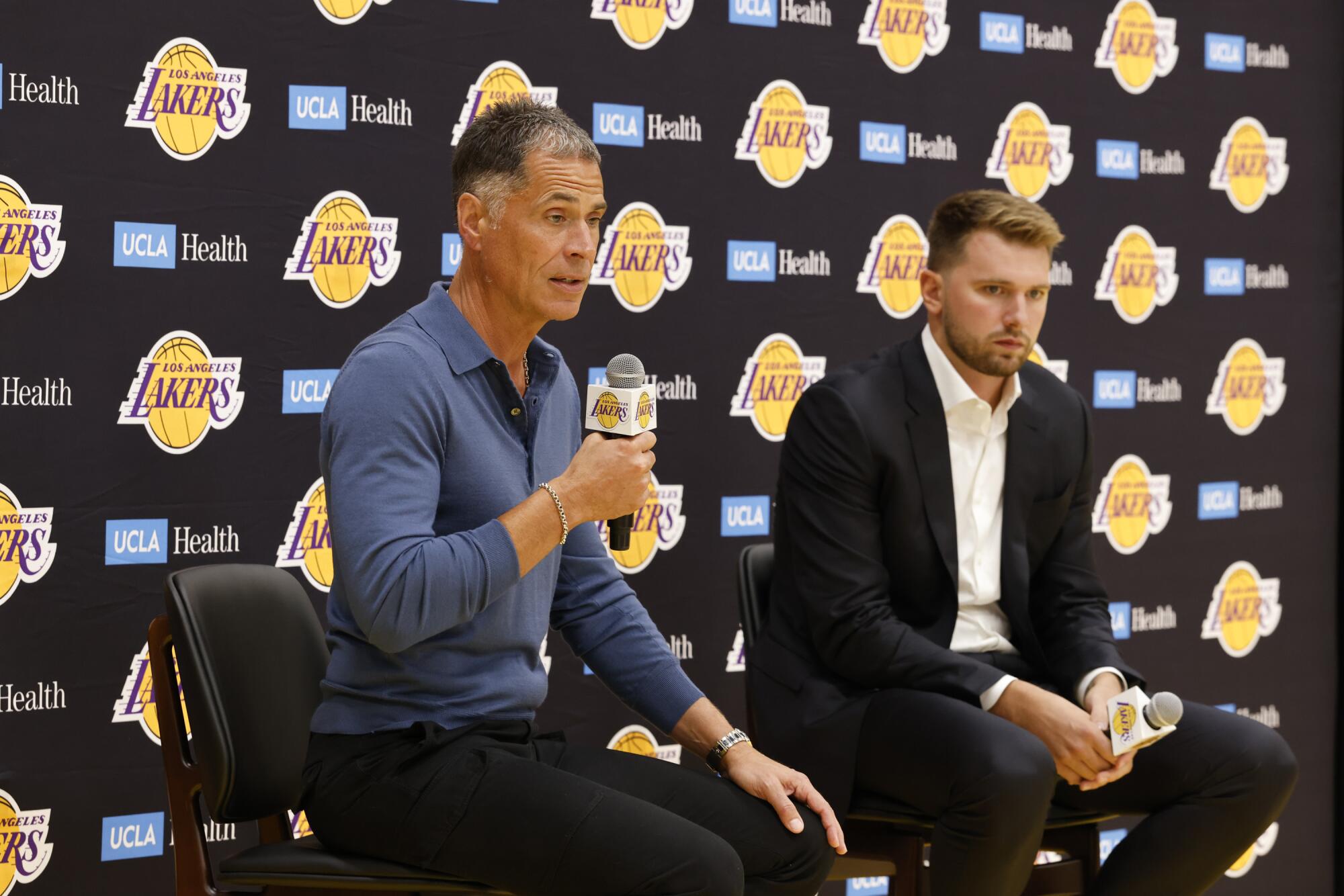
Lakers GM Rob Pelinka pulled off a blockbuster trade to acquire Slovenian superstar Luka Doncic. Can Pelinka build a winner around Doncic?
(Carlin Stiehl / Los Angeles Times)
Doesn’t matter that all the perceivable candidates — from the Utah Jazz’s Walker Kessler to the New York Knicks’ Mitchell Robinson, the Milwaukee Bucks’ Myles Turner, the Detroit Pistons’ Jalen Duren, the Cleveland Cavaliers’ Jarrett Allen, the Mavericks’ Daniel Gafford, even old friend A.D. — sit on a spectrum of unlikely to unwise.
Still, the best plan: Make Doncic happy; make a run at Kessler.
He’s a 24-year-old, defensively adept big man who would be a great pickup, just hard to get. But whether it’s overpaying in restricted free agency or working out a sign-and-trade deal, pry him away from the Jazz.
After nailing down a center, Pelinka also needs to really hit on the margins. Because in the modern NBA, the marginal is major.
The current contenders have depth borne of seasons spent tanking and loading up in the draft on athletic, affordable young talent or, in the case of the recently crowned Knicks, having a leading man take $113 million less than he was eligible for, as Jalen Brunson effectively did, to be able to play with his best buds.
In L.A., the Lakers don’t really have the first option and shouldn’t ever expect the second.
But Pelinka doesn’t have to swing for the fences every time; he doesn’t need to wow us now, he needs to have wowed us later. Take swings like he did trading for Rui Hachimura or netting sharpshooter Luke Kennard.

Former Laker Pau Gasol, right, speaks with GM Rob Pelinka during a Lakers practice in 2025.
(Allen J. Schaben / Los Angeles Times)
No one bats 1.000, of course, not even Andrew Friedman, the architect of the Dodgers’ three World Series titles since taking over as president of baseball operations in 2014.
But for the Lakers’ potential $51 million of cap space, for all of this summer’s much-hyped optionality, Pelinka’s competitive new boss isn’t the type to forgive errors that are forever front of mind for the Lakers’ faithful.
Pelinka can’t strike out on free agent signees like Gabe Vincent and Kendrick Nunn. Can’t let someone like Alex Caruso walk. Can’t whiff on draftees like Dalton Knecht or Jalen Hood-Schifino — and better hope he hasn’t on this year’s selection, Cameron Carr, who fell to the Lakers at No. 24.
The wrinkle, this offseason: Last year’s Lakers — 41-year-old LeBron James, Hachimura, Kennard and, if he opts out, Marcus Smart — will be among the most attractive free agents on the market, and they’re proven fits for a team that reached the second round of the playoffs.
But merely re-signing those guys won’t improve the Lakers’ odds of getting past the Oklahoma City Thunder or San Antonio Spurs in the playoffs.
And simply outspending those teams isn’t an option, either. So Pelinka is going to have to go bargain hunting, he’s got to find some hidden gems, pull some tricks out of his sleeve. Surprise us, like great general managers are supposed to do.
This is Pelinka’s opportunity to show us his blueprint for bringing another title to Los Angeles, to build a case for himself.