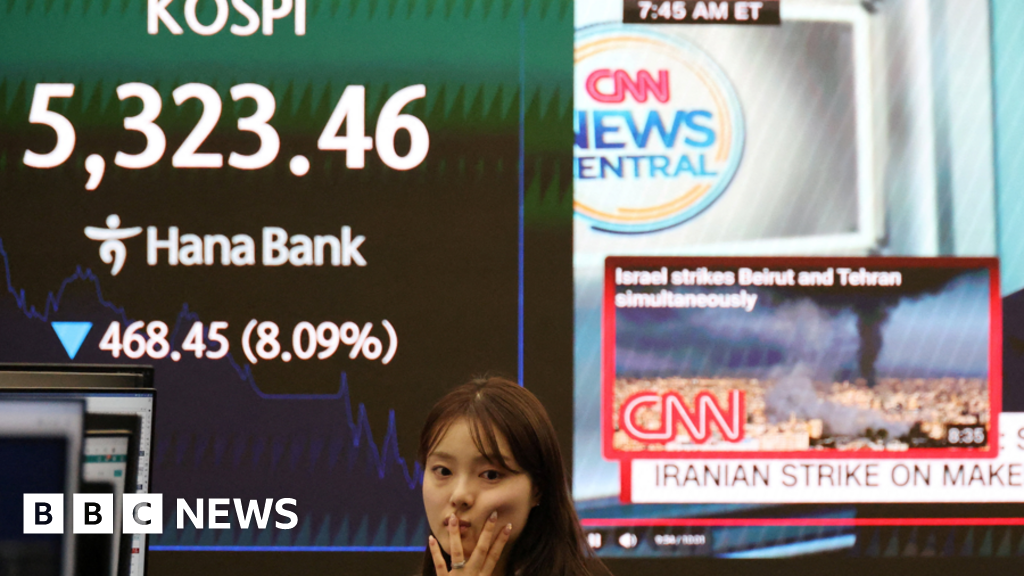
This photo, taken Thursday, shows the trading room of Hana Bank in central Seoul after the benchmark Korea Composite Stock Price Index soared almost 10 percent to close at 5,583.9, snapping a three-session losing streak. Photo by Yonhap
South Korean stocks sharply rebounded on Thursday from the previous session’s sharpest decline ever, soaring almost 10 percent, amid signs of an easing oil price surge sparked by the ongoing Iran conflict. The local currency rose against the U.S. dollar.
The Korea Composite Stock Price Index (KOSPI) added 490.36 points, or 9.63 percent, to close at 5,583.9, snapping the three-session losing streak.
It marked the largest daily gain in terms of points in KOSPI history, renewing the previous record of 338.41 points set on Feb. 3.
Also, the 9.63 percent rise is the second steepest since Oct. 30, 2008, when the index rose 11.95 percent in the midst of the global financial crisis.
The country’s main bourse operator, the Korea Exchange (KRX), issued a buy-side sidecar around opening, suspending the selling of KOSPI futures for five minutes.
Trade volume was heavy at 1.6 billion shares worth 44.8 trillion won (US$30.5 billion), with gainers sharply beating decliners 898 to 21.
Individual investors drove the steep rally, scooping up a net 1.79 trillion won, while foreigners and institutions sold a net 144.6 billion won and 1.7 trillion won, respectively.
“The KOSPI experienced the sharpest decline in history and dropped near the 5,000-point line the previous day,” Roh Dong-gil, an analyst at Shinhan Securities, said. “Bargain hunters returned to the market to pull off a turnaround.”
Overnight on Wall Street, the Dow Jones Industrial Average rose 0.49 percent and the tech-heavy Nasdaq Composite climbed 1.29 percent on calmed oil price hikes.
In Seoul, market heavyweights led the rally.
Market bellwether Samsung Electronics surged 11.27 percent to 191,600 won, and chip giant SK hynix soared 10.84 percent to 941,000 won.
Top carmaker Hyundai Motor escalated 9.38 percent to 548,000 won, and its sister Kia jumped 6.19 percent to 166,400 won.
Defense shares were among the biggest winners as industry leader Hanwha Aerospace vaulted 4.38 percent to 1.38 million won and LIG Nex1 shot up 23.26 percent to 763,000 won.
Shinhan Financial Group rose 4.62 percent to 92,900 won, and internet giant Naver advanced 5.77 percent to 220,000 won.
Samsung Biologics, a leading pharmaceutical firm, mounted 8.64 percent to 1.65 million won, and entertainment giant CJ ENM increased 5.91 percent to 64,500 won.
The Korean won was quoted at 1,468.1 won against the U.S. dollar at 3:30 p.m., up 8.1 won from the previous session.
Bond prices, which move inversely to yields, closed higher. The yield on three-year Treasurys fell 3.4 basis points to 3.189 percent, and the return on the benchmark five-year government bonds declined 3.5 basis points to 3.442 percent.
Copyright (c) Yonhap News Agency prohibits its content from being redistributed or reprinted without consent, and forbids the content from being learned and used by artificial intelligence systems.
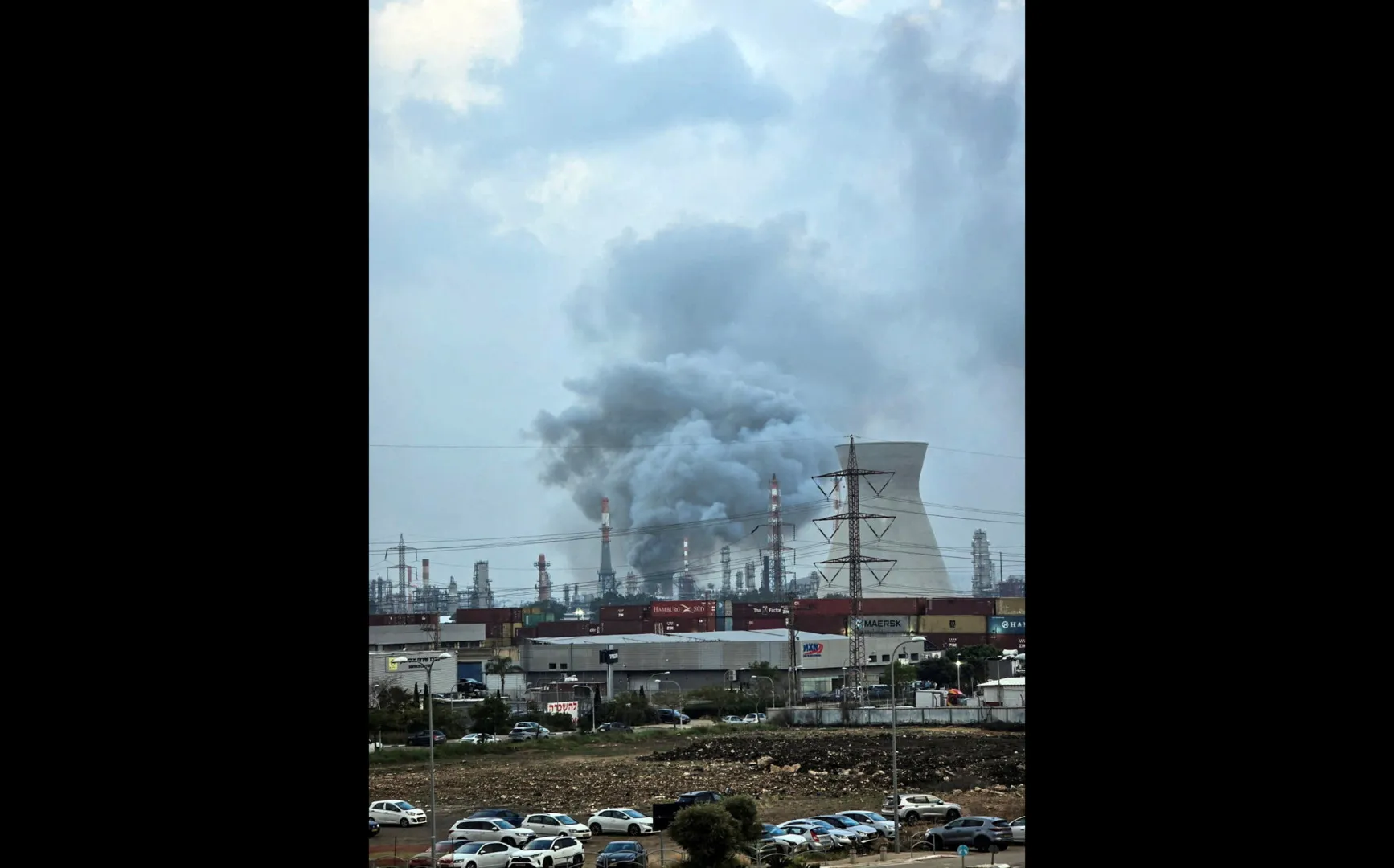
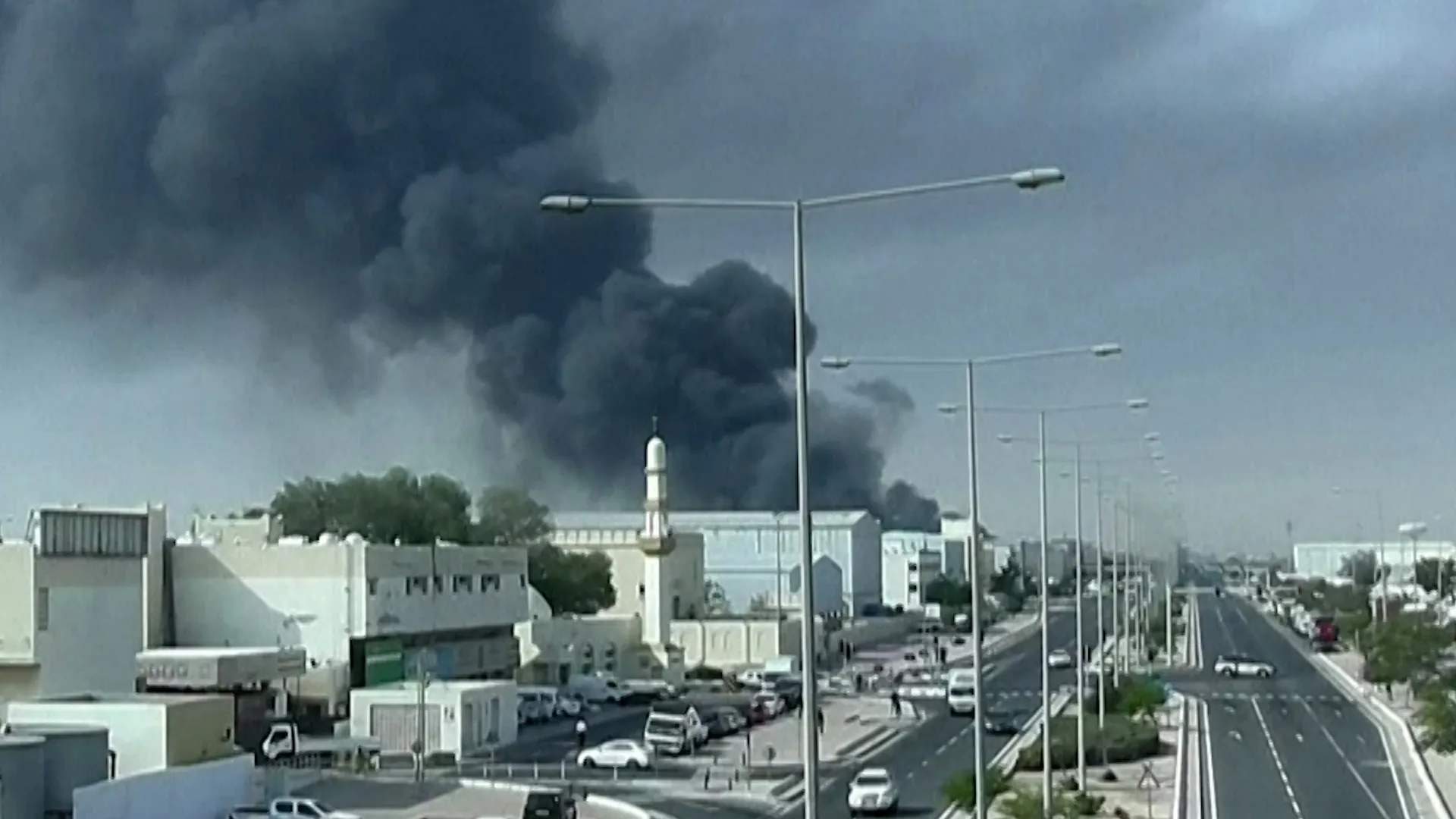
Loud explosions have been heard in Doha, the capital of Qatar, as defence systems shot down incoming Iranian missiles. Falling debris ignited large fire that sent plumes of black smoke rising above the city. Iran has hit multiple Gulf states as it responds to US-Israeli attacks.
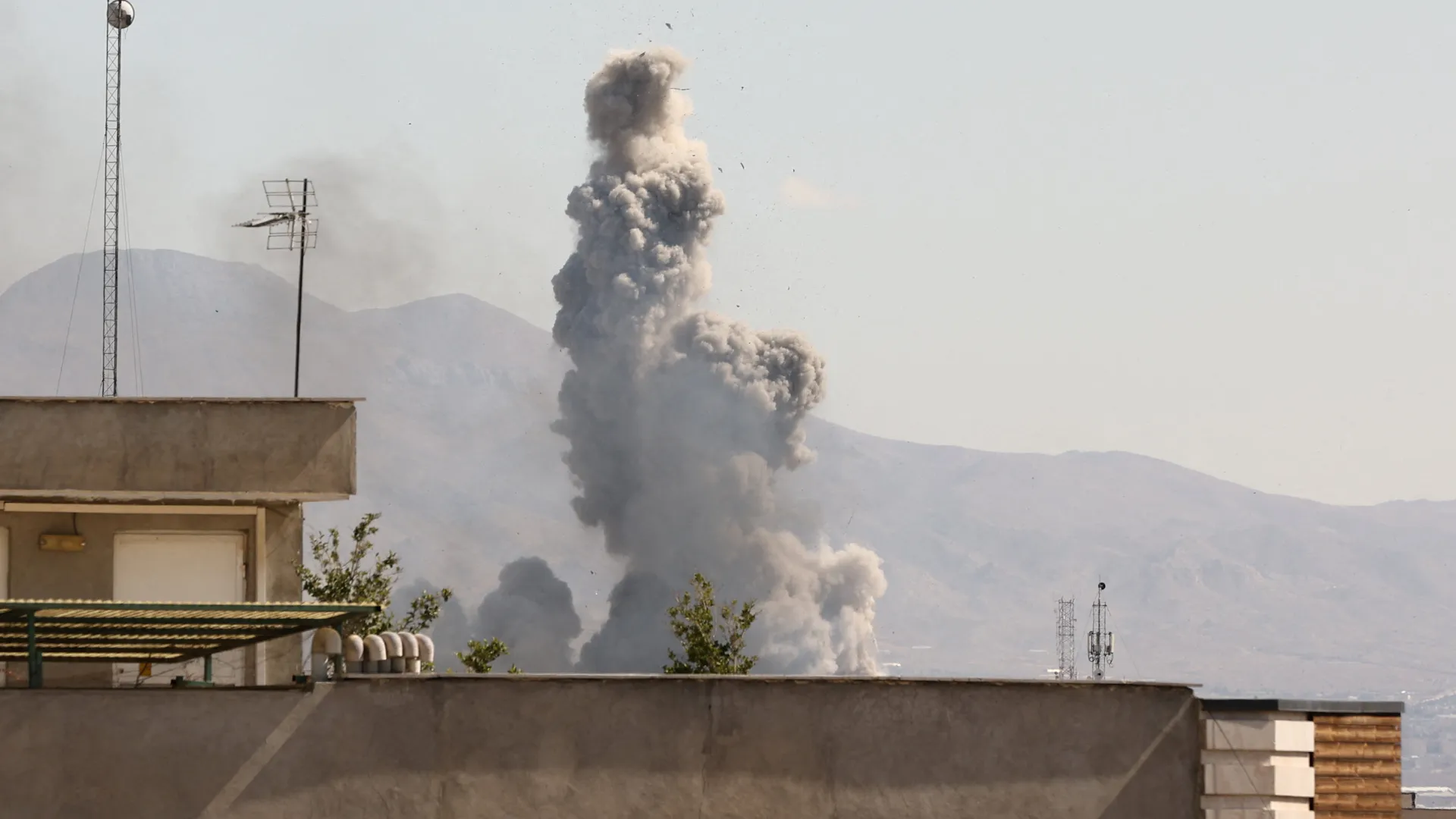
The Israeli Air Force has launched a new wave of attacks on Tehran. Huge plumes of smoke were seen rising about the Iranian capital as multiple targets were hit.
Names marked with an asterisk have been changed to protect identities.
London, United Kingdom – “People here are tired, scared and feel forgotten,” says Nabila*, a Muslim mother of two in Basildon, a town in the English county of Essex.
Recommended Stories
list of 4 itemsend of list
Sitting in her living room with a mug of tea, a Qur’an visible on the bookshelf and Japanese prints hanging to its right, she recalls a string of incidents in recent months: Glass thrown from a residential building at Muslim children, a racist attack on the local mosque where red crosses were daubed across its walls alongside the words “Christ is King” and “This is England”, and reports of drivers accelerating as Muslim women cross the road with their children.
Nabila has been documenting incidents of racism in Essex, her home county [Courtesy of Nabila]
According to the 2021 census, Basildon is 93 percent white, and Muslims make up less than 2 percent of the population. Campaigners have warned that in areas where ethnic minority communities are smaller and more geographically isolated, they face heightened risks, as visibility increases vulnerability.
A single mother working full time, Nabila has been documenting incidents of racism, supporting victims and organising meetings with local authorities.
She said she no longer feels safe in the place she calls home.
After being racially abused while walking through her favourite park, she stopped going there altogether. Women, she said, are increasingly changing their daily routines, constantly watching over their shoulders. Racism now permeates every aspect of their lives, she added.
At a women’s listening circle organised by Nabila in collaboration with the local authority at the Wat Tyler Centre, another Muslim woman, Zarka*, spoke about her experiences as a young mother in Basildon who wears the hijab.
After being told to “take that rag off your head” during the school run by a passer-by, she stopped taking her children to school for two weeks. Beyond verbal abuse, she described the cumulative effect of everyday hostility, from cars failing to stop at zebra crossings and hostile looks from passersby.
‘I can’t do this any more, Mum.’
Hundreds of miles north, similar experiences are unfolding in Scottish classrooms.
Etka Marwaha’s daughter Anisa was seven when she first experienced racist taunting at her primary school in Glasgow.
Marwaha said Anisa became quiet and withdrawn. She was isolated on the playground and subjected to racial slurs. Months later, she broke down in tears in front of her mother, explaining the abuse she had suffered.
On multiple occasions, Marwaha contacted the school, urging them to take action, even offering her own support on understanding racism. But, she said, they failed in their duty of care, and the extent of the problem was kept hidden.
It went on for two years before Etka felt compelled to take her daughter out of the school.
“The plan was never to move her into a different school,” she told Al Jazeera. “But she was refusing to go to school; she would come home very, very upset. She was isolated.
“She was in tears, saying, “I can’t do this any more, Mum.’ So she made the decision, at that young age, that ‘I want to get out of here.’”
The girl’s new school is not in the catchment area, nor is there a direct bus to it, causing further inconvenience. But it has a zero-tolerance approach to racism, and Anisa is happier.
At her new school, Anisa can speak about her experiences of racism and how it made her feel.
The ordeal brought back painful memories for Marwaha’s own experiences at school.
“The racist bullying, for me, started at secondary school. You’d think times have changed, that people have been educated, but I think things have changed for the worse when a seven-year-old can openly make a racist comment and that’s accepted by society, and parents don’t address it.”
Sam*, a doctor in northwest Scotland with dual heritage children, said he has been surprised by the level of racism in local schools.
“There has been a clear normalising of racist jokes and name-calling. Every one of our kids has been affected,” he said. “Perhaps the biggest surprise is how few other students stand up against racism. When I was growing up, if someone was racist, they would be the person being socially excluded. Now, silence. It has forced us to look at moving out of the UK.”
‘Racism is out of control’
In the latest incident of alleged and potentially dangerous racism, a man walked into Manchester Central Mosque on Tuesday, reportedly with an axe and weapons. The man was arrested. There had been 2,000 worshippers in the mosque at the time, for the evening tarawih prayers during Ramadan.
Official figures underline the scale of the problem.
In October 2025, the UK Home Office revealed that the number of hate crimes recorded by police in England and Wales had risen for the first time in three years, including increases in racially and religiously motivated offences.
Religious hate crimes against Muslims rose by 19 percent, with a spike following the Southport murders and subsequent riots in mid-2025, the Home Office said.
The rise comes as hard-right politicians and activists, such as Reform leader Nigel Farage and the Islamophobic activist Tommy Robinson, rail against immigration. According to recent YouGov polling, if a general election were held tomorrow, Reform would lead with 24 percent.
Shabna Begum, head of Runnymede Trust, a race equality think tank, said, “Mainstream political and media actors have played in normalising and enabling racist narratives that have scapegoated migrants, people seeking asylum, Muslims and people of colour generally.”
In a report released last year, How Racism Affects Health, Runnymede highlighted the hypervigilance that people of colour have to operate with in order to guard their safety, and which causes long-term physiological damage, affecting life expectancy and mental health outcomes.
“For those that live in more disparate communities where they show up as minorities in a more visible way, that sense of threat is acute,” said Begum.
School suspensions for racist incidents have more than doubled in recent years, according to UK Department for Education data.
“Children as young as four are being sent home for racist behaviour,” Begum said. “This shows a society where racism is out of control, and that our school systems are failing to deal with the problem.
“They are making calculated decisions about where they will go, what travel routes they will take; withdrawing from regular social and community activities because they can no longer trust that those spaces will be safe for them.”
Bodies of five asylum seekers wash ashore in Libya as three others die in a separate incident off the coast of Greece.
Police in Libya have recovered the bodies of five asylum seekers that washed ashore near the capital, Tripoli, as authorities in Greece announced the deaths of three others in a separate incident off the coast of Crete.
The bodies in Libya were found on Saturday by residents of the coastal town of Qasr al-Akhyar, according to a police officer.
Recommended Stories
list of 4 itemsend of list
Hassan Al-Ghawil, head of investigations at the Qasr Al-Akhyar police station, told the Reuters news agency that the bodies were all of dark-skinned people. Two of them were women.
He said people in the area had reported seeing a child’s body wash ashore before the waves returned it to sea.
“We reported to the Red Crescent to recover the bodies,” said Ghawil. “The bodies we found are still intact, and we think there are more bodies to wash ashore.”
The tragedy came weeks after the International Organization for Migration said some fifty-three migrants, including two babies, were dead or missing after a rubber boat carrying 55 people capsized off the coast of Zuwara town in western Tripoli.
It also came as Greek authorities were responding to a separate incident in the eastern Mediterranean.
The Athens News Agency reported on Saturday that authorities had recovered three bodies and rescued at least 20 people after a wooden boat carrying migrants and asylum seekers capsized off the coast of Crete.
Most of the survivors were Egyptians and Sudanese people, the agency reported. They also included four minors.
According to the Greek public broadcaster ERT, the wooden boat capsized when passengers were trying to climb up the ladders during a rescue effort involving a commercial ship.
The search for survivors was continuing with four patrol boats, an aircraft, and two ships from the European border agency Frontex, a spokesperson for the Greek coastguard told the AFP news agency.
According to ERT, survivors said about 50 people had been on board the wooden boat.
A second boat carrying about 40 migrants and asylum seekers was spotted in the area, leading to another rescue operation.
Thousands of people attempt the perilous crossing from Libya to Europe over the Mediterranean every year. Libya has become a transit route for people fleeing conflict and poverty to Europe since the fall in 2011 of longtime ruler Muammar Gaddafi.
Last week, a UN report said migrants in Libya, including young girls, are at risk of being killed, tortured, raped or put into domestic slavery, and called for a moratorium on the return of migrant boats to the country until human rights are ensured.
Many of the migrants and asylum seekers departing Libya seek to arrive in Crete, the gateway to the EU.
According to the United Nations High Commissioner for Refugees (UNHCR), more than 16,770 people seeking asylum in Europe arrived in Crete in 2025.
Faced with the surge in arrivals, the conservative Greek government suspended the processing of asylum applications for three months last summer, particularly for those arriving from Libya.
The UNHCR says 107 people died or went missing in Greek waters in 2025.
South Korean President Lee Jae-myung speaks during the National Startup Era Strategy Meeting to discuss strategies to nurture startups at the main building of the Cheong Wa Dae presidential office in Seoul, South Korea, 30 January 2026. File. Photo by YONHAP / EPA
Feb. 13 (Asia Today) — South Korean President Lee Jae-myung’s approval rating rose 5 percentage points from the previous week to 63%, marking his highest level this year, according to a poll released Thursday by Gallup Korea.
The survey of 1,003 adults nationwide, conducted Monday through Wednesday, found that 63% of respondents said Lee was “doing well” in handling state affairs.
Those who said he was “doing poorly” fell 3 percentage points to 26%, while 11% said they had no opinion.
Among reasons for positive evaluations, “economy and people’s livelihoods” ranked highest at 16%, followed by “real estate policy” at 11% and “foreign affairs” at 10%.
For negative evaluations, “real estate policy” and “economy and people’s livelihoods” were each cited by 15% of respondents. “Foreign affairs” accounted for 9%, while 7% cited concerns about “authoritarian leadership.”
Regionally, approval was highest in Gwangju and South Jeolla Province at 81%, followed by Daejeon, Sejong and South Chungcheong Province at 69%. Support stood at 63% in Busan, Ulsan and South Gyeongsang Province, 62% in Incheon and Gyeonggi Province and 58% in Seoul. Daegu and North Gyeongsang Province recorded the lowest approval at 49%.
By age group, support was strongest among respondents in their 40s at 75%, followed by those in their 50s at 70%, 30s at 66% and 60s at 65%. Approval among those 70 and older was 57%, while respondents ages 18 to 29 showed the lowest support at 39%.
Support for the Democratic Party rose 3 percentage points from the previous week to 44%, while backing for the People Power Party fell 3 percentage points to 22%.
The poll was conducted via telephone interviews using randomly selected mobile virtual numbers. It had a margin of error of plus or minus 3.1 percentage points at a 95% confidence level. The contact rate was 40.4% and the response rate was 13.3%.