Turkish student who criticized Israel can resume research at Tufts after visa revoked, judge rules
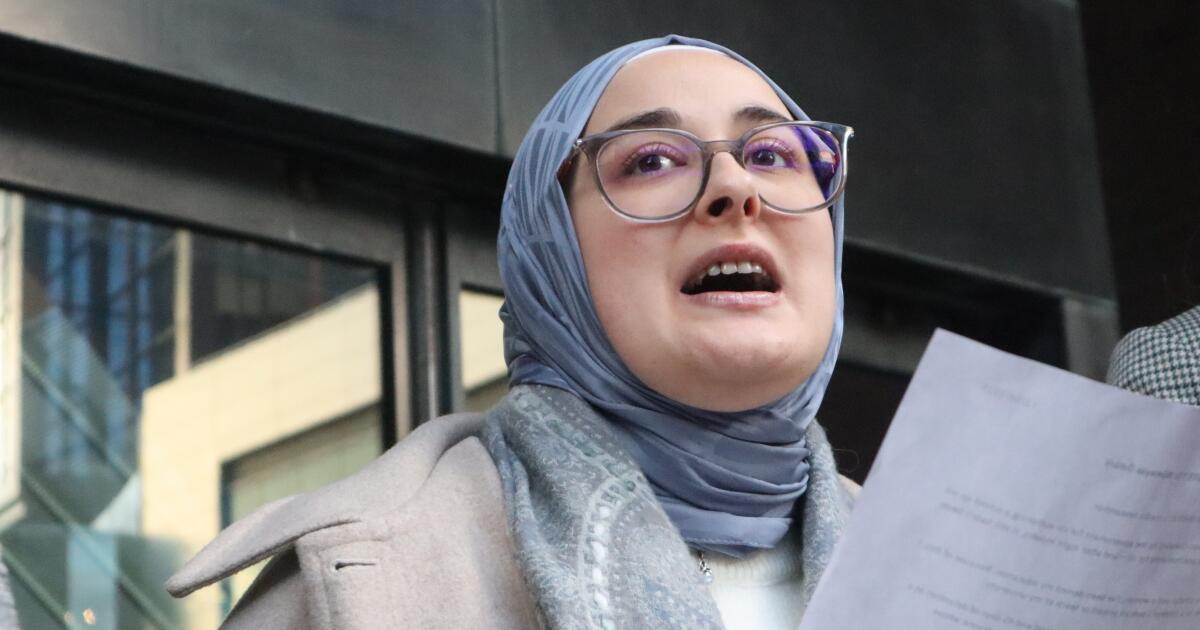
BOSTON — A federal judge has allowed a Tufts University student from Turkey to resume research and teaching while she deals with the consequences of having her visa revoked by the Trump administration, leading to six weeks of detention.
The arrest of Rümeysa Öztürk, a doctoral student studying children’s relationship to social media, was among the first as the Trump administration began targeting foreign-born students and activists involved in pro-Palestinian advocacy. She had co-authored an op-ed criticizing her university’s response to Israel and the war in Gaza. Caught on video in March outside her Somerville residence, immigration enforcement officers took her away in an unmarked vehicle.
Öztürk has been out of a Louisiana immigrant detention center since May and back on the Tufts campus. But she’s been unable to teach or participate in research as part of her studies because of the termination of her record in the government’s database of foreign students studying temporarily in the United States.
In her ruling Monday, Chief U.S. District Judge Denise J. Casper wrote that Öztürk is likely to succeed on claims that the termination was “arbitrary and capricious, contrary to law and in violation of the First Amendment.”
Government argued that termination was legal
The government’s lawyers unsuccessfully argued that the Boston federal court lacked jurisdiction and that Öztürk’s Student and Exchange Visitor Information System record, or SEVIS record, was terminated legally after her visa was revoked, making her eligible for removal proceedings.
“There’s no statute or regulation that’s been violated by the termination of the SEVIS record in this case,” Assistant U.S. Atty. Mark Sauter said during a hearing last week. The Associated Press sent an email Tuesday seeking comment from Sauter on whether the government plans to appeal.
In a statement, Öztürk, who plans to graduate next year, said while she is grateful for the court’s decision, she feels “a great deal of grief” for the education she has been “arbitrarily denied as a scholar and a woman in my final year of doctoral studies.”
“I hope one day we can create a world where everyone uses education to learn, connect, civically engage and benefit others — rather than criminalize and punish those whose opinions differ from our own,” said Öztürk, who is still challenging her arrest and detention.
The then-30-year-old was one of four students who wrote the opinion piece in the campus newspaper. It criticized the university’s response to student activists demanding that Tufts “acknowledge the Palestinian genocide,” disclose its investments and divest from companies with ties to Israel.
Öztürk, who is Muslim, was meeting friends in March for iftar, a meal that breaks a fast at sunset during the month of Ramadan, according to her lawyer, Mahsa Khanbabai. Her student visa had been revoked several days earlier, but she was not informed of that, her lawyers said. The government asserted that terminating her SEVIS record two hours after her arrest was a proper way of informing Tufts University about her visa revocation.
A State Department memo said Öztürk’s visa was revoked following an assessment that her actions “‘may undermine U.S. foreign policy by creating a hostile environment for Jewish students and indicating support for a designated terrorist organization’ including co-authoring an op-ed that found common cause with an organization that was later temporarily banned from campus.”
Öztürk running out of time to pursue teaching, research goals
Without her SEVIS status reinstated, Öztürk said she couldn’t qualify as a paid research assistant and couldn’t fully reintegrate into academic life at Tufts.
“We have a strange kind of legal gaslighting here, where the government claims it’s just a tinkering in a database, but this is really something that has a daily impact on Ms. Öztürk’s life,” her attorney, Adriana Lafaille of the American Civil Liberties Union of Massachusetts, said in court.
“We are running out of time to make this right. Each day that goes by is a day that she is being prevented from doing the work that she loves in the graduate program that she came here to be part of. Each day that this happens is a day that the government is allowed to continue to punish her for her protected speech.”
Öztürk, meanwhile, has maintained a full course load and fulfilled all requirements to maintain her lawful student status, which the government hasn’t terminated, her lawyer said.
Record created to collect information on international students
SEVIS is mandated by Congress in the Illegal Immigration Reform and Immigrant Responsibility Act of 1996 and administered by the director of Immigration and Customs Enforcement “to collect information relating to nonimmigrant foreign students” and “use such information to carry out the enforcement functions of” ICE.
According to the U.S. Department of Homeland Security, when a SEVIS record is terminated, a student loses all on- and off-campus employment authorization and allows ICE agents to investigate to “confirm the departure of the student.”
Willingham and McCormack write for the Associated Press. McCormack reported from Concord, N.H.