Sherrie Hewson has reunited with Tony Maudsley almost a decade after they finished filming Benidorm and fans have been quick to demand a reboot of the sunny sitcom
23:02, 27 Sep 2026Updated 23:06, 27 Sep 2026
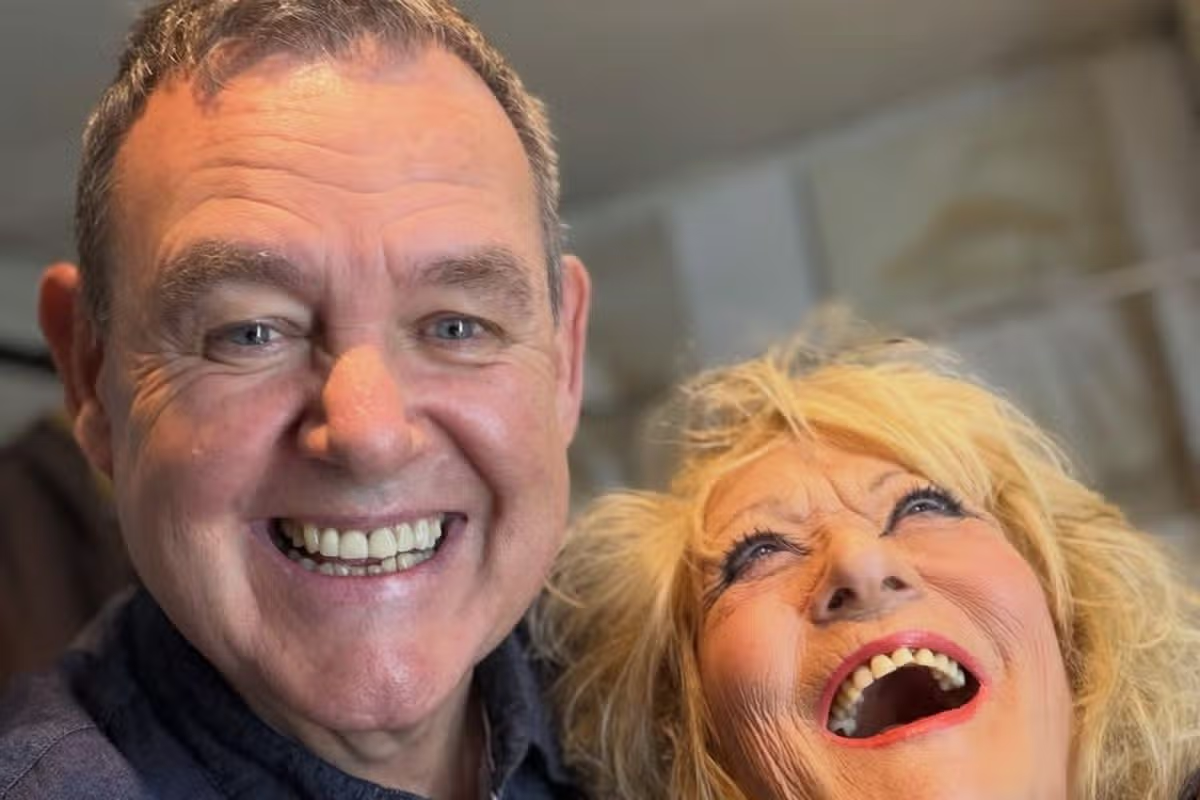
Sherrie Hewson has reunited with Benidorm co-star Tony Maudsley(Image: Instagram/tonymaudsley1)
Sherrie Hewson has reunited with Tony Maudsley almost a decade after they finished filming Benidorm. The actress, 76, played hotelier Joyce Temple-Savage on the sunny sitcom, which came to an end in 2018 after 10 series.
Tony starred as hairdresser Kenneth Du Beke, and took to social media to share a snap of himself and his former co-star Sherrie both enjoying their time together over the weekend,
He wrote on Instagram: “Back with my old sparring partner, Joyce Temple Savage. Had the best time reliving our Benidorm days.” In a second post, he wrote: “Laughs a-plenty with Dame Sherrie Hewson.”
Sherrie, who replaced Crissy Rock in the role of the hotel boss after series four, became a household name through her role as Maureen Holdsworth on Coronation Street in the 1990s and now Tony, 58, stars as George Shuttleworth on the ITV soap.
The post instantly caused a stir amongst fans of the show, and several of them rushed to the comments section to beg for a reunion.
One said: “Am still watching and loving the reruns,” and another wrote: “We need a Christmas special,” and a third wrote: “Will it be on TV again??”
A fourth said: “These two were the best in Benidorm … wish it was brought back to give us all some genuine comedy,” and a fifth wrote: “We need a petition up to bring it back ! @tonymaudsley1 you were both amazing in Benidorm. I watch it most nights. How did you walked in them tight shorts all day.”
She said: “In the difficult world we’re living in now… as soon as that music comes, it softens their world, and they feel so much better. And they laugh and laugh. Wouldn’t it be great as a film? The Benidorm film! A 2.5 hour film, wouldn’t that be fabulous?
Benidorm, created by The Catherine Tate Show star Derren Litten, first aired from 2007 until 2018 on ITV and focused on a group of holidaymakers at the Solana resort. Over the years, the cast featured a stellar lineup of names from the acting world.
For the first six series, Siobhan Finneran and Steve Pemberton played a couple who holidayed with their children alongside Sheila Reid as the cantankerous Madge Harvey. The programme was filled with several other fan favourites including swingers Donald (Kenny Ireland) and Jacqueline Stewart (Janine Duvitski), quiz enthusiast Geoff Maltby (Johnny Vegas) and barman Mateo Castellanos (Jake Canuso).
In 2023, show creator Litten revealed he had ideas for countless new episodes – and sent fans into a tailspin during an online Q&A. Taking to X, one fan asked the screenwriter: “Would be great to see new episodes…
“Derren Litten surely living in Benners you have plenty of stories you could pen.” Derren responded: “I don’t live in Benidorm but I live fairly close by.”
He then went on to tease: “I have more stories for another 74 episodes; if ITV wants them, they know where I am!” Benidorm fans were quick to react to his message – and began begging him, ITV and even Netflix to make his suggestion become a reality.”
José Rivera’s “Marisol” came out around the same time as Tony Kushner’s “Angels in America,” and both plays, vibrating with millennial anxieties, carry the earthly battle for human survival up to the heavens.
There’s a dramatically prominent Angel (Taylor Scott) as well in Rivera’s drama, now in an Open Fist Theater Company revival at Atwater Village Theatre. This celestial warrior has been protecting Marisol (Jade Santana) without her knowing it throughout her life. Marisol, referred to by a publishing colleague as “Miss Puerto Rican Yuppy Princess of the Universe,” still lives in the Bronx and is assailed by dangers just getting to and from work every day.
After an incident on the subway with a deranged man threatening her with a golf club, Marisol returns to her cramped, noisy apartment to learn that her guardian angel is abandoning her to enlist in the battle to replace a senile God, who (to judge by the ailing state of the universe) has grown too old for the job.
Jack Sharpe and Jade Santana in ‘Marisol’ at Open Fist.
(John Dlugolecki)
Marisol will have to fend for herself in New York, a dystopian landscape where crime is rampant, poverty is pervasive and the unhoused are threatened by roving gangs of Nazi skinheads who set them on fire for kicks.
What follows is a modern picaresque journey, in which a clever underdog has to rely on her wit and wiles to survive a corrupt and perilous world. Rivera’s play, which won an Obie Award, caught fire in its 1993 New York premiere at the Public Theater with its theatrical street sense, savage imagery and Puerto Rican-inflected magical realism.
The apocalyptic fears boiling up in the play are perhaps even more acutely felt today, with the ravages of climate change compounding each year and the threat of AI hanging an existential cloud over our heads.
But what’s most satisfying about this reencounter with “Marisol” is seeing a new generation embrace the play’s kinetic freedom. Rivera, who received an Oscar nomination for his adapted screenplay for the 2004 film “The Motorcycle Diaries,” solidified his reputation with this play after his breakthrough work “The House of Ramón Iglesia.”
Director Amanda Weier and her company approach “Marisol” as though it were a new play. The quicksilver changes of scene in this urban hellscape are handled with crisp dispatch. Subway cars and burned-out streets don’t require much in the way of elaborate illustration for the overhang of menace to be felt.
Occasionally, particularly in the early going, the blocking and Christopher Moscatiello’s sound design seemed to be working at cross-purposes. The production’s adventurousness, traversing every corner of Brad Bentz’s scenic design, can have a diffuse effect.
But the clever props design (Bruce Dickinson and Anna Krause) fills in any shoestring gaps. And Mylette Nora’s costumes artfully conjure both the underworld and the spiritual realm.
Jade Santana and Hutchins Foster in ‘Marisol’ at Open Fist.
(John Dlugolecki)
Santana’s Marisol, likable yet spiky, anchors the revival. Her interactions with the golf club maniac (Matthew Goodrich) and the scarred homeless man (Hutchins Foster) are fearfully intense, as they should be.
Grace Soens, who plays June, Marisol’s confederate at work, and Jack Sharpe, who takes on the role of Lenny, June’s mentally disturbed brother, expand this unstable world, where it’s hard to know who to trust.
“Marisol” is rife with ambiguity. One of the biggest questions is whether Marisol is dead or alive. But the surreal reality extends to the map of New York. Marisol can no longer tell if she is heading north or south. And the number of characters wielding golf clubs as deadly weapons raises the concern that the villains are interchangeable — and that the good guys have all fled.
One thing that’s certain is that Marisol will have to take up the fight for her own future. With no one left to protect her, she’s learning to look after herself and those she cares about. To become, in other words, the hero that’s needed to turn this momentous struggle around.
‘Marisol’
Where: Atwater Village Theatre, 3269 Casitas Ave, L.A.
When: 8 p.m. Fridays-Saturdays, 4 p.m. Sundays. (Check for exceptions and additions.) Ends Oct. 24
DAMASCUS: Syria’s civil aviation sector is moving beyond the restoration of suspended international routes toward a broader rebuilding of its air transport network, with foreign airlines returning, regional airports reopening and projects underway to expand capacity and connectivity.
After years of disruption and limited international services, Arab, regional and European carriers have gradually restored flights to Syria, initially through Damascus and Aleppo international airports. The recovery has since extended eastward, with Deir Ezzor International Airport returning to service and Qamishli International Airport nearing reopening.
Air traffic through Syrian airspace has also increased sharply, while airport expansion projects and new aviation ventures point to a wider revival of the sector.
International airlines return
One of the early signs of recovery came in March 2025, when Aleppo International Airport reopened after rehabilitation work. Royal Jordanian operated a test flight to the airport on March 23 to assess security and safety ahead of resuming regular services following a 14-year interruption.
European carriers followed. Romania’s Dan Air resumed flights to Syria on June 15, while Air Mediterranean operated a flight to Damascus from Austria and Greece on June 30.
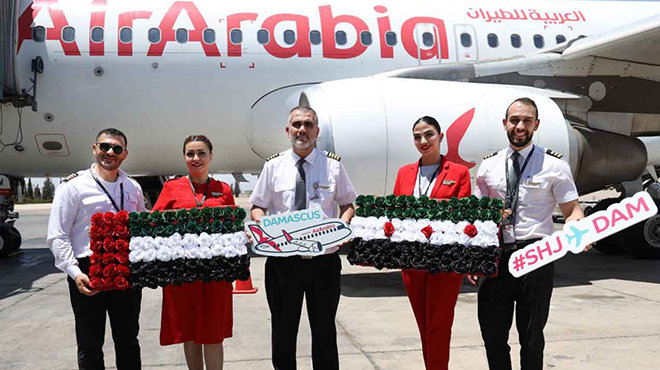
Gulf carriers also restored connections. Air Arabia returned to Damascus from Sharjah on July 10, followed six days later by Emirates, which resumed flights after a 13-year interruption.
Air Arabia became the first of Gulf carriers that had restored connections to Syria on July 10. Emirates resumed flights six days later. (SANA)
The first Emirates flight carried 286 passengers, including UAE Minister of Sports Ahmad Belhoul Al Falasi. The carrier announced three weekly Damascus-Dubai services, restoring a route that had carried nearly 2.5 million passengers between its launch in 1988 and suspension in 2012.
The expansion accelerated in 2026. AJet restored Istanbul-Aleppo flights in April, followed by Pegasus Airlines in June. Etihad Airways began scheduled Abu Dhabi-Damascus flights on June 14, while Jazeera Airways launched Kuwait-Aleppo service later that month.
Traffic through Syrian airspace surges
The recovery has been reflected in air traffic over Syria.
The General Authority of Civil Aviation and Air Transport said the number of aircraft transiting Syrian airspace rose from 32 in March, after the airspace was closed amid regional tensions, to 2,523 in April.
The increase coincided with the resumption of operations by 12 international airlines through Damascus and Aleppo airports.
Authorities have also focused on restoring direct air links with Europe through coordination with international aviation organizations on safety and operational requirements.
On July 2, the first Syrian Airlines flight from Amsterdam arrived at Damascus International Airport, launching a service three times a week. The airline said the route was the first in a series of international destinations planned for the carrier.
Air Arabia restored daily Sharjah-Aleppo flights on July 4 after an interruption of about 12 years, while Flydubai announced daily services to Aleppo beginning July 20.
Kuwait Airways also returned to Damascus in July.
The first LEAV Aviation flight from Düsseldorf, Germany, arrived at Damascus International Airport on July 29.
On July 29, the first LEAV Aviation flight from Düsseldorf arrived at Damascus International Airport, opening the first regular air service between Syria and Germany in 14 years.
The flight followed a final air transport agreement signed by the Syrian and German governments on July 16. The agreement includes services from four German airports operated by two German airlines.
Aleppo prepares for major expansion
Aleppo International Airport reached another milestone Aug. 1 when it received inaugural flights from three international airlines in a single day: Türkiye’s SunExpress, Germany’s LEAV Aviation and Saudi Arabia’s Flynas.
The development underscored the accelerating recovery of Syrian civil aviation and growing confidence among international carriers.
Authorities are also preparing to expand the airport’s capacity. Development work at the existing Aleppo airport is scheduled to begin in early 2027, with annual passenger capacity expected to exceed 2 million.
The project aims to improve operational efficiency, technical capabilities and passenger services while preparations continue for a new Aleppo International Airport.
On August 1, 2026, Aleppo International Airport received the inaugural flights of three international airlines in a single day: Türkiye’s SunExpress, Germany’s LEAV Aviation and Saudi Arabia’s Flynas. (SANA)
The plans followed talks in Jeddah from Sept. 7 to 10 between a Syrian civil aviation delegation and Saudi Arabia’s Elaf Investment Fund, led by Bin Dawood Investment Group.
The agreement covers development and operation of the existing airport and construction of a new international facility. The new airport is planned in stages, with initial capacity of about 6 million passengers annually eventually rising to 12 million.
The project also includes financing for an integrated navigation radar system covering Syrian airspace.
Aviation recovery extends eastward
The expansion is no longer limited to Damascus and Aleppo.
Deir Ezzor International Airport returned to service Aug. 5 after rehabilitation work and years of suspension. Syrian Airlines resumed flights from Damascus, while Jazeera Airways launched regular direct Kuwait-Deir Ezzor service Aug. 8. A World Food Programme flight arrived two days later as humanitarian air operations resumed.
Three days after Deir Ezzor International Airport returned to service on August 5, it welcomed Syrian Airlines flights from Damascus, while Jazeera Airways launched regular direct Kuwait-Deir Ezzor service. (SANA)
On Sept. 1, German carrier LEAV Aviation operated its first direct flight from Cologne to Deir Ezzor, becoming the first European carrier to provide scheduled service to the airport.
Authorities said three additional regional destinations were being prepared, with technical teams expected to inspect airport equipment, infrastructure and safety and security procedures.
Qamishli International Airport is also nearing reopening as rehabilitation work enters its final stages. The project, which began Feb. 25, is expected to help reconnect Hasakah province and the wider eastern region with Syria’s national air transport network.
New aviation ventures
New aviation projects are emerging alongside the restoration of existing routes.
During a visit to Riyadh on Sept. 7, Syrian aviation officials met Flynas CEO Bandar Almohanna to review implementation of an agreement establishing “flynas Syria” and discuss expanding aviation cooperation between Syria and Saudi Arabia.
The meeting followed talks between Syrian and Saudi aviation authorities on boosting air traffic and coordination.
In February, the two sides signed an agreement to establish “nas Syria” as a new low-cost airline as part of a broader package of Syrian-Saudi commercial agreements.
During a visit to Riyadh on September 7, the head of Syria civil aviation authority met Flynas CEO Bandar Almohanna to review implementation of an agreement to establish “flynas Syria”. (SANA)
Authorities are also planning to convert Mezzeh Airport in Damascus from a military facility into an airport for limited civilian operations, mainly serving private and executive aviation.
Preliminary work includes rubble removal and upgrades to air navigation infrastructure, while technical, operational, environmental and regulatory studies are underway. The airport is expected to complement Damascus International Airport.
Reconnecting Syrians and supporting the economy
The restoration of air routes is facilitating family reunification after years of separation and reducing reliance on costly indirect flights and transit connections for Syrians living in Europe and the Gulf.
The expanding network is also expected to strengthen links between expatriates and their homeland and facilitate the return of skilled professionals.
Economically, improved air connectivity could support trade, investment and tourism while strengthening Damascus and Aleppo as regional economic centers. Plans for Aleppo airport also envisage increased passenger and cargo traffic and greater support for industrial and commercial activity in northern Syria.
The revival has coincided with closer aviation cooperation with Arab and European countries, including the air transport agreement with Germany and expanding coordination with Saudi Arabia.
From restoring routes to rebuilding a network
From only a handful of flights in early 2025 to more than a dozen international airlines operating through Damascus and Aleppo by mid-2026, Syria’s aviation network has undergone a marked transformation.
Routes now connect Syria with Türkiye, Germany, the United Arab Emirates, Kuwait, Saudi Arabia, the Netherlands, Austria and Romania.
At the same time, Aleppo is preparing for major capacity expansion, Deir Ezzor has returned to domestic and international service, Qamishli is nearing reopening, Mezzeh is being considered for limited civilian operations and a new low-cost airline venture is under development.
What began as the restoration of routes suspended for years is developing into a broader rebuilding of Syria’s aviation network, reconnecting its provinces, linking Syrians abroad with their homeland and expanding the country’s connections to regional and international air transport networks.