Venezuela’s repressive system still active, Amnesty International says

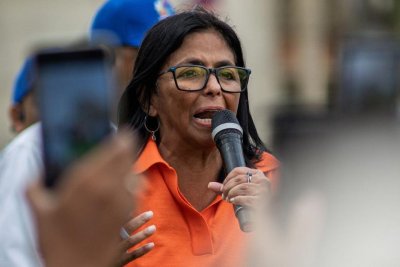
Repression in Venezuela has continued under interim President Delcy Rodriguez, Amnesty International says. File Photo by Henry Chirinos/EPA
April 22 (UPI) — Amnesty International said Venezuela has not dismantled its “repressive apparatus” nearly four months after former President Nicolás Maduro was arrested in a U.S. military operation.
During the presentation of its annual report in Bogotá, the organization said the country’s system of repression remains fully operational under the interim government led by Delcy Rodríguez.
Valentina Ballesta, research director for the Americas at Amnesty International, said Tuesday that Venezuela’s repressive structure continues to operate despite the political transition, according to reports by Infobae.
According to the report, Maduro’s government maintained a policy of systematic repression throughout 2025, with all branches of the state acting in coordination.
Amnesty International said authorities continue to use arbitrary detentions, forced disappearances and torture as tools of social control.
“These are not isolated incidents, but rather a pattern that amounts to crimes against humanity,” the report said.
The organization documented hundreds of cases in which detainees faced judicial proceedings without basic legal guarantees, including ineffective public defenders, the use of special anti-terrorism courts, lack of access to charges and repeated violations of due process rights.
Amnesty International also criticized the implementation of the Amnesty Law approved in February, saying its enforcement has been arbitrary and selective.
Many requests for relief were rejected without explanation, while some people initially granted benefits later had those measures reversed, according to Venezuelan news outlet Efecto Cocuyo.
While the nongovernmental organization Foro Penal and other groups confirmed the release of 673 political prisoners between Maduro’s capture and mid-April, Rodríguez’s government has reported much higher figures as part of what it described as “peace and reconciliation” measures.
In March 2026, government spokespeople said as many as 7,000 people had been granted full release or alternative legal measures. That figure, however, includes common criminals and people already serving conditional release.
Foro Penal said nearly 500 political prisoners remain in detention.
The Amnesty International report said impunity remains the driving force behind Venezuela’s repressive system and warned that the lack of an independent judiciary prevents victims from obtaining justice inside the country.
Analist also pointed to the recent restructuring of the Attorney General’s Office as an example of political control. The move replaced an official close to Maduro with another figure aligned with the Rodríguez political faction, which currently controls both the interim presidency and the National Assembly.
About 7.9 million Venezuelans have fled the country since 2015. Nearly 2 million people depend on international humanitarian aid, while severe shortages in basic services such as water, electricity and food persist, the report said.
Amnesty International further warned about the growing use of new technologies and artificial intelligence for population surveillance, along with continued harassment of journalists and human rights advocates.
Without a genuine dismantling of coercive state structures, Amnesty International said, Venezuela will not be able to restore fundamental freedoms.