releasing

Nepal’s youngest premier sworn in after releasing new rap song about unity | News

Balendra Shah, 35, and his three-year-old Rastriya Swatantra Party won a landslide after Gen-Z protests toppled the former government.

Balendra Shah, Nepal’s youngest prime minister, has been sworn in after his party’s landslide election victory following protests led by young people that toppled the government in September.

A rapper-turned politician, Shah was appointed prime minister by President Ram Chandra Paudel on Friday, after his three-year-old Rastriya Swatantra Party (RSP) won 182 seats in the 275-member parliament in the March 5 vote, the first election since anticorruption Gen Z-led protests in which 76 people were killed.

Recommended Stories

list of 4 itemsend of list

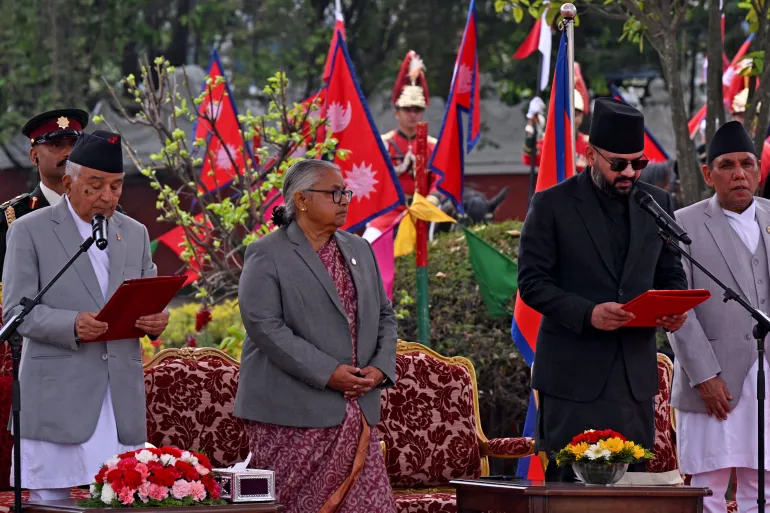
The 35-year-old wore black trousers, a matching jacket, his signature black Nepali cloth cap and sunglasses as he was sworn in at the President House, in the presence of diplomats and senior government officials.

A day earlier, the new premier, better known as Balen, released his first public statement since the historic vote with a rap song shared on social media.

“Nepal is not scared this time, the heart is full of red blood … Laughter and happiness will reach every household this time,” Shah raps in the song titled Jay Mahakaali (Victory to Goddess Mahakali).

His music video, which features visuals of large crowds cheering him during his election campaign, has racked up nearly three million views.

“The strength of unity is my national power,” his lyrics continue.

Rastriya Swatantra Party (RSP) leader Balendra Shah (2R) takes oath as prime minister during a swearing-in ceremony in Kathmandu on March 27, 2026.
Rastriya Swatantra Party (RSP) leader Balendra Shah (2R) takes oath as prime minister [AFP]

A former mayor of the capital, Kathmandu, Shah is Nepal’s first Madhesi premier – people of the southern plains bordering India – to lead the Himalayan nation.

China extended its congratulations to Nepal on the swearing-in of Shah, the Chinese Ministry of Foreign Affairs said on Friday, adding it will support its Himalayan neighbour in safeguarding its independence, sovereignty and territorial integrity.

Protests had raged over a lack of jobs and endemic corruption in the country of 30 million, where a fifth of the population lives in poverty and an estimated 1,500 people leave the country daily for work abroad.

Although he did not directly participate in the protests, Shah publicly expressed support for the largely Generation Z demonstrators who led the movement.

Political instability has been an uphill challenge for Nepal, with 32 governments taking office since 1990 and none of them completing a five-year term.

The Nepali Congress party, the country’s oldest party, became a distant second group in parliament with just 38 seats. The Communist Party of Nepal (Unified Marxist-Leninist) of KP Sharma Oli, who was forced to resign after the Gen Z unrest, controls 25 members.

Former Chief Justice Sushila Karki led the nation through the interim period up to the parliamentary election.

Source link

IEA due to meet as member states mull releasing oil reserves amid Iran war | US-Israel war on Iran News

International Energy Agency chief says talks aim to assess conditions as US-Israel war on Iran fuels global uncertainty.

The International Energy Agency (IEA) is set to hold an emergency meeting to assess the situation in the Middle East as the US-Israeli war on Iran continues to roil global energy markets.

Fatih Birol, the agency’s executive director, said representatives of IEA member states would meet on Tuesday to assess “the current security of supply and market conditions” amid the conflict.

Recommended Stories

list of 3 itemsend of list

“I have convened an extraordinary meeting of IEA member governments, which will take place later today to assess the current security of supply and market conditions to inform a subsequent decision on whether to make emergency stocks of IEA countries available to the market,” Birol said.

This week, oil prices hit their highest levels since mid‑2022 amid concerns of prolonged shipping disruptions linked to the war and reduced output from some key producers in countries that have been targeted by retaliatory Iranian strikes.

While the market reversed late in the day on Monday, with benchmarks falling below $90 a barrel, uncertainty persists around how long the United States-Israel war will drag on.

The Strait of Hormuz, a critical Gulf waterway through which about one-fifth of the world’s oil supplies passes, has effectively been shut down as a result of the war.

“If this drags on, it is not just going to be energy prices” that are affected, Al Jazeera’s Osama Bin Javaid explained. “It is going to have an impact on global economies.”

Bin Javaid noted that the extraordinary IEA meeting comes after Group of Seven (G7) countries met to discuss possible actions to help stabilise global energy markets.

European governments have been on edge about the prospect of a repeat of the energy crisis they faced in 2022, when prices surged to record peaks after Russia’s full-scale invasion of Ukraine.

“The IEA will ⁠be presenting an ⁠in-depth analysis of the pros and ⁠cons of releasing stocks ⁠now,” the European Union’s Energy Commissioner ‌Dan Jorgensen said before the agency’s meeting.

Earlier on Tuesday, G7 energy ministers stopped short of deciding on the release of strategic oil reserves in a call, instead asking the IEA to assess the situation before acting.

“Everyone is willing to take measures to stabilise the market, including the United States,” French Finance Minister Roland Lescure told reporters after the latest talks.

“We have asked the IEA to elaborate scenarios for a potential oil stock release; we need to be ready to act at any moment,” he added.

EU leaders also will discuss competitiveness, including energy prices, on a call later in the day with German Chancellor Friedrich Merz, Italian Prime Minister Giorgia Meloni, Belgian Prime Minister Bart De Wever, and others.

Source link

G7 ‘not there yet’ on releasing oil reserves as Iran war drives price surge

By Quirino Mealha with AP

Published on Updated

G7 finance ministers discussed a coordinated release of emergency oil reserves on Monday but failed to reach agreement, with France’s Roland Lescure saying the group was “not there yet” on a deal.


ADVERTISEMENT


ADVERTISEMENT

The G7 was exploring a coordinated release of emergency oil reserves to tamp down fears of an impending shortage but stopped short of a deal.

Japan’s finance minister, Satsuki Katayama, said the International Energy Agency (IEA) explicitly requested the coordinated release during the G7 meeting, according to Bloomberg.

Brent crude briefly hit $119.50 a barrel on Monday morning, its highest level since 2022, having jumped roughly 25% since Friday as the Iran war intensified, raising fears over global production and shipping.

At the time of writing, oil prices pared gains and are trading slightly below $100 a barrel, as markets remain highly volatile.

Stock markets fell worldwide on concerns the global economy would not be able to absorb a sustained oil price shock.

Equity markets drop over uncertainty

At the open on Monday, the S&P 500 fell 1.3%, coming off its worst week since October. The Dow Jones Industrial Average was down 1.5% and the Nasdaq composite 1.2% lower.

The most immediate pain on Wall Street is hitting companies with large fuel bills. Carnival lost 7.3%, United Airlines sank 6.9% and Old Dominion Freight fell 3.8%.

Retailers dependent on long-haul shipping, whose customers are also facing higher petrol costs, also struggled. Best Buy fell 4.4% and Williams-Sonoma dropped 4%.

The moves followed steeper losses in European and Asian markets, where economies are more exposed to imported oil and gas. South Korea’s Kospi sank 6%, Japan’s Nikkei 225 dropped 5.2% and Europe’s Euro Stoxx 50 tumbled 1%.

Potential stagflation scenario

Since the war with Iran began, the central worry for financial markets has been how high oil prices will go and how long they will stay there.

If prices stay very high for very long, household budgets already stretched by high inflation could break under the pressure.

Meanwhile, companies would see their own bills jump for key items such as fuel and stock items, as well as for powering their data centres.

It all raises the possibility of a worst-case scenario for the global economy: stagflation, or a period when economic growth stagnates and inflation remains persistently high.

Late on Sunday, President Donald Trump countered this narrative by assuring that high oil prices at the moment are both worth the cost and only temporary.

“Short term oil prices, which will drop rapidly when the destruction of the Iran nuclear threat is over, is a very small price to pay for U.S.A., and world, safety and peace,” he said in a post on Truth Social.

In the bond market, the yield on the 10-year Treasury held at 4.15%, where it ended Friday.

Worries about high inflation and oil prices are applying upward pressure on Treasury yields, while risks of a slowing economy are pulling in the opposite direction.

Concerns about stagflation deepened on Friday following a surprisingly weak US jobs report showing that employers cut more jobs last month than they added.

Source link

G7 finance ministers meet to discuss releasing emergency oil reserves

March 9 (UPI) — G7 finance ministers were set to hold an emergency meeting first thing Monday to discuss oil prices after Brent crude surged above $100 per barrel, with an option to release strategic reserves to calm the market on the table.

The virtual meeting, due to get underway at 8.30 EST, comes amid fears that disruption to oil and gas shipments from the Gulf via the Strait of Hormuz, which Iran has closed, could continue for some time, sending energy prices soaring and rattling financial markets.

The joint release of “emergency reserves,” if agreed, would be coordinated by the International Energy Agency, according to the Financial Times.

If G7 nations do release oil reserves, it would be the first time in four years since a crisis triggered by Russia’s full scale invasion of Ukraine triggered similar price shocks, although gas was hit the worst.

Exacerbated by escalating attacks on Gulf countries’ oil fields, refineries and storage plants — impacting their ability to produce and store product, as well as export it — Bent crude jumped more than 25% in Asian trade Monday, hitting a $119.50 per barrel high, before falling back with the price of West Texas Intermediate making similar moves.

Investors also reacted to fears that the crisis will push inflation and borrowing costs higher, with negative impacts for the global economy.

The key Nikkei 225 index in Japan slumped by more than 5% to end Monday down 2,892 points lower, with the jitters spilling over into Europe when the markets there opened.

At lunchtime Monday, the FTSE 100 in London was down 1.4%, Germany’s DAX was down 1.6% and the CAC 40 in Paris was off by more than 2.2%.

Former IEA head Neil Atkinson warned that unless there was a resolution to the situation in the Gulf and flows of oil resumed “very soon” the world faced a “potentially game-changing and unprecedented energy crisis,” even if the reserves were made available.

“Though there are oil stocks around the world, the point is that if this closure of the Strait persists, those oil stocks if they are deployed will be depleted and we are going to be in a situation where, with the oil production actually shut in, in Iraq and possibly in Kuwait and maybe even in time in Saudi Arabia, that we are going to be in a crisis the likes of which we have never seen before,” Atkinson told CNBC.

Source link