recording

Suno made a new AI music model with major labels. Here’s what it means

Two years ago, the biggest record labels took artificial intelligence music generators to court for copyright infringement. Now several of them are licensing their catalogs to those same companies, and the deals are starting to turn into products.

The latest example came earlier this month, when Suno, an AI music company valued at $5.4 billion, released its first models built with licensed music from Warner Music Group, BMG and Believe. Rival Udio has licensing deals with Universal Music Group and Warner.

The companies are pitching AI as a new revenue stream for artists. But so far, none of them have disclosed what artists will be paid, how many artists have opted in, or how much input individual musicians have over whether their work is used. And some musicians and songwriters are fearful of how these AI deals might affect livelihoods.

“It’s sort of a creepy and ominous cloud,” said Matt Evans, a 35-year-old Pasadena resident who’s played brass instruments on shows like “The Late Late Show With James Corden” and Netflix’s “Dr. Seuss’s Red Fish, Blue Fish.” “The fact that I could do something once and then it could be reused, and if that’s not negotiated in a contract, then I never got to make a choice to receive additional compensation. It all comes down to the loss of money.”

The American Federation of Musicians sued Universal and Warner in June, alleging the labels licensed recordings its members played on to Suno and Udio without paying those musicians or telling the union which recordings were involved. The labels have moved to dismiss the case.

In 2024, Universal, Sony Music Entertainment and Warner sued Suno and Udio for copyright infringement, alleging the AI companies trained their models on copyrighted songs spanning many artists, genres and time periods. The settlements began the following year. Universal settled with Udio in October and became its partner, and Warner settled with both Udio and Suno in November, signing licensing deals with each.

“The reason why they would settle this is they think they’re going to profit more from licensing music to them rather than from the outcome of a lawsuit,” said Jane Davidson, an entertainment attorney at Nolan Heimann who specializes in copyright and trademark infringement.

More deals followed. Udio signed with Merlin, which licenses music on behalf of independent labels, and with independent publisher Kobalt. Suno signed with BMG in August and with Believe, owner of the DIY distribution platform TuneCore, this month. Spotify, which wasn’t part of the lawsuits, struck deals with Universal and Merlin.

Not everyone is settling. Sony filed a second lawsuit against Udio over more than 30,000 recordings, and it is still suing Suno alongside Universal, which is licensing its music to Udio and Spotify at the same time. Sony and Universal also filed a new lawsuit last week alleging that Suno’s latest model still infringes on their copyrighted works. In July, a Munich court ruled against Suno in a case brought by GEMA, which collects royalties for German songwriters and publishers.

The deals between labels and AI music platforms — on which consumers can create full songs from text prompts — share a basic promise. Artists signed to the participating labels can opt in and will be credited and paid.

But each company is building something different. Udio operates under a “walled garden” model favored by Universal, in which songs made on the platform can’t be downloaded or distributed elsewhere. Spotify’s tool, a planned paid add-on for Premium subscribers, has no launch date. Suno lets users download what they make and release it elsewhere, with download caps and watermarks meant to curb abuse; songs made with its new models can be distributed through Believe and TuneCore.

Whether an artist opts out depends on who owns the rights. Songs typically carry two copyrights — one for the composition, usually held by songwriters and their publishers, and one for the sound recording, usually owned by the label. Every contract is different, so it’s unclear how AI products will handle music where those rights are split.

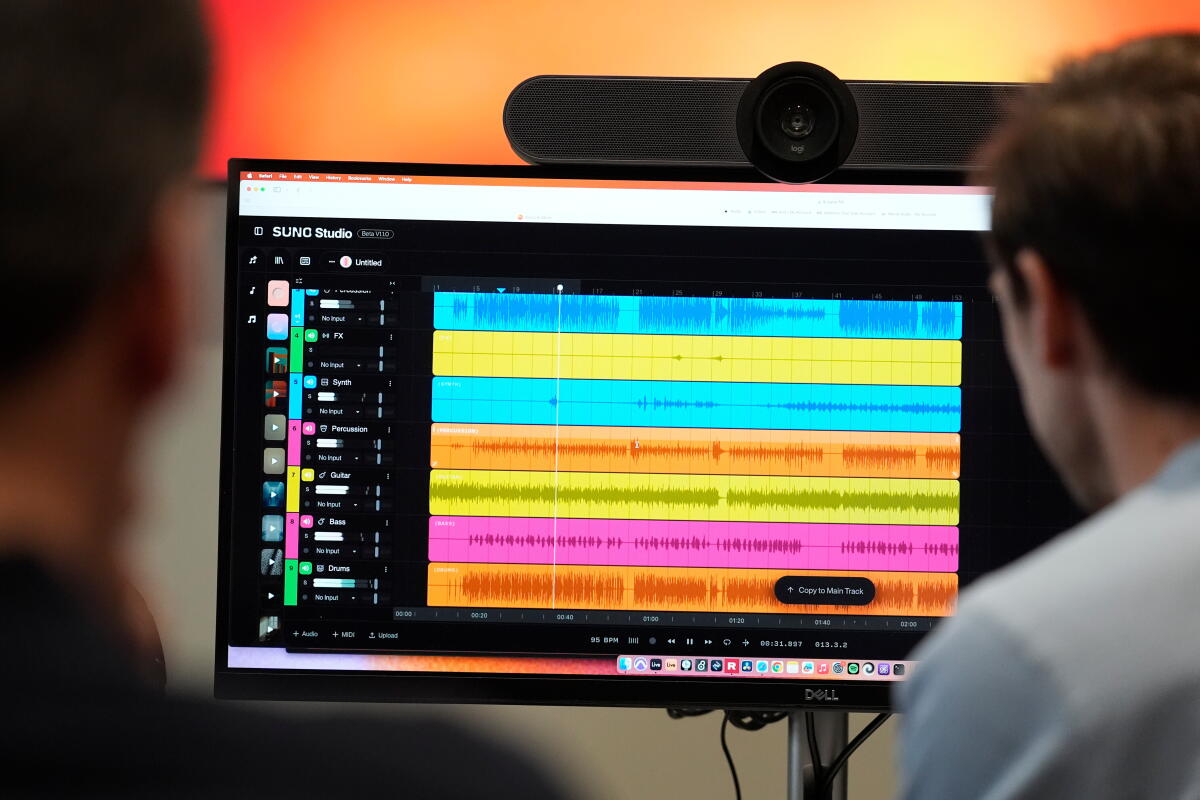
Waveforms of audio files from various instruments are displayed during the creation of an AI musical piece at SUNO

Waveforms of audio files from various instruments are displayed on a computer screen during the making of an AI musical piece at Suno.

(Robert F. Bukaty / Associated Press)

“These companies are able to make deals on behalf of their artists, and their control over their music is pretty significant based on what major label contracts typically say,” Davidson said. “But I expect that we will have some artists that push back against this and say that they didn’t authorize the use of their music for this purpose.”

Warner’s agreement with Suno, for example, lets artists opt in to having their names, likenesses, voices and compositions used in AI-generated music. But Jack Brody, Suno’s chief product officer, acknowledged that labels “ultimately have their contracts in place that will have some say in what an artist can and can’t do.” It’s also not always clear whether opting out keeps an artist’s recordings out of AI training, or only out of fan-facing features.

Michelle Lewis, a songwriter and the co-founder and chief executive of the nonprofit Songwriters of North America, said the composition side of that copyright split is often the harder one to defend.

“With AI, it’s so much easier to tell if you’ve infringed on the sound recording. You know what Beyoncé and Drake’s voices sound like,” said Lewis, who wrote Cher’s “A Different Kind of Love Song,” Little Mix’s “Wings” and the music for the Disney Jr. show “Doc McStuffins.” “But songwriting is so much more nebulous, so much harder to sue.”

“From the creator side, nobody asked for this. We like our job,” added Lewis. “The job is the process and what makes it special, interesting and artful.”

Some musicians argue the deals can’t cover rights the labels don’t control. A proposed class action filed last month by Jason Isbell and other musicians alleges Suno lets users generate songs that evoke specific artists’ identities without their consent, a right-of-publicity claim the plaintiffs say belongs to performers no matter who owns their recordings. Suno disputes the claims.

Session musicians like Evans are pushing back through their union.

“By licensing our members’ performances to AI platforms like Suno and Udio without consent, credit, or compensation, companies like Universal, Warner Records, and Atlantic are bypassing the very human creators who made their catalogs valuable in the first place,” AFM International President Tino Gagliardi said in a statement.

The labels have disputed the claims and argue that these deals advance the interests of artists and songwriters.

Jonathan Wyner, head of artistic technology initiatives at Berklee College of Music’s Emerging Artistic Technology Lab, compared the AI deals to the arrival of streaming services. Wyner has advised Suno.

“It’s a good step, and I think it was an inevitable step, especially if you want to stay engaged with musicians and the creative community,” he said.

That comparison cuts both ways. Streaming grew the industry while fueling years of complaints about artist pay.

Damon Krukowski, a musician and the legislative director at United Musicians & Allied Workers, said the deals so far don’t seem to benefit working-class musicians and could be used to cut them out entirely.

“It’s a new technology, but it’s not a new corporate story,” Krukowski said. “But the tools are even more powerful. It seems within their possible reach to destroy the labor market. The major labels are just seeing dollar signs without any regard to the long-term health or sustainability of this industry, because they’re envisioning an industry without artists who can push back.”

Brody disputed that, saying Suno is building ways for independent and unsigned artists to benefit, such as its deal with Believe and TuneCore.

With terms under wraps, it’s too early to know whether any of this will pay off for artists. The tests are still ahead — whether Sony and Universal win or settle, and what the first payouts actually look like.

“A label making a deal and an individual artist having a choice are not necessarily the same thing,” said Drew Silverstein, the senior advisor for AI at music tech company BandLab Technologies. “Our music industry has a long history of new revenue streams coming into existence that benefit certain folks, and create great financial opportunities for rights holders.”
Source link

LAPD internal affairs file spills details on racist recordings scandal

After LAPD recruitment officers were accused of making racist, sexist and homophobic comments — some of which were caught on tape — department leaders promised to look into whether they improperly disqualified any police applicants.

More than a year and a half later, the city is still waiting on the report.

But the contents of a separate LAPD internal affairs file reviewed by The Times has shed new light on the unit at the center of the scandal and how its officers responded to investigators who were looking into the matter.

No clear explanation has been given for the delay in publicly addressing the scandal’s effect on recruitment efforts.

In response to a records request from The Times, the city’s personnel department, which is conducting the inquiry, said it had not yet finished its review and had no timeline for doing so.

Last month, Los Angeles County Dist. Atty. Nathan Hochman charged Daniel Flores, the LAPD whistleblower who secretly recorded his colleagues, with 16 felonies, alleging he violated a state eavesdropping law. But, after criticism from Mayor Karen Bass and others, the district attorney downgraded the counts to misdemeanors with a diversion agreement that will probably allow Flores to avoid any time behind bars.

Flores’ recordings captured Los Angeles Police Department recruitment officers referring to Black people as “monkeys,” describing a female job applicant as “rapeable,” and saying “F—ing deport them, call ICE” during a conversation about Latinos, among a long list of other offensive remarks.

Asked about the pending LAPD report into the fallout from the tapes, Bass said in a statement that the review “has gone on too long.” The mayor said she had directed the personnel department to “complete the report and release it without further delay.”

Flores alleged in a complaint he filed with the LAPD in January 2025 that some recruits had been improperly rejected, adding to ongoing concerns about the department’s struggle to replenish its ranks.

As of last week, the LAPD had 8,507 sworn personnel — its lowest total since October 1995.

Even after efforts under Bass to streamline hiring and boost recruitment, Chief Jim McDonnell has warned that the department may not be adequately staffed in time for the 2028 Olympics.

McDonnell said after Flores’ allegations were made public in early 2025 that the personnel department would conduct a “biopsy” to examine “any adverse impacts” of the scandal on recruitment.

In a brief statement, the department said that it wouldn’t comment on what discipline, if any, had been meted out to the officers involved, citing state privacy law.

“The Department takes allegations of discriminatory or biased conduct seriously,” the statement read. “We are committed to ensuring the workplace is professional, respectful and free from misconduct.”

The Police Commission said in a statement that it is still waiting on the report, adding that “fair and equitable hiring of sworn and civilian employees remains a priority.”

The LAPD internal affairs investigative file reviewed by The Times described a frat-like office atmosphere in the Hiring and Evaluation Section in which Flores worked.

According to the internal affairs report, Flores claimed that at least one colleague, Shirley Burgos, had inappropriately disqualified candidates based on their appearance.

The report said that Burgos was captured in several recordings making fun of overweight candidates who were “ugly, creepy” people.

Another officer, Ayron McKay, told internal affairs investigators about an instance in which the unit’s officers were discussing a candidate who they believed was overweight.

Burgos then looked up the woman’s driver’s license picture on the DMV database, which several officers told internal affairs probably violated department policy, according to the report.

Burgos and McKay did not respond to inquiries to their work email accounts.

The internal affairs file said Flores recorded another officer saying he wanted to go to Big Bear, a popular winter sports destination in the San Bernardino National Forest, and roll the candidate down the ski slope. Meanwhile, according to the report, McKay asked the others how much they would pay to sleep with the woman, and referred to her as “Jabba the Hut.”

When asked about the conversation by internal affairs, the report said, McKay told investigators that the conversation started with Burgos venting about an applicant, but acknowledged that it should not have been allowed to continue.

In one recording made on Nov. 13, 2024, the report said, Burgos told her colleagues that she had released information about disqualified candidates to a friend of hers at the Los Angeles Sheriff’s Department, which is against LAPD policy.

The officers were all required to sign a confidentiality agreement that barred them from discussing candidates’ personal information with anyone outside the office.

During her internal affairs interviews, Burgos denied providing information to other agencies, saying it was clear from her laughter on the recording that she was joking.

Burgos told investigators that the only time she’d ever discussed a candidate with someone outside the department was during a conversation with an unnamed background investigator with the Sheriff’s Department or Santa Monica police — and said that was only to confirm that the candidate had in fact applied to the LAPD, according to the report.

The LAPD investigation noted that she and the other involved officers all denied that their office conversations had ever caused them to inappropriately disqualify a candidate.

The internal affairs report quoted the unit’s supervisor, Sgt. Denny Jong, a 20-year-department veteran, as describing his relationship with the officers under his command as friendly and professional; none of them had ever expressed discomfort about their work environment, he reportedly said.

Jong did not respond to emailed questions from The Times.

Several officers told investigators that they used gallows humor as a way to deal with the stress of working long hours in a small, windowless basement office.

According to the report, some officers, including Jong and McKay, acknowledged that the office banter sometimes crossed the line, but they denied that there was anything malicious about their comments. They also contended that the unit had little authority about which applicants advanced in the recruitment process — decisions, they said, that had to go through several layers of review.

During his internal affairs interviews, Jong often told investigators that he didn’t recall making certain inappropriate comments. The report said he also denied ever making any of the inappropriate comments that were contained in Flores’ complaint.

When he was confronted with audio of comments in which he referred to a candidate of Chinese descent as a terrorist, Jong said he was joking.

“He explained that this was based on current news stories at the time, which involved concerns over Chinese nationals attempting to infiltrate the country,” the internal affairs report said. “Jong was not serious and did not believe the candidate was a terrorist, but admitted the remark was an off-color joke and inappropriate for the workplace.”

Source link

Controllers warned Marine One pilots before dual takeoff, NTSB says

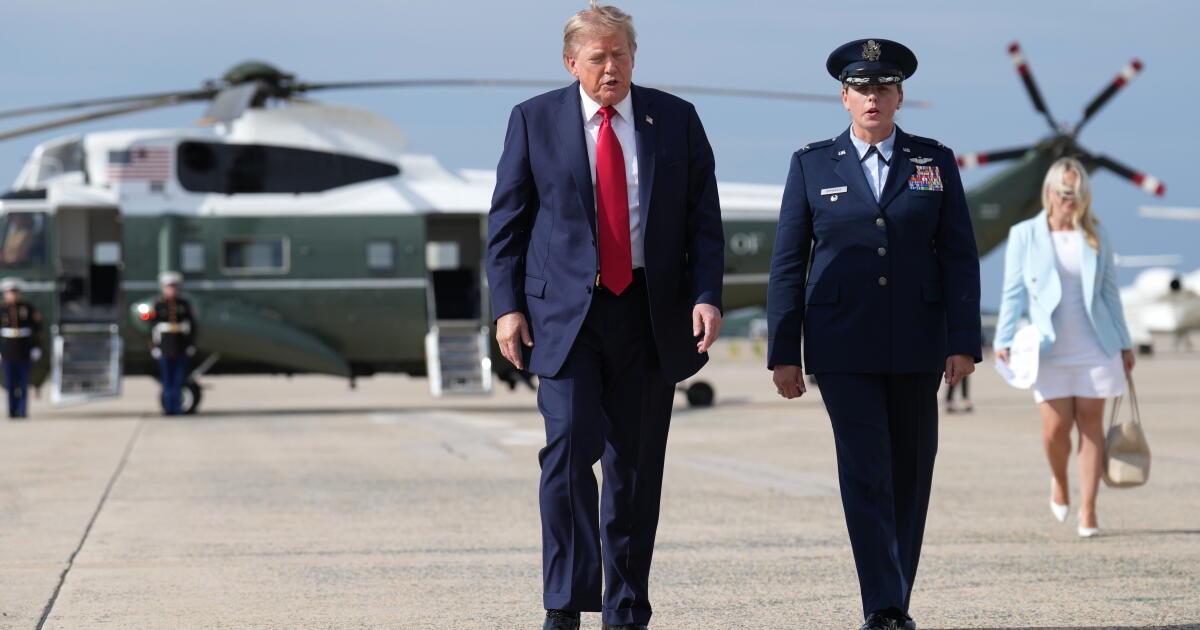
Air traffic controllers in Washington and the pilots of President Trump’s helicopter met to discuss communication issues one week before a jet was allowed to take off just as Marine One left the White House, federal investigators said Thursday.

Controllers reported not receiving the standard three-minute warning call ahead of Marine One flights, and both sides agreed to an alternative in those instances — but that plan to relay the radio call through someone else also was unsuccessful on the day of the Aug. 4 incident near Ronald Reagan Washington National Airport, the National Transportation Safety Board’s preliminary report shows.

Having both the jet and helicopter in the air at the same time seemed to violate safety procedures put in place after last year’s midair collision near the busy airport that killed 67 people, but officials stressed that the president was never in danger. The Pentagon also has a long-standing agreement with the Federal Aviation Administration to provide controllers with a three-minute warning before the president’s helicopter takes off that predates last year’s crash.

The NTSB said recordings from the tower showed that the controllers never heard the calls from Marine One’s pilot that day warning that the helicopter was getting ready to take off, but separate recordings posted by ATC.com show the helicopter did make those calls.

The helicopter pilots tried to relay their three-minute call through the helicopter facility at Joint Base Anacostia-Bolling, but that also was unsuccessful.

After an airliner collided with an Army Black Hawk helicopter on Jan. 29, 2025, the FAA decided all takeoffs and landings at the airport would be halted anytime a helicopter passes by on a conflicting route. The airspace near the White House and Reagan is heavily congested with military and commercial aircraft.

The FAA acknowledged the helicopter and airliner briefly got too close before the two aircraft started to move away from each other. The airplane quickly climbed above the helicopter after Marine One’s pilots saw the plane and paused until it safely left the area.

The NTSB said preliminary estimates show the helicopter and plane were about eight-tenths of a mile apart laterally and about 700 feet apart vertically at their closest. The crew of the Envoy Air flight told investigators they received a traffic warning from their collision avoidance system right after they took off, but they never saw the helicopter.

The official FAA recordings from the tower at Reagan did not include the warnings that Marine One was getting ready to head to Andrews Air Force Base with the president aboard.

A recording posted by ATC.com showed the Marine One pilot telling the tower that the helicopter was “three minutes to life” just like the 2013 agreement between the FAA and the military calls for. But the controller seemed surprised a few minutes later when the helicopter took off.

“Uh, Marine One, you said, uh, you’re proceeding as briefed?” the controller asked before giving the helicopter directions and commenting, “OK, no three minutes, roger, proceed as briefed.”

After the controller warned the helicopter about the plane taking off, the Marine One pilot said he saw the traffic and declared, “We’ll be doing a momentary delay.”

After last year’s midair collision, it became clear that poor communication between air traffic controllers and the military had been a long-standing issue. During a congressional hearing, it came out that a hotline connecting the Pentagon to the tower at Reagan hadn’t been working for more than three years, and the FAA hadn’t even realized it.

The NTSB said that after this incident involving Marine One, FAA technicians determined there wasn’t an adequate line of sight between the radio receiver at the airport and the location where the helicopter takes off at the White House. So those radios were moved from the neighborhood where they had been located to the top of the tower at Reagan. Subsequent tests showed the radios working well after that change.

Funk writes for the Associated Press.

Source link