Three Bomb Blasts Hit Maiduguri. Survivors Recall a Night of Panic
Umar Muhammad Mustapha had just stepped out of the mosque when he heard someone say an explosion had gone off in the Maiduguri Monday Market area on the evening of March 16. He panicked and asked when. “Just a moment ago,” someone replied, “while we were praying.”
Immediately, Umar began dialling his nephew’s number as he rushed toward the scene without first returning home. “The phone kept ringing, but he did not answer. A few moments later, it prompted ‘switched off’,” he recalled.
That was when the panic deepened.
“I began dialling those whose shops were close to ours.”
Umar sells gabgab at the market. His nephew, Muhammad Ibrahim, makes the local incense while he sells it. The 27-year-old has been with Umar since he was nine.
As he moved through the city that Monday evening, his thoughts raced ahead of him. “I began to imagine the condition in which I would meet him,” Umar said. “Is he alright? Is he alive? Is he dead? Is he injured? And how bad his injuries might be.”
They both work at the market, but that day, Umar stayed at home.
That night, at around 7 p.m., three explosions simultaneously rocked parts of Maiduguri, the Borno State capital in northeastern Nigeria, including the Monday Market, the Post Office area along Ahmadu Bello Way, and the entrance of the University of Maiduguri Teaching Hospital (UMTH).
As he hailed a tricycle to rush to the market, Umar was restless. “I felt as though the keke was not going fast enough and kept urging the driver to go faster,” he said.
From the market to the ward
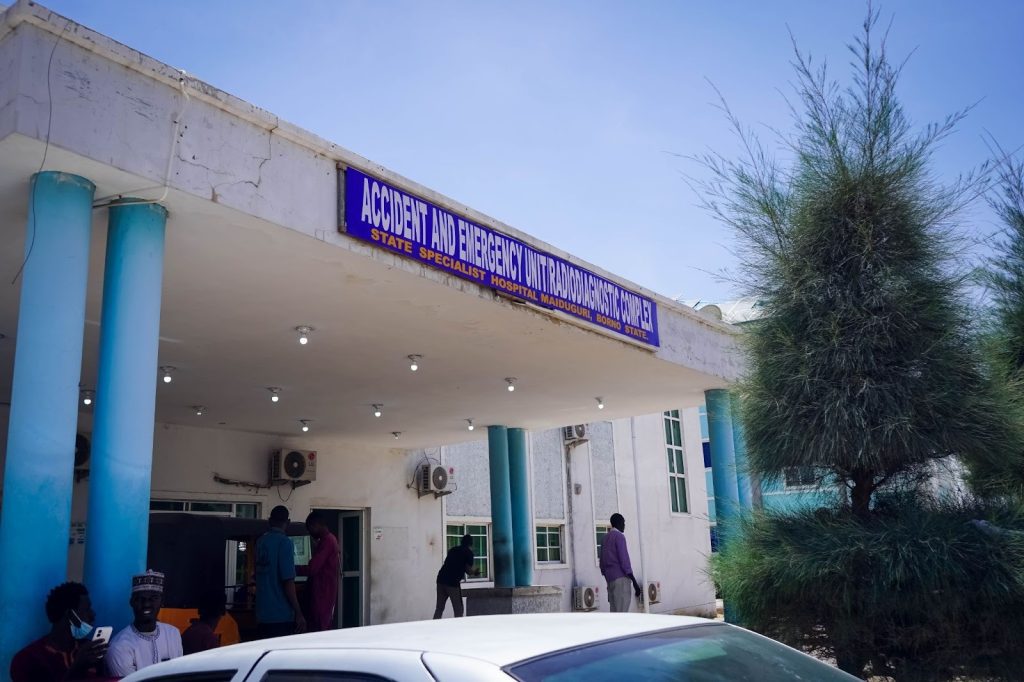
Before he reached the market, Umar’s phone rang, and Muhammad’s name was displayed. But when he answered, a different voice spoke. “Come to the emergency ward of General [State Specialist Hospital],” the person said.
In that moment, uncertainty gave way to reality. “An explosion occurred; he was affected,” the person continued. “He was brought to the hospital. You are the last person he talked to, so we are reaching out.”

The blasts at the market and the Post Office were especially devastating. The two locations sit minutes apart. Traders had closed for the day and were heading home when the first explosion tore through the Elkanemi junction, near the market.

In the immediate aftermath of the first blast, many people scattered and ran towards the Post Office area. Muhammad was among them. At the time Umar was trying to reach him, he had already escaped the market blast. In the confusion, he could not hear his phone. As he ran towards the Post Office area, another explosion went off.
It caught him, and he sustained injuries to his chest and legs.
When HumAngle visited the hospital on Tuesday, March 17, Muhammad could not speak, only nodding when spoken to. Umar said he was scheduled for surgery later in the evening.

Other survivors also carry similar stories.
Mohammed Babagana Bukar had just bought a pair of shoes for Eid al-Fitr, which is in a few days, with money he earned as a porter at the market. When the blast happened, the 15-year-old said, “We panicked and began running towards the Post Office when another one went off, close to where the flyover is being constructed.”
He was brought to the hospital by a stranger. “He carried me as I could not walk.”
Fantami Modu didn’t escape the first blast that rocked the market; he was injured.
“It affected my leg,” the 40-year-old said. “We were brought to the hospital by the police.” Fantami sells clothing materials and earns about ₦7,000 daily. It is what he uses to feed his family.
Now, he cannot work. Beside him, his brother, Babagana, said they are contributing to support the household until he recovers.
According to the Borno State Police Command, 23 people were killed, and 108 were injured in the multiple bomb blasts. No terror group has claimed responsibility for the attacks, but the Nigerian Army said they were “carried out by suspected Boko Haram terrorist suicide bombers”.
“Preliminary information further indicates that the terrorists may have deployed multiple suicide bombers into Maiduguri with the intention of carrying out coordinated suicide bombings at crowded locations,” Lieutenant Colonel Sani Uba, Media Information Officer of the Joint Task Force North East Operation Hadin Kai, said in a statement.
At the State Specialist Hospital, where victims were first rushed to, HumAngle counted 13 survivors on admission. The hospital is less than two kilometres from the scenes. Of these 13, 11 were males and two females, with varying degrees of injuries to the arm, leg, and chest.
Nurses at the hospital said at least 40 people were brought to the emergency ward that night, with many later referred to the UMTH. Only 14 survivors were eventually admitted, but one died on arrival.

UMTH was also targeted that night. An explosion that went off at the hospital’s entrance. Although no civilian casualties were recorded, sources said that a suspected suicide bomber, who tried to enter the hospital on a bicycle before he was stopped by security operatives, died in the incident.
A city remembering fear
For some residents, the events revived familiar anxieties.
“We had just broken our fast and were waiting for a tricycle to return home when we heard the explosion close to the Monday Market,” Sulaiman Muhammad, a resident, recounted. “Less than 20 minutes after, we heard another one from the Post Office area. In panic, we scattered.”
He did not go to the scene. “It is dangerous,” he said. “I remember in one explosion like this inside the market at the peak of the [Boko Haram] insurgency, another explosion went off immediately people gathered to help victims.”

Now, those memories are resurfacing. “People are in panic,” he said. “We had begun to experience relative calm until the past few days.”
Sulaiman has sold shoes at the market for more than 20 years. He believes the attacks will affect business. “As you can see, no one is out [to sell],” he said.
These incidents are part of a broader pattern of escalating violence.
The explosions came barely 24 hours after terrorists attacked a military base in Kofa, a community close to Ajilari on the outskirts of Maiduguri, on March 16. Joint security operatives repelled the attack, leaving many terrorists dead.
However, before then, there had been attacks by terror groups across Borno State, including assaults on rural military bases and resettled communities like Ngoshe and Dalwa. Also, on Dec. 25, 2025, a suicide bomber detonated at a mosque in the Gamboru Market area of Maiduguri. Five people were killed, and 35 others were injured.
Taken together, these incidents point to what observers describe as a violent resurgence. HumAngle has reported that the terror groups operating in the region have undergone several technological shifts that have aided their expanded attacks and operations, including the use of artificial intelligence and drones.
For Umar, the incident has narrowed into something smaller, more personal.
Muhammad, he said, loves to read.
“He would read verses from the Qur’an after his morning prayer. And after breakfast, he would head to the market. And by evening, he would return home. He would read in the evening too, before going to bed.”
When asked what he hopes for, Umar paused.
“I would have hoped for more security or for more vigilance,” he said. “But what would an empty hope solve? Authorities know what to do. They would act properly if they intend to.”