Asia’s foreign press clubs recalibrate amid regional political changes

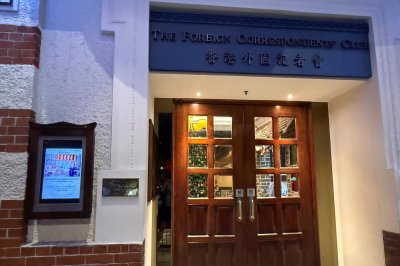
The Foreign Correspondents’ Club of Hing Kong is navigating a transformed political landscape, a radically shrinking media industry and a shifting geography of global news coverage. Photo courtesy of The Foreign Correspondents’ Club
Jan. 15 (UPI) — For decades, Asia’s foreign correspondent clubs were the region’s off-duty newsrooms — the late-night debating halls where journalists compared notes on wars, coups, trade deals, democratic uprisings and China’s rise. Now those storied institutions, once synonymous with a freewheeling press culture, are confronting a slow sunset.
No club illustrates this more clearly than the Foreign Correspondents’ Club of Hong Kong. Long considered the spiritual home of Asia’s foreign press corps, the club is navigating a transformed political landscape, a radically shrinking media industry and a shifting geography of global news coverage.
Its evolution has become a case study in how Asia’s information order is changing — and what the future of foreign reporting may look like.
A club built for a Hong Kong that no longer exists
The clubhouse in a colonial-era icehouse on Lower Albert Road remains visually unchanged. Photographs of Vietnam War correspondents still line the walls. The bar still hums with conversation. The dining room still hosts diplomats, academics, business executives and the occasional visiting author.
But beneath that surface, the club’s role — and the city around it — have changed drastically.
“I remain a member and a regular at the Foreign Correspondents’ Club,” said Philip Bowring, 83, a former deputy editor of the Far Eastern Economic Review and co-founder of Asian Sentinel. He added that while the club still survives as a social club; it is necessarily very cautious about the topics discussed.
Since Beijing imposed the National Security Law in 2020, Hong Kong’s once-vaunted press freedoms have tightened. Apple Daily was shut, journalists have been arrested or moved abroad and prominent foreign correspondents have relocated to more predictable bases, such as Seoul or Taipei. Events once taken for granted — open forums with dissidents, academics or activists — now carry political sensitivities.
The club’s suspension of the Human Rights Press Awards in 2022 signaled the depth of this pressure. Membership has also shifted: Once dominated by working correspondents from the Asian Wall Street Journal, Far Eastern Economic Review, AP, Reuters, UPI and major American newspapers, the club now leans more heavily toward academics, non-governmental organization workers, corporate members and public relations professionals.
“The most profound impact of Article 23 has been on the climate in which journalists operate,” said Morgan Davis, president of the Hong Kong Foreign Correspondents’ Club. “Vague definitions and legal uncertainty have left reporters unsure about what can safely be covered. That uncertainty has not required direct enforcement to be effective — it has already fostered self-censorship.”
Collapse of publications that sustained the club
The foreign correspondent club model was born in a different era — one where well-funded international bureaus were standard practice. Asia’s clubs thrived because Asia’s foreign press corps thrived.
But over the last two decades, the scaffolding that supported them has steadily eroded.
Asia’s once dominant foreign press institutions have steadily receded. The Far Eastern Economic Review folded in 2009, the Asian Wall Street Journal, a training ground for generations of financial reporters, was absorbed through corporate restructuring, and the International Herald Tribune vanished after rebranding and consolidation.
Even large broadcasters and wire services have scaled back their regional footprints as advertising revenue collapsed and digital pressures stretched newsroom budgets.
These changes hollowed out the clubs themselves. Bars once filled with correspondents trading tales of scoops are now shared with a broader mix of public relations professionals. Conversations that once revolved around embargoed policy briefings now tilt toward networking and cultural programming.
Regional press freedoms under strain
The political environment across Asia has grown increasingly hostile to foreign media.
In Myanmar, foreign reporters have been jailed or expelled since the 2021 military coup. In Cambodia, independent news outlets were shuttered ahead of national elections, narrowing the space for critical coverage.
Thailand and Malaysia continue to apply sweeping national security and royal defamation laws that discourage investigative and political reporting.
In China, authorities tightly restrict visas, travel, and reporting access for correspondents examining sensitive topics such as elite politics, Xinjiang and corporate wrongdoing.
Hong Kong’s rapid shift, once unthinkable, has emerged as the most visible example. The prosecution of Apple Daily founder Jimmy Lai and the recent guilty verdict of conspiring to collude with foreign forces under the Beijing-imposed national security law underscores the risks facing journalists operating in the city.
For an institution like the Foreign correspondents’ Club built on the premise of open discourse, the new environment has meant recalibrating — carefully.
Lai was found guilty on three charges — two counts of conspiring to collude with foreign forces and one count of conspiring to publish seditious material — in a case that has become a bellwether for the state of press freedom under Hong Kong’s national security law.
“This is a very different media environment than prior to the enactment of the National Security Law in 2020, but I would describe it as resilient and maintaining its core functions and the FCC is a reflection of that,” said Edith Terry, an author and former opinion page editor of the South China Morning Post, who has spent nearly four decades in Asia.
Forward-looking questions: reinvention or requiem?
While nostalgia shapes much of the conversation about foreign correspondent clubs, the more pressing question is whether they can reinvent themselves for an era when journalism, geopolitics and information flow are all being fundamentally reshaped.
Across Asia, clubs are confronting a moment of profound transition, but also an opportunity.
A major shift is already underway. With Beijing-based correspondents relocating to Taipei, Seoul and Singapore, the idea of Hong Kong as the singular headquarters for China-watching is over. Coverage of the world’s second-largest economy is now more dispersed, hybrid and remote. The centrality the Foreign Correspondents” Club enjoyed during the Cold War or China’s early reform era is unlikely to return.
With foreign bureaus shrinking, the infrastructure supporting journalism is shifting to nonprofit and academic institutions. Think tanks now publish investigative videos. Civil-society groups conduct data-driven environmental monitoring. Universities host China policy briefings once held at the club. These partnerships could be a lifeline, positioning clubs as conveners of evidence-based dialogue rather than relics of a journalistic past.
Foreign correspondents in Hong Kong still operate with a degree of privilege, but when the Foreign Correspondents’ Club press club fails to use it and falls silent, it leaves local reporters and their union in the firing line,” said Tom Gundry, co-founder of the Hong Kong Free Press. He believes that the club, which occupies government-owned premises, should speak up for press freedom as promised in its mission statement.
While local constraints have narrowed the scope of some public programming, the Foreign Correspondents’ Club’s international profile still gives it a platform few regional institutions can match — one capable of amplifying concerns about transparency, censorship and open debate beyond Hong Kong’s borders.
The club’s social and intellectual life remains intact. Jazz nights still draw packed rooms. Panel discussions are still well-attended, if less politically combustible than in years past. Foreign correspondents, scholars and regional analysts continue to gather there, keeping alive a tradition of debate that, in a more restrictive environment, has become quietly, but unmistakably, political.
But the club’s evolution mirrors the transformation of Hong Kong itself, from a city defined by openness and free exchange to one navigating political boundaries set in Beijing. As the foreign press corps disperses and the region’s political climate tightens, the club stands at a crossroads: reinvent or fade.
Across Asia, other foreign correspondent clubs face the same dilemma. Reinvention could preserve their influence, even if their identities shift. Failure to adapt may leave them as monuments to a media era that has already passed.
