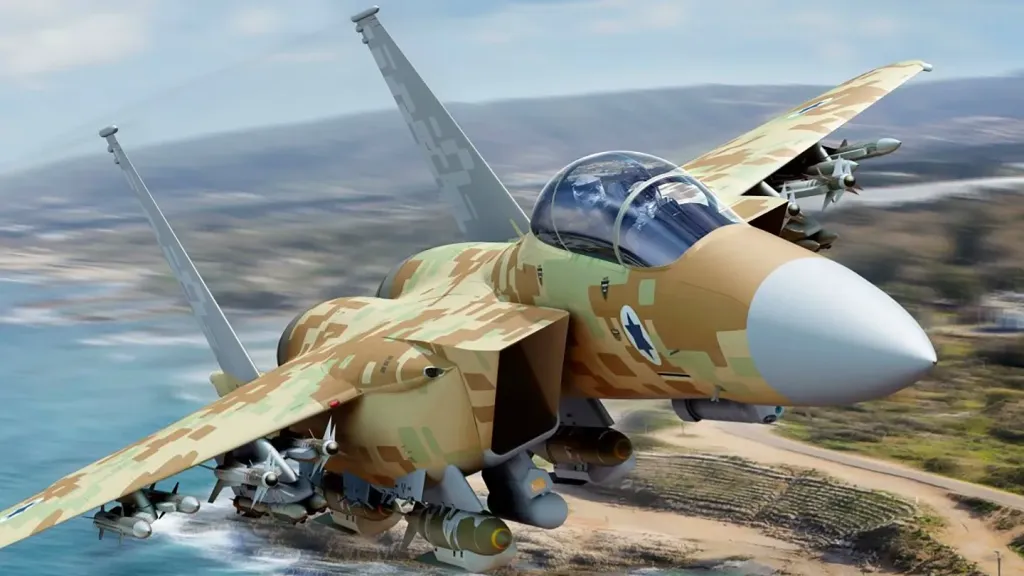
Israel Rearming Its Eagle Force With The New F-15IA
New-build F-15 Eagle fighters are headed to Israel again, with a contract for 25 new F-15IA aircraft placed with Boeing. These will be the first new Eagles that the country has acquired since 1999, when it received the last of its F-15I Ra’am jets and continues the enduring legacy of the F-15 in Israeli Air Force service.
The Pentagon announced on Monday that Boeing had been awarded a Foreign Military Sales (FMS) contract with a ceiling of $8.58 billion for the F-15 Israel Program. The contract covers the design, integration, instrumentation, test, production, and delivery of 25 new F-15IA aircraft, with an option for an additional 25. Work will be performed at St. Louis, Missouri, and is expected to be completed by the end of 2035. The aircraft will almost certainly feature extensive Israeli-specific modifications, as was the case with previous Eagles, especially when it comes to electronic warfare, weapons, and communications systems.

The contract announcement came after U.S. President Donald Trump met Israeli Prime Minister Benjamin Netanyahu in Florida.
In August 2024, Israel was given U.S. approval to buy as many as 50 F-15IAs, as well as upgrade its existing F-15Is as part of an overall package valued at $18.82 billion that you can read about here.
Subsequently, in November of last year, the Israeli Ministry of Defense announced that it had agreed to buy the 25 F-15IAs, reserving the option to buy the other 25 jets.
At that point, the Israeli Ministry of Defense said that deliveries of the F-15IAs would start in 2031, with between four and six aircraft being supplied annually. The stated cost was $5.2 billion, and it’s not exactly clear why that has since increased substantially. We reached out to Boeing for clarification, and the company deferred to the U.S. government.
“The new F-15IA will be equipped with cutting-edge weapon systems, including state-of-the-art Israeli technologies,” the ministry said at the time. “The upgraded aircraft will feature enhanced range capabilities, increased payload capacity, and improved performance across various operational scenarios.”
As we have discussed in the past, the F-15IA that Israel will be receiving is based on the F-15EX used by the U.S. Air Force.

In the past, Boeing and the U.S. Air Force have both stressed the aircraft’s range and stores-carrying capabilities. In a U.S. context, these attributes are seen as being especially relevant for operations across the vast expanses of the Pacific. Meanwhile, Israel has long prized the F-15 for its ability to strike targets at long range while carrying heavy loads of ordnance.
The latest versions of the F-15 also have a notable ability to carry outsize weapons, including hypersonic missiles, as well as simply larger numbers of legacy weapons. Once again, this is a feature of the jet that will be of particular interest to Israel. The Israeli Air Force’s recent operations against Iran have demonstrated the increasing importance of air-launched ballistic missiles and other air-launched standoff weapons, which would also be very well suited to the F-15IA.

The 25 new F-15IAs will provide the Israeli Air Force with an additional Eagle squadron. This will double the number of strike-optimized F-15s available to the service. Currently, the 25 F-15I Ra’am jets, delivered in the second half of the 1990s, serve with 69 Squadron “Hammers” at Hatzerim Air Base.

While it’s unclear for now if the F-15I fleet will also be upgraded, as once proposed, it seems reasonable to assume that the F-15IAs will go some way toward replacing the older F-15A-to-D Baz, which survive with two squadrons stationed at Tel Nof Air Base, which you can read more about here. If the F-15I fleet is upgraded, it would parallel the approach taken by Saudi Arabia, which bought new-build F-15SA jets and upgraded existing F-15S aircraft to the same standard.

The Baz is used for both air-to-air and air-to-ground missions, but these are mainly very old jets, with the first examples having seen combat as long ago as 1979. Successively upgraded and also bolstered through transfers from U.S. Air Force stocks, these jets remain very valuable to the Israeli Air Force, as demonstrated by their prominent role in recent combat operations.
The F-15IA deal has been widely viewed through the prism of the conflict that began in the Middle East after the surprise attack on Israel by Hamas militants on October 7, 2023.
However, Israeli interest in buying more F-15s dates back many years; it is Israel’s continued demand for F-15s of any kind that has seen the aging Baz jets progressively upgraded to keep them in frontline service.
Whatever color they are painted, F-15s are very much one of Israel’s primary long-range strike weapons.
At the same time, the F-35I Adir fighter is increasingly becoming a weapon of choice for combat missions both in close proximity to Israel and over much greater distances.

With that in mind, Israel has opted for procuring a mix of fighters, the benefits of which we have described in the past:
“Buying the F-15IA and F-35I will provide the Israeli Air Force with two complementary platforms, both of which are among the most capable anywhere in the world, especially when it comes to long-range strike. Israeli F-15s, in particular, are also used for forward networking and command and control nodes, vital for managing long-range operations. On the other hand, both the F-15IA and F-35I are also more than efficient for air defense, including against drone threats, as well as air-to-ground operations closer to Israel, such as the ongoing conflicts in Gaza and Lebanon.”
As part of this strategy, Israel opted to buy a third squadron of F-35Is last year. Covering 25 more F-35Is worth approximately $3 billion, this will expand the Israeli Air Force Adir fleet to 75 aircraft. The latest batch of the stealth jets will begin to be delivered in 2028, meaning at least some will be delivered in parallel with the F-15IA.
Whether Israel chooses to add more F-15s or even upgrades, the current security situation in the Middle East means it would be unwise to rule out the prospect of further combat aircraft acquisitions.
Contact the author: thomas@thewarzone.com