
Reapers

‘The Dog Stars’ review: It’s hard to sit up and stay interested

Hig (Jacob Elordi) may be the most perfect guy alive, not that he’s got much competition. In Ridley Scott’s simple-minded sociological study “The Dog Stars,” an influenza epidemic wiped out the majority of our squabblesome species sometime during the last decade. The LCD screens outside the Denver Nuggets basketball arena continue to flicker, although weeds and wolves have overrun the fast-food joints in a bit of postapocalyptic product placement.

A former mechanic and construction worker, Hig lives 25 miles north of the city on what appears to be a combination high school football field/rural airport. Periodically, the soft-spoken and generous man flies his Cessna into town to scavenge soda pop for a dozen or so cherubic Mennonite children on a nearby homestead. Those wholesome visits seem to cheer him up a little, what with the kids’ minder (Benedict Wong) striding around in a straw hat and overalls like something out of Norman Rockwell, and the youngsters thanking Hig with crayoned portraits of his doting German shepard, Jasper. Still, he’s bummed out about his dead wife (Sai Bennett), who, like most dead movie wives, appears in flashbacks as beatific, mute and adoring.

The script by Mark L. Smith (“The Revenant”) wants us to fret that Hig may succumb to suicide but whiffs that idea by trying to get it across in a scene where Hig shuts off the Cessna’s engine mid-flight with Jasper happily riding shotgun. Even if we were willing to accept that Hig might deliberately crash his plane, we can’t buy for a second that he’d hurt his sweet pup. Nevertheless, the film’s dystopian beats are so familiar, you’ve probably guessed by now that you shouldn’t get too attached to the dog.

Hig has bunkered down with a grouchy companion, Bangley (Josh Brolin), who thrives in this harsh world. To Bangley, the four essentials of life are “power, food, water and weapons.” Their armory is formidable; their cash supply, a source of comic relief. At night, Hig and Bangley play poker with stacks of $5,000 bills that they throw around as casually as nickels. Patrolling their two-man compound, Bangley insists on killing all outsiders before they might cause any trouble. Adding insult to headshot, he calls his casualties “cockroaches.”

Soon, Hig will meet a freckled widow named Cima (Margaret Qualley) and her suspicious father, Pops (Guy Pearce). The young pair make eyes at each other. Yet these survivors are so hard-wired to be fearful of their neighbors that Hig and Cima’s rusty, tentative flirtation takes place under the gaze of her daddy’s gun, a heck of a chaperone. The most they get up to is heavy spooning.

This is an uncomplicated yarn about a man prying open his heart and nudging other hard nuts to do the same. There’s little tension or drive, just shaggy scenes about paranoia, trust and hope. The characters seem to endure only to get to their next traumatic memory reveal.

At once plain-spoken and vague, the story lacks a firm grip on facts like the distance between places and how long this mess has been going on. It snatches at our attention with no more finesse than a losing fighter fumbling for a weapon. Hig’s Cessna works fine until it’s narratively convenient that it doesn’t. Then when needed, it works again. Meanwhile, Brolin’s Bangley oscillates in personality from miserable bastard to laugh factory.

At 88, Scott remains the cinema’s uneasy philosopher, continually fretting about the technological and societal tools we’ve developed to destroy ourselves. He’s made one genuinely optimistic film, 2015’s “The Martian,” which also happens to be his biggest box office success. Other than that, he’s never seemed confident that the future will turn out all right, although he’s kept on working out his worries onscreen, forever hunting for flakes of hope in the rubble. (If you take Scott’s IMDb as gospel, he’s got seven upcoming features in various stages of preproduction, more than George Lucas has ever made.)

“The Dog Stars” is based on Peter Heller’s 2012 novel of the same name, which, in those naive, pre-COVID times, was received as a rosier take on Cormac McCarthy’s “The Road.” Scott’s version of“The Dog Stars” borrows its title, premise and a handful of proper names. Otherwise, it’s loud where the book was quiet and subtle where the book got sweaty. A barrage of newly concocted action sequences in the second half makes the pacing so off-balance that the film feels like a heron trying to fly with one blinged-out wing.

I’m only half-complaining — those giddy, bloody scenes are the best parts of the movie. But we in the audience could have used some of that pizzazz at the beginning, too, before we spent nearly an hour settling into the idea that we’ve seen all of this before.

The attackers to come are a bizarre grab bag of baddies. One gang wears football pads as armor and comes galloping in on horses, whooping like the Apaches in a John Ford movie. Another horde, the Reapers, runs around shirtless to show off their thick black tattoos. The Reapers look awesome through cinematographer Erik Messerschmidt’s night-vision binoculars that make their skin glow an alien shade of green. Neither group comes across like human beings. The film handles them more like zombies or rabid raccoons, and since these extras are the only characters of color, I won’t fault anyone who finds their treatment morally queasy.

Late in the film, we also meet a third group headed by Allison Janney doing a cap-tip to Nurse Ratched as the soundtrack cues the mind-numbing waltz from “One Flew Over the Cuckoo’s Nest.” Otherwise, Harry Gregson-Williams’ meddlesome score tells us everything that’s about to happen 30 seconds before it does. Besides Janney and Qualley’s plucky Cima (what in the made-up name is that?), few grown women seem to be left alive for reasons probably better left unsaid. (A goon in the book wears a necklace made of dried labia. Scott sagely omits that detail.)

Elordi nearly shoulders the running time but plays his Hig a bit too humbly. I’ve rarely seen Elordi wearing his lanky, handsome screen presence comfortably; something about the actor usually seems to be apologizing for his own existence. His recessive Hig needs more charisma so we can care about him as a character, not just an idealized hero. But you like him anyway. How can you not when Hig is giving his dog a good scratch?

Having lived through a seismic pandemic himself, it makes sense that Scott would be drawn to the original novel’s blend of patience and poetry. Yet, it’s odd how little of it he’s kept. To hold my own interest, I imagined myself as a hunter-explorer trying to figure out why Scott had bothered to adapt it at all, and turned up a line where Brolin’s Bangley looks back on his old life and admits that he couldn’t understand what he had until it was gone. A lovely moment, although I don’t believe it’s in the book either.

That’s the theme of this rote exercise. But I preferred a minor beat a few minutes later when a character puts down their gun and picks up a guitar. Bad as this world feels, there’s still pleasure in making art. Which is why Scott keeps at it, too — and while I don’t think much of this one, I’m awful glad he does.

‘The Dog Stars’

Rated: R, for strong violence, and language

Running time: 1 hour, 58 minutes

Playing: Opens Friday, Aug. 28 in wide release
Source link

USAF Scrambling To Buy What Few MQ-9 Reapers It Can Find After Epic Fury Losses

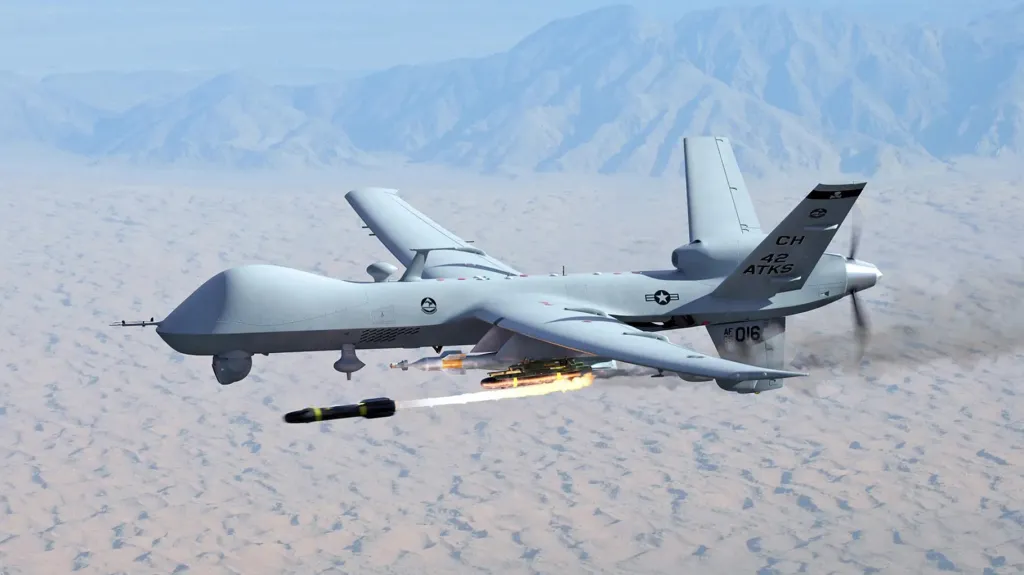
After reportedly losing dozens of MQ-9 Reaper drones while battling Iran, the Air Force on Friday confirmed to TWZ that it is planning to purchase an undisclosed number of unused ones from General Atomics, who made the aircraft. The company, however, said it has less than 10 of these drones to offer, and it remains unclear where else the Air Force can find more.

All of this continues to raise serious questions about the Air Force’s near-term ability to plug gaps left by the losses fighting against Iran and in other recent operations in and around the Middle East. The downed Reapers have a reported combined value of about $1 billion.

The Air Force has reportedly lost dozens of MQ-9 Reaper drones. (USAF)

Furthermore, despite the top Air Force officer recently praising Reaper as “perhaps the most valuable player” in the air war against Iran, the aircraft have been in the crosshairs of service officials. They have openly questioned the drone’s survivability and, by extension, general value in future operations. The Air Force has made several half-hearted efforts, without success, to find a successor. It is now in the early stages of a new attempt at acquiring an “MQ-9 Next.” You can read more about that effort in our story here.

An MQ-9 Reaper. (USAF)

It will be years, if ever, before “MQ-9 Next” comes online. Meanwhile, the search is on for existing replacements.

“The USAF intends to purchase several unused MQ-9A Block 5 from GA-ASI [General Atomics Aeronautical Systems, Inc.],” a spokesperson for the service told TWZ today. “A number of MQ-9A Block 5 aircraft were manufactured based on forecasted purchases for other customers but are no longer needed. The available aircraft are currently GA-ASI owned aircraft.”

“The USAF has received funds to begin the acquisition process,” they added.

A U.S. Air Force service member assigned to the 46th Expeditionary Attack Squadron, conducts pre-flight checks on an MQ-9 aircraft in preparation for an Operation Agile Spartan mission departing from Ali Al Salem Air Base, Kuwait, August 21, 2023. This MQ-9 and three others conducted the 386 AEW's first full air tasking order (ATO) cycle using satellite launch and recovery (SLR), providing crucial time-sensitive intelligence, surveillance and reconnaissance to leaders throughout the CENTCOM area of responsibility. (U.S. Air Force photo by Tech. Sgt. Isaac Garden)
A U.S. Air Force service member assigned to the 46th Expeditionary Attack Squadron, conducts pre-flight checks on an MQ-9 aircraft in preparation for an Operation Agile Spartan mission departing from Ali Al Salem Air Base, Kuwait, August 21, 2023. (U.S. Air Force photo by Tech. Sgt. Isaac Garden) Tech. Sgt. Isaac Garden

The Air Force was responding to our questions about congressional testimony from a top officer highlighting the service’s plans to backfill the combat losses. 

“We’re looking at options to buy back as many of the MQ-9As as we possibly can right now,” Air Force Lt. Gen. David Tabor, Deputy Chief of Staff for Plans and Programs, had told members of Congress at a hearing back on May 13. “So there’s a bit of a short-term effort to buy back things immediately, in this fiscal year.”

Tabor also said at that time that the Air Force’s total MQ-9A fleet had shrunk to 135 aircraft. Official budget documents say the Air Force had 165 Reapers in inventory as of the start of Fiscal Year 2026, which began on October 1 of last year. This had already marked a significant year-over-year decrease, down from 231 MQ-9As at the beginning of Fiscal Year 2025.

Despite Air Force needs, General Atomics told us the number of available Reapers is in short supply.

“Between parts in stock for new builds, and company-owned Reapers with some number of flight hours on them, there are less than 10 total ‘new’ MQ-9As available to any customers anywhere in the world,” General Atomics spokesperson C. Mark Brinkley told TWZ earlier this week. “There are some number of decommissioned Reapers out there, and some number of those could potentially be brought back into service.”

MQ-9A Reaper in flight. (General Atomics)

One place the Air Force won’t be able to find any Reapers is in storage. 

The 309th Aerospace Maintenance and Regeneration Group (The Boneyard) has zero MQ-9s in storage nor have they ever regenerated a MQ-9 back into service,” the spokesperson told us.

The MQ-9A is out of production. General Atomics has moved on to the MQ-9B, and currently offers those drones in multiple configurations. Though an evolution of the original Reaper, the core B model design differs in significant ways from its predecessor. Any new Air Force purchases of drones in this broader family would have to be of the B model and worked into the existing production schedule.

How many MQ-9As the Air Force has lost in operations in and around the Middle East since January 2025 is unclear, but is understood to be substantial. As of May, “nearly 30 MQ-9 Reapers have been lost in the course” of Operation Epic Fury against Iran, Air & Space Forces Magazine reported, citing “people familiar with the matter.” This is on top of dozens of Reapers reportedly downed while conducting operations targeting Iranian-backed Houthi militants in Yemen in the past year or so.

At the hearing last month, Tabor did not provide any official accounting of Reaper losses, but did acknowledge that “we are concerned about how they’ve attrited.”

In another effort to bolster the supply of operational Reapers, the Air Force told us that while it never regenerated MQ-1 Predator drones back into service, it was repurposing parts from these aircraft that the service stopped using in 2020. There were dozens on hand after they were retired.

More than 50 were sent to the 309th Aerospace Maintenance and Regeneration Group (AMARG) “and heavily cannibalized for spare parts for the MQ-9 aircraft,” the spokesperson told us.

An MQ-1 Predator flies above the flight line during launch and recovery training at Creech Air Force Base, Nev. Aircrew will fly the MQ-1 for the final time at Creech on March 9, 2018 before it is officially retired from the Air Force inventory. (U.S. Air Force photo by Senior Master Sgt. Cecilio Ricardo)
An MQ-1 Predator flies above the flightline during launch and recovery training at Creech Air Force Base, Nev. Aircrew will fly the MQ-1 for the final time at Creech on March 9, 2018, before it is officially retired from the Air Force inventory. (U.S. Air Force photo by Senior Master Sgt. Cecilio Ricardo) Senior Master Sgt. Cecilio Ricardo

Questions about the status of the MQ-1 fleet arose last week after U.S. Central Command (CENTCOM) acknowledged the loss of an “MQ-1” drone to Iranian fire. This has led many to question whether American forces are flying the venerable Predator again as a result of the Reaper losses.

At the time, the Air Force declined to say if it lost any of theirs and referred us to CENTCOM, which declined comment. However, on Friday, the Air Force told us that in addition to the Predators being used for parts, 20 had been transferred to the Navy. We reached out to them for comment. 

As we previously noted, it is also very possible, if not likely, that the uncrewed aircraft in question was an MQ-1C Gray Eagle, a related but different design still in active U.S. Army service. You can read more about this event in our original story here.

A U.S. Army MQ-1C seen being prepared for a mission somewhere in the Middle East on April 18, 2026. The official caption for this picture erroneously says the drone is an MQ-1 Predator. USAF/Master Sgt. James Cason

At the time of the incident, CENTCOM declined to tell us which variant of the MQ-1 was lost.

Regardless, the Air Force’s mad scramble to find additional Reapers highlights the value of having a high-flying, long-loitering drone that can gather intelligence and fire off munitions, no matter how slow it flies.

Contact the author: howard@twz.com

Howard is a Senior Staff Writer for The War Zone, and a former Senior Managing Editor for Military Times. Prior to this, he covered military affairs for the Tampa Bay Times as a Senior Writer. Howard’s work has appeared in various publications including Yahoo News, RealClearDefense, and Air Force Times.


Joseph has been a member of The War Zone team since early 2017. Prior to that, he was an Associate Editor at War Is Boring, and his byline has appeared in other publications, including Small Arms Review, Small Arms Defense Journal, Reuters, We Are the Mighty, and Task & Purpose.


Source link