Marines Realize They Can’t Depend On Army For Ballistic Missile Defense
The U.S. Marine Corps is exploring the possibility of fielding a theater ballistic missile defense capability. A key driver in this discussion is the U.S. Army’s capacity to provide protection against ballistic threats in future conflicts, or lack thereof, something TWZ has highlighted repeatedly in the past. The latest conflict with Iran has underscored the serious threats that ballistic missiles pose even to high-end integrated air and missile defense networks, which would be magnified further in a fight against a near-peer adversary like China.
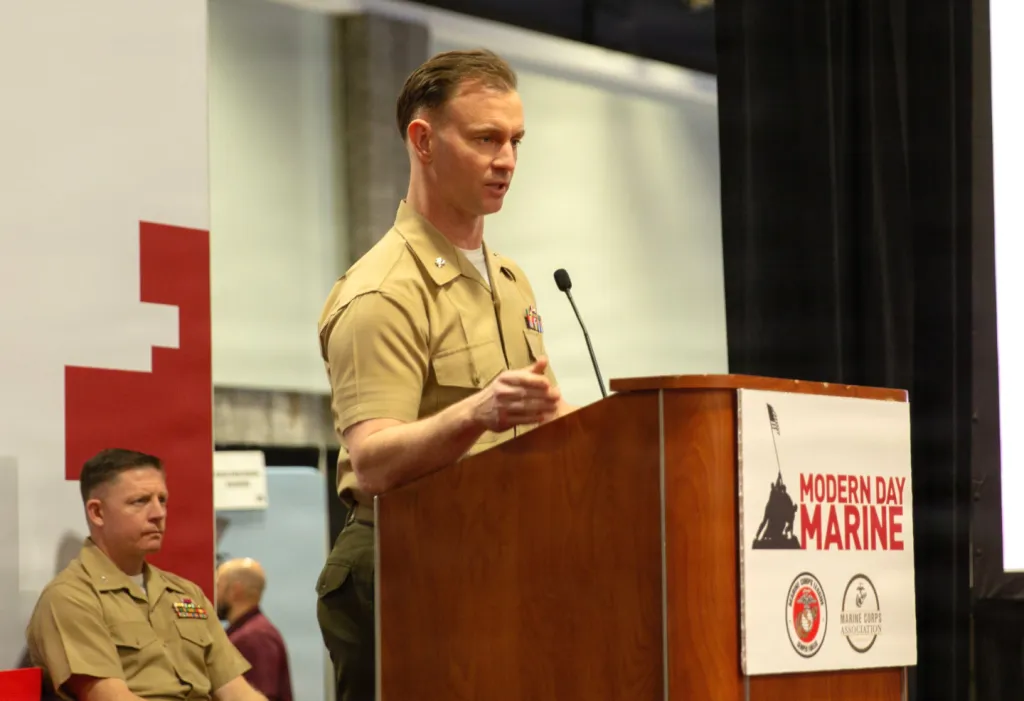
“We’re exploring theater ballistic missile defense. So we’re doing some studies, we’re running some simulations, to see if that’s a requirement for the service in the future,” Marine Lt. Col. Robert Barclay said during a panel discussion yesterday at the annual Modern Day Marine exposition, at which TWZ has been in attendance.

Barclay is currently the Marine Air Command and Control Systems (MACCS) Integration Branch Head within the Aviation Combat Element Division of the service’s Combat Development and Integration office. His portfolio includes service-wide air and missile defense requirements.
“We know our old sensor used to be able to do it, but it wasn’t really a requirement,” Barclay added. “What we need to determine is, is [defending against] a theater ballistic [missile] like an SRBM [short-range ballistic missile] or MRBM [medium-range ballistic missile], a requirement for the Marine Corps to do? I would argue that it probably is.”
“At the end of the day, I don’t think the Army’s going to have enough capacity with us where we’re operating to actually adjudicate on that threat,” he continued. “So, I think we need to take a hard look at that, and that’s what our intent [is] to do over the next year.”
To take a step back quickly, the Marine Corps’ main general-purpose ground-based anti-air weapon today is the Stinger short-range heat-seeking surface-to-air missile. The service currently fields Stinger in a man-portable air defense system (MANPADS) configuration using shoulder-fired launchers, as well as integrated on the Humvee-based Avenger air defense vehicles. Stinger offers a point defense capability against fixed-wing aircraft, helicopters, drones, and certain types of cruise missiles.

The Marines also hope to reach initial operational capability this year with a new Medium-Range Intercept Capability (MRIC), which is a service-specific variation of the Israeli Iron Dome system. MRIC uses a U.S.-made version of Iron Dome’s Tamir interceptor, called SkyHunter, and a trailer-based road-mobile launcher. Each launcher can accommodate up to 20 interceptors, which come preloaded in individual canisters, at a time. The system uses offboard sensors to spot and track targets and cue missiles to intercept them. The Corps’ existing AN/TPS-80 Ground/Air Task-Oriented Radars (G/ATOR) have been presented as the primary sensor for MRIC.

“The primary target set for MRIC is cruise missiles and your higher-end Group 5-type of [anti-]air application, as well as rotary wing, fixed-wing type of aspects,” Marine Col. Andrew Konicki, the service’s Program Manager for Ground Based Air Defense and another panelist at Modern Day Marine yesterday, explained. MRIC “can go after Group 3, because it’s probably a mismatch in terms of ammunition versus what it’s going after. So it’s primarily focused on that growing threat, or that higher-end threat, so to speak, as part of that integrated air missile defense application and layer defense piece.”
Groups 3 and 5 here refer to different categories of uncrewed aerial systems. The U.S. military defines Group 5 as consisting of drones with maximum weights greater than 1,320 pounds, and that can fly above 18,000 feet. The MQ-9 Reaper is a commonly used example of a Group 5 uncrewed aircraft. Drones that fall under Group 3 have maximum weights anywhere between 56 and 1,320 pounds, can operate at altitudes between 3,500 and 18,000 feet, and reach top speeds of up to 250 knots. Group 3 is very broad, but notably includes Iran’s now-infamous Shahed 136 long-range kamikaze drone, and the growing number of variants and derivatives thereof.
Lt. Col. Robert Barclay’s mention of an unspecified previous Marine ballistic missile defense capability seems most likely to be a reference to the HAWK medium-range surface-to-air missile system. The service retired HAWK in the 1990s, but versions of the system remain in use elsewhere worldwide, including in Ukraine. HAWK has used an evolving mixture of radars for target acquisition and engagement since the system was first introduced in the 1950s, as you can read more about here. Improved HAWK interceptors have also been developed, including variants explicitly intended to offer a rudimentary anti-ballistic missile capability.
The video below shows HAWK systems in service in Ukraine.

Американський ЗРК HAWK (Яструб) захищає небо України!
Barclay did not elaborate on what level of ballistic missile defense capability the Marine Corps might look to pursue in the future. In the past year or so, there have been reports of Israel using Iron Dome against incoming Iranian ballistic missiles in the terminal phase. However, the system’s effectiveness against ballistic missiles of any kind, which it was never designed to intercept, and whether the Marines might be able to employ MRIC in this role, is unclear.
Today, the main tool for providing ground-based theater ballistic missile defense across all of America’s armed forces is the Army’s Patriot surface-to-air missile systems. The Army also operates the Terminal High Altitude Area Defense (THAAD) system, which offers a higher-end ballistic missile defense capability over Patriot. Both Patriot and THAAD are only capable of intercepting incoming ballistic threats during their final terminal phase.

The PATRIOT Missile in Action
At the same time, as TWZ has highlighted several times in recent years, the Army’s Patriot force is heavily strained due to constant demands that it is simply not adequately resourced to meet. The THAAD force is even smaller and is in equally heavy demand.

The latest conflict with Iran has reignited discussions about the Army’s worryingly limited capacity to meet operational needs for ballistic missile defense, as well as protection against other aerial threats. Between February and April, Iranian forces launched repeated missile and drone attacks on key bases across the Middle East. They were successful in many instances in targeting high-value military assets, including aircraft parked on the ground and air and missile defense radars.
The conflict with Iran also put a new spotlight on concerns about the depth of American stockpiles of air and missile defense interceptors, and the ability to replenish them quickly. Pressure on Patriot and THAAD units would be even more pronounced in a high-end fight, such as one across the broad expanses of the Pacific against China.
The Army has been trying to take steps to rectify these issues, including efforts underway now to expand the size and capabilities of the Patriot force. The U.S. military, overall, has been pushing industry to ramp up capacity to produce air and missile defense interceptors, as well as other critical munitions. At the same time, it will take years to fully achieve these aims.
Still, as Lt. Col. Barclay noted yesterday, questions about Army air and missile defense capacity remain, especially in the context of the Marine Corps’ broader vision for future operations. The service’s current core focus is on preparing for expeditionary and distributed operations involving the relatively rapid deployment and redeployment of forces between forward operating locations that could be well within reach of enemy standoff strikes. The Marines, like the other services, also have large established facilities that would need defending in any major conflict scenario.
The ballistic missile threat ecosystem is also not static. This is underscored by Iran’s recent use of ballistic missiles with cluster munition warheads, which are also designed to release their payloads at very high altitudes, as a way to consistently get around Israeli terminal defenses. TWZ previously explored the very serious broader implications of this in a feature you can find here.
China, in particular, continues to expand on its already diverse arsenal of ballistic missiles. Earlier this month, North Korea also notably tested a ballistic missile with a new cluster munition warhead. These developments are just some examples of a broader surge in ballistic missile developments globally in recent years. Those capabilities continue to proliferate to smaller nation-state militaries and even non-state actors.
Ballistic missiles would be only one part of the threat picture in any future high-end fight. The development of new hypersonic weapons, as well as advanced cruise missiles, continues worldwide. There has also been an explosion in the development and adoption of long-range one-way attack drones like the aforementioned Shahed 136, a trend that now also includes the United States.
“I would argue that the adversary is not just going to throw drones at you. We’re going to have other threats in the future,” Lt. Col. Barclay stressed during yesterday’s panel, which was focused primarily on ongoing efforts to counter uncrewed aerial threats. “You’re going to see probably TBM [theater ballistic missiles], ballistic missiles, coming at you as well in a variety of other types of threats.”
With all this in mind, a new, organic theater ballistic missile capability may now be on the horizon for the U.S. Marine Corps.
Contact the author: joe@twz.com