rationale

‘Act of war’: Expert rejects Trump rationale for Venezuela attack | News

US President Donald Trump and his allies have defended the US attacks on Venezuela and the removal of President Nicolas Maduro from power amid widespread condemnation that the actions violate international law.

Trump told reporters on Saturday that Maduro was “captured” after US military strikes on the Venezuelan capital, Caracas, for carrying out a purported “campaign of deadly narco-terrorism against the United States”.

Recommended Stories

list of 3 itemsend of list

He said the US government would “run” the South American country during a political transition, promising the Venezuelan people that they would become “rich, independent and safe”.

But Claire Finkelstein, a professor of law at the University of Pennsylvania, has rejected the Trump administration’s arguments in defence of the attacks and removal of Maduro, as well as its plans to exert control over Venezuela.

“I don’t think there’s any basis under international law for the action that occurred overnight by the US government,” Finkelstein told Al Jazeera, describing the attacks as an “illegal use of force [and] a violation of Venezuelan sovereignty”.

“Maduro has personal jurisdiction rights, so not only is it a violation of Venezuelan sovereignty, but it’s a violation of his personal, international rights,” she said.

Numerous statutes of international law – including the UN Charter – prohibit states from attacking another country without provocation.

“All Members shall refrain in their international relations from the threat or use of force against the territorial integrity or political independence of any state, or in any other manner inconsistent with the Purposes of the United Nations,” the UN Charter says.

The US actions came amid a months-long pressure campaign against Maduro, whom the Trump administration accused, without evidence, of being linked to drug traffickers.

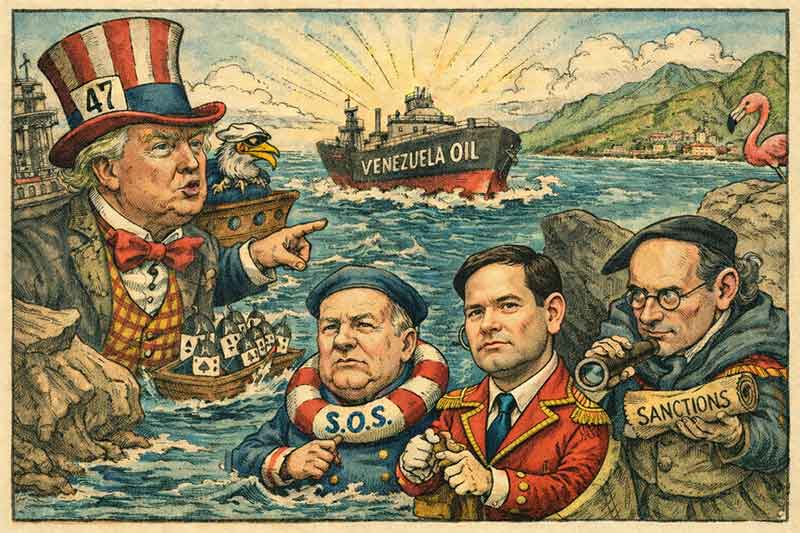
Washington had carried out deadly strikes on alleged drug-smuggling boats in the Caribbean, seized vessels carrying oil off the Venezuelan coast, sanctioned members of Maduro’s family, and threatened to launch attacks on the country’s soil.

“Nicolas Maduro wasn’t just an illegitimate dictator, he also ran a vast drug-trafficking operation,” US Congressman Tom Cotton, a top Trump ally, wrote on social media on Saturday, welcoming the moves against the Venezuelan leader.

Before he was seized, Maduro had said he was open to dialogue with the US on drug trafficking. He also had accused the Trump administration of seeking to depose him and seize control of Venezuela’s vast oil reserves.

‘No imminent threat’

Democratic Party lawmakers in the US had been demanding answers from the Trump administration about its aims in Venezuela, accusing the Republican president of seeking to unlawfully carry out acts of war without congressional oversight.

Under the US Constitution, only Congress has the power to declare war.

But that authority has been weakened over the last several decades, with the US carrying out military strikes around the world during its so-called “war on terror” based on loosely-interpreted congressional authorisations.

On Saturday, Gregory Meeks, the top Democrat on the House of Representatives Foreign Affairs Committee, said that, despite the Trump administration’s claims, “there was no imminent threat to the United States” from Venezuela, “certainly not one that justified military action without congressional authorization”.

“These actions violate both US and international law and, by Trump’s own admission, this is not a limited operation,” Meeks said in a statement shared on social media.

This was echoed by the University of Pennsylvania’s Finkelstein, who said there was no “immediate threat” to the US that would justify the executive branch carrying out attacks without notifying Congress.

“It was an act of war against Venezuela, and we did not have the kind of self-defence justification that would normally justify bypassing Congress,” she told Al Jazeera.

“Even if you believe the US is at grave danger because of drug trafficking, there isn’t the kind of imminence there that would justify the president moving unilaterally and not turning to Congress and trying to get them on board.”

Finkelstein also rejected Trump’s plans for the US to “run” Venezuela as “incredibly illegal”.

“States have sovereignty rights, and you cannot just invade them and take them over,” she said.

“Even if Maduro were to fall of his own accord and we had not brought that about, we don’t have the right to go in and start running their government,” Finkelstein said.

“Democracy is premised on the idea that the people are sovereign and the people choose their own leaders, and that’s something we should be promoting in Latin and South America, not trying to undermine.”
Source link

US Blockades Venezuela in a War Still Waiting for an Official Rationale

The Trump administration has shifted from a “narcoterrorism” campaign to economic coercive measures. (Countercurrents)

In our Donald-in-Wonderland world, the US is at war with Venezuela while still grasping for a public rationale. The horrific human toll is real – over a 100,000 fatalities from illegal sanctions and over a hundred from more recent “kinetic strikes.” Yet the officially stated justification for the US empire’s escalating offensive remains elusive. 

The empire once spun its domination as “democracy promotion.” Accordingly, State Department stenographers such as The Washington Post framed the US-backed coup in Venezuela – which temporarily overthrew President Hugo Chávez – as an attempt to “restore a legitimate democracy.” The ink had barely dried on The New York Timeseditorial of April 13, 2002 – which legitimized that imperial “democratic” restoration – before the Venezuelan people spontaneously rose up and reinstated their elected president.

When the America Firsters captured the White House, Washington’s worn-out excuse of the “responsibility to protect,” so beloved by the Democrats, was banished from the realm along with any pretense of altruism. Not that the hegemon’s actions were ever driven by anything other than self-interest. The differences between the two wings of the imperial bird have always been more rhetorical than substantive. 

Confronted by Venezuela’s continued resistance, the new Trump administration retained the policy of regime change but switched the pretext to narcotics interdiction. The Caribbean was cast as a battlefield in a renewed “war on drugs.” Yet with Trump’s pardon of convicted narco-trafficker and former Honduran President Juan Orlando Hernández – among many other contradictions – the alibi was wearing thin.

Venezuelan oil tankers blockaded

The ever-mercurial US president flipped the narrative on December 16, announcing on Truth Social that the US would blockade Venezuelan oil tankers. He justified this straight-up act of war with the striking claim that Venezuela had stolen “our oil, our land, and other assets.”

For the record, Venezuela had nationalized its petroleum industry half a century ago. Foreign companies were compensated.

This presidential social media post followed an earlier one, issued two weeks prior, ordering the airspace above and surrounding Venezuela “closed in its entirety.” The US had also seized an oil tanker departing Venezuela, struck several alleged drug boats, and continued to build up naval forces in the region.

In response to the maritime threat, President Nicolás Maduro ordered the Venezuelan Navy to escort the tankers. The Pentagon was reportedly caught by surprise. China, MexicoBrazil, BRICS, Turkey, along with international civil society, condemned the escalation. Russia warned the US not to make a “fatal mistake.”

The New York Times reported a “backfire” of nationalist resistance to US aggression among the opposition in Venezuela. Popular demonstrations in support of Venezuela erupted throughout the Americas in Argentina, Panama, Ecuador, Peru, Mexico, Brazil, Colombia, Honduras, and the US.

Trump’s phrasing about Venezuela’s resources is not incidental. It reveals an assumption that precedes and structures the policy itself: that Venezuelan sovereignty is conditional, subordinate to US claims, and revocable whenever it conflicts with Yankee economic or strategic interests. This marks a shift in emphasis, not in substance; drugs have receded from center stage, replaced by oil as the explicit casus belli.

The change is revealing. When Trump speaks of “our” oil and land, he collapses the distinction between corporate access, geopolitical leverage, and national entitlement. Venezuelan resources are no longer considered merely mismanaged or criminally exploited; they are portrayed as property wrongfully withheld from its rightful owner.

The day after his Truth Social post, Trump’s “most pointless prime-time presidential address ever delivered in American history” (in the words of rightwing blogger Matt Walsh) did not even mention the war on Venezuela. Earlier that same day, however, two House resolutions narrowly failed that would have restrained Trump from continuing strikes on small boats and from exercising war powers without congressional approval.

Speaking against the restraining resolutions, Rep. María Elvira Salazar – the equivalent of Lewis Carroll’s Red Queen and one of the far-right self-described “Crazy Cubans” in Congress – hailed the 1983 Grenada and 1989 Panama invasions as models. She approvingly noted both were perpetrated without congressional authorization and suggested Venezuela should be treated in the same way.

The votes showed that nearly half of Congress is critical – compared to 70% of the general public – but their failure also allows Trump to claim that Congress reviewed his warlike actions and effectively granted him a mandate to continue.

Non-international armed conflict

In this Trumpian Wonderland, a naval blockade with combat troops rappelling from helicopters to seize ships becomes merely a “non-international armed conflict” not involving an actual country. The enemy is not even an actual flesh and blood entity but a tactic – narco-terrorism.

Trump posted: “Venezuelan Regime has been designated a FOREIGN TERRORIST ORGANIZATION.” Yet FTOs are non-state actors lacking sovereign immunities conferred by either treaties or UN membership. Such terrorist labels are not descriptive instruments but strategic ones, designed to foreclose alternatives short of war.

In a feat of rhetorical alchemy, the White House designated fentanyl a “weapon of mass destruction.” Trump accused Venezuela of flooding the US with the deadly synthetic narcotic, when his own Drug Enforcement Administration says the source is Mexico. This recalls a previous disastrous regime-change operation in Iraq, also predicated on lies about WMDs.

Like the Cheshire Cat, presidential chief of staff Susie Wiles emerges as the closest to a reliable narrator in a “we’re all mad here” regime. She reportedly said Trump “wants to keep on blowing boats up until Maduro cries uncle,” openly acknowledging that US policy has always been about imperial domination.

The oil is a bonus for the hegemon. But even if Venezuela were resource-poor like Cuba and Nicaragua, it still would be targeted for exercising independent sovereignty.

Seen in that light, Trump’s claim that Venezuela stole “our” oil and land is less an error than a confession. It articulates a worldview in which US power defines legitimacy and resources located elsewhere are treated as imperial property by default. The blockade is not an aberration; it is the logical extension of a twisted belief that sovereignty belongs to whoever is strong enough to seize it. Trump is, in effect, demanding reparations for imperialists for the hardship of living in a world where other countries insist their resources belong to them.

Roger D. Harris is a founding member of the Venezuela Solidarity Network and is active with the Task Force on the Americas and the SanctionsKill Campaign.

Source: Countercurrents

Source link