F-35s Quarterbacking Drones Seen As Gateway To USMC’s 6th Gen Fighter
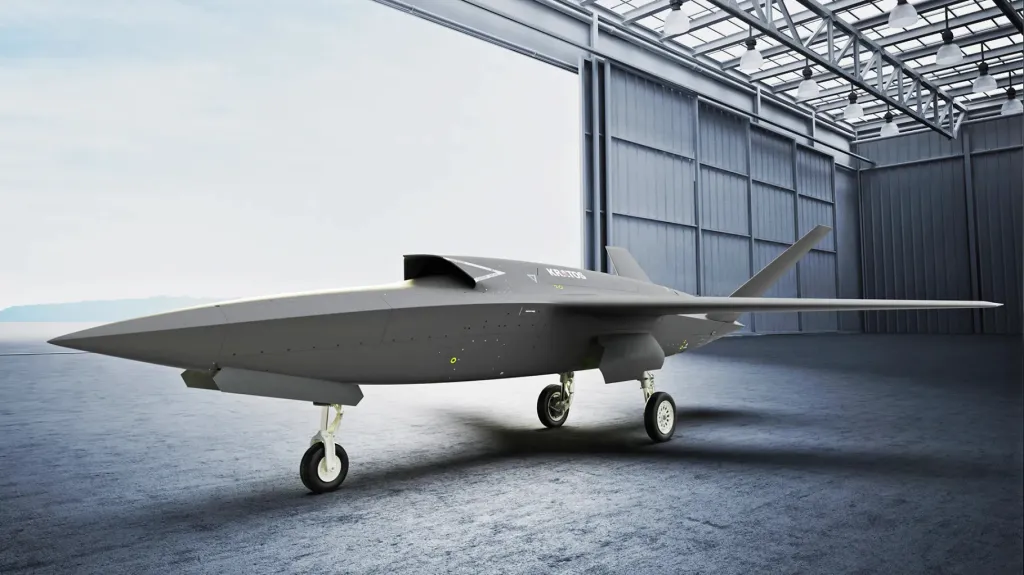
The U.S. Marine Corps says it is making good progress toward fielding Collaborative Combat Aircraft (CCA) type drones, starting with a landing gear-equipped version of Kratos’ XQ-58 Valkyrie. The service sees those aircraft, and potentially other CCAs, paired with its F-35s as a “bridge” to an entire family of next-generation air combat capabilities, which could include a sixth-generation crewed fighter.
Marine officials discussed the service’s CCA plans and broader future aviation vision during a panel discussion at the Navy League’s Sea Air Space 2026 exhibition, at which TWZ is in attendance. The Corps’ CCA efforts currently fall under a program called Marine Air-Ground Task Force (MAGTAF) Uncrewed Expeditionary Tactical Aircraft (MUX TACAIR). The MAGTAF is the primary organizing concept around which the service deploys air and ground forces.
“So, with the MUX TACAIR effort, I think we’re meeting our testing goals. I would say that it’s on track,” Marine Col. Dan Weber, the Unmanned Aerial Systems Branch Head in the office of the Deputy Commandant for Aviation, said. “From a funding and demand power perspective, I think we’ve got great support. We’ve got good partners. We’ve got good relationships right now to keep that program on track, and I expect that we’re going to meet all of our milestones and goals.”

“From the F-35 side, the vision ultimately is we want the F-35 to be a quarterback with CCAs as attritable mass, as enablers to ensure the MAGTAF can project power, the sensing, the lethality, [and] all of the intangibles that kind of go along with that,” Marine Col. Thomas Bolen, the Tactical Aviation (TACAIR) Branch Head, another one of the panelists, also said. “How we integrate with CCAs is going to be extremely important, and that will bridge us down the road to kind of the sixth-generation family of systems.”
One of the “main things in our portfolio that will be enduring and developing over the next couple years” is “man-unmanned teaming,” Marine Col. Richard Rusnok, head of the Cunningham Group, who was also on the panel, added. “We’re laying the foundation for that with our first foray into Collaborative Combat Aircraft, the MQ-58.”
The Cunningham Group, which also falls under the office of the Deputy Commandant for Aviation, is charged with plotting out the overarching future vision for Marine Corps aviation.
MQ-58 refers to Marine-specific variants of Kratos’ Valkyrie now in development. Last year, the Corps announced that it was transitioning what had originally been experimental work with a small fleet of XQ-58s into a full program of record to acquire an operational platform. Kratos has since partnered with Northrop Grumman to deliver these uncrewed aircraft.

Marine Valkyries will have built-in landing gear, unlike the original version of the drone, but will still be capable of making rocket-assisted takeoffs from static launchers. This means the uncrewed aircraft will retain a valuable degree of runway independence, but that there will also be tradeoffs, as TWZ has previously explored here.
In January, Kratos told TWZ it was hoping to see the first flight of a landing gearing-equipped Valkyrie in early 2026, but there has been no official announcement yet of that milestone being reached. The Marine Corps’ unclassified 2026 Aviation Plan presents the MQ-58 as a capability arriving in the 2026 to 2030 timeframe.

The Marines have also said previously that they expect the MQ-58 to be just the first in a planned series of CCA “increments,” which might entail the future acquisition of completely different types of drones. The service has said in the past that MUX TACAIR, broadly speaking, “will enhance Marine Corps Aviation’s lethality and ability to support the Stand-in Force (SiF) by delivering air-to-ground, reconnaissance, and Electronic Warfare (EW) capabilities.”
The Corps has also already chosen to use General Atomics’ YFQ-42A Dark Merlin at least as a surrogate to test new autonomy technologies and other mission systems under the umbrella of the MUX TACAIR program. The YFQ-42A is also one of two drones under development as part of Increment 1 of the U.S. Air Force’s CCA program. Dark Merlins have been flying since August 2025, but General Atomics announced an indefinite pause in flight activities earlier this month after one of the drones suffered an accident on takeoff.

Speaking on the panel today, Col. Thomas Bolen did not elaborate on what the Marine Corps’ “sixth-generation family of systems” might consist of. However, Marine Lt. Gen. William Swan, the Deputy Commandant for Aviation, said his service was beginning to explore what it might want in a future sixth-generation crewed combat jet during a press roundtable last week, as first reported by Breaking Defense.
“Last year’s Av[iation] Plan didn’t have six-gen on there, and I made the team put it on, because we need to think about that,” Swan said at that time. “We’re not there yet. We’re fast following with the Air Force, right? They got the F-47. The Navy’s looking at F/A-XX, and they’re just starting on that. So we are going to watch.”

“We want to be an all Block 4 F-35 fleet, and that’s probably going to take another 10 years. So we’re probably five to 10 years away from ultimately making that decision. And we’ll see what they have, see what the threat looks like,” Swan continued. “I think right now, if you had to say, ‘hey, what is it going to look like?’, I think it’ll look a lot more like what the Navy’s doing, because we still fly off the carriers, we’re part of the Department of the Navy.”
“I don’t know that we’re going to get high-end, and that’s really not a Marine Corps mission; it’s the Air Force,” he added. “So I think if I had to – if you said, make a decision right now, it would be yes, some amount to augment the fifth-gen [F-35] force, and it would probably look something like the F/A-XX, or whatever the Navy ends up being [sic; acquiring].”

Lt. Gen. Swan, who served as the moderator for today’s panel at Sea Air Space, as well as Col. Bolen, again stressed the importance of the Block 4 upgrades for the F-35, including for future teaming with CCAs. The Block 4 effort has been mired in delays and cost growth, even after a revision in the fielding strategy last year to focus first on a truncated portion of the planned capability improvements. The full package for all three Joint Strike Fighter variants is eventually expected to include a new AN/APQ-85 radar and electronic warfare suite, replacements for the AN/AAQ-37 Distributed Aperture System (DAS) and Electro-Optical Targeting System (EOTS), and a host of other improvements. A particular point of concern now is that new production F-35s might soon start being delivered without any radars at all, as a result of issues tied to the development of the APG-85.
As the Marine’s top aviation officer noted last week, it could be 10 years before his service at least sees all of its F-35s fully upgraded to the Block 4 standard. That, in turn, could have serious impacts on the service’s broader plans to acquire and field new crewed and uncrewed aircraft.

Marine Corps interest in whatever the Navy chooses for F/A-XX could be an important factor for the future of that program, as well. In response to a question from TWZ at a roundtable on the sidelines of Sea Air Space this morning, Chief of Naval Operations Adm. Daryl Caudle said he is now hoping to see the selection of the winning design in the F/A-XX competition by August. The program has been in bureaucratic purgatory since the Pentagon moved to effectively shelve it indefinitely last year, with Congress subsequently intervening to keep it funded. How the Navy’s next-generation carrier-based fighter plans will proceed now still very much remains to be seen.
If nothing else, the vision the Marines have put forward today clearly frames Block 4 F-35s ‘quarterbacking’ fleets of CCAs as a key stepping stone to the service’s next-generation aviation capabilities.
Contact the author: joe@twz.com