The Centrality of India-US Ties in Shaping Quad’s Future
With its recent Foreign Ministers’ meeting in Delhi, the Quad has again shown it remains active, defying widespread rumours of collapse.
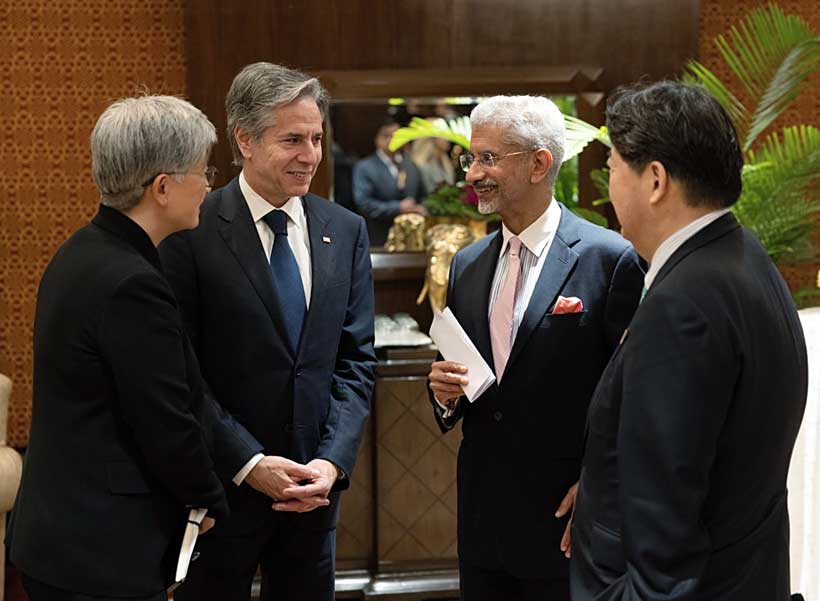
While the Japanese and Australian foreign ministers highlighted their countries’ strong relations with India and the Quad’s central role in shaping the Indo-Pacific security architecture, Marco Rubio’s four-day visit to India was the most noteworthy aspect, as he repeatedly emphasized the significance of Indo-US relations.
Speculations about the Quad’s potential dissolution, reminiscent of developments in the 2000s, were fuelled by the postponement of the leaders’ summit, President Trump’s apparent lack of interest, and a more conciliatory approach toward China. Even so, the meeting reaffirmed the US’s ongoing engagement in the region and its support for the Quad.
The Quad’s momentum currently faces its principal challenge not from India’s or the US’s relations with Australia and Japan, but from a complicated Indo-US relationship.
Two factors show why India-US relations are central to the Quad’s minilateral framework.
Over the past year, India has faced unprecedented criticism from the US administration, particularly from President Trump, who has been critical of India on trade and security fronts. Issues such as tariff disputes, H-1B visa restrictions affecting Indian professionals, deepening US relations with the Pakistan Army, and increased US involvement in Bangladesh and Nepal have contributed to growing distrust about the US’s willingness to cooperate with India and promote stability in the Indo-Pacific.
In response to several contentious statements by President Trump directed at India, Rubio’s visit served as a diplomatic effort to restore bilateral relations. His repeated emphasis on India’s role as a strategic partner signalled a commitment to improving ties. While a single visit cannot resolve all tensions from the past year, it reassures India and reduces the risk of further deterioration.
The Quad Foreign Ministers’ meeting became feasible only after India and the US undertook concerted efforts to revive bilateral relations. Notable examples include India’s invitation to the US to attend the AI Impact Summit in February 2026, ongoing trade agreement negotiations, and the US decision to invite India to the Pax Silica initiative. The meeting occurred only after a certain level of normalization had been achieved. Even so, a leaders’ summit is unlikely unless President Trump and Prime Minister Modi demonstrate a clear commitment to advancing India-US relations.
Second, without proactive American engagement, Japan, Australia, and India may develop their own trilateral regional strategies, perhaps with some Southeast Asian countries such as Indonesia, the Philippines, and Singapore. However, the impact of such an alternative would be limited and localized. Japan could take a greater role in sustaining and rebuilding regional economic frameworks, replicating the Trans-Pacific Partnership experiment. Still, due to constitutional and capacity constraints, Tokyo is unlikely to replace Washington as the region’s primary security guarantor soon.
Although the Quad’s resilience is maintained by the agency and commitment of Australia, India, and Japan rather than by exclusive US leadership, strong US involvement in the Indo-Pacific security mechanism will remain a cornerstone of the Indo-Pacific architecture.
China’s persistent assertive behaviour remains the central factor. It continues to employ coercive tactics and expand its influence in regions critical to the US and its partners, so the original motivations for revitalizing the Quad remain relevant. Although the US approach to China is evolving, the fundamental dynamics of US-China relations remain unchanged. In the long term, Washington will require frameworks such as the Quad to maintain stability in the Indo-Pacific and prevent the erosion of its strategic influence. Consequently, the Quad is likely to remain central to regional strategy, with India as a key partner.
The US Deputy Secretary of State Christopher Landau’s statement that the US is not going to make the same mistakes with India that it made with China 20 years ago must not guide Indo-US relations. The US needs India as much as India needs the US, and unlike China, India-US relations rest on shared values – democracy, freedom of speech, multiculturalism, and a common vision of maintaining a rules-based liberal international order. Both countries require mutually beneficial cooperation to advance their strategic objectives. Other Quad members and Indo-Pacific stakeholders also depend on collaboration between Washington and New Delhi to maintain strategic equilibrium and preserve the bloc’s cohesion.
The US regards India as a responsible stakeholder and a regional counterweight to China, especially after the limited outcomes of President Trump’s recent visit to China. Conversely, India depends on the US for advanced technology, strategic investments, and long-term defense needs. This mutual dependence makes both countries indispensable to each other, and significant short-term trade diversification is unlikely. Even if achieved, it would likely harm both parties.
The US must strengthen its engagement in the Indo-Pacific by leveraging the Quad and its member states to develop an effective regional strategy. Closer strategic coordination among Quad partners, particularly with India, is essential to this effort.