A few hours after their season-ending defeat in the NFC championship game last January, the Rams boarded a plane for their flight home from Seattle.
Quarterback Matthew Stafford was seated a row in front of veteran receiver Davante Adams, who once again had fallen just short of finally reaching the Super Bowl.
“He’s turning around, he’s looking at me, like, ‘I’m sorry, man, I wanted that for you so bad,’” Adams recalled. “Not for him, but he wanted it for me.”
Adams, 33, is expected to get another shot at playing on the NFL’s biggest stage.
Since the Green Bay Packers selected him out of Fresno State in the second round of the 2014 draft, Adams has played in and lost five NFC championship games, including last season’s 31-27 defeat by the eventual Super Bowl-champion Seahawks.
Adams was visibly upset in the locker room — “a mess” he said — so he is aiming for a happier result if the Rams reach the conference championship game for the fourth time under coach Sean McVay.
Last season, his first with the Rams, Adams led the NFL with 14 touchdowns catches.
And that was after the three-time All-Pro got no training-camp reps with Stafford, who sat out because of a back issue.
Stafford, an 18th-year pro, and Adams struggled to consistently connect on the field through the first six games. But that changed when the Rams traveled to London to play the Jacksonville Jaguars.
McVay described what happened at Wembley Stadium as “a turning point” for Stafford and Adams.
Rams wide receiver Davante Adams jogs with the ball during training camp at Loyola Marymount on July 26.
(Robert Gauthier / Los Angeles Times)
In the 35-7 rout, Adams caught three touchdown passes, all from two yards or closer.
“They really hit their stride,” McVay said.
Adams was sidelined the next game and the final two games of the regular season because of a hamstring injury. He returned for the playoffs and made several huge plays, including a spectacular sideline catch in a divisional-round victory over the Chicago Bears in Chicago.
Last spring, with the Philadelphia Eagles shopping wide receiver A.J. Brown, McVay acknowledged that Adams’ name had come up in trade talks.
“It’s just the way that this business goes,” Adams said at the outset of training camp. “You gotta evaluate, you gotta look at certain things, and ultimately I’m still a Ram and I’m here and I’m happy to be here.”
Stafford and Adams had scheduled rest days during camp but they still got plenty of reps together as the Rams prepared for next month’s opener against the San Francisco 49ers in Australia.
“We’re getting a whole different start than what we did last year,” Adams said, adding, “Any time you can have these grinding days where you come out here, play ball and lock in on the details, that’ll help you be in a much better position when it’s time to really go.”
During the offseason, the Rams added All-Pro cornerback Trent McDuffie, cornerback Jaylen Watson and defensive end Myles Garrett, the reigning NFL defensive player of the year.
McDuffie and Watson have helped Adams and fellow star receiver Puka Nacua hone their skills.
“It’s the epitome of iron sharpens iron,” Adams said when asked about McDuffie.
For both.
Adams is the best route runner in the NFL, McDuffie said.
“The more we can keep ping-ponging back and forth against each other, the more we can keep rising our standard,“ McDuffie said. “It’s going to be a great year for both of us, so I enjoy it a lot.”
Despite being the oldest wide receiver on the roster — “This is dog years out here,” he said, laughing — Adams is learning from and being pushed by his younger teammates.
“I am the old man and I feel young because I can still go out there and do young-man stuff,” he said. “But then my body don’t necessarily feel the same way. … If I can continue to play at a high level, I’ll deal with the other stuff, whether it’s talking about me being old or a little bit of extra pain.
“It’s just a little extra work you have to do to come out of it.”
Davante Adams catches a pass at Rams training camp on July 26.
(Robert Gauthier / Los Angeles Times)
Stafford and Adams are aiming for a celebratory postgame exchange if the Rams once again reach the NFC championship.
Of his interaction with Adams on the plane after their loss to the Seahawks, Stafford noted that Adams had been a part of good teams that fell short of playing in the Super Bowl.
“As much as I wanted to go play in that game, and a lot of other guys did too, I wanted it more for other guys that haven’t either gotten the opportunity to be there or win it,” Stafford said, adding, “[It was] on my heart at the moment and I decided to tell him how I was feeling.”
Adams appreciated the sentiment from Stafford and all of his teammates.
“For them to feel that way about me and to care that much to want to get me a [Super] Bowl before I get out of here, it says a lot about who they are,” he said, “and a little bit about who I am.”
Wilfredo Engalla, a 51-year-old Filipino immigrant, alleged in a medical malpractice case that Kaiser doctors misdiagnosed him with colds and allergies for years before eventually informing him he had terminal lung cancer.
He died before his complaint could be heard by an arbitrator, which his Kaiser policy required. His case prompted a withering rebuke from the California Supreme Court, which said Kaiser’s system of arbitrating legal disputes was subject to long delays and unfair to its members. The year was 1997.
Nearly three decades after the landmark decision, the HMO giant — which made a series of sweeping reforms after the ruling — is once again facing questions over whether its arbitration system is stacked against the interests of its members.
Plaintiffs attorneys, legislators and patients say Kaiser’s private and confidential process for arbitrating legal disputes over medical care still has key flaws that favor Kaiser over patients bringing malpractice cases. The company insures about 25% of Californians, including some employees of the Los Angeles Times.
“Kaiser has really lost its way,” said Assemblyman Robert Garcia (D-Rancho Cucamonga). Garcia, who is a longtime Kaiser member, recently introduced a bill to require the California attorney general to oversee arbitrations mandated by any health plan.
Kaiser defended its arbitration system, saying in a statement that it was fair for both patients and the nonprofit.
Many companies and other organizations, including some hospitals, HMOs and physician groups, require their customers or patients to take their complaints to private arbitration rather than to court.
But unlike most other companies, which send claims to large arbitration firms, Kaiser created its own system back in 1971.
Under Kaiser’s system, once a neutral arbitrator is selected, either party can opt to disqualify that person without cause. There is no limit on the number of disqualifications.
Although the health plan designed the system to be fair, patients and their lawyers have alleged that in reality Kaiser’s greater knowledge of arbitrators’ past rulings and its ability to veto arbitrators give it an advantage to pick favorable judges.
Critics such as Arlan Cohen, a physician and attorney who has brought more than two dozen cases against the health plan, say the system also provides a financial incentive to arbitrators to rule in Kaiser’s favor in order to be selected for future cases.
While Kaiser has access to all the decisions made by arbitrators in its system, the patient’s family gets a more limited disclosure of an arbitrator’s history of cases, lawyers say, adding that it’s not easy to see which arbitrators have ruled frequently for Kaiser.
Kaiser said it disagreed that the system allowed it to select favored arbitrators.
“The appointment process is not influenced by whether the arbitrator has ruled for or against KP or has a record of ruling against Kaiser Permanente,” its statement said.
“As required by law, both parties receive information about potential arbitrators and can decline to move forward with any they are not comfortable,” the statement said.
One problem is what experts call the “repeat player effect,” in which a large company appearing repeatedly before the same panel of arbitrators allegedly gains an advantage over the individual bringing a single complaint.
David Allen Larson, past chair of the American Bar Assn.’s dispute resolution section, said the repeat player effect happens because the patient will likely be choosing an arbitrator on the health plan’s system just once, while “Kaiser is selecting them every single day.”
“They know the system. They know the rules,” Larson said of Kaiser. “The entire process gives them an advantage.”
Alan Kang, a lawyer, in a recent petition filed in L.A. County Superior Court, contends that the fees the arbitrators earn from hearing cases — as much as $2,000 an hour — give them an incentive to rule in Kaiser’s favor so they are chosen to hear more cases.
“When a judge’s future income is at stake, it is impossible to be impartial,” Kang wrote in the petition.
The petition seeks to void the December decision of an arbitrator who ruled against the family of Evangelina Aquino, a Kaiser employee who died of cancer at age 40.
Kang, the Aquino family and the medical experts they hired for the case say her cancer would have been treatable if Kaiser doctors had found it with a test they said her symptoms called for. Kaiser argued it was a different kind of cancer that was aggressive and untreatable. The arbitrator agreed with Kaiser in the December decision.
After the ruling, Kang began analyzing data from Kaiser’s system.
His review of dozens of cases in the last six years found that judges overseeing the most cases nearly always ruled for Kaiser.
“The message is clear: deliver wins for Kaiser and you will get additional business,” Kang wrote in his court petition.
The Oakland-based health plan declined to answer questions about its arbitration system and Kang’s claims, but said in a statement that its “arbitration process is designed to be fair, impartial, and accessible to all members. While some arbitrators may handle multiple Kaiser Permanente-related cases, they are not employed by Kaiser Permanente, and they are selected by both parties, in accordance with the law.”
“We recognize that arbitration cases often involve difficult and deeply personal experiences for patients and families,” the statement said, “and we take all concerns raised through these processes seriously.”
Kaiser’s unique arbitration system
Arbitration can have advantages over the court system, including allowing Kaiser to save on legal costs, which otherwise would raise the price of premiums it charges to families, employers and governments.
Kaiser offers to pay the arbitrators’ fees, which can save families tens of thousands of dollars.
Arbitration may also lead to faster outcomes, possibly avoiding years of litigation. Unlike civil litigation, arbitration decisions are especially difficult to appeal.
After the criticism by the state Supreme Court in 1997, Kaiser reformed the system by creating the Office of the Independent Administrator. The office is funded by a Kaiser trust and the $150 fee each patient filing a claim must pay, said Marcella Bell, who serves as the independent administrator.
Bell said the office works independently from Kaiser.
The office selected 195 retired judges and lawyers to serve on a panel that patients and Kaiser can choose from when selecting a neutral arbitrator to oversee and decide a malpractice case.
Rules written by the independent administrator, in consultation with the health plan and an advisory board, allow Kaiser and the family to cut an arbitrator they don’t like, at multiple steps in the process.
The administrator’s office randomly selects 12 members from its panel. Both sides can each remove any four of those arbitrators. The two sides then rank the remaining arbitrators in order of preference. The administrator selects the top-ranked arbitrator to hear the case.
The two parties then still have the ability to disqualify that selection without cause.
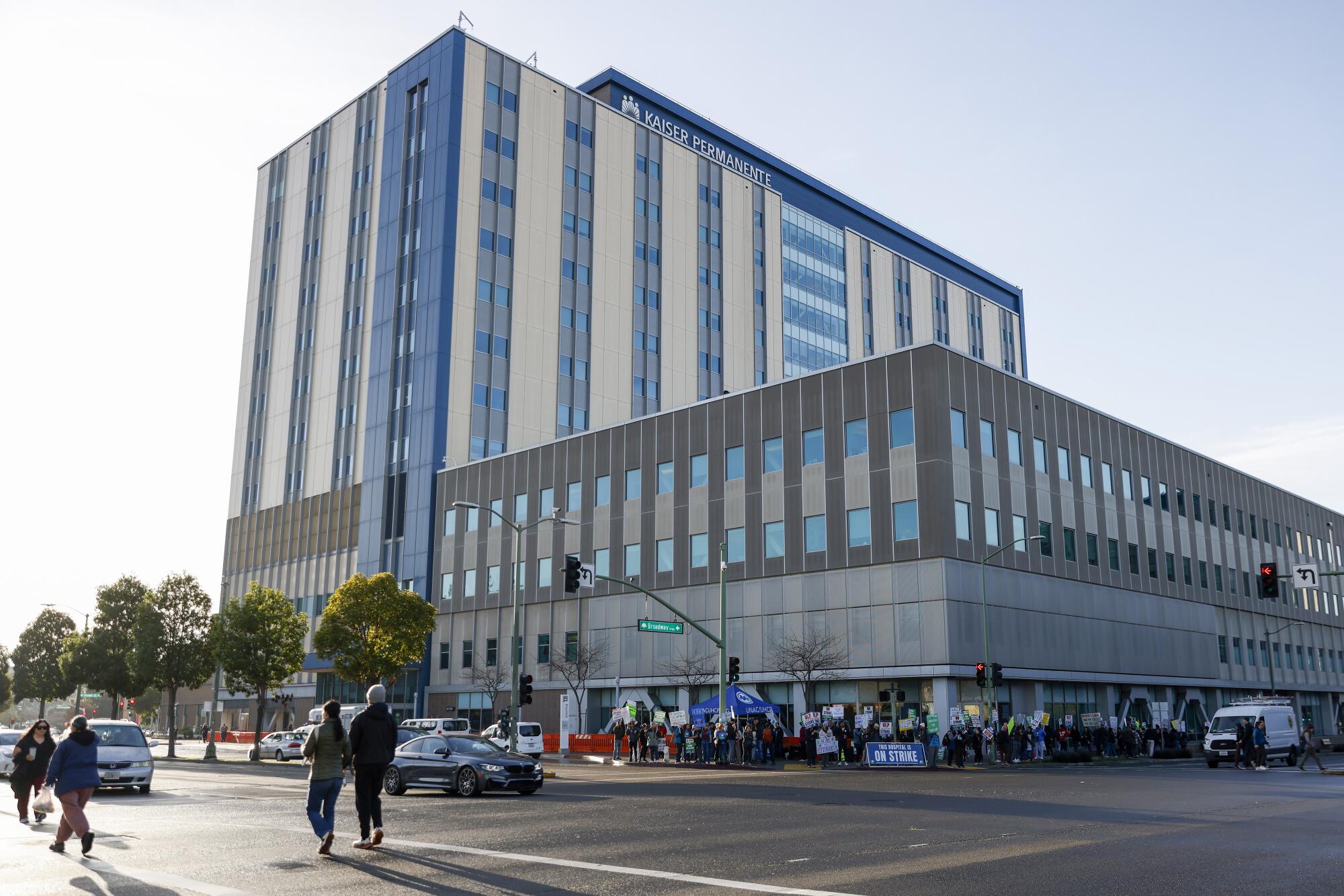
Members of the United Nurses Assns. of California and Union of Healthcare Professionals strike outside Kaiser Permanente in Oakland on Jan. 28.
(Jessica Christian / San Francisco Chronicle)
Last year, Kaiser’s arbitration system closed 529 arbitration cases.
The arbitrators threw out 14% of the cases, ruling in favor of Kaiser’s motion for summary judgment, and dismissed an additional 5% of cases on technical or procedural grounds.
Only 23 cases, or 4% of the total, went to a hearing. Among those, the arbitrator decided for Kaiser in 17, with the patient winning the remaining six.
Patients and their families withdrew their claim in 20% of the cases. About half of those patients did not have a lawyer and had tried to represent themselves.
The parties settled for an undisclosed sum in 57% of the cases. The settlements are confidential.
Patient safety questions
Those who have studied the use of arbitration by Kaiser and other HMOs for medical malpractice claims say the secrecy of the settlements and the closed hearings could keep safety problems from coming to light.
“The secrecy of arbitration proceedings may prevent publicity that could reveal poor doctors,” the California Research Bureau warned in a report in 2000 that analyzed Kaiser’s system. That compares with public court cases that could deter “bad behavior” in the future, the researchers wrote.
In December 2023, 53-year-old Francisco Delgadillo arrived at the Kaiser ER in Vallejo with severe chest pain. After an initial assessment, he waited eight hours for care, according to state regulators.
He died in the lobby. A state and federal investigation found multiple violations, including that Kaiser failed to have a licensed nurse monitoring the dozens of patients in the ER’s waiting room.
The Delgadillo family filed an arbitration claim. Their lawyer Jeff Mitchell said the case settled for a confidential sum and he could not discuss it.
Mitchell agreed that the secrecy raised patient safety concerns.
“They love the system, otherwise they would not be so hellbent to keep it,” Mitchell said of Kaiser’s repeated efforts to dispel criticism. “They don’t want these cases to get in front of juries.”
A licensed practical nurse attends to a patient at a Kaiser Permanente in Culver City in September.
(Allen J. Schaben / Los Angeles Times)
Calls for reform
Despite the changes Kaiser made after the 1997 court decision, patients and their families have continued to complain.
According to the administrator’s 2025 annual report, the “most common” complaint the office heard last year was about the neutral arbitrator.
“Most complained that the arbitrator was biased, partisan, unjust, and in Kaiser’s favor,” the report said.
Stephen Martinez, a retired aerospace engineer from Bellflower, is leading the effort to pass the state bill introduced by Garcia.
At an April hearing in the state Assembly, Martinez spoke about how his wife had found a lump in her breast and asked for an appointment with her longtime caregiver at Kaiser to examine it. Instead she was sent to a physician assistant, who dismissed it, he said.
“The PA prescribed warm compresses, a sports bra, and limited chocolate,” Martinez testified. “We would later find that Lindalee did have breast cancer that had already spread.”
Martinez and his wife said they spent $175,000 on lawyers and medical experts to bring that arbitration case. A chief breast surgeon at Kaiser and another surgeon who had retired from that job both testified that the Kaiser physician assistant failed to follow the health system’s guidelines.
Kaiser’s expert argued that the physician assistant did an appropriate exam and that his low suspicion of breast cancer was reasonable. The neutral arbitrator concurred and ruled against the couple.
After passing the Assembly, Assembly Bill 1770 is now in the state Senate for consideration. The bill lets the attorney general decide what actions they will take to ensure health plan arbitrations are handled fairly and transparently. If the bill passes, the state would add four deputy attorneys general, a legal analyst and three legal secretaries to do that work, according to a legislative analyst’s report.
Kaiser says it has concerns about the bill, including that it would “create overlapping state oversight and duplicative reporting requirements.”
Kaiser Permanente’s corporate offices in downtown Oakland in January 2025.
(Jane Tyska / East Bay Times via Getty Images)
Questions of a missed diagnosis
When Janene Fowler was 22, her body seemed to turn against her. She grew weak, pain shot through her hands and feet, her heart raced. She soon required a wheelchair.
Fowler’s medical chart detailed what could have caused her disabling problems. A test eight years before had found a deficiency of vitamin B12, according to the chart. Over the years, Kaiser doctors noted problems such as depression, unexplained pain, shortness of breath, a sore tongue and an abnormal gait — all possible symptoms of vitamin B12 deficiency.
In February 2022, after her family complained about her not being able to see a neurologist, she got an appointment. The specialist noted her vitamin deficiency, telling the nurse to start her on a supplement at once. But the treatment did not begin because the paperwork was lost, her medical records show.
Two weeks later, Fowler left Kaiser to see a doctor at UCLA. A doctor there quickly started injections of B12.
Her symptoms gradually got better, but her new doctors say the years-long deficiency left permanent damage. She still can’t walk without help.
The arbitrator, a retired judge, sided with Kaiser’s doctors and experts, who questioned whether Fowler’s problems were caused by a deficiency of vitamin B12. While one test showed a deficiency, he noted that a second test failed to confirm it. He wrote that Fowler and her lawyers had failed to prove that Kaiser “breached its duty of care.”
Cohen, Fowler’s lawyer, asserted that the retired judge’s decision was contrary to UCLA medical records, which detail her deficiency and treatment.
Fowler now spends most of her time at home. She can’t drive. She often falls when she tries to get around with a cane. She loves to cook, but said she burns herself when she tries.
“My hands don’t really do what I tell them,” she said.
Kaiser declined to answer questions about her case, citing patients’ privacy rights.
Fowler said she’s angry about how the health plan’s doctors and its arbitration system treated her.
“I thought I was going to die, and no one at Kaiser seemed to care,” she said. “What justice can you have in a system that is run by those you are trying to sue?”