punk

The Inland Empire is leading the Latino hardcore punk revival

When the gates opened at St. John’s Episcopal Church in San Bernardino on Good Friday, the music coming from inside wasn’t that of angel-faced choristers or pipe organs; it was the collective scream of electric guitars.

As the sky darkened over the white stucco church framed in palm trees and the dry peaks of the San Bernardino Mountains, fringed teenagers made their way inside, shaking their limbs and chattering in excitement. Fluorescent lights shone overhead in a room that, by day, hosted Bible studies and food pantries — that night, it would be the site of Spinkick Dance Hall, a regular underground music series where noses are bound to bleed and limbs to flail along to ear-splitting riffs.

It’s just one of many shows taking place from Pomona to Palm Desert, heralding a Latino-led youth revival where the freewheeling movement of mosh pits meets the raw power of punk rock: Inland Empire hardcore.

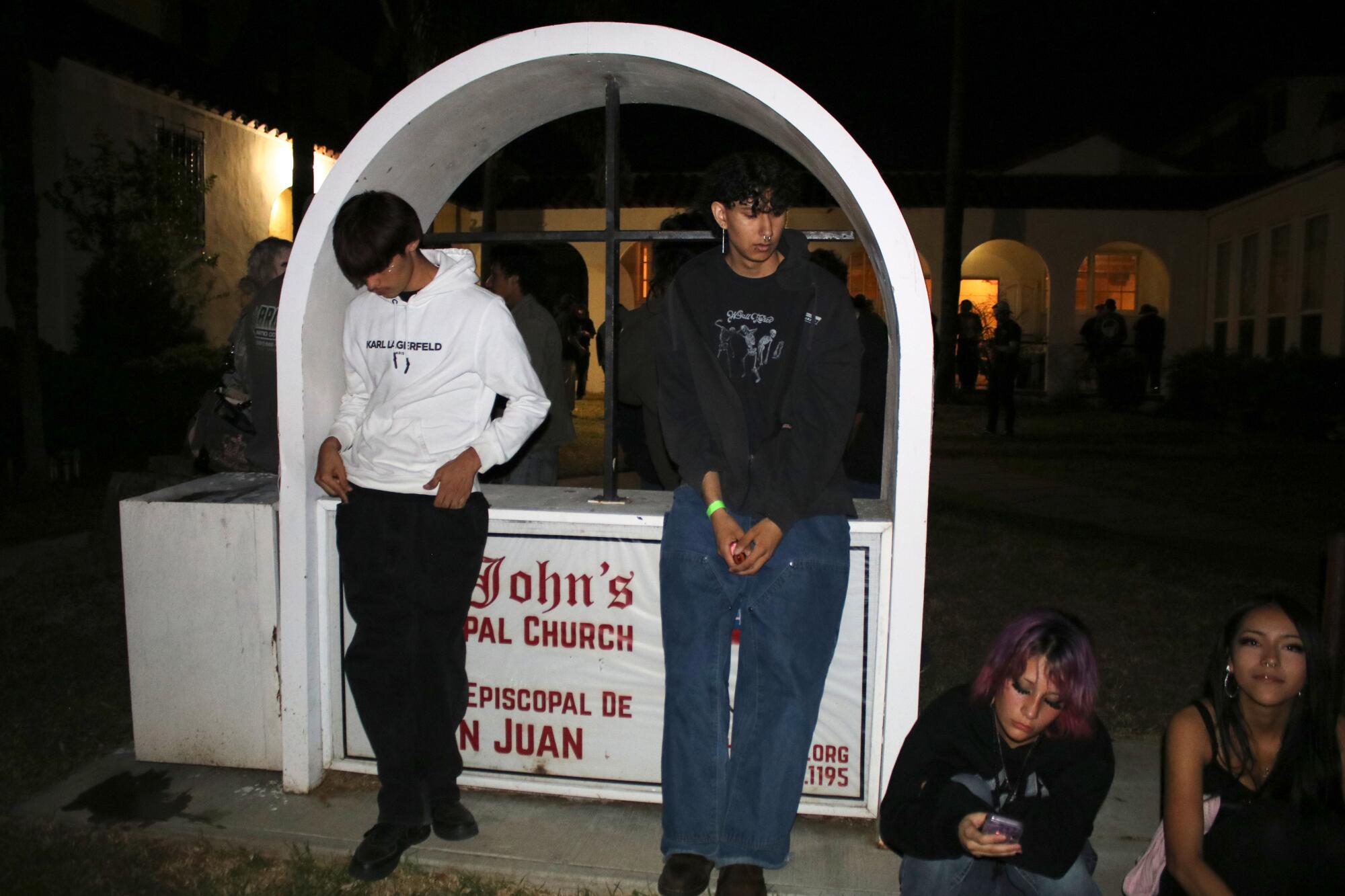
Teenagers congregate in front of St. John’s Episcopal Church

Teenagers congregate in front of St. John’s Episcopal Church in San Bernardino before the start of the night’s hardcore shows on April 3, 2026.

(Katerina Portela / Los Angeles Times)

As the fast-paced and anti-establishment genre known as punk went mainstream in the ’80s, a harder and more unhinged variant emerged in the States; bands like Bad Brains, Minor Threat and Black Flag pushed the limits of vocalization and instrumentation into dissonant new sounds that would make up the subgenre known as hardcore punk.

“As a teenager pre-social media, the music scene was the release for teen angst,” said music photojournalist Zach Cordner. “It was a convergence of nationwide bands that would come to play at [the now shuttered Riverside venue] Showcase Theater, and through word of mouth people got inspired to make cassettes and zines.”

Cordner and his friend Ken Crawford grew up in Riverside in the ’80s and ’90s, photographing the initial wave of hardcore punk taking shape in the Inland Empire. They turned these photographs into a sprawling exhibition held at the Riverside Art Museum earlier this year, “60 Miles East.”

“The scene looks a lot different today than it did in the ’90s,” Crawford said. “It’s browner, it’s queer, and that’s a good thing, to see how it’s become way more diverse.”

Inside the church, the frontman of all-Latino hardcore band Barrio Slam emitted rough growls as the crowd broke into a bustling mosh pit. Teenagers did pinwheel kicks, wrapped Mexican flags over their shoulders and filled the air with chants of “F— ICE.”

Lead vocalist Victor Campos’ family moved from Guadalajara, Mexico, to Pomona, where he says he discovered hardcore through friends. Then, at age 14, Campos attended his first rock show.

“That was the first time that I saw hardcore and metal and the heavier side of music for what it was, and the violence and culture of the shows just sucked me in and I’ve been in it ever since,” Campos said. “It felt like freedom.”

Angela, 19, was in the mosh pit when she was accidentally struck in the nose by another concertgoer on April 3, 2026.

Angela, 19, was in the mosh pit during Load Tha Nine’s performance when she was accidentally struck in the nose by another concertgoer on April 3, 2026, in St. John’s Episcopal Church in San Bernardino. Hardcore shows are characterized by intense music and rough dancing where bloody accidents are not an uncommon sight.

(Katerina Portela / Los Angeles Times)

Jose Ruelas and his Barrio Slam bandmates headbang as they perform on April 3, 2026, in St. John’s Episcopal Church.

Jose Ruelas and his Barrio Slam bandmates headbang as they perform on April 3, 2026, in St. John’s Episcopal Church in San Bernardino.

(Katerina Portela / Los Angeles Times)

Campos credits local Latino-led bands like Xibalba and Harsh Reality as inspirations to dive into making music and embrace his identity in the genre.

“In the I.E., it’s really the norm. We’re singing in Spanish, we’re proud. But when we tour, we see it’s not like that everywhere,” Campos said. “Some people still consider punk ‘not for us.’ My own family members will say, ‘You’re listening to white people music.’”

The show at St. John’s is just the tip of the Inland Empire’s DIY venue iceberg. Living rooms, restaurant dining rooms, tattoo shops and record stores have transformed into hardcore venues across the region as established locales closed down.

San Bernardino four-piece “beatdown” group Big Ass Truck is one band that found success beyond the I.E. scene. They signed to Nuclear Blast Records, and at the time of our interview, they had just returned from a tour of Europe.

“With the I.E. especially, we lose a venue like every week. If we have a venue, it’s not staying around for long. I’ve personally seen like three or four venues [in the last few years] just call it,” said Big Ass Truck vocalist Abel Abarca. “So we do get scrappy, and I think that’s what sets the I.E. apart from places like L.A. and O.C.”

San Bernardino hardcore band Big Ass Truck performs in Pomona

San Bernardino hardcore band Big Ass Truck performs a surprise concert at Creator Fest on May 2, 2026, at Creator Tattoo in Pomona.

(Katerina Portela / Los Angeles Times)

Izzy Leyva, 17, describes being met with an immediate “sense of welcoming” at her first DIY hardcore show.

“It’s nice finding people my age to talk about life with. You can start conversations so easily,” Leyva said. “Especially after moshing with someone in the crowd. If you’re struggling to make friends in school, you’ll be able to find someone here.”

She enters the mosh pit fearlessly, dodging flailing arms to two-step — a synchronized dance move that requires punching and running in place — unleashing her energy in the punk sanctum.

“I never feel like an outsider here,” Leyva added.

1

Mauricio Rivera performs with his band Barrio Slam on April 3, 2026, in St. John's Episcopal Church in San Bernardino.

2

Toni Feliz shows her "IE" tattoo, a nod to her hometown, at Creator Fest on May 2, 2026, at Creator Tattoo in Pomona.

3

Izzy Levya, 17, two-steps during Marked for Death's performance on April 3, 2026, in St. John's Episcopal Church in San Bernardino.

4

Fans dance and "two-step" during Barrio Slam's performance on April 3, 2026, in St. John's Episcopal Church in San Bernardino.

5

Andres Rodriguez, 18, moshes during Marked for Death's performance on April 3, 2026, in St. John's Episcopal Church in San Bernardino.

1. Mauricio Rivera performs with his band Barrio Slam on April 3, 2026, in St. John’s Episcopal Church in San Bernardino. (Katerina Portela / Los Angeles Times) 2. Toni Feliz shows her “IE” tattoo, a nod to her hometown, at Creator Fest on May 2, 2026, at Creator Tattoo in Pomona. (Katerina Portela / Los Angeles Times) 3. Izzy Levya, 17, two-steps during Marked for Death’s performance on April 3, 2026, in St. John’s Episcopal Church in San Bernardino. (Katerina Portela / Los Angeles Times) 4. Fans dance and “two-step” during Barrio Slam’s performance on April 3, 2026, in St. John’s Episcopal Church in San Bernardino. (Katerina Portela / Los Angeles Times) 5. Andres Rodriguez, 18, moshes during Marked for Death’s performance on April 3, 2026, in St. John’s Episcopal Church in San Bernardino. (Katerina Portela / Los Angeles Times)

As 25-year-old Guatemalan American vocalist Jorge Cruz entered the show, he embraced his friends and bandmates. Cruz, who fronts the voracious hardcore band KnuckleSandwich, says he sees TikTok as a major platform for hardcore fans to find one another.

“I saw shows online and was hooked … I used to be so nervous to be in the mosh pit, I’d throw up outside. But when I got in there for the first time, I feel like it changed me into someone who was more comfortable in myself,” Cruz said. “It was like a baptism.”

His music, ranging from songs like “Melting ICE” and corrido-hardcore fusion “El Corrido del Maton,” is inspired by his immigrant household upbringing and interest in Chicano studies.

“Especially with this growing anti-intellectualism going on, and conservatives in our government, writing about Chicano identity and the issues in America feels important,” Cruz said. “There’s no one out there to speak up for us than us.”

A day after attending the show, Garrett Boyer and Kenny Sylvia, longtime friends with nearly matching tattoo sleeves and baseball caps, stood talking in Creator Tattoo Parlor in Pomona.

The pair helps to run Division One, a local booking company that books anywhere from Corona storefront DBZ Books N’ Records to their very own tattoo parlor.

A few weeks prior, Boyer got a call from his sister: His niece was diagnosed with an aggressive childhood cancer called neuroblastoma that had spread through her body, causing his sister to tackle insurance and medical costs. Boyer said he reached out to the hardcore community for help and was “overwhelmed” by the response.

“The community really, really, really came together. A lot of people reached out and really quickly we threw this benefit show that raised thousands of dollars,” Boyer said. “That’s the core of what hardcore music should be and is. It’s community.”

A few months before that, they had united with local bands to throw a benefit show, raising money for immigrant coalition groups after increased ICE raids.

“We thought, ‘How could we not help?’ I’m second generation from El Paso. So many of my neighbors and even my partner’s family were directly affected,” Boyer said. “So many shows are not just about music but they can [impact] people’s lives.”

Brett Rock, bassist of San Bernardino hardcore band Big Ass Truck, performs during Creator Fest

Brett Rock, bassist of San Bernardino hardcore band Big Ass Truck, performs during Creator Fest on May 2, 2026, at Creator Tattoo in Pomona.

(Katerina Portela / Los Angeles Times)

In Creator’s graffitied back lot area on May 2, bands Load Tha Nine, ’92 and Auditory Anguish opened up a DIY festival called Creator Fest, where 22-year-old Cynthia Garcia came out to “let off steam.”

Garcia, who fronts local band Exutoire, said discovering the local alternative scene “changed everything.”

“In high school, it was very much like nothing was happening. We’re all bored. We’re all depressed. We’re writing, and finally, we get to put the writing to use,” Garcia said. “We meet people that are like-minded and trying to get out of that boredom, and then [the music scene] just exploded.”

At Garcia’s shows, she says she constantly meets concertgoers from L.A., or even from San Diego, who drive hours into the I.E. to be part of its blossoming scene.

At Creator Fest, Abarca commanded the stage, building up the energy of the crowd until hair whipped in frenzies. Abarca says he sees I.E. hardcore continuing to evolve, fusing new genres and making the Inland Empire a place to watch as alternative music booms in the “scrappy” venues of San Bernardino, Corona, Pomona and Riverside.

“Latinos in the Inland Empire have always been hardcore,” Abarca said. “People just know it now because we make them hear us.”

Source link

Olivia Rodrigo slams babydoll disses, says it normalizes pedophilia

Some are calling the controversy over Olivia Rodrigo’s recent outfit choices babydoll-dress-gate, Olivia Rodrigo calls it “weird.”

The dress debacle kicked up in early May when Rodrigo released the music video for “Drop Dead,” in which she runs through the Palace of Versailles wearing a pink-and-blue ruffled babydoll set while singing about the intensity of a crush. Then on May 8, she wore a cottage-core pink-and-white floral babydoll dress with knee-high Dr. Martens during a live performance in Barcelona.

Rodrigo was drawing from subversive feminist and punk fashion of yore, but internet critics were quick to slam the “deja vu” singer, saying the ensemble was sexualizing child-like imagery. In an hour-and-a-half interview with the New York Times Popcast that dropped on Thursday, Rodrigo staunchly defended the dress and called the criticism disturbing.

“I have worn outfits that are maybe revealing on stage, like I’ve been on stage in a sparkly bra and little shorts — which is my right — that’s fun,” she said. “I felt cool and comfortable in that, and that wasn’t inappropriate, but me fully covered up in a dress that people deemed to be, like, childlike was inappropriate, and I think it shows how we really normalize pedophilia in our culture.”

Rodrigo further decried the criticism as rhetoric that girls are fed from a young age, “which is ‘don’t wear that, because then a man is going to sexualize your body, and it’s your fault’ — it’s so weird.”

Rodrigo said she didn’t think she looked “sexy” in the babydoll dress; she was going for a cool look à la Kathleen Hannah or like Courtney Love, musicians whom the pop star said are her heroes. Love appeared to defend Rodrigo on social media by resharing posts defending the singer-songwriter in since-expired Instagram stories.

“I just think if we start dressing in a way that’s like, ‘Oh, I don’t want some f— freak to think that I am sexy like a baby’ or some crazy thing like that, I think it’s losing the plot a little bit,” she said. “I’m very protective of younger women and girls, and I don’t ever want them to be fed that rhetoric. You shouldn’t be responsible for some guy sexualizing you in a way that was never your intention.”

Rodrigo’s third studio album, “You Seem Pretty Sad for a Girl So in Love,” which features hit singles “Drop Dead” and “The Cure,” will be released June 12.

Source link

Punk in the Park festival’s founder donated to Trump. The fans revolted

Cameron Collins was sick of Joe Biden.

The owner of concert promoter Brew Ha Ha Productions describes himself as a libertarian-leaning conservative who built his career in San Juan Capistrano. He’d kept his personal politics out of his popular SoCal events, like the ska fest OC Super Show and the nationally touring Punk in the Park fest, a staple for bands like Bad Religion and Pennywise.

On May 30, 2024, Collins felt dismayed that Biden had pursued reelection. In a fit of anger, he donated $225 to Donald Trump’s campaign.

“It was just an impulsive thing,” Collins said in an interview. “Biden had said he was going to run again. I was like, nope. He’d said he wasn’t. It was more about that than anything. I don’t post anything political or talk about anything politically. I’ve never donated to anything like that before.”

That donation proved fateful. After a small punk label discovered and decried Collins’ donation, the scene turned on him. Influential bands pulled out of his festivals or said they wouldn’t return.

On Feb. 27, Collins canceled every Punk in the Park date for 2026.

“The current climate surrounding the events has created challenges that make it impossible for us to move forward,” the organizers wrote on Instagram.

It’s no surprise that an underground music scene would loathe a Trump-donating promoter. Amid the Iran war, raids by U.S. Immigration and Customs Enforcement, and the Epstein files, many Americans want Trump supporters gone from their lives, some viewing any form of support for him as an attack on their and others’ safety and dignity.

Yet until this donation, Collins was a respected promoter whose events sustained hundreds of acts, including progressive bands. Some artists who relied on Collins’ festivals — even if they hate his politics — said the backlash will hurt their livelihoods too.

“It was the worst money I ever spent,” Collins said. “It was not worth this.”

On a March afternoon after canceling his tours, Collins spoke to The Times on a Zoom from his home in Texas. He wore a thick gray beard and the chunky glasses of an aging rocker. His home office was plastered in concert posters from his decades of shows, which include Punk in Drublic (a long-running collaboration with his friends in the left-leaning band NOFX), Silverado Showdown in Orange County and SoCal rock radio station KLOS’ Sabroso Festival.

He expressed bewilderment over the fan revolt that turned him from a scene mogul who gave to pediatric cancer research charities to a villain with a gutted festival business.

“I feel like my reputation with every artist I ever worked with was that they would say, ‘The guy’s got integrity. He treats everyone right. He fights for this scene,’ ” Collins said. “I’m wondering what is happening right now that this has become so polarizing.”

Asked what Trump policies he supported, Collins sighed and said, “A vote for a candidate is not an endorsement of everything they stand for. I am very antiwar. There were promises that Trump made — no more foreign wars, supporting Ukraine by ending that war, lowering prices on gas and on groceries. Dinner table topics.”

Those goals are significantly at odds with the president’s track record. Did Trump deliver on Collins’ donation?

“The way that this whole fiasco has gone down — no one would have voted for that,” he said.

Punk has long struggled with a reactionary streak. British bands in the ‘70s wore swastika armbands for shock value. The Sex Pistols’ Johnny Rotten and the Ramones’ Johnny Ramone turned rightward, and Orange County’s hardcore scene has had neo-Nazi extremists. Gen X punk fans who consider themselves anti-establishment might see online leftists as imposing on their ability to have consequence-free political speech.

Yet the vitality of today’s punk scene is driven by young, racially and sexuality-diverse fans who believe they are in grave danger from Trump’s policies.

Last year, Brandon Lewis, the founder of the Columbus, Ohio-based label Punkerton Records, was poking around on the donor database Open Secrets. He was curious how his scene was donating, and he’d attended Brew Ha Ha events like the Ohio punk festival Camp Anarchy. He checked where Collins put his money and was appalled that it went to Trump.

“We refuse to support, defend, or stay silent about someone who gave money to a man actively destroying everything we care about, deporting our friends and families, erasing the existence of our trans community, stripping away civil liberties, civil rights, and workers’ rights, while dismantling the Constitution itself,” Lewis wrote from Punkerton’s Instagram.

“I’m a combat veteran, and this administration is just pushing everything I believe in about freedom out the window,” Lewis told The Times. “When I would listen to Trump’s rhetoric about ICE — I’ve got friends who are undocumented. Supporting that in a financial way, supporting someone saying my trans friends don’t exist, and to do so coming from a music scene that to me is accepting and kind and certainly not ripping families apart, I couldn’t in good conscience let that go.”

Other bands in the scene, like Dillinger Four, found more donations — around $100 or $200 each — from Collins going to the Trump-supporting political action committees WinRed and Never Surrender and the Trump National Committee. Collins’ support ran deeper than a one-off gesture.

Left-leaning fans demanded that bands drop off Collins’ festival bills.

Dropkick Murphys, a rough-and-ready enemy of Trumpism in punk, had played Collins’ past events. When word of his donations spread, the band came out swinging.

“Punk Rock and Donald Trump just don’t belong together,” they wrote in an Instagram post . “So, upon finding out that Brew Ha Ha promotions donated to the Trump campaign, we will not be playing any more Punk in the Park shows.”

Some acts, like old-guard punks the Adicts and ska group the Aquabats, canceled sets at Collins’ events. Other bands, like Dead Kennedys, said they opposed his beliefs but fulfilled their contracts.

“Dead Kennedys have always stood firmly against authoritarianism, racism, and fascism. That has not changed,” the group wroteon social media. “After these scheduled appearances, we will not be participating in future Punk In the Park events.”

Collins said he understood why bands jumped ship. “There was so much pressure building,” he said. “The bands are a business. You have to say, at what level is the pay worth the headache?”

Yet he insisted that “anyone that pulled off did not pull out because they were standing for something, but were being pummeled to the ground by everyone that said they’d better do it or else. I don’t want those bands to go through that.”

Many fans say that Collins is seeing the predictable consequences of supporting a politician the scene despises.

Others struggled with what to do in response. Monique Powell, the singer for the Orange County ska band Save Ferris, describes herself as a “queer anarchist anti-Netanyahu Jewish child of a North African immigrant,” and far from a Trump sympathizer. Yet Save Ferris played Collins’ OC Super Show event in spite of the protests and bands pulling out.

She said that, while she opposes MAGA, she “wasn’t willing to disappoint fans and put hundreds of people out of work just because someone had a view I didn’t agree with.”

She said Collins “has been an important part of creating and nurturing this scene. He gave a lot of people work. From onstage, I see all the vendors, the stage crew, all providing jobs for people of all backgrounds. He’s given a place for fans to come together, even if they don’t all believe the same stuff.”

Save Ferris was a breakout act in the ‘90s and is now a working-class band on the ska and punk festival circuit. “I see the midsized, hometown venues that the bands of my ilk play — they’re being bought out or dying,” Powell said. “I’m not about to start getting out pitchforks for someone who did something that’s nothing compared to the effects of larger companies.”

Take, for example, Beverly Hills-based concert giant Live Nation, which was in the news last week after a federal jury in New York ruled against it in an antitrust case. Live Nation’s chief executive, Michael Rapino, has donated to Democrats Kamala Harris, Sens. Jacky Rosen of Nevada, Lisa Blunt Rochester of Delaware and Adam Schiff of California, and the music biz-friendly Texas Republican John Cornyn. Live Nation’s PAC has given to Republican Sens. Marsha Blackburn of Tennessee and Ohio Rep. Jim Jordan, alongside several Democrats. Billionaire Philip Anschutz, whose namesake firm AEG is the parent company of Coachella promoter Goldenvoice, has donated millions to Republican politicians, PACs and party organizations for decades — exponentially more than Collins ever did.

It’s fair for to wonder why music fans who hold the line on supporting a Trump donor like Collins might attend those other shows. Lewis said he struggles with that contradiction too but said it hurt worse coming from a punk promoter.

“Donating to Trump is antithesis of what punk means. Hating people for their sexuality or skin color is not punk in the least bit. People clearly expected better from a punk rock festival,” he said.

“I think Live Nation should be broken in half,” Lewis added. “But it’s no knock on someone who wants to see Social Distortion at a Live Nation venue; they need escape as well. I’m just not going to pretend Live Nation is a beacon for good things.”

Those punk communities are pushing back beyond Collins’ events. The SoCal gothic-cumbia DJ collective Los Goths pulled out of the Orange County festival Los Darks after learning its organizers, Peachtree Entertainment, produced the MAGA-champion Kid Rock’s controversial Rock the Country festival. The Los Angeles crust-punk event C.Y. Fest was scrapped after its organizer, Ignacio “Nacho Corrupted” Rodriguera was accused of sexual misconduct (he called the claims “false allegations and misinformation,” but stepped back from the festival).

Collins’ company produces events outside the punk scene, focused on craft beer and other music genres. He recently revamped his upcoming Me Gusta festival into Sublime Fest after the rap group Cypress Hill pulled out. (Last year, Sublime played at the Trump National Doral golf course for the Saudi-backed LIV Golf tour.)

Collins is not sure how he’ll find his way back into the punk scene or if the fans will want him there again.

“I still go out into the audience because I just want to see, is it real? Do people hate me?” he said. “We have bands up there like the Casualties, who are flying [anti-ICE] flags. People are like, ‘You’re a fascist,’ but I’m paying a band to go on my stage to say whatever they want, and then signing a check and going, ‘Thanks for doing it.’ ”

In America‘s current political climate, left-leaning punk fans may not have patience for Trump sympathizers. Having heterodox beliefs is one thing; financially supporting the president is another. Collins is a free market guy, and the punk market has spoken.

Yet huge companies that donate to Trump and his allies are consolidating the industry. It’s harder for progressive punks who want the scene to reflect their values.

“I feel like we created a sustainable, realistic scene that can keep going for years, and bands can earn the money that they need to anchor those tours,” Collins said. His donation caused this avoidable backlash, but “if you take away festivals that are their anchors, like we have been for so many of these artists over the years, how do they tour? This is what the bands are telling me, that ‘we’re the ones getting killed here.’ ”


Source link