‘How Punctuation Remade the World’ author explains the unexpected history of those little marks
Pity the period. And the comma and the semicolon too. Punctuation is the sturdy armature of written language, yet it does its job quietly, in the background. We tend to spend far more time analyzing the written words than we do the dots, dashes and ellipses that give those words meaning, nuance and tone.
In her new book “On the Mark: From Periods to Interrobangs, How Punctuation Remade the World,” author Florence Hazrat argues for punctuation as no less than the bricks and mortar of civilization, the deceptively simple and endlessly pliable tools that made humankind. I recently chatted with Hazrat, a Berlin resident, about scare quotes, emojis and the magic of parentheses.
✍️ Author Chat

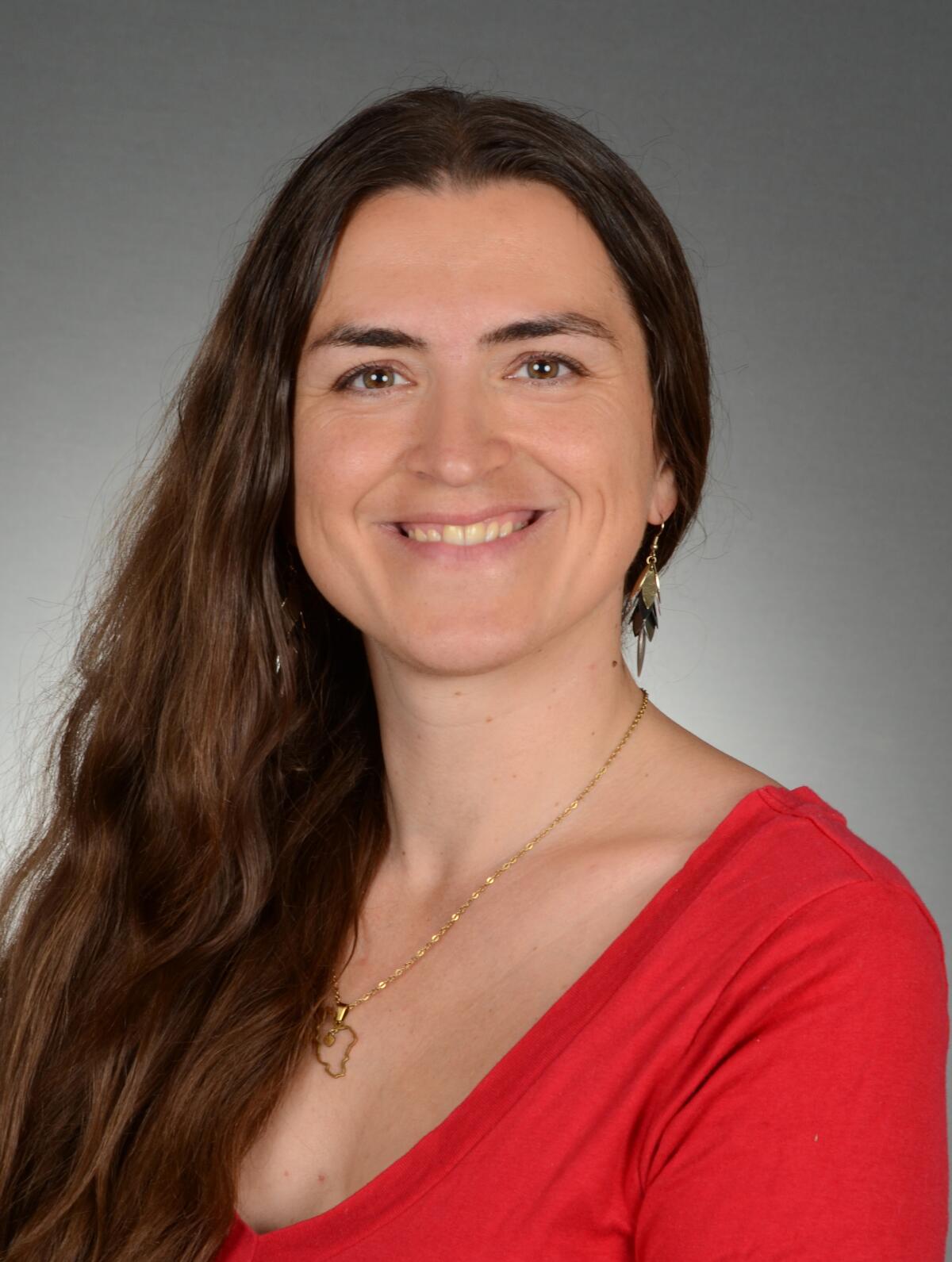
Florence Hazrat, author of the new book “On The Mark,” writes about the history of punctuation.
(Masoud Ali Shaiwani)
What sparked your interest in punctuation?
It was a long time back, when I was studying for my master’s degree. I was working with Renaissance romances, which have a lot of parentheses. I just asked myself, where does this come from? And why don’t we use parentheses like this anymore? And then I did my post doc on this very topic. So it’s the gift that keeps on giving.
Going back to the earliest cuneiform texts, we see that they consist of words bunched together like commuters on a rush-hour subway. There is no space between words and no punctuation.
Writing was just a manifestation of speech. Text was meant to be read aloud. It would have been shocking 2,700 years ago to see someone reading silently. There is an anecdote that when Alexander the Great was spotted reading to himself, people were stunned.
It took hundreds of years for punctuation to really bloom. The Renaissance, with its increased literacy rates, elevated punctuation into an art.
During the Renaissance, text needed to do more. Writing moved out of the monastery, into trade and diplomacy, science, education and so on. The humanists of the Renaissance who loved language wanted text to be able to do more than it historically had been doing. They wanted to bring more nuance and tone into writing.
And silent reading became the normal practice.
Silent reading is so interesting because it’s a kind of subversive act. It’s a private act, so you can be reading anything. There was a lot of consternation at the time that women would spend all their time reading romance stories.
You also write about punctuation as a political tool, especially the power of quotation marks to ironize or diminish the meaning of the words in between the quotes.
Quotes in and of themselves are empty signs. Which means they can be used for all kinds of political purposes. We can delegitimize an entire race of people using scare quotes or belittle something like COVID-19 simply by putting it in between quotes. We’re wresting a word used by another group and changing its meaning with quotes.
You discuss the advent of digital communication, and the ways we use and abuse punctuation now. Yet, we are very sensitive to punctuation in the public sphere. I’m thinking of the use of capital letters in words that connote race, for example.
Absolutely. There are two sides of the culture that contradict each other. Texting seems to be such an informal medium and something we dash off very quickly. Nobody really expects proper grammar in a text. Yet a misplaced period or comma in certain texts, like the 2nd Amendment of the Constitution, for example, can set people off into endless arguments.
What is your feeling about emojis? I find them to be a very rich communication tool. They can have literal or figurative meaning, depending on context. And the meaning can shift over time.
I love emojis. I think they’re still quite misunderstood. They are covering so many functions, because we put them after clauses, for example. We just don’t put them anywhere. But they aren’t punctuation, because we can’t actually make them when we write manually.
Are you pessimistic about the future of punctuation with kids on ChatGPT and texting in elementary school?
Not really. Children who are texting at 9, 10 years old are still learning the rules of grammar and punctuation offline at school ideally. They still have to read books. They have to write essays by hand. So I think the human brain knows how to process different inputs and switch accordingly.
This Q&A was edited for length and clarity.
📰 The Week(s) in Books

Paris Hilton performs at the Pussycat Doll Lounge located inside Pure Nightclub in Las Vegas on Feb. 16, 2008.
(Chris Weeks / Associated Press)
“Up All Night,” Imogen Willetts’ new history of urban nightlife, devotes a chapter to the L.A. club scene of the early aughts, when Paris Hilton was a ubiquitous scenester and Perez Hilton was writing about her. “I’m born and raised in London and lived here my whole life and when I was a teenager, it was like the early 2000s era,” Willetts told Lina Lecaro. “I was like, I have to write about L.A. in the 2000s because that was what we were absolutely aspiring to at all times.”
Shortly after the trailer for the movie adaptation of her novel “Children of Blood and Bone” dropped, author Tomi Adeyemi hinted at an on-set ordeal that traumatized her, Emily St. Martin reports. “It’s a reality that I’ve had to live with for about a year and a half, and everyone involved, at least at the highest level, has been made aware of this reality, and they haven’t done anything to make it better,” Adeyemi said in a video posted to social media.
Stand-up comedian Anthony Jeselnik, an avid reader, has started an online book club that is gaining traction. “My goal was to curate and give people their best shot at enjoying reading,” he told Maddie Connors.
Ryan Murphy’s TV adaptation of Bret Easton Ellis’ novel “The Shards” is a visually vivid throwback to 1981 Los Angeles. Eloise Rollins-Fife gets the lowdown from the show’s production designer, Cat Smith, an L.A. native. “This is like time travel, but you’re traveling back to your childhood,” said Smith. “I’ve done period before, and you always feel like you’re time traveling to a certain extent, but it’s visceral when it’s yours.”
📖 Bookstore Faves

Hollywood Books is an indie bookshop started by a freelance film researcher.
(Roxanne David)
Hollywood Books is the most indie of indie bookshops. Housed in a nondescript storefront on Melrose Avenue, its only signage is a craft paper sign with bubbly pink letters. Hollywood Books was started by Rebecca Ressler, a freelance film researcher. Blond wood shelves surround the store; a round gingham couch beckons page-grazers to bide their time finding that perfect new or secondhand book before taking a short walk to Ressler’s husband’s restaurant Stir Crazy for a bite and a glass of Malbec.
I chatted with Ressler over email about her store.
What made you want to open a bookstore and how did you land upon your location?
The location, in many ways, inspired me to open the shop! I lived down the street and loved the space when it was Nonaka-Hill’s second gallery. After I had my son, I found it really hard to return to my work as a freelance researcher for filmmakers. I was originally set on figuring out a way to make the space a shared office with my husband and some friends. At some point, I had the idea of making it a bookstore and became determined!
What kind of books do you sell?
We sell both used and new books. We have small curated sections in photography, art, design, fashion, film, literature (novels, poetry, plays), nonfiction, children’s books, and cookbooks! I hope our customers find things at our shop they’ve never read or seen or a great copy of a classic they’re excited to cherish. Our books also make great gifts!
Who is shopping there? Who are your clients?
We are really lucky to be surrounded by great art and furniture galleries that people travel from all over to visit. Those customers are happily surprised when they wander into our store. We also have tons of neighbors and friends who keep coming back and help me determine what I can add to our inventory!
What genres tend to sell?
A little bit of everything! Children’s books are very consistent — even if people don’t read themselves they still want their kids to!
Why a bookstore in 2026 when The Atlantic, among other places, is decrying the end of reading?
Because I love books and think enough other people do too to keep my little store afloat!
Hollywood Books is at 6917 Melrose Ave., Los Angeles, CA.