Why a father of five is telling Judy Blume’s revealing life story
On the Shelf
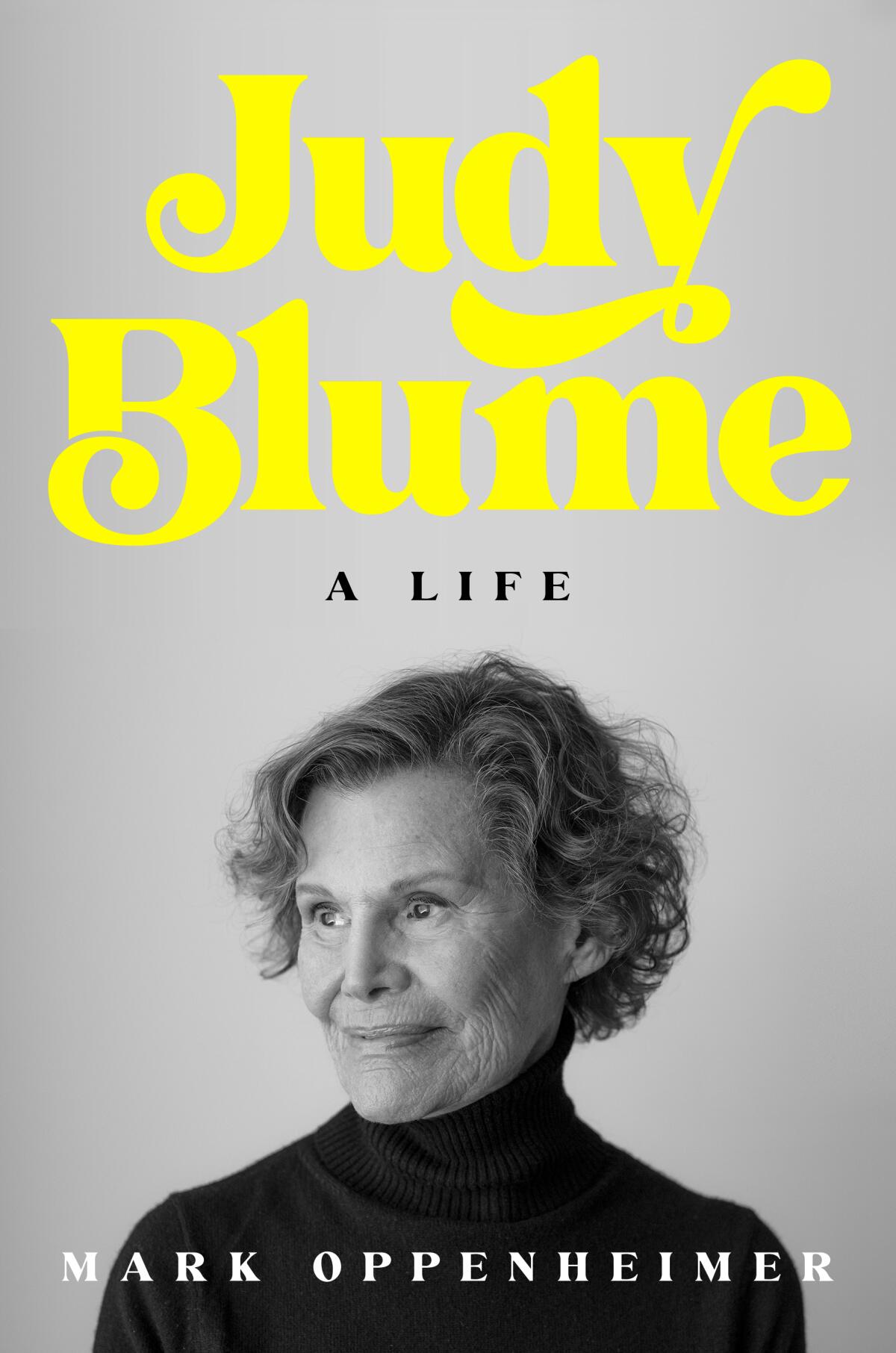
Judy Blume: A Life
By Mark Oppenheimer
G.P. Putnam’s Sons, 480 pages, $35
If you buy books linked on our site, The Times may earn a commission from Bookshop.org, whose fees support independent bookstores.
One of the biggest takeaways from the biography “Judy Blume: A Life” may not be in the story itself but in its author. Because of her frank talk about puberty and sexual awakenings, Blume’s work is usually associated with young female readers. Her biographer, Mark Oppenheimer, is a middle-aged father of five.
He says he received minimal pushback on the idea that a man should be allowed to write Blume’s definitive life story. If the whole point of her books is that there should be no shame in body awareness, what service does it do to say only a woman has the authority to write her story? Plus, although her books aren’t selling as well as they used to — who’s are? — Oppenheimer’s biography points out that there are still plenty of parents who will throw a copy of her seminal “Are You There God? It’s Me, Margaret.” at their kids rather than have the menstruation talk or risk any misinformation that may be online.
“No good writer should be ghettoized,” Oppenheimer says during a recent Zoom call with The Times. “If you’re a good writer, you shouldn’t be marketed just to girls or just to boys or just to white people or just to straight people. Good art should be for everyone.”

It is intrinsic and impossible not to parlay Blume’s stories of sibling rivalries, first loves, friends and frenemies, and (most famously) puberty with what was going on in your life when you read them. Books like “Deenie” and “Superfudge” and “Margaret” are also remarkably malleable enough so that, even if a kid picks them up decades after their release or cannot relate with a parallel experience, they can become placeholders and explainers for what must be going on in the minds of their classmates. Last year, TV creator Mara Brock Akil adapted “Forever,” Blume’s 1975 story of the kind of mutually shared devotion that feels like it will last eternally, into a miniseries set in 2018 Los Angeles.
“I think for many of us, Judy’s books are our first crush or our first love and they do hold a special place that no book we read in our world-weary, cynical 40s can hold,” says Oppenheimer.
Some of this can be attributed to time and brain space. Oppenheimer discovered Blume’s work when he was a child. He’s now a parent, with a career and all the other time-sucks that come with adulthood.
“The books I read as a child imprinted on me in a way that books today don’t,” he says. “I probably remember more plot points of the first Judy Blume books that I read than I do of any book I’ve read in the past five years.”
But what of Blume herself? Can America’s mom also be a three-dimensional person who makes her own mistakes? Discovering her four adult novels — especially “Wifey,” a book about a gilded-caged suburban housewife that even Oppenheimer describes as “a very salacious, one might say, smutty, adult novel” that even some of Blume’s collaborators wanted her to publish under a pseudonym — or watching documentaries about her like 2023’s “Judy Blume Forever,” in which she is seen joking about masturbation with employees at her Key West, Fla., bookstore, can seem as evasive and dangerous as reading your mom’s diary.

Author Mark Oppenheimer
(Lu Arie)
There have been other books about Blume and her work, most notably Rachelle Bergstein’s 2024 deep-dive “The Genius of Judy: How Judy Blume Rewrote Childhood for All of Us.” But Oppenheimer’s biography is a more straightforward tracing of Blume’s life and career. He starts with her childhood when she was encouraged to read Philip Roth at home and went to sleepovers at friends’ houses that were more about body awakenings. He discusses her stifling first marriage, which gave her the last name she carries with her to this day and her two children but is also where she hung her college diploma and another award over her washing machine as reminders of her intellect. There’s talk of her second marriage, which Blume has always been reluctant to discuss, as well as the two abortions that resulted from it. And there are details on her life with her third husband, the polymath George Cooper.
Oppenheimer relied on past news stories about Blume, as well as a collection of her work and professional correspondences that are archived at Yale’s Beinecke Rare Book & Manuscript Library and, probably most informatively, his own interviews with Blume and her friends and family. (Although Blume did agree to speak with Oppenheimer for his book, she declined our request to interview her for this story about that book).
“I think that the difficult subjects are sometimes the ones that make her more relatable,” Oppenheimer says of his subject. “I think most of her fans will find it interesting and admirable that she speaks so candidly about her abortions, about especially her divorce from her first husband, which came as she was getting involved in the [second-wave] women’s movement, about her early same-sex experiences, about masturbation as a girl; these are things we would expect Judy Blume to be candid about.”
Oppenheimer matches how these life events correspond with the ones of Blume’s characters because, for better or for worse, she almost always was an author who wrote what she knew even if her fandom transcended it. What her books lack in character diversity, they make up for in specificity. And that, in turn, also makes them relatable.
“Judy found incredibly compelling human drama in books about the New Jersey suburbs, and that’s a testament to her strength as an artist,” Oppenheimer says.

Writer Judy Blume at her nonprofit bookstore Books and Books on March 26, 2023, in Key West, Fla.
(Mary Martin / Associated Press)
Examining and reexamining Blume’s work as an adult also gave Oppenheimer a better perspective of her writing style. Blume didn’t begin to try to write professionally until she was a married mother of two and some have criticized her work for not being as flowery and polished as others’.
“All of her books tend to take a fairly tight focus on the characters,” Oppenheimer says. “They don’t tend to pull back and look at large societal forces or changes going on in the country or the world. And that’s fine. You know, the same could be said of Jane Austen.”
Perhaps the best example of this is Blume’s own religious foundation. Her most autobiographical novel, “Starring Sally J. Freedman as Herself,” has a protagonist who is paranoid that she sees Adolf Hitler on park benches and whose life is imprinted with stories of a relative who followed her mother into the concentration camps and the neighbors sitting shiva (a time of mourning) for their daughter who got pregnant with her non-Jewish boyfriend. And yet, Oppenheimer notes, Blume is not always immediately thought of as a Jewish writer. Nor have most of her readers been Jewish.
“I think that her Judaism is there, if you know where to look,” says Oppenheimer, who spends the early part of his biography looking at how the synagogue and religious community were a normal part of a young Blume’s life. He adds that “she is somebody who speaks really, really well across religious, cultural and racial differences, and that’s partly why she has sold tens of millions of books.”
Oppenheimer acknowledges that Blume’s characters may not be diverse enough by today’s standards; that they don’t usually discuss “gender identities or sexualities; children of multiracial backgrounds; children who have disabilities.” They can also feel like time capsules to other dimensions; his 12-year-old daughter was scandalized by how normative bullying was after she read “Blubber,” Blume’s 1974 novel about tween mean girls and body shaming.
He adds that some of today’s bestselling young adult novels, like Rick Riordan’s Percy Jackson series about a teen demigod or Suzanne Collins’ dystopia-set “Hunger Games” books, are “contemporary realism [that] focus on extraordinary or unusual circumstances.” And while he’s happy for these books’ popularities, he says that some subjects may be better told by kids who also aren’t tasked with saving the world. (I am pretty sure I learned more about male puberty from Blume’s 1971 story “Then Again, Maybe I Won’t,” which is as much about wealth divides and questionable friend choices as it is about a 13-year-old boy’s inner monologues about her awkward adolescence).
“If what you’re looking for is realism that isn’t focused on obvious external differences, but rather on interiority,” Oppenheimer says, “then Judy Blume still remains one of the premier novelists that you would want to read.”
Friedlander is a pop culture and entertainment journalist based in Los Angeles who hates coffee but loves Coke Zero.