Trump Claims Iran Has Stopped Killing Protestors
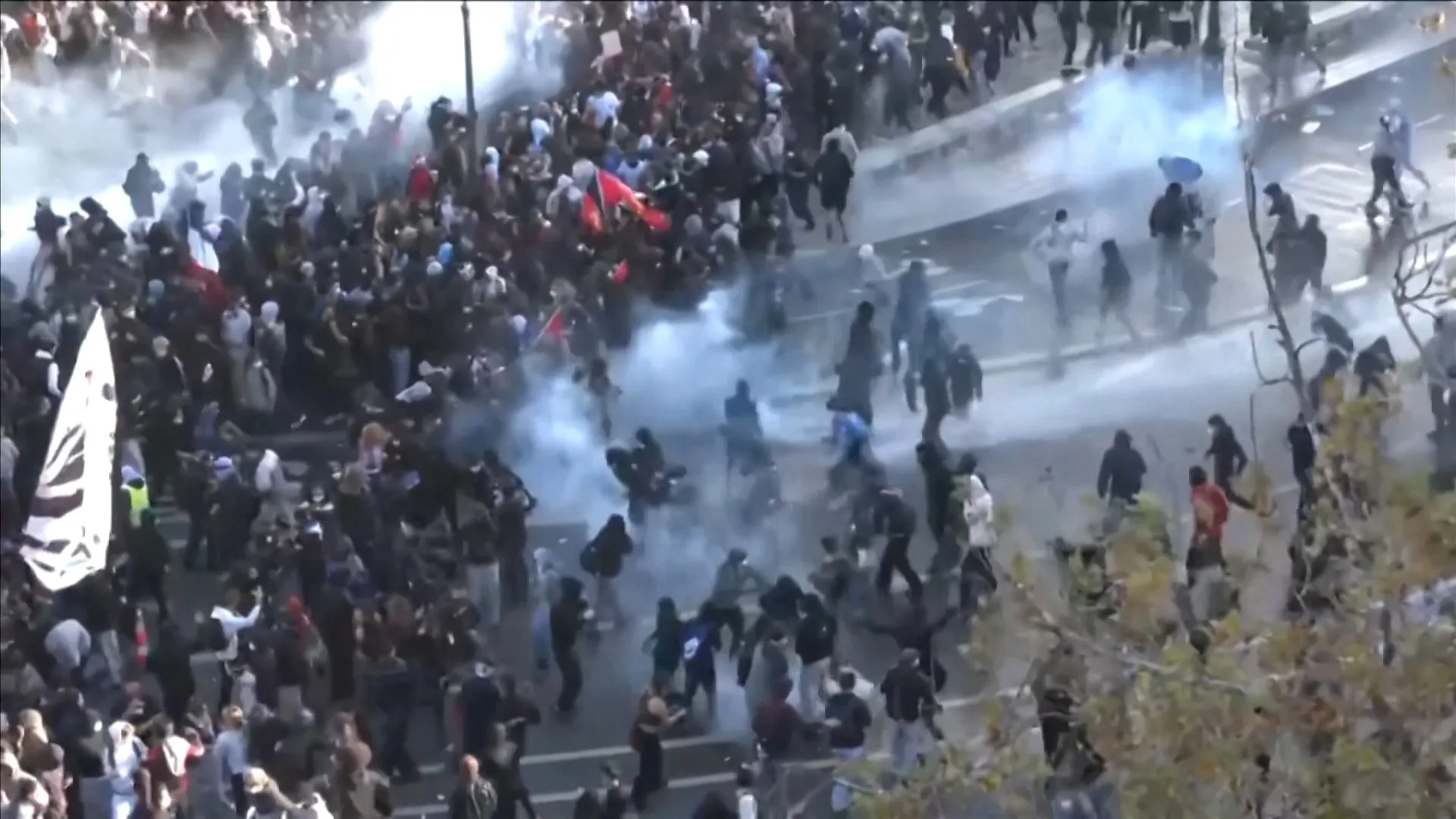
Even as flight tracking data shows an apparent exodus of aircraft from the biggest U.S. base in the Middle East ahead of a possible new conflict with Iran, Trump on Wednesday said the rationale for an attack may be subsiding. The president claimed that the killings of anti-regime protesters, which sparked his repeated threats against Iran, seem to be ending. His comments have created confusion in military, political, and diplomatic circles about what he intends to do about Iran.
You can catch up with our previous coverage of the unfolding events here.
“We were told that the killing in Iran is stopping and stopped – stopping, and there’s no plan for executions or an execution or executions,” Trump stated. “So I’ve been told that on good authority. We’ll find out about it.”
Asked if that meant an operation against Iran was off the table, Trump said: “We will watch and see how the process develops. However, we have received a very good — very good — statement from people who know the situation well.”
Before Trump’s White House statements, it was reported that Wednesday’s planned execution of Erfan Soltani, a 26-year-old protester who has become the face of imperiled demonstrators, was postponed.
On Tuesday, Trump put out a message on his Truth Social platform, urging continued protests against the regime, adding a perceived promise of action that “HELP IS ON ITS WAY.”
In an exclusive story later in the day, NBC News reported that “Trump has told his national security team that he would want any U.S. military action in Iran to deliver a swift and decisive blow to the regime and not spark a sustained war that dragged on for weeks or months.” The network cited a U.S. official, two people familiar with the discussions and a person close to the White House.
“If he does something, he wants it to be definitive,” one of the people familiar with the discussions told NBC.
“But Trump’s advisers have so far not been able to guarantee to him that the regime would quickly collapse after an American military strike, the U.S. official and two people familiar with the discussions said,” the story continued, “and there is concern that the U.S. may not have all the assets in the region it would need to guard against what administration officials expect would be an aggressive Iranian response.”
Trump’s comments on Wednesday have reportedly left diplomats bewildered about what will happen next. In a post on X, Wall Street Journal reporter Laurence Norman reported that there is “Utter confusion, uncertainty about what’s going on now with #Iran among various senior diplomats.”
Still, there were signs potentially indicating impending military action. The Pentagon ordered some personnel at Al Udeid Air Base in Qatar to evacuate the facility.
Later on Wednesday, as we pointed out earlier in this story, U.S. military aircraft appeared to be leaving that facility in numbers.
The U.S. Embassy in Qatar advised personnel to “exercise increased caution and limit non-essential travel to Al Udeid.”
In Kuwait, the U.S. Embassy instructed mission personnel to halt movements to military bases in that country.
“‘Tehran has told regional countries, from Saudi Arabia and UAE to Turkey, that U.S. bases in those countries will be attacked if the U.S. targets Iran,” Reuters reported. We saw a similar pattern in June, just days before Trump ordered the Operation Midnight Hammer attack on Iranian nuclear facilities, when the Air Force evacuated many of its aircraft from bases near the Persian Gulf in order to save them from a potential barrage.
There have also been peculiar aircraft movements to Hawaii, though the reason is not clear. The Hawaii Air National Guard (HANG) is holding Sentry Aloha, a large training exercise involving fighter aircraft, airborne early warning jets and refueling tankers. This could account for some of the activity, but that even kicked off today and usually participating aircraft do not show up the night before such an exercise.
It also should be remembered that the Pentagon purposely made sure flight trackers could see the movements of what appeared to be a large group of B-2s over the Pacific ahead of Midnight Hammer in what became a very effective information operation. In reality, the real strike force was heading east without being tracked, over the Atlantic and the Mediterranean, before making their way to strike their targets in Iran.
“At midnight, Friday into Saturday morning, a large B-2 strike package comprised of bombers” left the United States, Air Force Gen. Dan Caine, Chairman of the Joint Chiefs of Staff, explained during a press conference following Midnight Hammer. “As part of a plan to maintain tactical surprise, part of the package proceeded to the west and into the Pacific as a decoy, a deception effort known only to an extremely small number of planners and key leaders here in Washington and in Tampa.”
Whether there is any connection between what we are seeing in Hawaii and any attack on Iran is something we will only really know after the fact, just like Midnight Hammer. But aside from prepositioning refueling assets, this seems less likely at this time.
As far as Navy assets, a handful of unconfirmed reports state the U.S. is ordering the USS Abraham Lincoln and its carrier strike group (CSG) to the Middle East. This would mark the first major movement of Navy assets to the region since massive protests against the regime of Ayatollah Ali Khamenei broke out across the country last month. There are currently no U.S. aircraft carriers in the region.
“A US official tells Al Jazeera: The USS Lincoln aircraft carrier and its strike group…will move from the South China Sea to the Middle East,” the news outlet reported on Telegram Wednesday afternoon. While The War Zone cannot independently confirm that, such a movement fits in with our assessment earlier today that the Lincoln CSG would be the most likely choice for a carrier deployment should the Pentagon decide to plus-up its Navy presence in the region. We will continue to monitor this situation for updated information.
Earlier today, a Navy official told us that there were six ships in the CENTCOM region – three Areligh Burke class destroyers, USS McFaul, USS Mitscher and USS Roosevelt, as well as three Littoral Combat Ships, the USS Tulsa, USS Santa Barbara and USS Canberra.

In comparison, at the time of the Operation Midnight Hammer attack on Iranian nuclear facilities in June, the Vinson Carrier Strike Group was deployed to the region as well as two Arleigh Burke class destroyers, according to USNI’s Fleet and Marine Tracker. An additional three Arleigh Burkes were on station in the Eastern Mediterranean, well within range of Iran for its long-range missiles. There are currently no U.S. warships in that body of water, the Navy told us this morning.
Wednesday morning, Adm. Daryl Caudle, Chief of Naval Operations, addressed questions about whether he was concerned no carriers are now in the CENTCOM region.
While those deployments provided far more punch than exists now, we have previously pointed out that other capabilities can fill-in for a carrier strike group, at least to a degree. This includes land-based aircraft and additional land-based air defenses, although we have seen no indication of major movements of those capabilities, either. It’s also worth noting that there is a sizable U.S. force deployed to the Middle East at any given time.
“So we can show up pretty much anywhere in the world and provide options right away [but] it’s about risk,” he told reporters, including from The War Zone, at the Surface Navy Association’s annual symposium. “This is risk. This is risk to mission. It can be risk to force and certainly risk to objectives if combatant commanders don’t have the forces they need.”
Regardless of Trump’s comments or U.S. military movements, the region remains on edge. The British closed their embassy in Tehran while India ordered its citizens to leave the country.
Meanwhile, Israel seems to be preparing for a major event, though officials are trying to maintain an element of calm.
“The IDF says it has stepped up its defensive posture and is closely monitoring developments amid reports of a possible US strike on Iran and Iranian threats of retaliation against Israel, while urging the public to rely only on official updates and avoid spreading rumors,” the Times of Israel reported.
A senior IDF official told us that he is seeing mixed signs of preparation.
“I have just returned from the Kirya base, the IDF’s main headquarters,” he said, speaking on condition of anonymity to discuss operational details. “I did not observe anything out of the ordinary there. At the same time, I continue to hear ongoing directives instructing units to maintain a high level of readiness for any possible scenario.”
“I am aware that aircraft are armed and on immediate standby, and that all active missile defense systems are fully operational and prepared,” he added.
Jerusalem is also preparing for attacks from the Houthi rebels of Yemen and the Hezbollah insurgents of Lebanon. Both groups are Iranian proxies that have had frequent conflicts with Israel.
The German airline Lufthansa told employees to immediately prepare to leave Israel, which is at a high state of alert for an attack on or from Iran.
As for the situation inside Iran, it remains extremely difficult to assess what is really taking place. The scope of any ongoing protests remains unclear.
Iran, as we previously noted, has largely shut down the internet and telephone service, including attempting to jam Starlink terminals. An exact number of deaths since the protests began on Dec. 28 over rising prices, devalued currency that saw the rial crater now to basically nothing, a devastating drought, and brutal government crackdowns, is hard to pin down. On Wednesday, the Human Rights Activist News Agency (HRANA) reported that more than 2,400 protesters have been killed so far. A day earlier, CBS News stated that the death toll was at least 12,000 and possibly as high as 20,000.
The events in and around Iran remain highly fluid and we will continue to provide updates when warranted.
Contact the author: howard@thewarzone.com
