Prospects

Iran deliberates Hormuz arrangement amid uncertain prospects with US | US-Israel war on Iran News

Tehran, Iran – Iran’s authorities are weighing a finalised arrangement with Oman over the Strait of Hormuz, but top officials maintain that the strategic waterway’s full reopening will hinge on concessions from the United States.

Foreign Minister Abbas Araghchi on Saturday said the agreement with Oman was “very close”, but cautioned that a full reopening of the strait would depend on the US staying true to commitments given as part of a June memorandum of understanding (MoU) that were violated.

Recommended Stories

list of 3 itemsend of list

Iran has previously slammed the US for backing a southern Omani route in the waterway without coordination with Tehran, not halting Israel’s attacks on Lebanon, and refusing to unfreeze any of Iran’s money blocked abroad due to sanctions.

Separately on Saturday, Hossein Mohebbi, spokesperson for the Islamic Revolutionary Guard Corps (IRGC), told state media the reopening of the Strait of Hormuz “has its own specific mechanism and has nothing to do with the negotiations between Iran and Oman”.

He added the US will have no choice but to accede to “conditions” set by the Islamic republic to reopen the strategic strait, which Mohebbi said the IRGC views as not just an economic waterway, but a source of power tied to Iran’s geographical position that it intends to leverage.

The IRGC spokesman urged the administration of US President Donald Trump not to “interfere” in the talks with Oman, “which have nearly reached their conclusion”.

On Friday, the spokesperson for the national security commission of Iran’s hardline-dominated parliament also confirmed that the framework of an arrangement with Oman over the strait had been agreed upon, and a deal could be expected soon.

Hassan Qashqavi said the decision was pending a green light from “higher levels”.

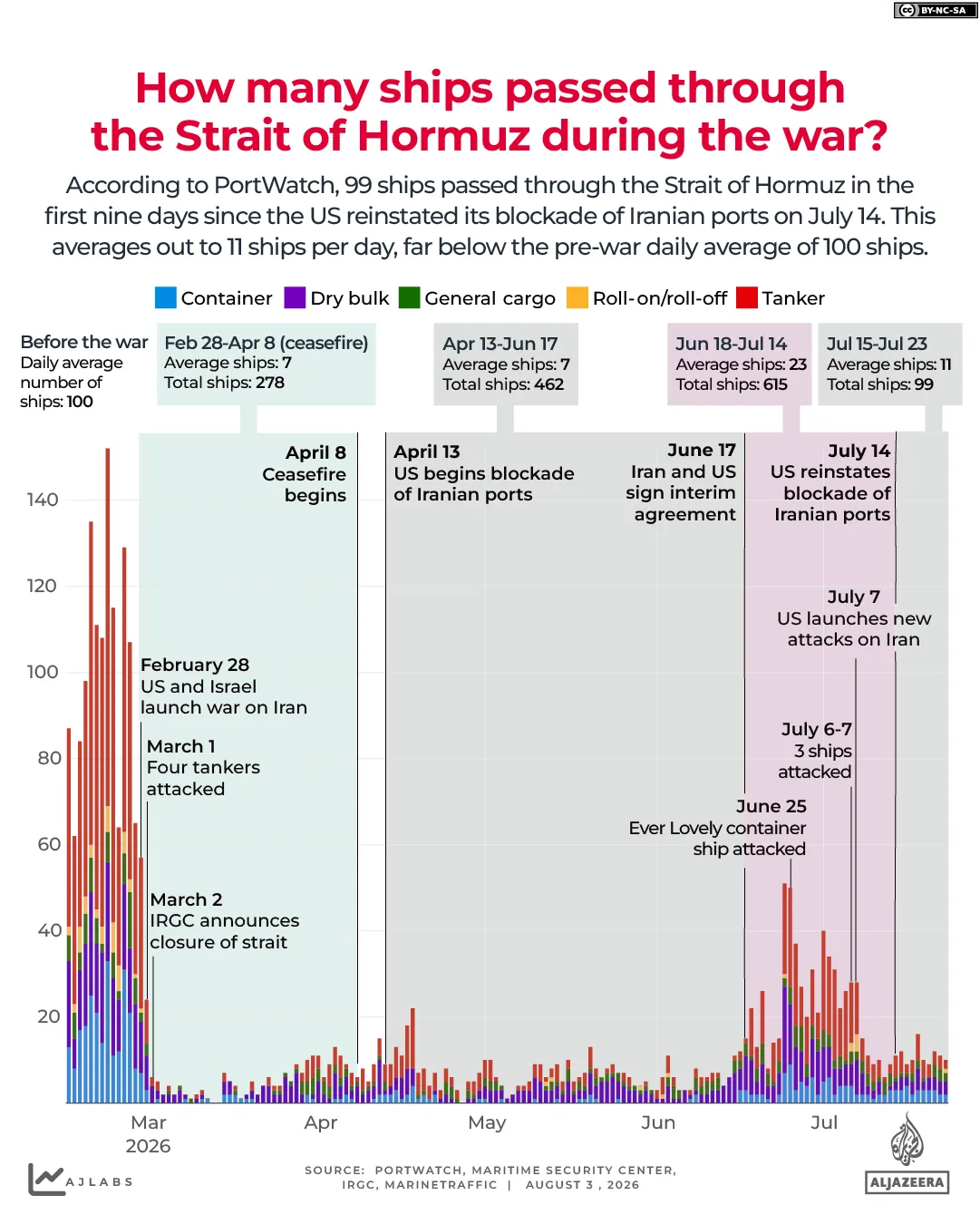
INTERACTIVE - ships - Strait of Hormuz - aug3, 2026 copy 6-1785747412
(Al Jazeera)

In a televised interview, President Masoud Pezeshkian said he would “strongly defend” the MoU signed with the US in June and once again rejected speculation that he would abandon his office, despite claims by hardliners that he has used the threat of resignation as a way of combatting opponents who are against a diplomatic resolution with the US.

The Ministry of Foreign Affairs said earlier that a joint statement could be expected with Oman if a deal is reached to bring back some traffic to the strait, which has been mostly disrupted since the US and Israel attacked Iran on February 28.

Iran and Oman have agreed on the coordinates of routes to be taken by vessels through the waterway as part of the arrangement. Inbound traffic is to pass through a northern lane through Iranian territorial waters, while outbound traffic will go through a southern lane in Omani waters, coordinated with Iran.

US media have said the interim agreement is envisaged for 60 days and can be extended. They have also reported on discussions concerning naval mine clearance from a central corridor that could be utilised in the future, the passage of military vessels and a potential coordinated fee system for passing vessels.

There are questions over what will happen with a US naval blockade of Iran’s southern ports and a drawback of US military assets, which Iran has said will be necessary on the way to fully reopening the strait, through which about 20 percent of the world’s oil passes in peacetime.

Even more ambiguous are prospects of a broader long-term resolution that will also address the future of Iran’s nuclear programme, as well as years of harsh US sanctions over nuclear enrichment that have exacerbated economic shockwaves imposed against 90 million Iranians.

In the meantime, while military activity has significantly dropped across the region to give space to the Oman talks, tensions remain high and maritime security continues to dominate discussions.

The United Arab Emirates said a vessel belonging to the Abu Dhabi National Oil Company (ADNOC) was targeted by a missile while crossing the Strait of Hormuz on Saturday, but that there were no casualties.

In a statement, the UAE’s Ministry of Foreign Affairs said targeting commercial shipping and using the strait “as a tool of economic coercion or blackmail represents acts of piracy” by the IRGC “and constitutes a direct threat to the stability of the region, its peoples, and global energy security”.

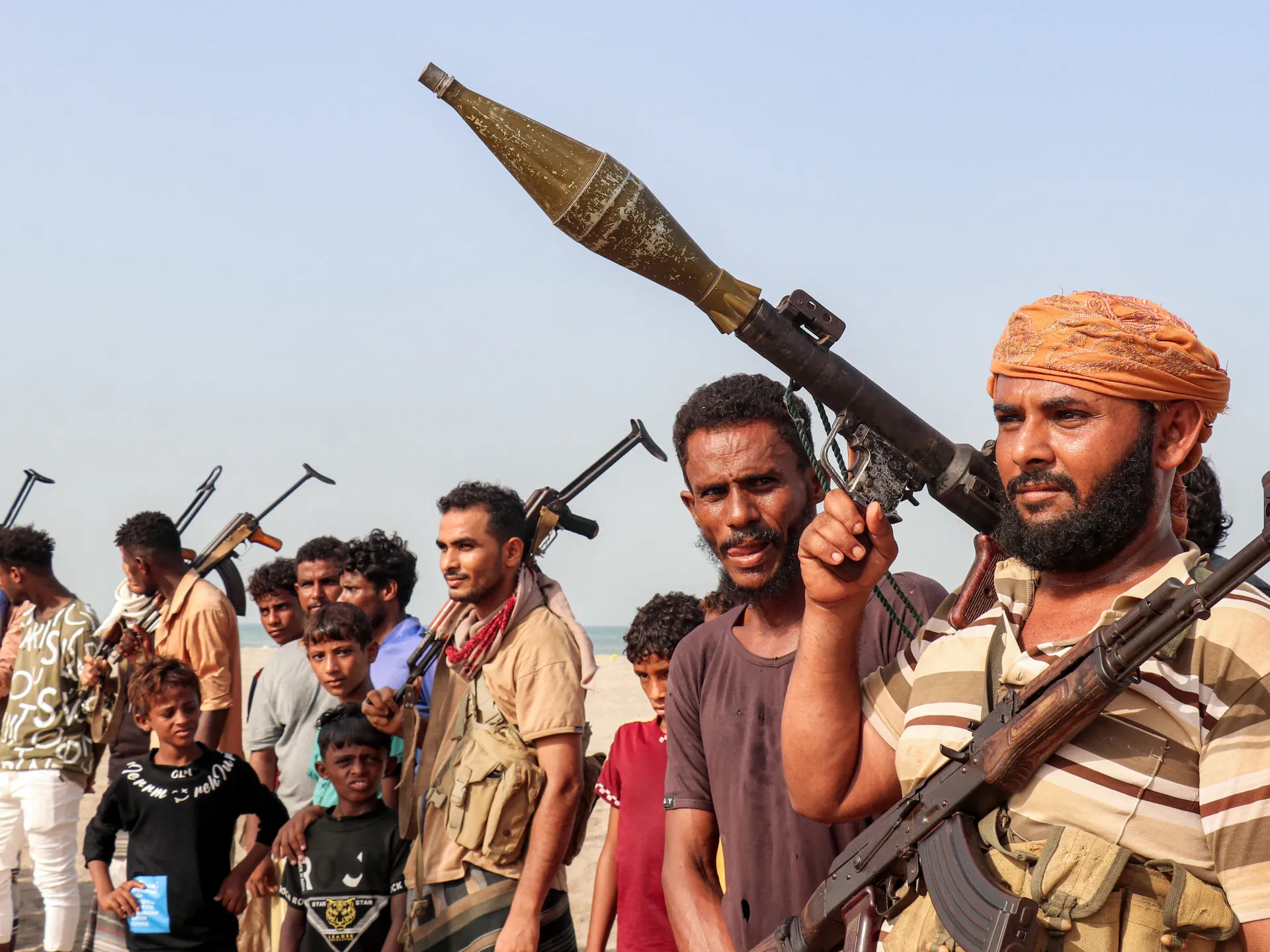
The Iran-aligned Houthis in Yemen also continue to face off against Saudi Arabia and create disruptions for Saudi-linked vessels in the Red Sea and the Bab al-Mandeb Strait.

On Friday, the Houthis launched a deadly attack on an area of Marib controlled by the Saudi-backed, internationally recognised Yemeni government, with the government announcing a military response on several fronts on Saturday.

The Yemeni group also struck southwestern Saudi Arabia’s Najran on Thursday, a day after claiming two separate attacks on Saudi oil tankers.

Traffic in both the Bab al-Mandeb and Hormuz straits was down to just a handful of vessels on Wednesday on the back of the latest escalations, but has relatively rebounded while still far from unobstructed pre-war levels. Some ships have resorted to turning off their transponders to avoid being detected.

Global energy markets have once again welcomed the increasing prospects of a diplomatic agreement that could positively affect the Strait of Hormuz, with Brent crude standing at about $83 per barrel at Friday’s close.

Markets inside Iran also reacted positively on Saturday, the first day of the working week in Iran, with the national currency strengthening to 1.85 million rials against the US dollar, slightly recovering from all-time lows of about 1.94 million reached last week.

The main index of the Tehran Stock Exchange also climbed by 112,000 points or just over 2 percent to reach 5.52 million, near an all-time high.
Source link

Yemen faces a new challenge amid prospects of confrontation | US-Israel war on Iran News

The conflict in Yemen has entered a new chapter with a declaration by the Houthis that they are imposing a maritime siege on all shipping to Saudi Arabia.

The Yemeni rebel group, also known as Ansar Allah (or supporters of God), has attacked a number of Saudi tankers in the Red Sea.

Recommended Stories

list of 3 itemsend of list

This development has placed the Bab al-Mandeb Strait, the strategic waterway that connects the Red Sea to the Gulf of Aden and the wider Indian Ocean, at the heart of the war between the United States and Iran, and amplifies pressure on global trade routes.

The Iranian-backed Houthis, who seized Yemeni capital Sanaa in 2014, have threatened to close the strait, the route through which much of Europe’s energy supplies pass. It is also a key passage for imports to Saudi Arabia.

The Houthis’ decision to announce a maritime blockade cannot be separated from the turmoil created by the ongoing war between Washington and Tehran, which erupted on February 28 when the US and Israel attacked Iran.

Houthis raise stakes for Saudi’s support

On Monday, Yemen’s internationally recognised government claimed responsibility for an air strike on Sanaa airport, saying that it was a measure to prevent an Iranian plane from landing in Yemen’s Houthi-controlled capital. But the Houthis blamed Saudi Arabia for it.

The Houthis responded by firing missiles into Saudi Arabia – a key backer of the Aden-based Yemeni government – and later upped the stakes by announcing a naval blockade on the kingdom.

These developments mark a major escalation in Yemen’s civil war. Saudi Arabia, which has sought in recent years to avoid a new war on its southern borders, is facing a more complex equation with the threat shifting from land to sea, and the targeting of one of the most important alternative routes for its oil exports.

All of this raises the question: will this escalation cause a new confrontation between the Yemeni government and the Houthis? And if so, what does the balance of power look like between the Houthi and government sides after more than a decade of war? Has the balance changed enough to increase the odds of a military resolution to the conflict?

There has been talk of potential escalations in recent years, but this now seems more likely, especially since it intersects with local, regional and international events and the return of the US-Iran war.

The Yemeni government has restructured its military with a single decision-making centre, and regional messages suggest the military option has not been shelved, as was once thought.

So, will retaking Sanaa return to the table as a military objective to be thought of seriously, and what does that mean practically? And how ready are the parties, especially the Yemeni government, for battle?

The structure of government-affiliated forces

The anti-Houthi camp today comprises the National Army as the official framework of the Ministry of Defence, in addition to new formations with independent commands, such as the Giants Brigades, and the Guardians of the Republic forces in al-Makha, or Mocha, in the west.

These different groupings – all on the anti-Houthi side in the conflict – have emerged over the years due to the weakening power of the central government, the growth of independent figures, and the backing of regional countries.

The number of National Army personnel in the field is estimated at about 400,000, according to recent statements by the Defence Ministry. Its organisational structure includes Yemen’s seven military regions, but troop deployment is concentrated in Marib, Taiz and the country’s southern and eastern governorates, as a result of Houthi control over vast parts of the country’s northwest, including Sanaa.

Also backing the army are the Emergency Forces, comprising between 30,000 to 40,000 personnel, and the Homeland Shield Forces, created in 2022 with between 30,000 and 40,000 recruits, and tasked with taking over camps in Hadramout and the southern governorates in December 2025, following the defeat of separatist forces who previously controlled those areas.

Fighting late last year between the Yemeni government and affiliated forces on one side, and United Arab Emirates-backed separatists on the other, has led to changes in Yemen’s south and west.

After the defeat of the 75,000-strong separatist Southern Transitional Council, following a Saudi intervention on the side of the government and the withdrawal of the UAE from Yemen, the group’s organisational cohesion has been impacted. But they have not been disarmed, and remain in many locations in the south, with some elements absorbed – even if nominally – into government structures.

Another formerly-UAE backed force, the Tariq Saleh-led Guardians of the Republic, is estimated to number about 20,000 fighters. They are stationed primarily on the Red Sea coast and are considered among the most heavily armed formations, due to the past Emirati support.

The Giants Brigades are among the most prominent combat formations in the anti-Houthi camp, with an estimated 20,000 fighters and a presence on the Red Sea coast, in Aden, and in some southern areas.

Consequently, the total size of the forces affiliated with the government and the anti-Houthi camp is estimated at more than 500,000 personnel, albeit with a clear disparity in levels of training, discipline and institutional integration.

Quality of armament and military equipment

The types of weapons held by these forces do not differ as significantly as the level of their operation and management. The National Army relies on conventional weapons inherited from the Yemeni army pre-war, including light and medium weapons, armoured vehicles, tanks and field artillery, alongside various communication and transport capabilities.

The Homeland Shield Forces, backed by Saudi Arabia, are considered among the most relatively well-equipped modern formations. They rely on tactical vehicles, light armoured vehicles, and superior communication systems suited for rapid deployment missions and the protection of institutions.

The Emergency Forces rely on light to medium armament focused on urban operations and rapid deployment missions, more akin to a field military force with rapid intervention duties, combining a security character with combat capability.

The Giants Brigades rely on medium and heavy armament, armoured vehicles and fire support units, and they are recognised for their capability to conduct offensive ground operations compared with other forces.

As for the formations affiliated with the Southern Transitional Council, they rely on diverse weaponry, though readiness varies as a result of the organisational changes they have undergone.

In recent years, the majority of government forces have also developed their drone capabilities, both within regular units and some irregular formations. These assets are now used for reconnaissance and surveillance missions, and occasionally for limited tactical support.

Balance of power with the Houthis

Official military records in Sanaa indicate that Houthi-affiliated army units comprise more than 200,000 fighters and can also mobilise tens of thousands of members from their volunteer Popular Committees for rapid intervention and support.

However, these figures, much like the military rosters in the government camp, may not accurately reflect the actual combat strength on the ground due to the inclusion of reserve or inactive names in registries.

Although government-affiliated forces may possess more manpower, the balance of power in Yemen is not determined solely by numbers.

Despite sustaining significant damage to its forces and assets from US and Israeli strikes over the past few years, the Houthi side benefits from a more centralised command structure and possesses experience in managing asymmetric warfare.

This is in addition to possessing missile, drone and maritime threat capabilities that have proven their impact in the Red Sea and the Bab-al-Mandeb Strait. It appears that the military balance in Yemen is more a balance of organisational and war management rather than a balance of weaponry and numbers.

Readiness of government forces for a major battle

Indicators suggest government forces are capable of engaging in defensive battles, holding territory or managing extensive security deployments. However, they face significant challenges should they consider launching a large-scale offensive.

The most prominent of these challenges was the multiplicity of military decision-making centres – before Saudi Arabia assumed control of this decision-making following the UAE’s withdrawal – and the varying levels of training and discipline, compounded by the difficulty of operational coordination.

Geography is also a factor, as the Houthis’ control over the mountainous northwest grants them a defensive advantage, whereas government forces are dispersed across multiple fronts, limiting their ability to mobilise at a decisive point.

The scenario of entering Sanaa

So far, there are no clear public indications that any international power, including the US, has adopted a declared plan to support a large-scale military operation to take Sanaa.

Although Houthi attacks in the Red Sea have elevated the level of international interest in the Yemeni file, the international strategy has been focused on degrading Houthi capabilities related to the sea and smuggling, rather than on a ground offensive. However, reports have emerged from sources within the Yemeni state regarding a possibility of waging a war against the Houthis with US support.

If an operation towards Sanaa is considered, its success would require complex conditions, most notably unifying the government’s military command, providing broad domestic and regional political cover, and ensuring the ability to manage the city after seizing control of it. Some of these conditions may have already been met.

Has Saudi Arabia provided cover to confront the Houthis?

The Yemeni government’s military decision-making is largely tied to Saudi political and military support, and any broad move against the Houthis remains contingent upon Riyadh. But Riyadh has preferred to focus on protecting the kingdom’s southern borders, securing shipping lanes and preventing the expansion of the Houthi threat deep into Saudi territory.

It seems that Saudi strategy has previously leaned towards managing the conflict rather than resolving it, by combining limited military pressure, diplomatic moves and de-escalation tracks to reduce the security and economic costs of the war.

The Saudi position may have shifted recently in light of international and regional events, particularly concerning the security of navigation in the Red Sea. Riyadh may be pushed to re-evaluate its options regarding the Yemeni file, and the one currently on the table may be a military one.

Source link

Prep Rally: Here are the MLB draft prospects for local players

Hi, and welcome to another edition of Prep Rally. I’m Eric Sondheimer. I’m back from a two-week vacation in Japan. Did you miss me? There are two weeks to go before the MLB amateur draft July 11-14. Let’s take a look where things stand for local players.

Get our high school sports newsletter

Prep Rally is devoted to the SoCal high school sports experience, bringing you scores, stories and a behind-the-scenes look at what makes prep sports so popular.

Draft prospects

Major-league baseball’s amateur draft is set to begin July 11. The Chicago White Sox have the first pick and are expected to select UCLA shortstop Roch Cholowsky.

There’s a strong contingent of college and high school players from Southern California who could be taken in the first three rounds.

Former Orange Lutheran outfielder Derek Curiel from LSU and former Villa Park outfielder Gavin Grahovac from Texas A&M are both tracking as first-round draft picks. UCLA third baseman Roman Miller from Servite and first baseman Mulivai Levu from Ocean View are considered top hitters and helped the Bruins be the No. 1 team in the regular season. Let’s see how they are selected.

UCLA pitcher Logan Reddemann from Quartz Hill should be a first-round pick. Harvard-Westlake grad Will Gasparino is another Bruin likely in the top three rounds.

USC pitcher Mason Edwards from Palisades established himself as a first-round prospect.

It’s also a good year for high school graduates. Jared Grindlinger, a pitcher and outfielder from Huntington Beach, is 17 and a certain first-round draft pick after reclassifying to be taken next month. Other potential high picks include outfielder Blake Bowen from JSerra, pitcher Logan Schmidt from Ganesha and the Corona duo of shortstop Trey Ebel and outfielder Anthony Murphy.

Few players helped themselves more with an outstanding senior season than St. John Bosco pitcher Julian Garcia and Harvard-Westlake shortstop James Tronstein. Tronstein, The Times’ player of the year, is committed to Vanderbilt.

Since MLB has made a proposal to no longer make high school baseball players eligible to be drafted starting in 2028, more players similar to Grindlinger could be expected to reclassify next year if such a proposal were to be enacted. But the players’ union must agree and there would be legal challenges.

New NCAA rule

The NCAA approved new age-based eligibility rules, giving athletes five years to complete their college eligibility. The clock begins upon initial full-time enrollment in college or at the beginning of the academic year after their 19th birthday, whichever occurs earlier. Here’s the report.

It’s a big deal that will affect high school recruits. Already some recent graduates are being told by schools they no longer have room on their rosters for them.

Here’s a look at what parents need to know.

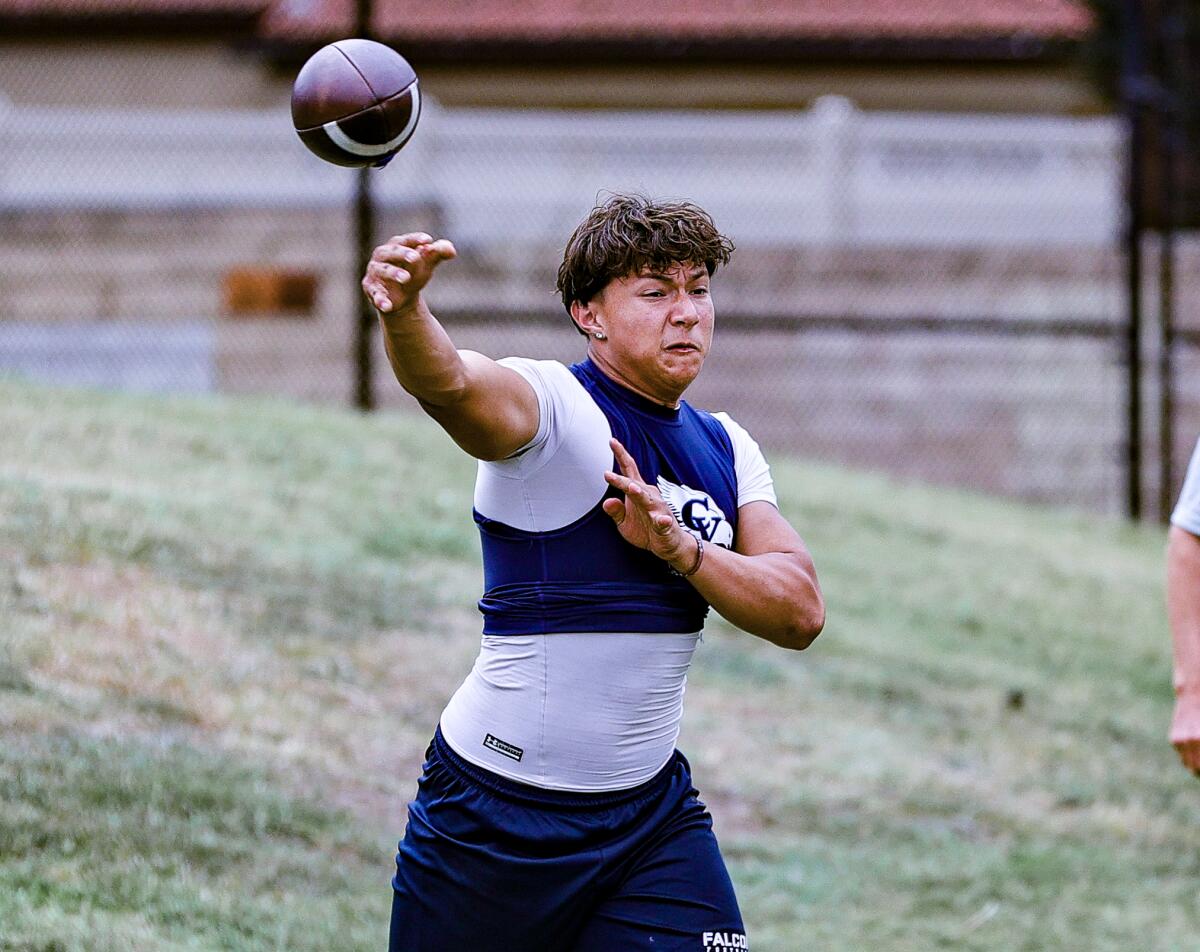
Julian Savery of Crescenta Valley missed his junior year because of a torn ACL.

Julian Savery of Crescenta Valley missed his junior year because of a torn ACL. He switched positions, from running back to quarterback, and the Falcons are thrilled.

(Craig Weston / For The Times)

The seven-on-seven passing competition continues. Crescenta Valley has an unlikely new starting quarterback in Julian Savery, who was a running back before suffering a torn ACL and missing the 2025 season. He has returned as a quarterback, and the Falcons are happy. Here’s the report along with other summer notes.

In one of the biggest offseason transfers yet, running back AJ McBean, a Stanford commit, has left Mira Costa for Gardena Serra. Here’s a look. Here’s the transfer tracker.

Top Jewish athletes

Call it the passing of the high jump torch.

Call it the passing of the high jump torch. Former Olympic high jump Dwight Stones presents JJ Harel of Sherman Oaks Notre Dame the high school player of the year award from the Southern California Jewish Sports Hall of Fame .

(Eric Sondheimer / Los Angeles Times)

The Southern California Jewish Sports Hall of Fame held its latest induction ceremony Sunday. The boys and girls high school athletes of the year were high jumper JJ Harel from Sherman Oaks Notre Dame and basketball player Shira Abramson from YULA.

Harvard-Westlake basketball coach David Rebibo was inducted into the coaching category. Here’s the complete list of inductees.

Notes . . .

Julian Garcia of St. John Bosco was named Division 1 p;layer of the year in baseball. Here’s the All-CIF team….

Liliana Escobar of JSerra was named Division 1 player of the year in softball. Here’s the All-CIF team.

Dorian Clark is the new boys basketball coach at St. Bonaventure….

Standout junior basketball player Tatianna Griffin from Ontario Christian has transferred to Mater Dei, breaking up one of the most successful girls basketball duos the last two seasons. Griffin and Kaleena Smith helped Ontario Christian rise to the top in Southern California girls basketball….

Iggy Porchia is the new football coach at Venice, replacing his mentor, Angelo Gasca, who died earlier this year. He’s a former Venice player and served as an assistant coach. Gasca encourged him to become a teacher and coach. He played at UNLV….

Receiver Jay Williams of Long Beach Millikan has committed to Kansas….

Defensive back Wesley Ace of Gardena Serra has committed to San Jose State….

Defensive back Jaden Walk-Green of Corona Centennial has committed to Washington….

Offensive lineman Kota Seshimo of Irvine has committed to Fresno State….

Offensive lineman Tyson Seidman of Sierra Canyon has committed to San Diego State….

Offensive lineman Lucas Rhoa of Orange Lutheran has committed to Texas….

Standout Royal pitcher Dustin Dunwoody has committed to USC….

Corona Centennial’s basketball team is looking to be an Open Division title contender. The Huskies picked up 6-foot-4 sophomore guard transfer Juleeyan Williams from Monterey Trail in Elk Grove….

Dominic Loehle, a senior guard at Heritage Christian, has transferred to Loyola….

Charlie Adams, who started at guard for St. Bonaventure as a freshman, then Cleveland as a sophomore, has transferred to Sherman Oaks Notre Dame….

Brentwood, Crespi and Palisades were among the local schools winning basketball championship in the Section 7 tournament in Arizona….

Chavez in San Fernando has changed its named to Arroyo High….

Former St. Bonaventure football coach Joe Goyeneche is the new head coach at Walnut….

Thomas Silverman is the new basketball coach at Sierra Vista….

Quarterback Chris Fields III of Carson, the reigning City Section player of the year, has committed to Georgetown…

Quarterback Ryan Rakowski of Palos Verdes has committed to Nevada….

Receiver Blake Wong of Norco has committed to Brigham Young….

Offensive lineman Micah Butler of Hamilton has committed to Sacramento State….

Offensive lineman Amaziah Siale of Mission Viejo has committed to LSU….

Defensive back Jaxson Rex of San Clemente has committed to Brigham Young….

Sophomore receiver Austin Miller of Bellflower has committed to Ohio State….

Offensive lineman Lex Mailangi of Mater Dei has committed to Oregon….

Receiver Jack Junker from Mission Viejo has committed to San Jose State….

Two former Crespi pitchers are on the move. Diego Velasquez has left USC for LSU. Standout Hawaii pitcher Isaiah Magdaleno has entered the transfer portal. He’s also draft eligible…

All-City closer Aidan Martinez of City Section Open Division champion Birmingham has committed to UC San Diego. He came back from Tommy John surgery to throw 92 mph….

Standout guard Lauren Wolfe from Villa Park has transferred to Orange Lutheran….

Junior girls’ soccer player Kendra Hansen of Mater Dei has committed to Stanford….

Ella Bott, star girls’ soccer player from the Santa Margarita class of 2028, has committed to Stanford….

The No. 1 kicker in Southern California, Westlake’s Gabriel Goroyan, has committed to Stanford….

Receiver Mason Maddox of St. Francis has committed to Princeton….

Keith McGill is the new football coach at Whittier Christian…

Nick Heinle will be the interim football coach at Esperanza….

Pitcher Shane Wendler of Servite has committed to USC….

The nation’s top volleyball player from the class of 2027, Mateo Fuerbringer of Mira Costa, has been selected for the U21 national team….

Vista Murrieta has hired Murrieta Valley offensive coordinator Alex Rosenblum to coach its offensive line. He’s a head coach in waiting. He’s a Calabasas grad who once coached at Sierra Canyon….

Mater Dei has hired Brett Luch to be the boys water polo coach….

Madison Gillinger of Edison has committed to UCLA for beach volleyball….

Jaslene Massey of Aliso Niguel has been named the Gatorade state girls player of the year in track and field for her record-breaking performances in the shot put and discus. Maximo Zavaleta of King is the boys state player of the year for his distance running….

Max Gamboa is the new boys volleyball coach at Corona del Mar. He has been the school’s girls volleyball coach….

From the archives: Hal Harkness

Former City Section commissioner and long-time track expert Hal Harkness turns 88 in September. He’s been a state rules interpreter in track and field and helped with the Arcadia Invitational and many others.

He served as City Section commissioner from 1986 to 1993 and once was cross-country coach at UCLA.

Here’s a story from 1986 on him becoming City Section commissioner.

Here’s a story from 1993 regarding his retirement.

Recommendations

From the Los Angeles Times, a story on Harvard-Westlake tennis player Chase Klugo promoting expanded coverage of hearing aids.

From MyBurbank.com, a story on the firing of longtime baseball coach Bob Hart at Burbank.

From the Los Angeles Times, a story explaining the changes in high school soccer through the eyes of former El Rancho High star Cristian Roldan, perhaps the last high school player to make the World Cup team.

From 12sportsconsulting.com, a story on how the 105-man roster limit in college football is changing the preferred walk-on path.

Tweets you might have missed

Until next time….

Have a question, comment or something you’d like to see in a future Prep Rally newsletter? Email me at eric.sondheimer@latimes.com, and follow me on Twitter at @latsondheimer.

Did you get this newsletter forwarded to you? To sign up and get it in your inbox, click here.


Source link